


Films showing this week either in cinemas or on streaming platforms
FILM OF THE WEEK
F1 The Movie (15)
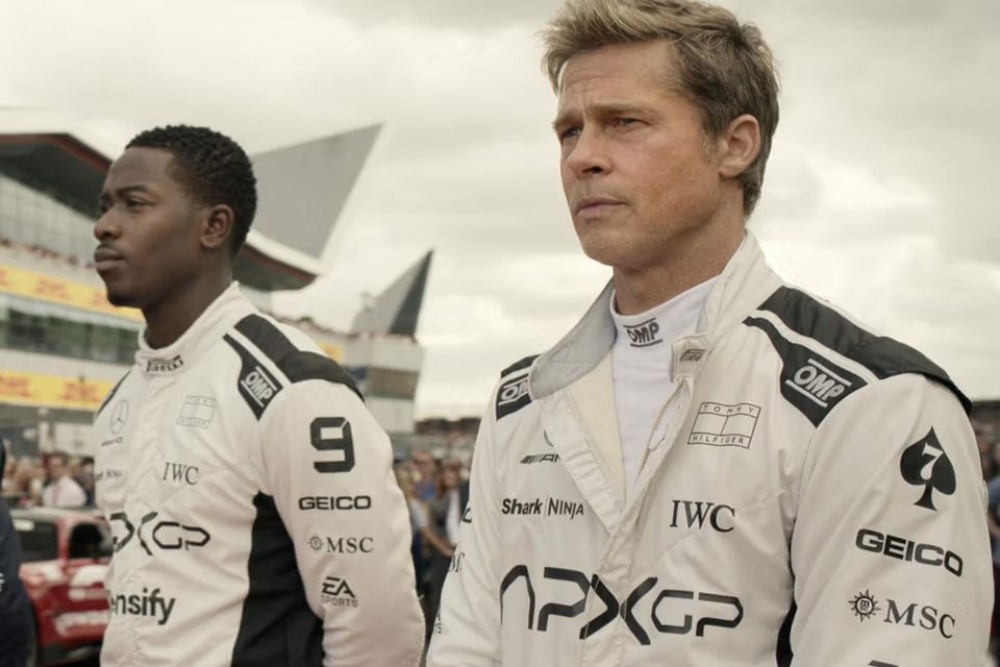
Having taken to the skies for fast planes in Top Gun: Maverick, director Joseph Kosinski now returns to the ground for fast cars, the actors again actually behind the controls, for this formulaic but adrenaline-spiking brand-endorsed Formula One motor racing comeback redemption melodrama, with Lewis Hamilton as a producer as well as cameoing as himself along with all ten Formula One teams and their drivers in the 2023 season.
Swapping out Tom Cruise for Brad Pitt as the older guy showing the rookies how it’s done, he plays Sonny Hayes, a former F1 hotshot (cue de-ageing into blonde boyish flashbacks) until a near fatal crash took him of the track, spending the next 30 years as a professional (if unsuccessful) gambler, New York cabbie with a string of failed marriages (the press conference slyly plays off Pitt’s one personal track record) and, now, living out of his camper van and a nomadic racing driver for hire. His past catches up with him when his former racing buddy Ruben Cervantes (Javier Bardem), now owner of the APXGP F1 team but unlikely to be for much longer if their current piss poor run continues. He wants Sonny back in the seat with his old school magic, a move that, when he turns up at Silverstone, is met with sniffy disapproval by devious board member Banning (Tobias Menzies) and open disdain by skilled but cocky and insecure rising star Joshua Pearce (Damson Idris) who seems him as a threat to his No 1 driver status. A feeling shared by his protective mother (Sarah Miles) who declares Sonny as not a has-been but a never-was, With negative press, a “shitbox” of a car and driver friction, staying on the track let alone in the series will prove a real challenge.
Anyone familiar with sports movies can probably see the rest of the narrative coming as Hayes and Pearce butt heads before the latter learns to work together as a team as things head to the Grand Prix finale in Abu Dhabi, Sonny mixes things up with his, er, maverick, attack tendency to throw the rule book out of the car cockpit, some board member backstabbing and, of course, not forgetting the obligatory romantic interest, here in the form of a sterling Kerry Condon as APXGP technical director Kate McKenna who both gets to build the game changing supercar and play with Sonny’s gearstick.
Bringing his familiar sexily cool nonchalance to a character in it for the rubber burning moment of transcendence rather than the money and glory, Pitt exudes high octane charisma ably supported by a suave but panicking Bardem and the resentful, competitive Pearce, even if the latter’s character is less well-developed. There’s top gear back up too, notably Kim Bodnia as team principal Kaspar Smolinski, Will Merrick as Sonny’s race engineer, Abdul Salis as chief mechanic Dodge and Callie Cooke as tyre gunner Jodie who’s miscalculation in the early stretch afford a running narrative thread.
Fuelled by a stupendous Hans Zimmer score and opening set to Zeppelin’s Whole Lotta Love, at two and a half hours is well overlong but between the breath-taking race action, much from the driver perspective (filmed with mini-IMAX cameras), complete with crashes and those superfast tyre/parts changes, there’s also plenty of off-track personal dramas to keep you engaged. More pointedly, while most racing movies focus on the racing, this is equally balanced with the strategies and engineering mechanics involved in getting past the chequered flag first. As such, this is laps ahead of things like Days Of Thunder, Le Mans and Gran Turismo even if, for all the amusing Hayes/Pearce macho sparring and banter, it never quite rises to the same character dynamics as the Hemsworth/Bruhl classic Rush. Nonetheless, this is a Pitt stop you won’t want to miss. (Cineworld 5 Ways, NEC, Solihull; Everyman; Odeon Birmingham, Broadway Plaza Luxe, West Brom; Omniplex Great Park. Reel; Royal; Vue)
ALSO RELEASED
M3GAN 2.0 (15)
Rather like the switch between The Terminator and The Terminator 2, the killer android doll is back but there’s a narrative sea change in that she’s now one of the good guys (you could argue that, in following her instructions to the letter in the first film, she was just miscoded, she says she was upset) as she goes up against another, more advanced bot who seems to have Skynet-like plans to make AI the dominant species.
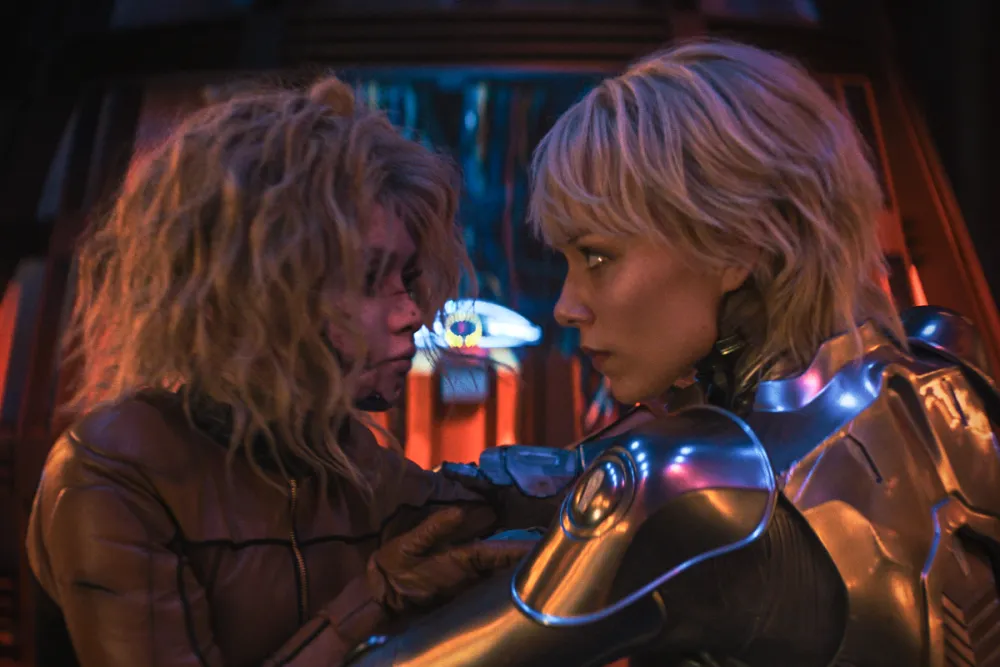
The new fembot, played by Ukrainian-born Ivanna Sakhno, is named AMELIA (autonomous military engagement logistics and infiltration android) and is a product of the same code roboticist Gemma (Allison Williams) used to create M3GAN and programmed to protect her orphaned niece Cady (Violet McGraw, somewhat sidelined this time around), who’s now also a techno hot shot. However, after the events in the first film, she’s written a cautionary book entitled Modern Moderation and joined the Center for Safe Technology, an organisation about limiting the use of AI.
Clandestinely developed by corrupt tech billionaire defence contractor Christian (Aristotle Athari) as a super-asset, the opening sees AMELIA shuck of external control and go rogue, setting about eliminating anyone connected with her, which brings military Sattler (Timm Sharp) and the FBI to Gemma’s (literal) in-house smarthome lab to say and her team are probably next on the list. Fortunately, it seems M3GAN (again Amie Donald on motion capture and snarkily voiced by Jenna Davis) wasn’t actually destroyed, her AI still the ghost in the machine, to which end Gemma’s persuaded to reactivate her, initially in a green teletubby like body, much to her clear annoyance, before relenting to an upgrade in a new taller, more powerful body so she can take down AMELIA who intends to access and bond with the AI mother box prime – an old household robot program from the ’80s – that’s kept securely in hidden vault.
There are, of course. any number of twists in the unfolding narrative (one which could easily be retooled for as Mission: Impossible), among them lecherous tech oligarch Alton Appleton (Jermaine Clement), who’s developed brain-implant technology and fatally tries to seduce a disguised AMELIA at his launch party (complete with go go dancers dressed as Asian bots), and Cady, Gemma and her team, Cole (Brian Jordan Alvarez) and Tess (Jen Van Epps) infiltrating a high tech complex, M3GAN gliding in on black wings, before the fembot on fembot showdown. And this time round M3GAN has, you know, feelings not just programmed responses.
Again directed by Gerard Johnstone, who also takes on screenplay duties, it may veer away from the original film concept (with a longer running time) but, while upping the acrobatic action (Williams get to flex too in an ex-skeleton), played with self-aware irony, it still retains its camp qualities and a mischievous sense of humour in M3GAN’s dialogue and attitude, as well as emotional good mum pep talk that has her singing Kate Bush’s This Woman’s Work. Other pop culture nods include Steven Seagal and Wallace & Gromit.
If the original was a cautionary satire on parenting by technology, this warns all extremes are wrong and is part of the AI zeitgeist in advising that technology is only safe in the hands of responsible humans who can control it. Well, good luck with that. Meanwhile, this is a whole lot more fun than such sequels tend to be. (Cineworld 5 Ways, NEC, Solihull; Everyman; Mockingbird; Odeon Birmingham, Broadway Plaza Luxe, West Brom; Omniplex Great Park. Reel; Royal; Vue)
Parthenope (15)
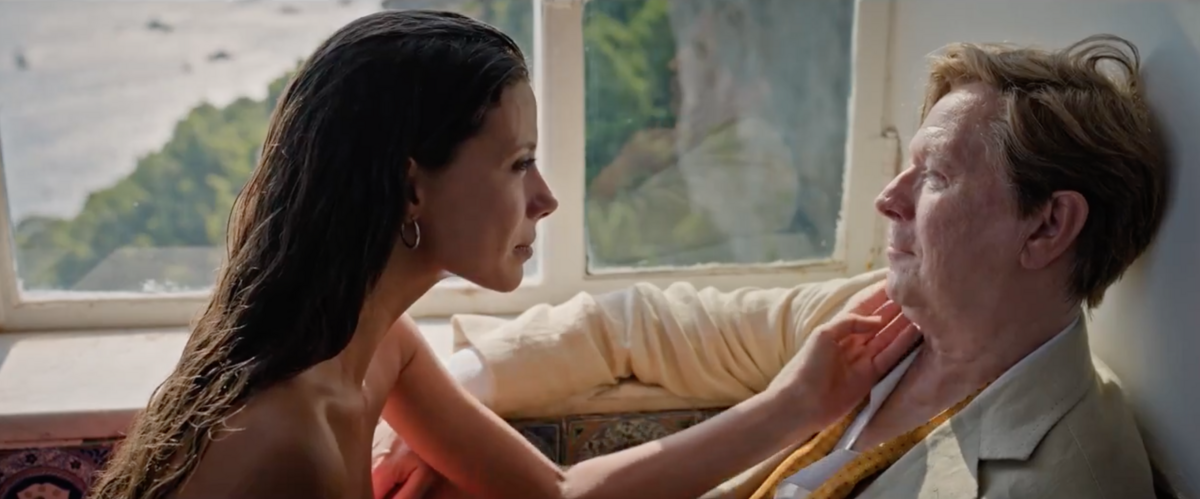
Written and directed by Paolo Sorrentino as a love letter to but also critique if his hometown of Naples, this is a glorious feast for the eyes with its sunsets, panoramic vistas and the mesmerising beauty of its star Celeste Dalla Porta as (for most of the film) the titular character named, by her wealthy shipping magnate godfather Achille Lauro (Alfonso Santagata), for Naples (its own name originating in Greek myth) itself.
Opening in 1950 as Lauro arranges for her mother to be transported in an ornate rococo carriage for the water birth, attended by her older brother Raimondo and Sandrino, the son of the family’s housekeeper, it follows Parthenope over the next five decades, through assorted career choices (anthropology of suicide student, failed actress, successful researcher and lecturer) and lovers as pretty much every man she meets swoons at her feet, taking in both highs and lows. As the third arm of a love triangle between his sister and Sandrino (Dario Aita), Raimondo (Daniele Rienzo) throws himself off the Capri cliffs, for which the family naturally blame her, while she’s later impregnated by a mafiosa and has an abortion, and has sex with a lecherous cardinal while researching an article about the liquefaction of the blood of San Gennaro. Finally, she gets to meet beguilingly grotesque disabled son of her professor/mentor Marotta (Silvio Orland) before, in the coda, she moves past guilt over Raimondo’s death and finally returns to Naples.
In addition to the son, there’s some memorable scenes and images: a crab-like vehicle d with angular protuberances spraying disinfectant in an attempt to ward off cholera; her meeting with elderly eccentric diva Flora Malva (Isabella Ferrari), who wears a mask on account of botched plastic surgery, has a bed covered with dolls and, amid a smokey haze, implores her to kiss her; a party held by ageing Naples-born actress Greta Cool (Luisa Ranieri) where the heirs of two Camorra families publicly have sex to conceive a child and, later, Cool addressing the Naples crowd and telling them in no uncertain terms what she thinks of them and the city. Amid all this Gary Oldman gets to cameo as John Cheever (like Lauro a real-life figure), the jaded, alcoholic repressed homosexual novelist with whom Parthenhope is obsessed.
The story of a woman constantly in search of but never finding satisfaction, flirting with magic realism and melodrama, indulgent and burdened with portentous straight-faced dialogue, at one point Parthenhope’s beauty is described unforgettable but joyless, which pretty much sums up the film itself. (Until Wed: MAC)
NOW SHOWING
28 Years Later (15)
It opens on a small Scottish community where a bunch of children are gathered watching an episode of Teletubbies. There are noises off and a heartbeat later they’re being slaughtered by their now Rage-infected parents. One lad escapes and flees to the church where is father is the pastor, he welcoming the infected as the day of judgement. The boy escapes again, and that’s the last we see of him, unless, as I suspect, he’s linked to a character who appears in the final scenes sporting an inverted crucifix with his track-suited parkour gang and their clubs despatching a clutch of undead. Fast forward then 28 years as director Danny Boyle and writer Alex Garland reignite the franchise they began back in 2002, reunited with cinematographer Anthony Dod Mantle here capturing much of the film on iPhone cameras, Almost three decades on, the virus has been pushed back from continental Europe and is contained in a quarantined British Isles (one in which the iconic felled Sycamore Tree still stands), regularly patrolled by naval forces to keep it so. Connected to the mainland by a causeway only passable at low tide, a small community of survivors are holed up on Lindisfarne where, flying a tattered St George and with a coronation era portrait of Queen Elizabeth, they subsist by farming, hunting and occasional foraging expeditions, armed only with bows and arrows. Among them is the beardedly macho Jamie (Aaron Taylor-Johnson) who is about to take his 12-year-old son Spike (Alfie Williams) off on a rites-of-passage trip to the mainland for as spot of infected killing. Here, amid the sprawling lush greenery, we discover the infected (who are now all mostly naked) have both evolved – hard to kill, fast-running Alphas with a propensity for ripping off heads, spines attached – and devolved – blubbery worm eaters who slither on their bellies -. the latter affording Jamie his ritual first kill and the former pursuing them back to the gates of their fortress.
At the party in his honour, embarrassed by his father’s exaggerations of his son’s deed and shocked to see him having sex with one of the women, he learns from his grandfather than the fires they spotted were probably those of the supposedly crazy Dr Kelson (Ralph Fiennes, magnetic), a former GP, and, seizing on the possibility that he can help his mother Isla (Jodie Comer making the most of a slightly plot device character) who is fading away with a mystery illness that sometimes affects her grip on reality, he sneaks away with her to try and find a cure.
At this point, James pretty much disappears from the narrative which now places its focus on Spike’s coming of age in his attempt to save his mother, a tense quest that sees them rescued by a Swedish survivor of one of those naval patrols before finally (somewhere around Gateshead given they come upon the rusting, overgrown Angel of the North) crossing paths with Kelson whose diagnosis, tower of skulls and talk about the meaning of memento mori – a reminder of mortality – affords the film’s emotionally piercing moments. Did I mention the infected’s newborn baby (a development presaged by a scene during Spike’s kill-trip) which Isla delivers on a rusting trainwreck?
The first half is more experimental in nature with archive montages of marching soldiers, an archers scene from Laurence Olivier’s Henry V, and discordant soundscape while, despite some hallucinatory moments and lighting effects, the second is of more straightforward highly visceral and adrenaline-fuelled fight and flee nature, newcomer Williams holding it all together brilliantly. And, of course, there’s all those themes and motifs buzzing around, post Brexit isolation, survivalism, the endemic nature of human violence, parent-child dynamics, young boys seeking adventure, etc. Pointedly, early on James tell his son “the more you kill, the easier it gets” and that the infected have no mind and no soul. The way the film unfolds shows otherwise.
A monumental triumph, it ends with a cliffhanger setting up part two of the proposed trilogy, as Nia DaCosta takes over to direct 28 Years Later: The Bone Temple (suggesting we’ve not seen the last of Fiennes), arriving in cinemas in January: just over 28 weeks later. (Cineworld 5 Ways, NEC, Solihull; Everyman; Mockingbird; Odeon Birmingham, Broadway Plaza Luxe, West Brom; Omniplex Great Park. Reel; Royal; Vue)
Anora (18)
Written and directed by The Florida Project’s Sean Baker, this catapults Mikey Madison from supporting character roles to Oscar winner as Anora (the Hebrew word for light or grace) aka Ani Mikheeva, a stripper of Uzbek heritage living in Brooklyn’s Russian-speaking neighbourhood Brighton Beach. Materialistic and looking to the world of lap dancing at her upscale Manhattan strip club. So, as the only one of the girls who speaks passable Russian, she’s introduced to Ivan ‘Vanya’ Zakharov (Mark Eydelshteyn, Russia’s Timothée Chalamet), the spoiled, gangly, immature hard partying son of a wealthy Russian oligarch who lives in his parents’ lush gated mansion where he spends his time getting high, drinking and playing video games. Though vehemently denying she’s a prostitute, she takes up his lucrative offer for several bouts of sex, he then offering her $15,000 to stay with him for a week and pose as his girlfriend. This in turn finds them and his entourage flying to Las Vegas where he proposes (not least so he can get a green card and stay in America) and they end up getting hitched in one of the wedding chapels. So far so whirlwind romance as Ani quits her job to play shag-happy wife. However, when word gets out that Vanya’s ditched his clueless Russian-Armenian minders, Garnick (Vache Tovmasyan) and Igor (Yura Borisov), whose job it is to clean up the messes he makes, and rumours spread on Russian social media, his Orthodox priest godfather Toros (Karren Karagulianis) is ordered by Vanya’s domineering mother Galina Zakharovato (Darya Ekamasova) to find him and get the marriage annulled, she and her husband Nikolai flying over to America to take him back home. However, when his minders turn up, a coked-up Vanya does a runner and, after a lengthy apartment-trashing tussle (there’s a lovely moment as Igor tries to restrain Ani while respecting her personal space), they, Tonos and Ani set out to try and track him down, she reluctantly agreeing to $10000 in return for the annulment but hoping to convince everyone their love is real.
A cocktail of After Hours, Uncut Gems and Pretty Woman, with copious scenes of energetic screwing and liberal doses of black comedy, it’s a tad overlong to get going with perhaps more naked, gyrating lap dancing than are strictly necessary, but once the tragi-comic farce is underway it crackles with real energy and emotion. As the panicking Tonos, his beleaguered brother Garnick and tough but placid enforcer Igor, Karagulianis, Tovmasyan and Borisov (at times suggesting an Armenian Ewan McGregor) make for a wonderful comedic hapless trio and, while neither of the two central characters are especially likeable (both in it for what they can get), Eydelshteyn is immensely watchable as the brattishly entitled and shallow Vanya while Madison sets the screen alight as the smart, unsentimental but vulnerable Ani, giving the touching final shot a real hammer to the heart. (Sky Cinema)
Back In Action (12)
The title carrying a double meaning in that this is Cameron Diaz’s first film in 10 years, reaming with her Annie remake co-star Jamie Foxx, himself returning after being hospitalized, directed by Seth Gordon it’s a generic thriller that mines a familiar narrative involving kids who don’t know their parents are spies. Or at least they were. Fifteen years ago, more than platonic partners, she discovering she’s pregnant, CIA agents Emily (Diaz) and Matt (Foxx) narrowly escaped from a plane crash after apparently being betrayed by Baron (Andrew Scott, making the most of a thin role), an MI6 agent.
Resolving to retire, they’ve given up espionage and forged new lives and workaday mundane careers, now living in Atlanta with their two kids, snarky Alice (McKenna Roberts) and her younger rule-following techie brother Leo (Rylan Jackson). However, when a video of Matt losing his cool in a disco after discovering Alice isn’t actually studying with friends goes viral, their old handler Chuck (Kyle Chandler) turns up warning them their cover’s blown. But no sooner has he done so than he’s shot and the pair have to quickly grab the kids and hit the road, being pursued by both Polish KGB agent turned terrorist Balthazar Gor (Robert Besta) and his mercenary henchmen and Baron, who’s still nurturing a running gag crush on Emily, both believing they have the master-key, which they stole during Gor’s kiddies’s birthday party for his daughter, that will give its owner the ability to control any system in the world and which was never recovered from the plane wreckage. All of which means, clearly enjoying being back in the game, they have to, to the confusion of the kids, adopt new names and head to London to seek help from her long-estranged mother, Ginny (Glenn Close), a still formidable former British spy who’s living with her wannabe MI6 agent toyboy Nigel (an amusingly bumbling Jamie Demetriou as a nascent Johnny English).
Unfolding into a road movie with a series of brawls, parenting messages and boat and motorbike chases along the way, while it may be relentlessly rote there are some enjoyable spins, such as the couple improvising weapons out of a petrol pump, a bottle of Diet Coke and a tube of Mentos, an amusing joke at the expense of Jason Bourne and fights staged to Papa’s Got a Brand New Bag at the Tate Modern and Dean Martin’s Ain’t That a Kick in the Head as they literally kick thugs in the head. Trading off one another, Diaz and Foxx have palpable chemistry, Close sinks her teeth into the ham while Roberts and Jackson step up to the not exactly demanding mark as the kids finding mum and dad aren’t the bores they seemed. Undemanding fun, but fun nevertheless. (Netflix)
The Ballad Of Wallis Island (12A)
Expanded from James Griffiths’ 2007 short The One and Only Herb McGwyer Plays Wallis Island, and co-written by its stars Tom Basden and Tim Key, this is a very British and very funny low key comedy.
Basden is the aforementioned Herb, a once famous folksinger and one half of a Buckingham-Nicks-like duo McGwyer Mortimer (though Baez and Dylan are the more likely touchstone) before they split nine years ago as he embarked on a (crassly commercial) solo career who, in the opening, is ferried by rowboat to a small – fictional –Welsh island where he’s been booked – for £500,000 – to play a private gig, the money needed to fund his new album. He’s not expecting it to be for an audience of one, Charles Heath (Key), a geeky two-time lottery millionaire winner superfan with poor social awareness and boundary issues and a predilection for appalling puns (when Herb falls in the sea he dubs him ‘Dame Judi Drenched’, and refers to his rider – pickled onion Monster Munch, Braeburn apples and Johnnie Walker Blue Label – as a Winona), in whose sprawling mansion he’s to be staying. “I’m in Misery, I’m going to wake up with no ankles” he tells his manager from the payphone.
Nor, more pointedly, is he expecting to be reunited with his former personal and professional partner Nell Mortimer (a wonderfully warm Carey Mulligan), who Charles has also booked (at a lower fee, since she didn’t write the songs) in the hope of a permanent musical reunion (that she arrives with her American husband – Akemnji Ndifornye, swiftly dispensed to go birdwatching), stymies any romantic one, though there is a brief spark of resurrected attraction).
As a lonely, melancholic soul with a sad widower backstory and a shyness that won’t allow him to bring himself to act on his feelings for Amanda (Sian Clifford) who runs the island’s solitary store (cue a running gag about rice to dry out Herb’s phone) and is blissfully unaware of things like Reese’s Peanut Butter Cups (she offers Herb peanut butter and a cup), Kay brings deep poignancy to Charles as the film navigates themes of love, loss, growth, the difficulty in reconciling with the past and the transformative and healing power of music, all to a stunning rustic backdrop and a winning collection of songs, Basden and Mortimer in glorious harmony.
With echoes of Local Hero and John Carney films such as Flora And Son, Once and Sing Street, beautifully acted and as emotionally on point as it’s gently humorous, it’s one of the year’s loveliest films. (Mockingbird; Odeon Broadway Plaza Luxe; Royal; Mon/Wed:Everyman)
Ballerina (15)
Filmed three years ago, this John Wick spin-off finally makes it to the screen amid rumours of credited director Len Wiseman been booted off and Wick helmer Chad Stahelski coming in to do reshoots and add new characters and subplots. All of which might lead you to expect a bit of a mess. However, while there are flaws and it’s not a patch on any of the Wick series, to be mention being a bit eerie to see Lance Reddick, who died in 2023, returning as Charon, the concierge at the Continental, it’s actually a decent and decidedly action-packed affair.
The revenge plot, set between John Wick 3 and 4, is fairly generic. As a young girl, Eve Macarro (Victoria Comte) sees her father killed by assassins dispatched by the Chancellor (Gabriel Byrne), head of a secret assassins cult who’s come to take her for reasons not revealed until the third act twist. Befriended by Winston (Ian McShane), who was privy to her father’s backstory, he places her under the care of the Director (a stiffly regal Anjelica Huston), who runs the Ruska Roma, an academy, much like that of the Black Widows programme, that trains young girls to be ballerinas but is really equipping them the fighting skills for their future roles as assassins to rent protecting those in danger (her mentor, Sharon Duncan-Brewster, advising her to fight like a girl rather than use male moves) , the Academy and Cult having a centuries-old agreement not to interfere in the other’s affairs.
Fast forward several years and that’s all thrown out the window when, while on a mission to safeguard Daniel Pine (Norman Reedus), a man with a contract on his head, and his young daughter, Ella (who the Cult also want to snatch) in the course of taking out those looking to claim the bounty, the now grown killing Eve (Ana de Armas) finds one with the same brand on his hand as those who killed her father. Ignoring the Director’s warning to let it be, she sets off to track down their secret hideaway and kill the Chancellor. This prompting the Director to enlist the typically stone-faced Baba Yaga himself (a cameoing Keanu Reeves) who she met earlier in the film) to eliminate the problem.
The narrative arc is, of course, just an excuse for the second act’s non-stop series of expertly choreographed fights variously involving guns, knives, kitchen utensils, ice skates, samurai swords, grenades and whatever comes to hand as, one sequence set in an armoury run by, in an amusing line, a guy called (“let me be”) Frank, Eve takes on a seemingly inexhaustible array of Cult goons, headed up by Lena (Catalina Sandino Moreno with a late in the going reveal), the whole thing climaxing in the Cult’s base, a snowy Austrian mountain village populated entirely by assassins and their families, with a quite literal firefight involving two flamethrowers.
Though not match for Reeves as far as inner calm goes, de Arnas delivers on her No Time To Die promise of solid female kick ass, doing most of her own stunts, even if she’s rather better with her fists and feet than her dialogue, the ending (as she goes to see former dance student Tatiana in Swan Lake and learns she herself now has a bounty on her head) laying the way for her to welcomingly pirouette into her own sequel. (Cineworld 5 Ways, NEC, Solihull; Odeon Broadway Plaza Luxe; Omniplex Great Park; Vue)
Blitz (12A)
When your star is Saoirse Ronan, it’s going to takes real effort to sink the credibility and quality she brings, but, his third feature after 123 Years A Slave and gritty crime thriller Widows, which were followed by the acclaimed Small Axe TV series and documentary Occupied City, Steve McQueen does rather fumble the ball with this tonally uneven and at times clunkily written wartime drama.
Set during the London Blitz of WWII, Ronan plays Rita, the mother of nine-year-old bi-racial George (a winning Elliott Heffernan), her Grenadian partner Marcus (CJ Beckford, seen in a hot club dance flashback), in absentia, living with her dad Gerald (Paul Weller in a decent acting debut and getting to sing Ain’t Misbehavin’ round the old joanna) in Stepney and working in a munitions factory where, a decent singer, she gets to perform for a Down Your Way-like morale-boosting BBC outside broadcast before her feisty fellow workers take the opportunity to call for better civilian protection against the air raids instead of locking the Underground stations.
When, on account of the bombing, London’s children are packed off as evacuees, George, feeling guilty at the way he angrily treated her for sending him away, jumps off the train and sets off to walk back to London. It’s a picaresque journey of adventure and self-discovery that will involve him with Ife (Benjamin Clémentine), a kindly Nigerian ARP warden (who he meets in a particularly clunky scene in an arcade with dioramas portraying Africans as savages), and, in less friendly circumstances, an embarrassing subplot straight of Oliver Twist involving a gang of Cockney scavengers (Stephen Graham and Kathy Burke hamming like panto villains) who enlist him to pilfer the corpses’ pockets in the bombed out ruins.
Meanwhile, back home, Rita’s helping out in shelters set up by socialist community organisers and, learning George has done a runner, going frantic and determined to find him. Added into her story is Jack (Harris Dickinson), a shy firefighter with a crush on her, but that never really goes anywhere.
Cobbling together the old-fashioned spirit of The Railway Children, Powell and Pressburger, and the those Children’s Film Foundation films, when not indulging in period drama cliches (and Haley Squires as Rita’s Cockerney sparra colleague) and repeatedly showing close-ups of bombs on their way to cause devastation, McQueen lurches from a sentimental road movie in the manner of Disney’s The Incredible Journey with a plucky child instead of animals to broad brush commentary about the era’s casual racism (George’s often called a monkey. There’s moments when, such as the scenes at a ballroom after a bombing with the hoi polloi in frozen death postures, crowds trying to escape a flooding tube station, and the opening shot of a fireman trying to grapple with an errant hose, he manages to capture wartime authenticity, but mostly it’s all rather politely tableaux through which Ronan wanders. All that and some surrealistic images of flowers. A cosy if at times uncomfortable Sunday afternoon watch in front of the telly, but for McQueen a major disappointment. (Apple TV+)
Carry-On (12)
Though indisputably Die Hard lite (or more accurately, given the time and setting, Die Hard 2), taking time off from having Liam Neeson kill people, set on Christmas Eve director Jaume Collet-Serra turns in some watchable if credibility stretching B-movie action hokum anchored by a central cat and mouse battle of wits between Taron Egerton and Jason Bateman.
The former is Ethan Kopek, sleepwalking through life as a Transportation Security Administration agent at Los Angeles International Airport after being rejected for the police academy after concealing his father’s criminal history. He’s given a wake-up call when his girlfriend Nora (Sofia Carson), who’s just been promoted to a senior role at the airport, announces she’s pregnant. To which end, he finally asks his boss (Dean Norris) about possible promotion and more responsibility and is given a trial period in charge of scanning luggage on one of the security lines, substituting for his friend and co-worker Jason (Sinqua Walls), and dealing with a steady stream of obstreperous passengers.
This, as it turns out, is rather unfortunate, since Bateman’s character, only ever known as the Traveller, had put in place a plot to force Jason, whose family he was going to imperil, into letting a passenger’s suitcase pass through unchallenged. So now, instead of Jason, Ethan becomes the mark, with Sofia’s life as the bargaining chip. And, after initially assuming it’s a prank, with his every move monitored by the Traveller’s sniper and surveillance accomplice (Theo Rossi), who’s holding someone captive in his van, with no way of alerting anyone, he reluctantly agrees to play ball, placing Nora’s life above the lives of everyone on the plane. What he doesn’t know is that the case, carried through by one Mateo Flores (Tonatiuh), contains a vial of Novichok, the world’s most lethal nerve gas. Meanwhile horrified to learn on the case’s contents, having framed Jason as drinking on the job in order to get back on the security line, Ethan is now frantically seeking a way of foiling the plot, but the Traveller, who’s feeding him instructions via an ear piece, is always one step ahead, as the death of the cop he passes a message to illustrates.
And as he racks his brain looking for a solution – finally confronting the Traveller, in his black coat and hat, who is clearly in total control, having investigated a fire that took the lives of two Russian mobsters at the start of the film, dogged LAPD detective (Danielle Deadwyler) has intuited something’s not right and called in Homeland Security as she starts putting all the pieces together, trying to figure out who the bomb may be targeting. It’s not a huge surprise to learn everything’s down to corporate profits.
There’s a few twists written in to its otherwise fairly simplistic narrative as not everyone involved turns out to be a bad guy while Collet-Serra throws in some messy but thrilling action sequences, variously involving a showdown among the luggage belts and an in-car struggle set to Last Christmas. It’s not one that stands up to scrutinising the logic, but Egerton again effortlessly carries off the action hero, albeit here a reluctant one, while Bateman sinks his teeth into a rare chance to play the villain, amusingly offering Ethan relationship advice in-between his demands. Ultimately, they’re not McClane and Gruber and there’s no rousing yippee ki-yay moment, but the film ably rises above the baggage it’s carrying. (Netflix)
Champions (12)
The Farrelly brothers have always had a thing about comedies featuring characters with intellectual disabilities, but never for cheap laughs. Now, making his solo directorial debut, Bobby returns to the source for an underdog sports movie in the Bad News Bears tradition in which a disgraced character is given a chance to redeem themselves by coaching a team of misfits. Here, adapted from 2018 Spanish film Campeones, itself based on a real life team, Woody Harrelson plays Des Moines assistant basketball coach Marcus Markovich (Harrelson), a hot head with NBA ambitions who gets fired from his minor league team for shoving his boss (Ernie Hudson) over ignoring his strategies and is subsequently convicted of drinking and driving after crashing into a cop car. In an amusing court scene with as the judge (Alexandra Catillo) and his attorney (Mike Smith), he avoids a prison by accepting 90 days community service coaching a rubbish local team with intellectual disabilities nicknamed The Friends who operate out of a run down, budget-challenged rec centre run by Julio (Cheech Marin), who also gets to deliver the exposition about the different players and how they have full lives.
All played by ten actors with special needs, among them are Craig (Matthew Von Der Ahe), who keeps going on about having sex with his girlfriend, Showtime (Bradley Edens) who will only shoot the ball backwards, and always misses, Marlon (Casey Metcalfe) who wears a padded helmet and quotes obscure trivia, and the outgoing Johnny (Kevin Iannucci) who has Downs Syndrome, works in an animal care centre, refuses to shower and whose protective sister turns out to be Alex (It’s Always Sunny in Philadelphia’s Kaitlin Olson), a struggling actor first seen as Marcus’s didn’t end well Tinder one-nighter, which adds further complications but also the developing romantic subplot.
It’ll come as no surprise to find that Marcus goes from initially feeling humiliation and apathy about the task and his team to coming to love them and pushing them to win at the upcoming Special Olympics championship in Winnipeg. Nevertheless, Farrelly ensures the predictable (save for the final winning shot moment) journey with Marcus learning to care for others and not just himself is heartwarming, funny, inspirational and never patronising. Harrison and Olson are engaging characters while the Friends are an irresistible bunch, each getting their moment to shine with particular stands outs being Iannucci, James Day Keith as Benny, a restaurant dishwasher who gets to stand up to the abusive restaurant boss who refuses to give him time off for games (setting up a hilarious sting), Joshua Felder as star turn Darius who, for reasons revealed in a later poignant scene, refuses to play for Marcus, and especially a scene stealing Madison Tevlin as Consentino, another Downs Syndrome player who’s brought in to replace him and takes no shit from either her coach or fellow players. It’s minor league, but it certainly deserves its spot on the court. (Netflix)
Cleaner (15)
As played with athletic nimbleness by Daisy Ridley, as directed by Martin Campbell, Joey isn’t someone who, like Winston Wolfe in Pulp Fiction cleans up the aftermath of murders, but quite literally a window-cleaner who, while regularly arriving late for work, goes about her job suspended from the roof of a Canary Wharf energy company high-rise. It’s while she’s doing this that a gang of eco-terrorists, posing as masked dancers, led by Marcus (Clive Owen) and her co-worker Noah (Taz Skylar) take it over and hold 300 hostages. The former just wants to raise awareness, the latter’s more hot-headed, quickly evidenced when he kills one of the executives with a champagne bottle down the throat , and has his own anti-humanist agenda involving a series of culpability-admitting videos by everyone from CEOs to government ministers, leaving Owen to make an early exit.
Now, stuck on the gantry outside (control taken over by activist hacker Flavia Watson), it’s up to Joey, conveniently ex-military and discharged after an altercation with a fellow, male, soldier, to do a John McClane and, lighting up a blazing SOS message, save the day. To which end she has three assets, her childhood skill at climbing (acquired by escaping from the sound of her abusive father), the female police superintendent (Ruth Gemmell) she’s convinced she’s not one of the bad guys, and Michael (a capable Matthew Tuck), her neurodivergent brother she’s had to bring to work and leave ibn the care of a security guard after being kicked out of his latest care facility and who regularly references Marvel movies and carries around a replica of Thor’s hammer, which ultimately comes in useful.
Ridley never quite persuades as a bad ass and the plot’s about as shaky as the cleaning gantry, but Campbell keeps the tension and the action on the boil as it builds to the inevitable Die Hard mirroring finale, even if the switcheroo she pulls rather defies plausibility, but it does what it does with B movie efficiency. (Sky Cinema)
Clown In A Cornfield (15)
Pitched firmly at a teenage horror audience, adapted from a2020 novel, it’s as utterly generic a slasher as the title suggests, rolling out one cliché after another. Starting in 1991 with two characters meeting the inevitable horror movie fate of any teen who goes off to make out, it moves forward several years as the obligatory new girl with a dead mother, Quinn Maybrook (Katie Douglas), arrives in middle of nowhere Kettle Springs, Missouri, with her dad (with whom she naturally has issues) Glenn (Aaron Abrams), to make a fresh start, he the new doctor. She’s befriended by mean girl classmate Janet (Cassandra Potenza) and her sidekick Ronnie (Verity Marks), her jerk boyfriend Matt (Alexandre Martin Deakin), who makes spoof horror videos featuring Frendo with Tucker (Ayo Solanke), and Cole Hill (Carson MacCormac), the love interest son of the local mayor (Kevin Durand), who’s had some sort of falling out with his close (and you can see the queer twist coming) redneck buddy Rust (Vincent Muller), who’s also Quinn’s neighbour.
It’s the 100th anniversary of Founder’s Day, Cole’s family having established the town and the Baypen Corn Syrup factory, for which Frendo the clown (seen in the initial skewering) was the company mascot (along with a pop up jack in the box), but which has now been burned down with Cole and his friends being blamed. As the celebrations gather so too does the body count with not one but several Frendos variously butchering the town’s teens.
Directed and co-written by Eli Craig who made the terrific hillbilly slasher meta parody Tucker And Dale vs Evil, it matches it for visceral slicing and dicing but while the cast play it knowingly straight it lacks that film’s gleefully subversive hilarity (and, lest you not get the joke, has one of the characters say “It’s like we’re in some awful 80s slasher horror movie!”) but the old vs young generation (children of the corn perhaps) plot does at least bring something new, despite the mind-boggling illogicality of it all. Even so, it’s still corn on the cobblers. (Odeon Broadway Plaza Luxe)
Companion (15)
After a spate of films sounding warning notes about AI, writer-director Drew Hancock impressively flips the narrative from perpetrator to victim in a cautionary tale about technology and relationships woven with a commentary on toxic masculinity.
Meeting romcom cute in a supermarket, Iris (Heretic’s Sophie Thatcher) is in a relationship with underdog nice guy Josh (The Boys’ Jack Quaid), though there’s something uneasy about how, docile and submissive, she professes she’s wants to ensure all his wants and desires are fulfilled. Her opening voice-over sets you up for that’s to come as she says the two most important moments of her life where when she met him and when she killed him.
They’re off on weekend getaway to a remote luxury home owned by adulterous billionaire Russian Sergey (Rupert Friend with bristling moustache and thick accent), joined by Josh’s standoffish ex Kat (Megan Suri), who’s also Sergey’s girlfriend, and, also in their first flush of romance, mutually besotted gay couple by catty Eli (Harvey Guillén) and the hot but dim, anxious to please Patrick (Lukas Gage), who coincidentally also have their own meet-cute, although Iris feels uncomfortable and unwelcomed in their company. Well, not that unwelcomed by Sergey who, alone by the lake, attempts to rape her. We next see her walking back into the house, covered in his blood. At which point the film upends everything to reveal that Iris is in fact a humanoid, a lifelike fuckbot companion Josh is renting (flashbacks show her being delivered and programmed – her intelligence, level of aggression, voice, etc., all remotely controlled), theoretically programmed to not harm humans,.
It turns out that killing Sergey, apparently a drugs dealer, also throws a spanner in the works regarding the real reason the others are there, namely to steal $12million. But, as events spiral out of control into a cat and mouse battle of wits and survival between them and Iris, that’s not the only secret being hidden, but to reveal more would spoil the thrills as they unfold.
Thatcher is terrific in the way she handles Iris coming to terms with who or what she is (learning her tears are just fed from an internal reservoir), gaining Josh’s smartphone app controls and trying to become autonomous and overcome the restrictions of her programming and the feelings with which she’s been implanted. Playing counter to his character in The Boys, Quaid is also compelling in Josh’s mix of spinelessness and ruthlessness, and while Suri’s character is less developed, Guillén and Gage throw some clever curves as things develop.
Sporting an ingenious screenplay and working with themes of manipulation, appearances and reality, control, emotional abuse, the weaponisation and commodification of feelings and , it consistently takes off in unexpected directions, fusing moments of comedy with ones of sudden violence and horror, it’s already on the year’s best of list. (Apple TV+)
Conclave (12A)
Peter Straughan’s take on the Robert Harris novel , despite a seemingly unpromising plot pivoting round the election of a new Pope, directed by Edward Berger this is a grippingly tense thriller about faith and the nature of and desire for power and unequivocally one of the year’s best films, its success in America a welcome reminder that, amid the familiar CGI-littered blockbusters, there’s still an audience for intelligent, thought-provoking filmmaking.
The central figure is the conflicted Cardinal Lawrence (an inscrutable, nuanced turn by Ralph Fiennes), who, when the Pope dies in his room in Domus Sanctae Marthae, is charged with overseeing the conclave, an assembly of fellow cardinals who, sequestered in the Sistine Chapel, charged with electing his successor (a problematic task foreshadowed by the difficulty in removing the Papal ring). It’s not a position Lawrence, whose resignation from his post as Dean of the College of Cardinals amid his crisis of faith in the church the Pope had refused, welcomes and he certainly harbours no ambitions for the position himself. That’s not the case, however, for the narrow-minded Tedesco (John Tuturro lookalike Sergo Castellitto) who wants to return the Papacy to the old, pre-liberal days with everything in Latin, or Tremblay (an almost salivating John Lithgow),who lusts for the power it brings. Lawrence’s fellow liberal friend Bellini (an edgy Stanley Tucci) claims he’s not a viable candidate, but for the sake of the Church, would rather himself than his rivals. Also in contention is the equally conservative and homophobic Nigerian Adeyemi (Lucian Msamati).
Amid the conspiratorial machinations, matters are complicated by Lawrence learning that Tremblay apparently had a meeting with the Pope just before he died and was apparently sacked for conduct unbecoming, though he insists this never happened. There’s also an incident with Adeyemi and a nun from Nigeria who was flown in to the Vatican at the express wish of one of his rivals. With all the cardinals secluded from any outside communication and forming their own cliques, as a web of secrets unfolds, there’s also the surprise arrival of the soft-spoken Mexican cardinal Benitez (Carlos Diehz) who wasn’t on the list and whose posting in Kabul was unknown to all and who, it transpires, had a planned visit to Switzerland paid for by the late Pope. All of this is being quietly observed by the head nun, Sister Agatha (Isabella Rossellini, scene stealing in an almost dialogue-free role).
As Lawrence stars digging into the rumours, while becoming increasingly worried that he’s getting votes himself, working with Bellini to try and stave off the election of either Tremblay or Tedesco, more hidden secrets come to light and there’s more coldly calculated backstabbing, as, bolstered by a tremendous score from Volker Bertelmann, Berger ratchets up the suspense to nail-biting levels while the screenplay throws up provocative debates about the state of the Roman Catholic Church in present times, as well as a sudden .intrusion by political events beyond the Vatican walls.
Amid the raft of outstanding performances, Fiennes gets a terrific sermon, declaring that he fears certainty to be the biggest threat to faith and encouraging the cardinals to embrace doubt while, amid the sea of red robes and detailed rituals, there’s some riveting visual moments, most notably an overhead shot of the cardinals gathering in the courtyard with white umbrellas that could easily become an iconic poster. Climaxing with a twist you’ll never see coming, it’s a masterclass in filmmaking and storytelling. (Amazon Prime)
The Damned (15)
With an unnerving score from Stephen McKeon and Eli Arenson’s striking cinematography, the feature debut by Icelandic director Thordur Palsson is one of the best of the recent best horrors, at times evoking thoughts of M.R.James. Set in 19th century Iceland with an atmosphere so thick it threatens to choke you, it centres around a shipwreck just off the coast that serves as home to a small fishing community. It’s winter and times are hard, food scarce and the weather murderous. Seeing the wreck, the villagers are divided, some say it’s their moral duty to rescue the survivors, others take the pragmatic view that, with scant food supplies already, doing so would threaten their own survival. It’s the latter view that wins the day and ships are not put out, However, when they do take to sea the next day hoping to recover the ship’s barrels of salt pork, they’re shocked to discover that some of the sailors have made it to the jagged rocky outcrop known as “The Teeth”, and when they try to get aboard they have to be beaten off and left to drown, though it also costs the life of their helmsman Ragnar (Rory McCann).
When the bodies eventually wash up (a shocking scene suggests one’s still alive but the stomach moments prove to be an eel that got inside the body), they’re buried on the beach, the elderly superstitious Helga (Siobhan Finneran) telling that they must have their hands tied with rope, their feet nailed down, and their wooden coffins rotated three times in order to confuse their spirits and prevent them returning as Draugr, undead creatures of Nordic lore composed of skin, bone and blood, only capable of being destroyed by fire. What follows is a series of mysterious deaths and suicides as well as unnerving visions of a black figure that are inevitably taken to be rooted in hauntings by the drowned men. The truth proves both less and more horrifying. As Daniel (Joe Cole), who becomes the new helmsman says, the living are more dangerous than the dead.
Morality play and psychological horror, it’s a spartan affair, cold and dark, steeped in shadows and mist, drawing on folklore superstition and guilty paranoia alike, given gutsy strength by a strong cast led by Odessa Young as Eva, a young but steely widow who’s in charge of the fishing boat and gets to make the decisions, and Joe Cole as Daniel, their mutual feelings throwing up another ethical dilemma that further stokes the simmering tensions amid a community founded on tough masculine values and survival through strength. Damned good indeed. (Sky Cinema)
Den of Thieves: Pantera (15)
A sequel to the 2018 original, inspired by the 2003 Antwerp diamond robbery, this reteams writer-director Christian Gudegast and its stars Gerald Butler and O’Shea Jackson Jr as testosterone sweating LASD sheriff ‘Big’ Nick O’Brien and cool master thief Donnie Wilson for another heist drama styled on Michael Mann’s Heat and its macho interplay between the two leads.
Just divorced and apparently put on leave, Big Nick, blackmailed by the girlfriend of Federal Reserve robber Merriman who wants her cut of the loot Donnie made off with, apparently in a Panama bank, heads to Nice where, armed with an expired international marshal’s badge and struggling with how to pronounce croissant, and working with the local task force led by Detective Hugo (Yasen Zates Atour) he intends to track him down. Donnie, meanwhile has hooked up with The Panthers, a criminal gang of Balkans who codenamed Pantera by the French cops and fronted by Jovanna aka Cleopatra (Evin Ahmad), intend to rob the ultra-secure and heavily guarded vault at the World Diamond Centre, to which end he’s posed as a high flying diamond dealer to infiltrate the bank where Chava (Nazmiye Oral), the wife of the vault concierge Olivier (Stéphane Coulon), is their insider, but can’t get initially access to the vault itself.
Having flirted with Jovanna at a night club (and getting into a fight with her ex, Marko who’s subsequently ejected from the Panthers along with his buddy Vuk, forming a rival gang), and convincing Donnie’s he’s had enough of the cop life and wants in on the heist, Nick too becomes part of the gang, its members using code names Houdini and Ronin (a John Frankenheimer reference) as they weigh in on a meticulously detailed plan to break into the vault.
Matters are complicated however by the fact that the Calabrian mafia, headed by The Octopus (Adriano Chiaramida) are after Donnie for stealing a red diamond from them in the film’s opening Antwerp sequence, demanding its return and setting up one of several high octane action sequences.
However, while there may be car chases and gunfights, the film’s prime and intense focus is on how, while Jovanna and her right hand man Dragan (Orli Shuka) keep surveillance, Nick, Donnie and Slavko (Salvatore Esposito) break into the vault by coming at from above after scaling the rooftops, the tension piling on as they negotiate the red and green light status to move from one location to the next. Added to which, echoing Heat, there’s those long alpha male bromance dialogue scenes, a lengthy backstory about their respective fathers included, between Nick and Donnie who, for some reason (and underscoring the sexual tensions), he keeps calling Fraulein which plays into the film’s criminal/cop moral ambiguity and con inside a con narrative.
Despite clocking at around 140 minutes, there’s not a second of filler, the yin and yang chemistry between the composed and calculating Jackson and the volatile Butler giving off high voltage sparks mesmerisingly compelling, the ending setting up a potential and highly welcome threequel reuniting all the Panthers for another ingenious heist. (Amazon)
Elio (PG)
Marking 30 years since Pixar launched with Toy Story, this is the studio’s 29th animation, coming a year after the blockbuster success of inside Out 2. Recently orphaned, traumatised 11-year-old Elio Solis (Yonas Kibreab) now lives with his well-meaning but harassed singleton agave up her astronaut ambitions to care for him. An oddball introvert with anger issues and no friends who stares off into space and listens to recordings of legendary astronomer Carl Sagan, Elio’s dream is to be contacted by aliens and, inspired by Nasa’s Voyager 1 space probe Golden Record sending out a message outer space, in a montage set to Talking Heads’ Once In A Lifetime he starts scrawling messages on the beach begging any intergalactic life form to come and abduct him because no one loves him on Earth.
That comes true rather more vividly than he imagined when, having transmitted a message off into space and causing a power outage, he’s sent off to a sleepaway camp (sporting a blue eye patch after getting into a fight with two army brat radio hams), and is beamed up to the Communiverse, a sort of galactic answer to the UN. Here, having been vetted by blue gelatinous liquid supercomputer Ooooo(Shirley Henderson), he’s mistakenly believed to be Earth’s leader and invited to join them. Then, looking a lot like Emperor Zurg, along comes Grigon (Brad Garrett), aka The Blood Emperor, a warlord with interplanetary conquest ambitions after being rejected for membership, and, surely somewhat out of a character for someone with such low self-esteem, Elio offers to negotiate with him.
It turns out though that Grigon has a son, Glordon (Remy Edgerly), who is nothing like his dad (to whom he’s naturally a disappointment) and, save for looking like a slug with legs and teeth, is a sort of alien version of Elio. Meanwhile Ooooo has created a cloning clay lookalike that’s been sent back down to Earth to take Elio’s place, where the fake version declares he has no interest in space.
And so it goes, Elio and Glordon, who has none of his dad’s warlike qualities, becoming buddies and the latter pretending to be a bargaining ship in the negotiations and himself getting cloned in an attempt to fool his dad so he and Elio can stay together. All this makes it feel like a film desperately in search of a storyline (doubtless down to the many changes and delays it’s had along the way) and, of course, it ends with hugs and reconciliations all round. It’s fun enough and visually inventive with an array of colourful characters such as flatworm-like telepath Questa (Jameela Jamil), but, repetitive, thematically generic and overly-familiar in its theme of outsiders and finding yourself and your own tribe, this is unlikely to match is predecessor in box office terms, but nevertheless delivers more than most of the studio’s rivals can match on their best day. (Cineworld 5 Ways, NEC, Solihull; Everyman; Odeon Birmingham, Broadway Plaza Luxe, West Brom; Omniplex Great Park. Reel; Royal; Vue)
Emilia Perez (15)
Mired in controversy over its leading actress’s racist tweets, directed by Jacques Audiard and loosely based on a chapter in Boris Razon’s 2018 novel Écoute, it’s a tonally jarring affair that, initially imagined as an opera, marries songs and sung dialogue to an overcooked, melodramatic narrative that, based in Mexican crime territory, explored themes of identity (a constant in his films) and moral conscience.
Having got her wealthy client off for murdering his wife but with her boss taking the credit , Mexico City lawyer Rita Mora Castrio (Zoe Saldana), is approached by Manitas (transgender actress Karla Sofía Gascón), a notorious cartel boss, who wants her to help his disappear so that he can transition to the woman he’s always felt himself to be, the gender reassignment surgery performed by Dr Wasserman whom she sources in Tel Aviv (following a musical montage in Bangkok to a song called La Vaginoplastia) who’s persuaded after hearing Manitas’s recollections of gender dysphoria as a child.
Four years later, Manitas declared dead, he now returns, surfacing in London and posing as his long lost cousin, Emilia Perez, enlisting Rita to relocate her ‘widow’, Jessi (Selena Gomez, making more of the role than the script offers) and two children from Switzerland, where they were sent for safety, back to Mexico, moving in to live with her. Jessi only agrees, however, so she can be reunited with Gustavo Brun (Édgar Ramírez), with whom she had an affair.
A chance encounter with the mother of a missing child, stirs Emilia’s conscience over his former life and, with Rita’s help, she sets up a nonprofit, charity for the victims of cartel violence and the ‘disappeared’, their bodies exhumed for identification, proper burial and closure, prompting an amusing moment when a woman, Epifanía (Adriana Paz) declares she’s relieved her abusive husband’s dead, she and Emilia beginning a relationship. Meanwhile, while having freed herself from a corrupt justice system, while herself somewhat morally compromised, Rita’s troubled that many of the charity’s donors are themselves dangerous shady characters. When Jessi announces she intends to marry Gustavo, taking the children with her, Emilia’s reaction sets up the inevitable poignantly confessional and tragic climax.
An exploration of the complexities of human nature, told largely through Rita’s eyes and her bon with Emilia, driven by powerful performances from Saldana and Gascón, it’s a strong melodramatic and emotional narrative (Audiard initially conceived it in operatic terms) with a sharp political edge regarding the grip criminals and corrupt businessmen and politicians exercise over Mexico. However, it’s debatable whether it really needed the song and dance sequences that punctuate it, not to mention the way characters sing their lines, especially when so few of them are especially memorable or stirring (though Saldana’s showpiece at a charity event in Mexico City where she dances in a red velvet power suit while delivering a critique of the country’s corrupt ruling class is easily the strongest). That said, given the tonal rollercoaster, conceiving it as a highly theatrical musical was probably the only way it would work without feeling like some sub-Aldomovar cheesy soap opera. (Netflix)
Final Destination: Bloodlines (15)
Fourteen years after the last film and marking the franchise’s 25th anniversary, self-contained this pretty much dispenses with everything in-between (but finds ways to include easter egg references) yet remains true to the concept (originally a spec script for The X Files) wherein someone has a premonition of a disaster and saves everyone’s lives only for Death, who doesn’t take kindly to having his plans thwarted, kills one by one in the order they should have died. This time, though, there’s a fifty-six year gap between the premonition and the tidying up of loose ends in the form of descendants who were ever meant to exist.
It opens in 1968, as, with the intention of proposing, Paul Campbell (Max Lloyd-Jones) takes his girlfriend Iris (Brec Bassinger) to the grand opening of the Skyview Restaurant Tower. At the dance party, she has a premonition of how a loose chandelier shard, poor health and safety practices, shoddy workmanship and a brat throwing a coin (a quite literal bad penny that pops up later) off the platform cause the glass floor to shatter and the tower to catch fire and explode resulting in a truly visually spectacular and inventive orgy of bloodily gruesome and grisly dismemberings, impalings, burnings and squishings (including, with some satisfaction, that of the aforementioned brat,). However, disrupting the band playing Shout and warning of what’s about to happen, she saves everyone, among them the young son of the band’s singer.
Fast forward to the present and college student Stefani Reyes (a stressed out Kaitlyn Santa Juana) is having recurring nightmares about the disaster that never happened, to which end she returns home to dad Marty and kid brother Charlie (Teo Briones), her mother Darlene (Rya Kihlstedt) having left when she was much younger, to try and find some answers. This leads her to her uncle, Howard (Alex Zahara), aunt Brenda (AprilTelek) and, her estranged cousins, tattoo artist Erik (Richard Harmon), Julia (Anna Lore), and peanut-allergic Bobby (Owen Patrick Joyner). Learning that Howard’s mother was Iris and that she subjected him and sister Darlene to a rigidly overprotective upbringing, given letters by Brenda she tracks her down to a remote, heavily fortified cabin in the woods where she (Gabriel Rose) relates how she disrupted Death’s design and that, over the years, he’s been taking out the survivors and their descendants, the bloodlines of the title. The only reason he’s not caught up with her family being that she’s never ventured out of her fortress. Stefani’s understandably sceptical until, stepping outside to give her a book documenting the deaths, Irish is skewered by a weather vane. Now, back home, Darlene returning for the funeral, she has to convince the rest of the dysfunctional family that Death is coming for them too.
At the barbecue, it’s Stefani’s turn for a premonition , ending up in Howards’ death by lawnmower and the others, but not Howard, taking her seriously. There was also mention in Iris’s book of a survivor who cheated death, who turns out to be the boy Iris saved who’s grown to become hospital mortician William Bludworth (a poignant emaciated final appearance life is precious monologue by franchise veteran and Candyman horror icon Tony Todd, who was dying of cancer at the time) who explains you can cheat death by dying and then being brought back to life.
Needless to say, while the snarky Erik would appear to be safe due to a revelation about his parentage (despite teasing a tattoo parlour nose ring meets ceiling fan demise), the bodies begin to mount up in order of birth with yet another series of bloody and blackly comic slayings (you’ll not want an MRI scan anytime soon) before a climax back at Iris’s cabin and Charlie’s prom night coda that, Death having the last word, suggests a sequel is highly unlikely.
Directors Zach Lipovsky and Adam B Stein knowingly mixing the splatterfests and franchise references with very real anticipatory tension as you wonder who’s next in line and how, the characters (some of who you actually care about) grounded with personalities rather than mere cipher fodder. Huge fun. (Cineworld 5 Ways; Odeon Birmingham, Broadway Plaza Luxe; Vue)
Get Away (15)
Written by and starring Nick Frost, this is another of his genre spoofing excursions, turning the lens this time on folk horrors such as The Wicker Man and Midsommar with a plot that follows the familiar trope of outsiders being caught up in deadly rituals. The clueless targeted victims are middle-aged couple dorky dad Richard (Frost) and condescending Susan (Aisling Bea) Smith, who call each other mummy and daddy, and have brought their reluctant, bickering adolescent kids, sarcastic vegan Sam (Sebastian Croft) and surly misanthropic Jessie (a drolly deadpan Maisie Ayres), for a holiday stay on the fictional Swedish island of Svalta to watch the annual Karantän festival, an eight-hour re-enactment of a cannibalistically murderous 19th-century history incident when the locals killed and ate the four British soldiers who’d starved the island.
The family’s warned by the local storekeeper not to take the ferry, advising they won’t be made welcome, but, naturally, as in all such horrors, the blithely proceed, arriving to face a hostile reception led by veteran Karantän organiser Klara (Anitta Suikkari) before checking into the Airbnb they’ve rented off Matts (Eero Milonoff), who turns out to be a creepy pervert who steals Jessie’s underwear and watches her through a two way mirror.
As the islanders make no secret of how they feel about those culturally-deaf interlopers (having a dead rodent thrown at them seems pretty indicative), the Smiths are left in no doubt that more than theatrical blood may well be spilled. And indeed, things do finally erupt in knife-slicing and stabbing carnage with eviscerations and severed limbs and heads. But, as Frost delivers a wicked Psycho-spun twist, not quite in the way you might have assumed.
Directed by Steffen Haars with an enthusiastically scattershot narrative, it is, of course, all utterly but deliberately silly, ridiculous, and wildly overacted as it bathes in geysers of blood and gleefully sends up the genre conventions, complete with a punchline motto I can’t possibly reveal. Great fun. (Sky)
Havoc (18)
Tom Hardy seems to be all over the show at present, and, adding to his magnetic turn in Mobland, he now turns up in the Wales-set thriller as Patrick Walker, a bent cop who works as a fixer for corrupt politician and mayoral candidate Lawrence Beaumont (Forest Whitaker) and is a pretty crappy divorced dad (it opens with him doing last minute shopping at a convenience store for his daughter’s Christmas presents). Saddled with an idealistic new rookie partner, Ellie (Jessie Mei Li), he finds himself in the thick of things following the hijacking of a truck full of washing machines (loaded with cocaine, as it happens) that results in one of the pursuing narcotic cops, Cortez, ending up in hospital.
As the plot unfolds, it turns out the heist was carried out by Beaumont’s estranged son Charlie (Justin Cornwell) and his girlfriend Mia (Quelin Sepulveda) who take the coke to Triad head Tsui (Jeremy Ang Jones) only for three masked men to burst in and massacre everyone else. Now, Patrick has to somehow get Charlie and Mia to safety with Tsui’s mother (Yeo Yann Yann) flying in to exact revenge, her brother Ching (Sunny Pang), Tsui’s henchman, having claimed them as the killers, while also evading fellow corrupt cops Jake (Richard Harrington), Hayes (Gordon Alexander) and Vincent (Timothy Olyphant) who, as this is hardly a spoiler, are in league with Ching to whom they were planning to sell the drugs in the first place.
It’s all convoluted and complicated, but, directed by Gareth Evans who made the two Raid movies and clearly has a hard on for John Woo, it’s also wall to wall, with violent action, crushed skulls, severed limbs and geysers of blood spraying aesthetically on to the white snow, plus a grisly fishing harpoon death, all climaxing at a gunfight at a secluded cabin along with the redemption arc you could see coming a mile off and an ambiguous ending that leaves room for a sequel. For all the excess, Evans doesn’t really bring anything to the table you’ve not seen before, but you have to admit he puts on a pretty decent feast. (Netflix)
How To Train Your Dragon (PG)
Despite being a scene by scene, note by note and even joke by joke live action remake of the 2010 animation, helmed by original co-director Dean DeBlois, this somehow manages to be over half an hour longer. Which probably explains why, in the early going, it puts the drag into dragon.
A favourite among tweenagers, set on the remote island of Berk, subj ted to regular raids by dragons to steal the sheep and torch the huts, the animation told the story of Hiccup Haddock, a teenage Viking boy who was a disappointment to his father, tribal chief Stoick, whose wife was apparently killed by dragons, for not being of a warrior disposition. Looking to earn dad’s respect, when his bola invention manages to down a fabled but never seen Night Fury, he sets out to find the wounded dragon and kill it. However, he’s unable to do so and ends up befriending it (think ET with wings), creating a contraption for its injured tail to it can fly again, naming the black reptilian Toothless on account of its gummy expression, flying on its back and, ultimately, persuading dad and the other Vikings that, with a little mutual understanding (and taking out their fearsome Queen), the dragons don’t have to be enemies.
Nothing’s changed in the transition to live action. Hiccup (Mason Thames with floppy fringe) still has daddy issues (it’s still a bit disappointing that the father-son dynamic is conditional), as does Snotlout (Gabriel Howell), one of his fellow dragon-slaying trainees (under the tutelage of Nick Frost’s amputee dragon master Gobber) alongside dimwit twins Ruffnut (Bronwyn James) and Tuffnut (Harry Trevaldwyn), hulking softie Fishlegs (Julian Dennison) and feisty romantic interest Astrid (Nico Parker) who’s set on winning the dragonslayer mantle and is increasingly annoyed by how Hiccup, using taming secrets he’s learnt from Toothless to subdue their opponents, always manages to come out on top.
Returning to the role he voiced in the original, Gerard Butler is ebulliently well-cast as the macho Stoick unable to express his feelings while the new cast all acquit themselves honourably. Key moments from the animation such as the initial bonding between Hiccup and Toothless, with a large fish as a peace offering, still carry the emotional resonance and the accept me for who I am message remains pertinent, while the interactions between the human and scaly characters are convincingly realistic. Even so, while the training bouts and Hiccup and Toothless’s sky-soaring scene are fun enough, the sheer familiarity of them means it takes far too long for the film itself to actually take flight. When it does, however, in the third act as the Vikings invade the Dragon Nest, waking the humungous Queen, and Hiccup and his now dragon-partnered chums come to the rescue, the aerial action sequences soar with exhilaration while the Irish landscapes are often breathtaking. Like most animation to live remakes, it has no real reason to exist other than as a box office magnet, but after the woeful Snow White and the underwhelming Lilo & Stitch, it does at least have some fire in its belly.(Cineworld 5 Ways, NEC, Solihull; Everyman; Odeon Birmingham, Broadway Plaza Luxe, West Brom; Omniplex Great Park; Reel; Royal; Vue)
It Ends With Us (15)
Directed by and co-starring Justin Baldoni, and adapted by Christy Hall Colleen Hoover’s 2016 bestseller about the cycle of domestic abuse and denial, this may be a melodramatic soap opera (as is the ongoing legal battle between director and star), but it’s one from the top shelf, and, while overlong and reliant on contrived coincidence, has a dark edge and unfolds with some twists you don’t readily see coming.
Blake Lively stars as aspiring flower-shop entrepreneur Lily Bloom who we meet as she returns home to read the eulogy for her estranged father’s funeral but, scarred by the abuse she saw him (Kevin McKidd) mete out to her mother (Amy Morton), can’t find a single thing to say, her list of five point remaining blank. Later, she has a flirty rooftop encounter with neurosurgeon Rile Kincaid (Baldoni), a textbook tall, dark, and dashing self-styled stud (“Love isn’t for me. Lust is nice though”) with a line in smooth chat-up patter, who startles her by angrily kicking a chair though, as he explains, he’s upset because, a neurosurgeon, he’s failed to save a young boy following an accident with a gun (and yes, this does cycle back at ). There’s sexual tension but nothing happens, they part and she returns to Boston to oher shabby chic florists, Lily Bloom’s where she hires the irrepressible Allysa (Jenny Slate), even though she confesses to hating flowers, who rapidly becomes her best buddy. And, wouldn’t you know it, when Rile wanders into the store it turns out he’s her brother. And so the pair reconnect, she keeping things cool but agreeing to give him a dating chance. As the romance blossoms they, Allysa and her husband Marshall (Hasan Minhaj in a virtually identical role to that in Babes) go to a new upmarket restaurant which, back after eight years in the Marines, turns out to be owned by Atlas (hunky newcomer Brandon Sklenar), a former classmate and Lily’s first love.
Their backstory’s told in flashbacks with him (Alexander Neustaedter) apparently living homeless opposite her parents and the young Lily (a convincingly lookalike Isabela Ferrer) bring him food and the pair eventually falling in love (take note of the heart carved out of oak and the tattoo on her shoulder) before her irate father puts a brutal end to things.
Time moves on, Allysa gets pregnant, Lily and Rile get married and all seems roses. But Atlas’s suspicious of her bruise she says she got by accident and there’s an altercation between him and Rile at the restaurant. Then, after blow up about her relationship with Atlas, Rile apparently falls down the stairs. It’s not though, until later that, in hospital and learning she’s pregnant, the veil of denial’s torn away and she remembers exactly what happened to cause those bruises and wounds.
Both predictable and unpredictable in equal measure as it explores how we find ourselves repeating dysfunctional patterns in our lives (though not why the characters have such bad taste in clothes), it does rather want to have its cake and eat it when it comes to the central abuse and how we’re supposed to feel about Rile. We’re asked to despise him because of his abuse, but at the same time sympathise when we learn of the tragedy that made him who he is and also because he clearly want to try and be a better man, giving him a grace note in the way things end between them. Still at least her wife-beater dad’s 100% vile.
Bolstered by solid supporting turns, the two (three if you factor in young Lily) central performances are strong, complex and layered Lively on terrific form as a woman coming to realise she has to make the right choices, difficult though they may be. And if the screenplay can’t resist ending on the promise of a happy new future, it’s probably earned it. (Sky Cinema)
Karate Kid: Legends (12A)
The original a blockbuster success back in 1983, it spawned three sequels and a 2010 remake, interest being revived with the TV series Cobra Kai with Ralph Macchio and William Zabka, reprising their respective roles as Daniel LaRusso and Johnny Lawrence. That now brings it back to the big screen with another teenager finding his way in being trained in the art of karate. The difference is that, Li Fong (a lightness of touch from Ben Wang), a student at the Beijing dojo run by his uncle shifu Han (Jackie Chan, as charming as ever), who took over from the Mr Miyagi (the late Pat Morita who has a posthumous scene setting cameo here), replacing ‘wax on, wax off’ with ‘jacket on, jacket off’ Except, while skilled in kung fu, he’s been forbidden to fight by his doctor mother (Ming-Na Wen) following the murder of his older brother Bo (Yankei Ge) by the opponent he’d just beaten in a championship.
Kickstarting the narrative, his mother announces they’re moving to New York where she’s been appointed to a hospital. He soon encounters fellow teen Mia (Sadie Stanley), who works after school at an Italian pizzeria (where he gets his nickname ‘Stuffed Crust’) run by her father, Victor Lipani (Joshua Jackson), a former boxer now in debt to O’Shea (Tim Rozon), the bullying owner of a local karate dojo.
Romance sparks but there’s a problem with her aggressive ex, champion fighter Conor Day (Aramis Knight), O’Shea’s prize pupil, who swiftly makes his dislike of Li known with a black eye, prompting his mother to enlist a tutor, Alan (Wyatt Oleff affording comic relief) to keep him away from trouble and ensure he scores high in his SATS. The straightforward coming of age plot follows some conventional patterns, with Li training Victor for a boxing comeback so he can pay off the debt and, when that fails and guilt over Bo’s death rendering him unable to act (resulting in Mia distancing herself), he resolves to defy his mother (who gives in a little too easily) and enter the Five Boroughs Tournament which will climax on a Manhattan skyline rooftop. Re-enter Mr Han, who’s come to New York, who helps him train (on Alan’s rooftop pigeon loft garden) and, after what feels like an eternal wait, prompts the arrival of Russo from Los Angeles to help Li learn karate to augment his kung fu. Or, as Miyagi explained and Han keeps repeating ‘two branches, one tree” (and yes, that headband will resurface).
A solid if generic directorial debut by Jonathan Entwistle, creator of The End Of The Fucking World, with a surfeit of montages and a knowing upbeat stylistic throwback to the 80s, and engaging performances (even if Knight has to play stereotypical bully), it all hinges on a kung fu move called the dragon kick, a corkscrew balletic twirl that climaxes with a foot-smash, pioneered by Bo but which Li has so far failed to master, and led him to a humiliating fight with Conor. It ends just as you’d expect with an end credits scene linking it back to the TV series, laying the ground for not one but possibly two sequels. (Cineworld Solihull; Vue)
Lilo & Stitch (U)
While not the abomination that is Snow White, Disney’s latest live action remake from their animation catalogue is still yet another misfire, albeit with moments that depressingly suggest how much better it might have been. Directed by Dean Fleischer Camp, who made the delightful Marcel The Shell With Shoes On, while introducing new characters it sticks almost rigidly to the 2002 original (but with fewer Elvis songs) with blue-furry koala-like Experiment 626, covertly created as a super-weapon by Kweltikwan mad scientist Dr Jumba Jookiba (Zach Galifianakis), is sentenced to be exiled by the United Galactic Federation only to escape in a space-pod and end up on Earth, specifically Hawaii. Here, he crosses paths with Lilo Pelekais (cute as a button Maia Kealoha) who, both grieving following the recent deaths of their parents, lives with her older sister Nani (Sydney Elizebeth Agudong), who’s struggling to pay the bills, stock the fridge and prevent social services in the form of the sympathetic social worker Mrs. Kekoa (Tia Carrere, who voiced Nani in the original). Lilo, meanwhile is bullied at school, has no friends and (while somewhat softer here) is regularly getting into trouble and spats with her sister. As such, their elderly neighbour (Amy Hill, fruit vendor Mrs. Hasagawa in the original), whose surfer grandson David (Kaipo Dudoit) is sweet on Nani, takes her to adopt a dog, which turns out to be our escapee bunny-eared alien (looking absolutely nothing like any sort of dog, exotic or otherwise, even after withdrawing two of its six legs back into its body) who recognises that bonding with an earthling might afford protection from whoever’s coming after him. Sharing a sense of mischief and aptitude for destruction, Lilo names her cuddly, big-toothed new pet Stitch (again voiced by Chris Sanders who wrote and co-directed the original animation and created the character) but their escapades lead to Nani becoming unemployed and foster care looming for Lilo.
They do have other problems, though. The Grand Councilwoman (Hannah Waddingham) has ordered Jumba to recapture his creation and assigned the one-eyed Plorgonarian Agent Pleakley (Billy Magnusson) ,the Federation’s nerdy ‘expert’ on the wildlife reserve of Earth to accompany him and ensure no native life is harmed, the pair assuming human hologram projections as they go about their bumbling comic relief business. Plus, there’s also Cobra Bubbles (Courtney B. Vance),a CIA agent posing as Kekoa’s superior on a mission to capture the alien lifeform.
Hewing so close to the original, it just ends up feeling a pale imitation, one that takes forever to get into gear although the final two-thirds to crank up both the action fun (much involving portals through which characters plunge) and, as Stitch learns to speak English and discovers there’s more to him that simply destruction, the emotional punch as it unfolds a familiar soul searching message about healing a broken family – or Ohana. What with its fart gags, slime and toned down chaos, this is pitched firmly at six-year olds, who will no doubt love it and see merchandising sales of blue plushes spike, but fans of the original will feel this is definitely unstitched. (Cineworld 5 Ways, NEC, Solihull; Odeon Birmingham, Broadway Plaza Luxe; Omniplex Great Park; Vue)
Lollipop (15)
The feature debut by Daisy-May Hudson, whose career as a documentarian was launched when her family was made homeless, this is an uneven but raw drama that both exposes the callousness but to an extent sympathises with the decisions social services frequently have to make. Just out of prison as well as an abusive relationship, Molly (Posy Sterling) is expecting to be reunited with her two children, articulate smart 11-year-old Ava (Tegan-Mia Stanley Rhoads) and her tap dancing student five-year-old brother Leo (Luke Howitt). She left them with her mother Sylvie (TerriAnn Cousins), an unreliable volatile alcoholic who gave her the titular nickname, when, for reasons never specified, she went inside but now discovers they’ve been taken into foster care. When social services tell her she can’t just pick them up, her world falls apart.
Living out of a tent, she’s told they can’t be returned as by going to jail she made herself ‘intentionally homeless’. And, she can’t have them back until she has a home, But, Catch 22, since they’re in care she can only qualify for a single person’s dwelling. At this point she’s reunited with childhood friend Amina (Idil Ahmed) who is currently living in a hostel with her daughter Mya (Aliyah Abdi) after her landlord refused to return her deposit. Together, Amina encouraging the understandably angry and distraught Molly to calm down and not get everyone’s backs up
Putting both the system and motherhood under the microscope, two scenes involving singing underline the golf between Sylvie and Molly, in the first the former pressures her daughter into singing Amazing Grace at a wake, while the second has Molly and the kids belting out a karaoke version of I Only Want To Be With You. Equally powerful is Molly having to talk a frightened Ava through her first period over the phone. And when her daughter’s testimonial letter is read out in court, you’ll need the tissues at hand.
Having experienced hostel-life first-hand, Hudson brings a gritty realism to the film and, while some of the performances are a bit shaky and the dialogue blunt, spiralling between despair and hope, Sterling adeptly draws you into her plight even when she’s frustratingly acting out and making things worse. It’s not subtle, but the heart within it beats fiercely. (Mockingbird)
Jane Austen Wrecked My Life (15)
A huge Austen fan, Agathe Robinson (Camille Rutherford) works with her bestie Félix (Pablo Pauly) in Shakespeare and Company (as did debuting writer-director Laura Piani), the real-life Paris bookshop Notre Dame. Surviving the car accident that killed her parents when she was younger, she lives quietly with her sister Mona (Alice Butaud), and young nephew, Tom (Roman Angel), She has no social life, doesn’t date and hasn’t had sex in two years but does aspire to be romantic fiction novelist (she daydreams of naked men in Chinese restaurants and her writing tutor berates her for writing Mills & Boon fluff), but is too insecure to try and get published.
However, Felix engineers her an invitation to a Jane Austen residency at her estate in England which she’s pressured into accepting, which, in a post ferry crossing meet cute wherein she vomits on his shoes, sees her cross paths with literature professor Oliver (Charlie Anson), a descendent of Austen (though not a fan of her writing) who, on leave from his university, his helping his mother (Liz Crowther) and cognitively declining father (Alan Fairbairn) run the residency which, in addition to Agathe, features various stock would be writers, among them the friendly Cheryl (Annabelle Lengronne) and the pompous Olympia (Lola Peploe) . Though initially considering him arrogant, she’s naturally attracted to the brooding Oliver but matters are complicated by the fact that the womanising Felix kissed her before she left and she can’t work out her feelings for him, all the more so when he turns up for the costumed Residency Ball.
A riff on Pride and Prejudice (ironically Anson appeared in Pride and Prejudice and Zombies) with a dash of Mansfield Hall and Bridget Jones for good measure, with both French and English dialogue, its frothy fun with a touch of farce (mistaking doors after a shower, a naked Agathe walks in on Oliver) and a pair of spitting llamas with Piani nicely balancing her concerns between Agathe’s romantic and literary ambitions as he struggled to put anything down on paper while making the point that romantic fiction and real life don’t necessarily make for a good match. With encouragement from Oliver to find the ruins in her life for inspiration and a poetry reading epilogue that features a cameo by documentarian Frederick Wiseman, lovers of old fashioned rom coms should need little persuasion to see it. (Until Sun: Mockingbird)
Mission: Impossible: The Final Reckoning (12A)
Directed by Christopher McQuarrie and produced by star Tom Cruise, the sequel and conclusion to 2023’s Dead Reckoning, to all intents and purposes it’s also the last of the long-running eight-film franchise. As such, while arguably not as good as Fallout, it ends with a huge popcorn explosion of action, stunts and emotional punches. However, in determining to pay homage to the preceding films – and Cruise’s daredevil stunts – much of the early going is a bit of a blurry mess of expositionary flashbacks to pivotal scenes and characters, something that even extends to later in the film with a scene involving Eugene Kittridge (Henry Czerny), the former IMF director now CIA head and a connecting flashback clip from the first film of John Voight as IMF founder Jim Phelps.
For those needing quick catch-up before the action finally kicks in after an hour or so, at the end of the last film Ethan Hunt (Cruise) and his team, technical expert Benji (Simon Pegg), computer whizz Luther (Ving Rhames), pickpocket turned agent – and teased romantic interest – Grace (Haley Attwell) and new French assassin addition Paris (Pom Klementieff) were outsmarted by Gabriel (Esai Morales) who’s the human liaison to The Entity, an AI programme with the capability of taking control of cyberspace and over all the world’s nuclear arsenals with the aim of eradicating humankind and who, it’s revealed, actually owes its existence to Hunt’s past mistakes. So basically, there’s just four days left to save the world, to which end former CIA director now President Erika Sloane (a regal Angela Bassett) assign (on the sly) Hunt and his team the responsibility of stopping The Entity, all of which will involve using the cruciform key Ethan acquired in the previous films to unlock the Podkova, a source code located in a Russian nuclear sub sunk in the Bering Sea, while the rest of the team try and figure out its location with the help William Donloe (Rolf Saxon), a CIA analyst last seen in the first film who now lives in Alaska with his Inuit wife.
So cue a lengthy underwater sequence and risk of death by decompression, a run in with Russian troops, an internal plot to override Sloane for their own Entity agenda, a dying Luther’s ‘poison pill’ that needs to be paired with the Podkova, a knife fight in white shorts, two tense bomb defusion moments, and, of course, the much touted stunt involving two bi-planes filmed up-lose with the wind gusting through Cruise’s hair (Attell amusingly notes how the longer style suits him).
A supporting cast that includes Shea Whigham’s US Intelligence agent Jasper Briggs, Theo Degas as his former partner now on Hunt’s team, Janet McTeer’s Secretary of State, Hannah Waddingham as the Rear Admiral commanding the aircraft carrier loaned to Hunt, Holt McCallany’s Secretary of Defence and Nick Offerman as the Chairman of the Joint Chiefs of Staff all do solid work and while well self-aware of the preposterous nature of its plot, the tsunami of adrenaline sweeps away any quibbles. As characters are fond of saying “It’s all been leading up to this” and, while it’s hard to ignore the near messianic glorification of Cruise/Hunt for whom “every living soul on Earth is his responsibility”, when he says “I ask you to trust me, one last time”, it’s not a mission you should turn down. (Cineworld 5 Ways, NEC, Solihull; Mockingbird; Odeon Birmingham, Broadway Plaza Luxe,; Omniplex Great Park; Royal; Vue)
My Old Ass (15)
Written and directed by Megan Park, this is a bittersweet comedic riff on the what if your adult self could go back and advise your teenage version. The latter here is Elliott (Canadian actress-singer Maisy Stella and star of Nashville making her feature debut), a slightly brattish, gay 18-year-old who, along with her middle brother Max (Seth Isaac Johnson), a budding golfer, and the precocious younger Spencer (Carter Trozzolo) , lives with her parents (Alain Goulem, Maria Dizzia) on their Ontario cranberry farm. With no interest in carrying on the business, she’s going away to college at the University of Toronto in a few weeks.
Motoring out on her boat to spend the night on an island with her besties, Ruthie (Maddie Zeigler) and Ro (Kerrice Brooks) getting high on shrooms, Elliott hallucinates meeting her sarcastic older self (Aubrey Plaza ever wonderful in her few scenes) in an amusing set-up that knowingly wrings laughs from how they don’t look similar and how the former thinks 39 is middle-aged. She’s materialised to tell her she’ll grow up to take a PhD, advise her to be less distant from her folks and siblings and, most importantly, avoid anyone called Chad. She refuses to give more details as to why.
Returning to normality, she dismisses it all – until, out swimming, she meets a personable young man called Chad (Percy Hynes White) who’s got a summer job on her dad’s Ontario farm, returning to check out his family’s roots and is a dab hand at things mechanical. It’s a shock, but as much as discovering her phone now has a number under the name My Old Ass (a phrase she used when flirting with her older self) and that she can text and speak to her in the future (there’s no explanation how, just take it on trust).
She tries hard to avoid Chad but inevitably, with confused feelings, she begins to fall for him and also learns from Max, who was going to take it over, that her parents are selling up the farm. It hits hard because while she wants to leave, she also assumed she could always return. All of this is part of the film’s life lessons about savouring the moment because, as Chad tells her, you never know when it’s the last time you’ll experience something and how “The only thing you can’t get back is time”. Having been out of contact while she’s been overwhelmed with confused feelings, older Elliott then suddenly turns up just after younger Elliott and Chad have had, as she puts it, dick sex, leading to finally explaining, in a heartbreaking moment, why she told her to avoid him.
With a wistful tone that complements its end of summer photography, it’s both touching and humorous, the core actresses lighting up the screen with their charisma and comic timing, Stella having the look and vibe of a young Reese Witherspoon (and getting to sing a Justin Bieber cover), while White is charm personified. Park also sneaks in some sly filmic nods, a clip from Greta Gerwig’s Little Women, a nod to teen TV series Euphoria and having Spencer decorate her room, which he’s pre-emptively taken over, with pictures of Saoirse Ronan. Nestling in a similar YA coming of age zone to Booksmart and The Edge of Seventeen, it’s a low key but immensely engaging joy. (Amazon Prime)
A New Kind Of Wilderness (12A)
Directed by Norwegian film-maker Silje Evensmo, but mostly in English, this is a poignant documentary about grief, coming to terms with loss and making new starts. A celebrated photographer, Maria Vatne and her British husband Nik Payne made the decision to leave the city behind and (mostly) live the simple life relatively off the grid on a rural farm in Norway, home-schooling their three children, young boys Ulv and Falk and teenager Freja, and Ronja, the elder daughter from Maria’s previous partner. It’s an idyllic life with home movie footage of one of the boys literally hugging a tree. However, as revealed in 2018 in her A New Kind of Wilderness blog and shown in photographs and footage of shaving her hair, Maria developed cervical cancer and died in 2019 aged 41.
The documentary – at times clearly staged re-enactments – details how, with Maria’s income, Nik’s forced to sell the farm, move into a smaller house and take a job as a labourer, the children having to go to a regular school three days a week which they actually quite take to (Freya, the oldest of the three, eventually declaring she wants to go full time) and make new friends. At one point Nik, saying he feels like an alien in Norway, takes the three younger kids back to England, where his family have a farm, for several months, contemplating perhaps staying there, while Ronja, unable to come terms with her mother’s death and feeling estranged from her half-siblings, moves back in with her father before deciding to relocate to the remote Nordland county to train as a midwife, prompting several scenes between her and Freya as they seek to re-establish their relationship.
Eventually, part through homesickness for Norway and part Nik feeling guilt at betraying his wife’s dream, they return home, Freya, Ulv and Falk moving on with their lives even if their father finds that harder. Its portrait of a family gradually working through grief and healing after the loss of a wife and mother is beautifully crafted with any fake sentimentality and some very real tears and, while there’s no neat happy ending (the credits point audiences to Maria’s website and her blogpost titled The Letting Go), the warm bittersweet glow it leaves you with is incredibly uplifting. (MAC)
The Phoenician Scheme (15)
These days, it’s fair to say there are Wes Anderson audiences and then everyone else. Droll, deadpan, mannered, witty and idiosyncratic, they are, perhaps, the archly meta absurdist equivalent of Peter Greenaway. The follow-up to Asteroid City, again co-written with regular collaborator Roman Coppola, it reunites him with Benicio del Toro from The French Dispatch, here taking the lead role, alongside recurring Anderson faces such as Tom Hanks, Willem Dafoe, Scarlett Johannson, Hope Davis, F.Murray Abraham, Jeffrey Wright, Bryan Cranston, Rupert Friend, Mathieu Almeric and Bill Murray (as God) alongside newcomers to his universe, Michael Cera, Riz Ahmed, Richard Ayoade and Kate Winslet’s daughter Mia Threapleton.
Dedicated to Anderson’s late father-in-law, Lebanese construction mogul Fouad Mikhael Malouf, it’s a satire on capitalism that takes in themes of family, religion, mortality, redemption and more along the way, del Toro stars as Zsa-zsa Korda, a 50s European arms-dealer industrialist of no particular nationality trying to bankroll a byzantine three-part public works project, the “Phoenician Land and Sea Infrastructure Scheme (the plans for which are separated into shoeboxes) as his legacy, while, in America, a secret business and political cartel of his enemies (headed by Friend as Excalibur) are looking to sabotage it and someone is also trying to assassinate him. Case in point being a mid-air explosion on his private jet which, like previous attempts, he walks away from relatively unscathed. It does, though, prompt him to reconcile with his estranged pipe-smoking novice nun daughter Liesl (Threapleton) – he also has nine young sons – who he’s not seen for six years, put his dealings in order and make her his heir, something which she’s reluctant to do, not least because she thinks he may have murdered her mother (rumours are he killed all his wives, among them Charlotte Gainsbourg),
Persuaded to go along, they and Korda’s new personal assistant Bjorn (a hilarious Michael Cera), a Norwegian entomologist geek and the boys’ tutor who may not be all he claims to be and has a crush of Liesl, head out to try and make deals with various associates to cover the funding gap, these lining up as Prince Farouk (Ahmed), American railway tycoon associates Reagan (Cranston) and Leland (Hanks) who negotiate by way of a basketball challenge in an underground railway, shady fez-wearing French nightclub owner Marseilles Bob (Almeric), their meeting interrupted by Sergio (Ayoade) and his a gang of liberal-minded revolutionaries, American shipping magnate Marty (Wright) from whom he gets a blood transfusion after taking a bullet, cousin Hilda (Johannson) who’s building a desert kibbutz and to whom he proposes a marriage of convenience, and, finally, his duplicitous Germanic half-brother Uncle Nubar (Benedict Cumberbatch, who starred in Andersons Henry Sugar short) who may be behind the assassination attempts and Liesl’s real father.
With Jason Watkins always ready as the notary to stamp the agreements, all of this labyrinthine mix of espionage , conspiracy and business dealings is punctuated with trademark Anderson quirkiness, such as Korda handing out gifts of own-brand grenades and, after each brush with death, his visions of appearing before a celestial tribunal (which includes Dafoe, Abraham and Murray) – filmed in black and white –to account for his dodgy life and dealings.
The cast is firmly committed to Anderson’s aesthetic with everyone delivering their dialogue in pitch perfect form, del Toro while Threapleton is comedic joy as Liesl opens herself up to the temptations of booze, sex and opulent ceremonial daggers. Not, perhaps, up there with The Grand Budapest Hotel in the grand scheme of Andersonworld, but devotees will love it – and, who knows, it could pull in a fair few converts too. (Until Tue: Mockingbird)
Portraits Of Dangerous Women (15)
A quirky British dramedy from Swiss film-maker Pascal Bergamin, while driving her car down the country lanes, and quarrelling with her art gallery owner dad Jon (Mark Lewis Jones), stressed out primary school teacher Steph (Jeany Spark) hits a dog which, it transpires, has already been hit, though not necessarily killed, by Tina (Tara Fitzgerald), the school caretaker with a shady past. As they get out to survey the incident, troubled teen Ashley (Yasmin Monet Prince from Supacell), who’s standing at the roadside, distraughtly announces that the dog was hers.
The question as to who was to blame and what to do with the deceased canine is just the start of a series of events and unlikely connections that bring all four together with Ashley approaching Jon with a view to exhibiting a series of found photographs she’s been collecting depicting ‘dangerous women’, and essentially appointing herself his assistant and taking on aspiring painter Claude (Joseph Marcell) as a client. Meanwhile Steph adopts (briefly) an elderly cat of an elderly cat that’s a mirror of her boring partner Paul (Gary Shelford), and (equally briefly) flirts with the pet shop owner Steve (David Mumeni) while Tina, dressed up in a gold number, decides to throw a secret party in the school hall to celebrate, her divorce, something which ends up involving Jon’s police officer sister Cathryn (Abigail Cruttenden) and Steph being taken to hospital. Meanwhile, Ashley admits the dog wasn’t hers and the three women try and track down the real owner. All of which serves to explore how all three are lonely, lost and needing connections, the way they dress (Steph all floral, Tina in dungarees) acting as signposts to their self-image. Oh, did I mention the roadside grappa bar?
There’s some droll British humour as well as flashes of poignancy that keeps you engaged even if the dialogue can feel mannered and storyline and its focus on the everyday mundane tends to wander all over the place, dropping plots and characters as it goes but the cast, which includes Annette Badland and Sheila Reid as dotty old dears, are, if not exactly dangerous, extremely entertaining company. (Amazon Prime; Apple TV+)
The Salt Path (12A)
In 2013, empty nesters Raynor Winn and husband Moth were scammed by someone they believed to be a friend and, after a lengthy court battle, ended up penniless and homeless, evicted from the countryside farmhouse where they’d raised their children (Rebecca Ineson, Tucker St. Ivany, despatched to uni) and rented out to holidaymakers. Almost simultaneously, Moth was diagnosed with CBD, a rare degenerative and terminal illness, and given at most two years to live. So, as you do, inspired by Five Hundred Mile Walkies, a book written by Mark Wallington who had done the South West Coast Path with his dog, they decided, she 50 and he 56 with nothing better to do, to set off from Somerset with a tent and a few clothes and living off £40 from tax credits a week, and, over the course of two summers, walk the 630-mile coastal path around southern England, wild camping as they went. The walk gave them both a sense of purpose when all seemed lost, and Raynor’s 2018 memoir of their experiences went on to become a huge bestseller.
It now comes to the screen courtesy of screenwriter Rebecca Lenkiewicz and, in her film debut, Tony-winning theatrical director Marianne Elliott with understatedly affecting performances from Gillian Anderson (hair suitably windswept and unkempt) and silver-haired Jason Isaacs as the couple for a series of gentle, amusing (Moth’s mistaken for the poet Simon Armitage) and emotionally compelling (a scene where Ray discovers they only have £1.38 in their account is bittersweet combination of both) picaresque incidents, mishaps and encounters with those they meet along the way. Not to mention some very inclement weather and copious bruises.
Coloured with wry observations on British eccentricity and more pointed ones on our broken justice and social systems, while the non-linear structure can be frustrating, there’s a touching reaffirmation of basic humanity in a couple who give them the day’s unsold pastries, James Lance as man who buys them ice cream and the hippie commune where they get somewhere to recharge. With a support cast that includes Hermione Norris as their friend Polly, who gets them interim jobs, and Gwen Currant as Sealy, an endangered young woman who briefly shares their journey, it’s a story of resilience, determination and rebirth, of the real meaning of home, reconnecting with nature and each other, with Moth, who favoured walking over pills as a treatment, still going strong (the couple subsequently walked the Cape Wrath Trail in north-west Scotland, the subject of her third book, and the Thames Path). At almost two hours, it can be a bit rambling at times with the dialogue sometimes clunkily obvious, nevertheless it’s a path well worth taking. (Cineworld NEC, Solihull; Omniplex Great Park; Vue)
Sinners (15)
Directed by Ryan Coogler, set in the 1932 Jim Crow era Mississippi over 24 hours, at its most basic, this is a Black take on Robert Rodriguez’s vampire horror From Dusk To Dawn but with considerably more thematic and allegorical layers about racism, family and cultural appropriation or, as Delroy Lindo’s scene-stealing blues piano playing drunk Delta Slim puts it “white folks like the blues just fine; just not the people who make it”.
Opening with gifted young bluesman, Sammie (R&B singer-songwriter Miles Caton making an impressive acting debut) aka Preacher Boy, staggers into his preacher father’s church, his face scarred and clutching the broken neck of a guitar, dad having warned him that if you dance with the devil one day he’ll follow you home.
Flashback then to introduce his cousins, the goateed Smoke twins, nicknamed in one of several blues legend puns as the blue-capped Smoke (the more volatile of the two) and red-capped, gold-toothed Stack (both played by Coogler regular go-to Michael B. Jordan on compelling double duty),back in Clarkesdale after fighting in WWI and working for the mob in Chicago. Their plan is to get rich by opening a juke joint in the sawmill they’ve bought, with stolen mob money, from local white landowner Hogwood (David Maldonado) who protests rather too forcefully that the Klan no longer exists. To which end they set about recruiting help for the opening night, starting with Sammie and his dobro then adding Slim, sharecropper Cornbread (Omar Benson Miller) as bouncer, Chinese grocery store owners Bo (Yao) and Grace (Li Jun Li) to paint the logo and supply the catfish to go with the 500 bottles of Irish beer they’ve acquired, and Smoke’s occult-dabbling spiritual healer ex-lover Annie (a strikingly soulful Wunmi Musako) to cook. Along the way, at the railway station Stack’s also confronted by his well-heeled, mixed-race former lover Mary (Hailee Steinfeld, who gets to sing Dangerous, her first new music in two years) who’s still pissed that he never returned for her as he promised and that neither of them attended the funeral of her mother who raised them when they were orphaned. While at the station, Sammie also encounters Pearline (the fiery Jayme Lawson), a young woman stuck in a loveless marriage, with palpable sparks striking between then. She’ll come to the opening night and also take to the stage to sing a smoulderingly erotic blues number. Despite being advised by Cornbred not to come in, Mary also turns up as old flames are passionately – and ultimately fatally – rekindled.
All this is a slow build-up that initially feels like some period anti-hero gangster movie with assorted dysfunctional relationships, motivations and desires. But then it switches gear as an Irish folk singer called Remmick (a manic Jack O’Connell), smoke steaming from his body knocks on the door of Klan couple Bert (Peter Dreimanis) and Joan (Lola Kirke) begging they hide him from a posse of Choctaws. Bad move, because he’s a vampire and quickly turns them both into followers. The pace and action gathers when the three of them arrive at the club asking to be invited in (true to lore vampires can’t enter of their own accord) and play. Rebutted, they wander off but stay close, to be found singing Will Ye Go, Lassie Go? when Mary rather foolishly ventures out to talk to them. She now turned, one of the twins soon follows suit along with more of the guests and workers, ultimately erupting into a blood bath feeding frenzy as Remmick’s now swollen legion of memory-sharing followers burst in to be met with garlic, silver and wooden stakes.
To reveal who survives until sunrise would be a spoiler, but suffice to say there’s hard decisions to be made about loved ones before a bizarre hallucinatory vision about Annie and Smoke’s dead baby and the mid-credits scene with bluesman Buddy Guy as the older and successful Jamie getting two visitors from the night.
With allusion to the blues being the devil’s music, there’s times when it feels Coogler’s brought more to the thematic table than the film can support, be it the wages of sin, the nature of freedom, disenfranchisement, racism, money, power and more. Nevertheless, he never loses his grip on either character or action, delivering to remarkable musical set pieces, one with Remmick and his cult, now with numerous Black vampires, doing a wild Irish jig to Rocky Road to Dublin and the other inside the club where Sammie’s guitar playing crosses time and space in a number that blurs cultures and eras (a voiceover relates how music can pierce the veil between life and death and summon timeless spirits, among them evil ones, who Annie calls the ‘haints’) to involve an electric guitar player, a hip-hop DJ, a breakdancer, West African ceremonial dancers, women in traditional Oriental dress and a girl in contemporary gear. At two hours plus, it’s a tad overextended, but every second is invested with a molten intensity. (Odeon Broadway Plaza Luxe; Vue)
The Six Triple Eight (12)
While there are flaws, you can help but think that some of the acidic criticism it’s received is more about attitudes to its director Tyler Perry than the actual film which, telling the story of the real-life second world war battalion composed entirely of Black women and the only such group to serve in Europe, is a solid, well-acted and inspirational tribute that hits all the right emotional and indignation notes.
The pivotal figure is Lena Derriecott (Ebony Obsidian), a young small town Black woman whose best friend is the white Jewish Abram David (Gregg Sulkin), a relationship that naturally does not sit well with the white folk, especially her bitchy bigoted blond classmate Mary Kathryn (Sarah Helbringer). Before he ships out, having signed up as a pilot, he gives Lena a ring asks her to wait for him. Tragically, he’s destined never to return, shot down and burned beyond recognition, a bloodied letter to her recovered by the soldier that pulled his body from the wreckage.
Grief struck, Lena too resolves to enlist, joining the Women’s Army Corps where, inevitably, she and her fellow Blacks find the same bigotry, racism and segregation they faced in civilian life. At boot camp at Fort des Moines, they’re put through basic training under the command of Charity Adams (Kerry Washington) , her tough, no-nonsense approach fuelled by a determination not to give her white male colleagues any reason to claim her soldiers weren’t up to the task, reporters always looking to embarrass the military for accepting Black women into its ranks.
Constantly pushing to be deployed to Europe, Adams (eventually promoted to Major, the highest ranking Black woman to serve in the US Army), and, a result of a campaign by activist Mary McCloud Bethune (Oprah Winfrey) who bends the ear of Eleanor (Susan Sarandon) and Franklin Roosevelt (Sam Waterson), her troops are finally assigned a mission as the 6888th Central Postal Directory Battalion and deployed to Birmingham, and, without formal orders and adequate resources, lodged in freezing wooden buildings at King Edward’s School in Edgbaston, their job being to sort some 17 million letters to and from home that have piled up in enough bags to fill several aircraft hangers, having the knock on effect of damaging morale at both the front and back home. Given just six months, it’s a task the bigoted Southern General Halt (Dean Norris) believes they are incapable of pulling off and is determined to seem the fail. He, however, fully underestimates the 855-strong battalion and especially, Adams who, when threatened with being relieved of command and replaced by some white Lieutenant, responded “over my dead body, sir”.
With Lena’s lost letter naturally among those being sorted (setting up a moving cathartic moment), Adams comes to realise their job is far from demeaning, but of vital importance to the war effort, as the women devise ingenious ways of identifying otherwise undeliverable mail from fabrics, logos and even perfume scent.
While the real-life Derriecott and Adams are the central characters, this is very much an ensemble piece with Sarah Jeffery, Kylie Jefferson, Sarah Helbringer and Shanice Shantay among Lena’s circle, the latter scene-stealing and providing sharp comic relief as the straight-speaking Johnnie Mae (who may or may not be based on Pvt Johnnie Mae Walton) while Jay Reeves give charm as the soldier who takes a shine too (and eventually married) Lena.
Other than the opening battlefield scenes and a sudden UXB incident that claims to women’s lives, the action and tensions are wholly embodied in the combat against prejudices, Adams and the others fighting with a verbal armoury to prove themselves and seek equality and respect. Ending with photos of the real women and credit notes on what happened to some of them along with an oration by Michelle Obama celebrating the 6888, it’s not in quite the same league as the similarly themed Hidden Figures, but, like the women it portrays, it deserves far more respect than it’s been afforded. (Netflix)
Small Things Like These (15)
His first film since Oppenheimer, though the scale is smaller Cillian Murphy (who served as producer) and the intensity of the story are no less intense. Set near Christmas in 1985 New Ross, Ireland, Bill Furlong (Murphy) is a successful coal merchant, married with five daughters. One day, delivering coal to the local convent where young girls are supposedly trained for their future, he sees something that gives him pause, a women being dragged inside while her mother ignores her pleas. Going inside, he finds young women, supposedly the school’s pupils, being made to scrub the floor and one who asks for his help so she can escape and drown herself. It’s pretty clear –and one unspoken common knowledge – that the convent is, in fact, one of the infamous Magdalene Laundries, Catholic institutions little more than workhouses where unmarried sex workers and pregnant women, so called ‘fallen women’ – were sent for supposed rehabilitation, their babies taken away. Bill can sympathise, he himself being the illegitimate son of an unmarried teenage mother, though, while ostracised by her family, she was fortunate as a wealthy woman took her in as her maid.
Troubled but reluctant to get involved, his conscience is pricked on his next visit to discover Sarah (Zara Devlin) shivering in the coal shed, ostensibly locked in by accident, who asks him to help find her baby. They’re interrupted, however, by Sister Mary (Emily Mortimer) who, feigning kindness, says the girl is mentally unwell and bribes him with a hefty bonus for his wife who – along with the local publican – tells him to not get involved. After all, the church treats the townsfolk well in exchange for turning a blind eye. But, finding Sarah again in the shed, he can no longer stand idly by, reputation be damned.
Directed by Tim Mielants and based on the novel by Claire Keegan, it’s a slight story but still carries a heavy weight about, to borrow the old phrase, how evil thrives when good men stand by and do nothing. Bill’s discovery of his father is, essentially, a redundant element when the film’s thrust is the cruelty and moral turpitude of the outwardly respectable Catholic Church in a repressive Ireland as well as the underlying toxic masculinity. There’s no melodrama and dialogue is sparse, Murphy conveying his emotions through his eyes and expression while Mortimer is chilling as the corrupt and cruel Mother Superior with a fierce and intimidating stare, and the film, which is dedicated to the more than 56,000 young women who suffered in the laundries up until 1996 and the children taken from them, is drenched in a devastating melancholy. It may lack the incendiary power of Peter Mullen’s The Magdalene Sisters, but its quiet anger is no less compelling. (Amazon Prime; Apple TV+; Sky Cinema)
Speak No Evil (15)
A remake of the unrelentingly grim 2022 Danish film (an in-joke nod concerns a Danish trio obsessed with food), complete with title, plot and even large chunks of dialogue, but with a change from the original’s devastatingly nihilistic ending, Eden Lake writer-director James Watkins’s thriller cautions that kindness to strangers may have an ulterior – and sinister – motive. Their marriage having problems since he lost his job and she quit hers in PR, not to mention a dash of infidelity, holidaying in Italy with their anxiety-prone (she can’t bear to be separated from her stuffed rabbit) 11-year-old daughter Agnes (Alix West Lefler), might just be the tonic Americans Ben (Scoot McNairy) and Louise (Mackenzie Davis) need. Life certainly brightens up when they’re befriended by retired doctor Paddy (James McAvoy) and his wife Ciara (Aisling Franciosi), who have their own young child, the mute (his tongue apparently shorter than the norm) and distant Ant (Dan Hough), who invite them out for meals, ward off the annoying Danes and are generally friendly, solicitous and outgoing to a fault. When it’s time to go, Paddy invites them to come visit their farm in the West Country and, while Louise is hesitant, she agrees and off they duly go,
Everything seems great. Their hosts are charming and considerate, even if they seem to forget Louise is vegetarian (she nevertheless accepts a slice of their prize goose, as it would be rude not to given it was roasted in their honour). Paddy plies Ben with his homemade cider and, in touch with his alpha male, takes him out in the wilds for some primal scream therapy, their kids hang out together and the foursome go for a dinner of locally sourced food at a friend’s restaurant. But something feels off, and not just that Paddy happily lets Ben pay the bill or that they wind them up faking under the tablecloth fellatio and Paddy saying he’s not actually a doctor when Louise cuts herself.
Louise is put off by the stained bed blankets and resents Ciara calling Agnes out on her table manners, but is apologetic when told the reason. At one point, Louise having found Agnes in the couple’s bed, they pack up and leave before dawn, forced to return for the forgotten toy. Again Ciara offers a reasonable explanation. And, as Louise tells herself, they are British after all. Nevertheless, it’s harder to ignore red flags like the bruises Ant shows Agnes, or how Paddy loses his cool when his son can’t dance in time to Cotton Eye Joe, later saying he’d had too much to drink.
Things take a turn for the terrifying, however, when Ant, whose previously showed Agnes Paddy’s watch collection and passed her an indecipherable message, steals the keys to the locked barn and reveals its and his secrets. Now, it’s a case of trying to get away as soon as they can, Ben forcing himself to man up. But Paddy, who’s professed he prefers the hunt to the kill (someone says he likes playing with his food), and Ciara aren’t about to let that happen.
The core cast are all in solid for, but this is very much McAvoy’s show as he brilliant channels Paddy’s passive-aggressive and controlling nature, his forced smile and predatory eyes speaking volumes, before going full over the top berserker in the last act as Watkins switches from uneasy dark social comedy of manners to full on visceral Straw Dogs intensity. And you’ll never hear The Bangles’ Eternal Flame the same way again. (Sky Cinema)
Tornado (15)
Shot in the Scottish Highlands and set in 1790, written and directed by John Maclean, his first since 2015’s Slow West, with clear nods to Kurosawa, it opens with a young woman running across the landscape followed by a younger boy, both being doggedly pursued by a gang of bandits. Initially taking refuge in a remote and decaying manor before escaping into the hills when the gang arrives she comes across a travelling circus (run by Joanne Whalley) and is taken in by the strongman, an old friend.
At this point, it hits flashback mode as we learn the girl is the Tornado (Kōki), the rebellious, Anglo-Japanese daughter of Fujin (Takehiro Hira), a former swordsman, the two of them samurai marionette puppeteers in the circus, he training her in swordsmanship despite her indifference to her father’s culture. During a performance, she sees the urchin (Nathan Malone) picking pockets, Later, the gang, fresh from a gold robbery, led by the brutally murderous Sugarman (a coldly menacing Tim Roth) and sporting names like Kitten (Rory McCann), Squid Lips (Jack Morris) and Lazy Legs (Douglas Russell) and the mysterious man in black Psycho (Dennis Okwere), turn up and take time out to watch the show, the boy stealing their two sack of gold while they do. Witnessing the theft, she helps him hide the stash in her father’s wagon before throwing him off into the road. A tree blocking the path, they’re forces to stop, Sugarman and his men catching up, realising where the gold’s gone, Tornado burying the sacks in the wood, the boy following and spying on her, Fujin stabbing Sugarman before he’s killed and his sword taken.
Things pick up again from the start, the gang – always walking, there are no horses in this Western, turning up, killing two of the performers and destroying the circus as they continue their pursuit to recover the loot. Meanwhile Sugarman’s duplicitous son, Little Sugar (Jack Lowden), uneasy at his father’s increasingly violent, obsessive and erratic ways, has his own plan.
Unfolding at slow, measured pace, allowing characters and atmosphere to hook the audience, it builds to more deaths and a final confrontation as Tornado puts her samurai skills to bloody service. Remember my name, she says, before walking off into the sunset. You will. (Odeon Broadway Plaza Luxe)
Touch (12A)
A departure from his usual action movies, adapted from the novel by Olaf Olafsson, Icelandic director Baltasar Kormákur delivers a decades and continents-spanning romantic melodrama of memory, ageing, loss and love that will inevitably but also deservedly prompt comparisons with Past Lives. An elderly Icelandic widower who owns a restaurant in Reykjavik and sings in a local choir, Kristófer (Egill Ólafsson) learns he has early onset dementia and is advised by his doctor that it might be a good time to settle any unresolved business. To which end, much to his somewhat overbearing daughter’s consternation, he heads for London just as pandemic lockdown looms (the only guest at his hotel with the 2 metre rule giving the title an extra resonance), to try and find his first love, the less conservative daughter of the stern but fatherly owner of Japanese restaurant Nippon, Takahashi-san (Masahiro Motoki), for whom, he worked as a dishwasher after dropping out of the London School of Economics some 50 years earlier (the reference to John and Yoko’s bed-in places it in 1969), his Marxism at odds with his studies.
As such, the film moves back and forth between Kristofer’s present day search, the restaurant now a tattoo parlour, and 60s flashbacks to his youth (Palmi Kormákur, the director’s son) and the growing but clandestine romance with Miko (Yôko Narahashi) as he teaches himself Japanese, the tones of the cinematography changing accordingly. There’s a poignant backstory involving Hiroshima regarding why Miko and her father moved to London after the war that adds further emotional resonance to the narrative, the relationship coming to abrupt end when Kristofer discovers they have closed the restaurant at short notice and just vanished. Back in the present, he learns they moved back to Japan, setting up the third act as he travels to Tokyo to finally reunite with the now older Miko (Yoko Narahashi, also the film’s casting director) and learn of her new life and why she left the old one.
Switching languages and locations, a film about accepting your life and the changes that accompany it, it slowly build its melancholic warmth in its tale of compassion, understanding and forgiveness, interspersed with amusing and touching sidebars such as the older Kristofer’s sake bar encounter with a Japanese “salary man” widower (Masatoshi Nakamura) that ends up with them doing karaoke together, and the younger man being persuaded to sing for his Japanese friends not to mention a truly sensual scene of Kristofer preparing a Japanese breakfast for Miko.
With grace notes support from Meg Kubota as Nippon waitress Hitomi, Tatsuya Tagawa as opera-singing chef Arai-san and Ruth Sheen as young Kristofer’s nosy landlady and a soundtrack that takes in Nick Drake and The Zombies, it’s a beguilingly bittersweet gem that truly puts the touch into touching. (Sky Cinema)
The Wild Robot (PG)
The Oscar for next year’s best animation looks like coming down to the wire between Inside Out 2 and this, the last DreamWorks in house animation, both of which are not only masterpieces of the art but also full to the brim with heart-tugging emotion.
Based on Peter Brown’s 2016 novel, it unfolds on a remote island where a cargo ship from robotics corporate Universal Dynamics has crashed during a typhoon, with only one of its all-purpose people pleaser domestic products, ROZZUM Unit 7134 (Lupita Nyong’o), surviving. Charged with providing whatever assistance is needed, she attempts to offer her services the local wildlife, who, rather inevitably, see her as a monster. Even learning how to speak their language doesn’t help and, she’s about to activate her retrieval signal when she’s chased by a Thorn (Mark Hamill), a grizzly bear and, in the process, manages to crush a goose nest and its occupant, leaving only a single egg. Preventing it from being eaten by Fink (Pedro Pascal), a wily but friendless red fox, it hatches and the young gosling runt immediately imprints itself on her and manages to break her beacon transponder. Now, stuck on the island, after being informed by Pinktail (Catherine O’Hara), a mother opossum, that the chick thinks she’s his mother, she now has a task, to feed him, teach him to swim and ensure he learns to fly in time to join the winter migration. And a ROZZUM always finishes their task.
She now calling herself Roz and naming the gosling Brightbill (Kit Connor), the film follows her and Fink’s efforts to get him into shape, while, discovering others of his kind, he’s treated as a laughing stock for his size, ungainly swimming and living with the monster that killed his true family. As such, the film has familiar messages about belonging, family, thinking with your heart, love and working together, but it’s also a poignant commentary on how, as Pinktail explains, being a mother is a case of making it up as you go along and not just checking boxes (breaking programming), especially if the kid’s adopted.
Eventually, with mentorship from a falcon (Ving Rhames), Brightbill learns to fly in his own individual fashion (we all have to find our way to soar) and is taken under the wing of Longbill (Bill Nighy) for the migration, he and Roz bidding each other goodbye, possibly not to meet again.
After the geese depart, a particularly harsh winter sets in, and Roz and Fink rescue the other animals and bring them to the shelter she’s build, Fink firmly telling them that they have to work and live together if they want to survive (they also promise to not eat each other once things improve, which makes you wonder if the food chain goes vegetarian). They also come together to rescue Roz when Vontra (Stephanie Hsu), a retrieval robot, arrives to capture her and take her memories for Universal Dynamics to study, albeit the ensuing battle setting the forest ablaze.
Roz is wonderful creation, with her extending limbs, remarkable expressive spherical head, detachable self-functioning hand and the ability to mirror any animal’s movements as she ‘goes native’, and barely a second goes by without a stunning visual design, inspired animation, heartfelt emotion or droll and refreshingly unsentimental humour (Pinktail’s litter are all hilariously obsessed with death), Headed up by sterling performances from Pascal and Nyong’o, the voice cast are faultless, their number also including Matt Berry as Paddler, a sarcastic beaver who’s mocked for trying to gnaw down a massive tree. While following in the lineage of The Iron Giant and Wall-E, two earlier animations about robots with similar themes, this is on an entirely different level and one of the most beautiful and moving films you’ll see this year. (Sky)
Woman Of The Hour (15)
Ana Kendrick not only stars but makes a very impressive directorial debut in this true crime recounting of 70s serial killer Rodney Alcala (Daniel Zovatto) who, when eventually caught, was convicted of five murders though the estimated number of victims was far higher (he killed two, a woman and young girl, while out on bail). As seen in the opening in 1977 Wyoming, posing as a photographer looking for models, he would lure women to a remote spot before killing them during a sexual assault. The film depicts two further victims, that of young runaway Amy in 1979 San Gabriel (she escaped, leading to his arrest) and, in a change of routine, flight attendant Charlie in 1971 New York City whom he kills after helping her move into her apartment.
The story centres, however, in 1978 Los Angeles where, after a string of failed auditions, struggling aspiring actress Sheryl (Cheryl) Bradshaw (Kendrick) is persuaded by her agent to appear as a contestant on the TV show The Dating Game. She thinks it’s beneath her but with the potential to be spotted as well as meet potential suitors, she agrees, turning up to her episode in which she has to ask questions of the three bachelors hidden behind a partition. Bachelor #3 is revealed to be Rodney.
Much to the annoyance of the host (Tony Hale), Sheryl ditches the banal prepared questions and starts asking her own, confusing dim-witted Bachelor #1 with one about philosophy and exposing Bachelor #2’s sexism. Alcala, though, is smooth and charm her, they winning a romantic trip for two to Carmel. However, a member of the audience recognises him as the man she saw with her friend, who was later found murdered but, just as the police didn’t respond to reports by survivors, isn’t taken seriously by the show’s security. Meanwhile, out in the parking lot, after the show, Sheryl’s having reservations about her intended date, especially when, having brushed him off after they’ve been for drinks and his mood shifts, he starts following her.
As director, Kendrick adeptly builds the tension and navigates the film’s themes of sexism and misogyny and how women so often have to bear the burden of proof when reporting assault, though is less assured in the generic narrative mechanics, the abrupt ending feeling somehow tossed away, leaving credits to wrap things up. However, as Sheryl she delivers another strong and multi-faceted performance while Zovatto is suitably chilling and the creepily smooth but compassionless long-haired Alcala. An impressive debut, it’ll be interesting to see how she builds on this. (Netflix)
.
Screenings courtesy of Cineworld 5 Ways & Odeon Broadway Plaza Luxe
CINEMAS
Cineworld 5 Ways – 181 Broad St 0871 200 2000
Cineworld NEC – NEC 0871 200 2000
Cineworld Solihull – Mill Ln, 071 200 2000
The Everyman – The Mailbox 0871 906 9060
MAC – Cannon Hill Park 0121 446 3232
Mockingbird – Custard Factory 0121 224 7456.
Odeon Birmingham, 0871 224 4007
Odeon Broadway Plaza Luxe – Ladywood Middleway 0333 006 7777
Odeon West Bromwich – Cronehills Linkway, West Bromwich 0333 006 7777
Omniplex Great Park, Rubery www.omniplexcinemas.co.uk/cinema/birmingham
Reel – Hagley Rd, Quinton, Halesowen 0121 421 5316
Royal – Birmingham Road, Maney, Sutton Coldfield 0121 492 0673
Vue Star City – Watson Road 08712 240 240