
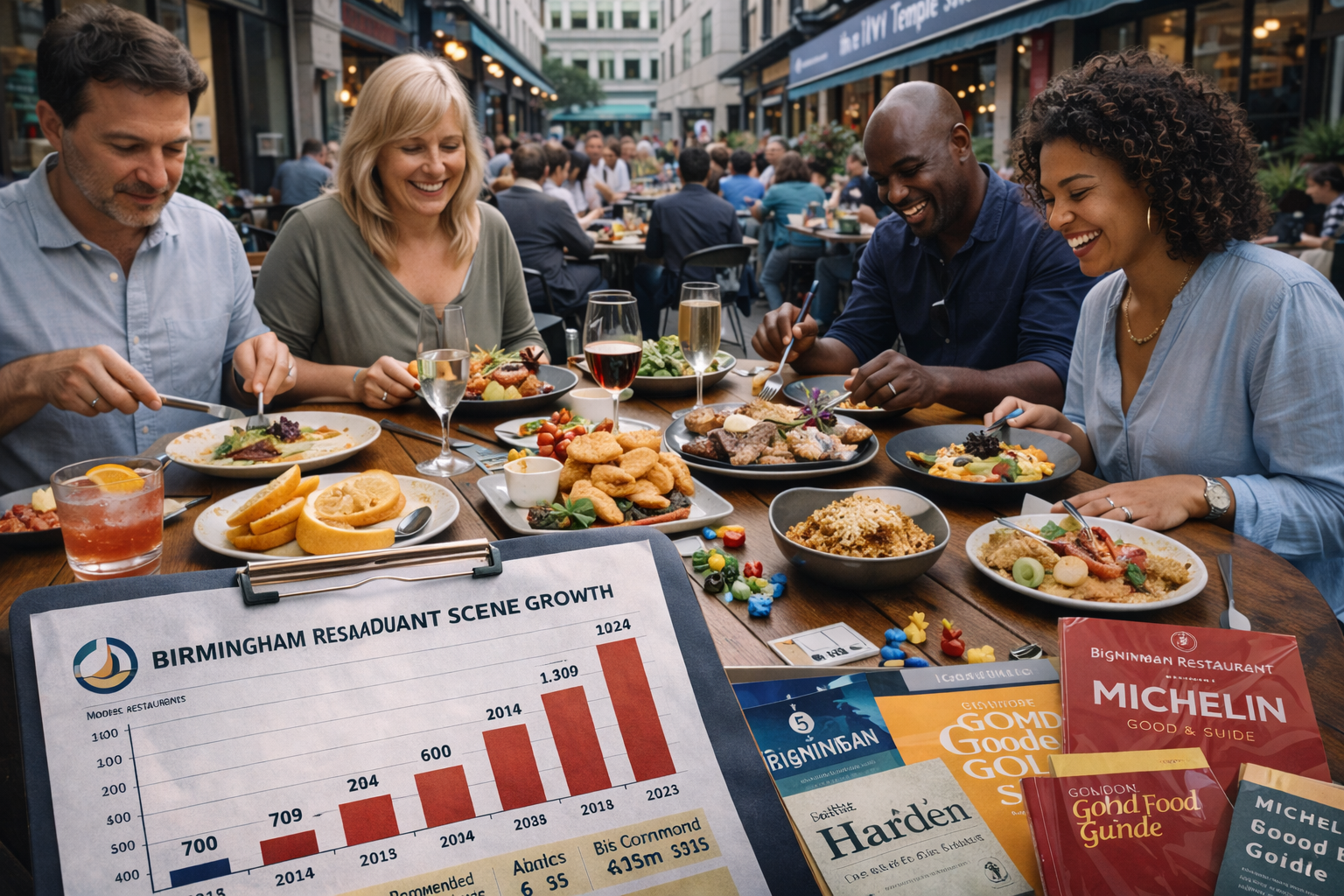
In early 2024, a Birmingham restaurant made history. It became the first Indian restaurant outside London to earn two Michelin stars — and the first Indian restaurant anywhere in the UK to hold that rating at all. The ceremony took place in Manchester. The attention, briefly, went entirely to Birmingham.
That single moment tells you something. But the numbers behind it tell you considerably more.
The Michelin Count and Why It’s Just a Starting Point
Birmingham now holds more Michelin stars than any other UK city outside London. Three restaurants currently carry one star each, and one holds two. One of those one-star restaurants has held its star since 1999 — 26 consecutive years at the time of writing. That kind of longevity matters to anyone who tracks performance over long cycles in competitive systems.
People who follow probability and long-run data closely — whether in sport, finance, or online games at a site like luckycapone — tend to look past single-moment results and focus on sustained output instead. In food terms, Birmingham’s Michelin record points toward something structural rather than a short burst of activity. You don’t hold a star for 26 years by accident.
Still, star counts measure a narrow slice of a city’s restaurant output. They skew toward expensive tasting menus and formal settings. The more useful question is what sits underneath the headline count.
The Volume Data: An 86% Increase in One Decade
In 2014, TripAdvisor listed 1,495 restaurants in Birmingham. By 2025, that figure had grown to approximately 2,778 — an 86% rise in just over a decade. During the same period, the total number of licensed food and drink premises across Great Britain fell year-on-year from 2017 to 2023. Birmingham went up while the national trend went down.
An Audit Consulting Group analysis published in early 2026, drawing on CGA industry data, placed Birmingham and Manchester as the fastest-growing foodservice cities in the UK by outlet count. The reasons are structural, not accidental.
The table below summarises key indicators from Birmingham’s restaurant sector across this period:
| Indicator | 2014 | 2025 |
| Restaurant listings (TripAdvisor) | 1,495 | 2,778 |
| Michelin-recognised venues | 4 | 5+ |
| Michelin stars held | 4 | 5 (incl. one two-star) |
| Residents under 30 (city) | ~44% | 45.7% |
| UK foodservice growth ranking | — | Top 2 outside London |
Four structural factors explain why Birmingham’s restaurant density keeps rising while other cities stagnate:
- Age profile: 45.7% of Birmingham residents are under 30, against a national figure of 36.8% for England. Younger populations spend a higher proportion of income on food outside the home.
- Student concentration: The city’s universities hold more than 65,000 undergraduate students, generating consistent year-round demand across quick-service and mid-market dining.
- Commercial rent differentials: Central Birmingham rents run significantly below London rates, allowing independent operators to hold viable margins that London long since squeezed out.
- Culinary heritage: Decades of immigration from South Asia, the Caribbean, and East Asia built a restaurant culture grounded in authentic cooking — with the Balti Triangle as the most measurable example.
The Balti Triangle: Economics of a Culinary Identity
The balti dish did not originate in a food lab or a restaurant group’s development kitchen. A Pakistani restaurateur in Sparkbrook invented it in the mid-1970s. The bowl — a flat-bottomed pressed carbon steel vessel — came from a manufacturer in Washwood Heath, and still does. Birmingham created the dish, the container, and the category.
By 2014, Marketing Birmingham estimated the Balti Triangle’s economic value at £6 billion to the city economy. That figure covers supply chains, hospitality employment, and tourism spin-off spending. Researchers at University College Birmingham found the authentic balti contains more iron and less saturated fat than a standard curry — a detail that rarely makes the travel guides but matters to the science of why the dish holds its appeal after 50 years.
What the Balti Triangle created, economically, was a pull effect. People travel to Birmingham specifically to eat in those streets. That footfall feeds the wider hospitality sector — hotels, cafés, bars — in a chain that starts with a single dish cooked fast in a thin metal bowl. The multiplication effect explains why a street food economy that began without planning or investment still registers in economic impact data four decades on.
Street Food and the Independent Sector
Digbeth Dining Club launched in 2012 from a repurposed industrial space in the city’s Irish Quarter. By 2025, it operated across two permanent venues with event capacity for up to 4,000 people. The organisation runs incubator programmes for emerging street food traders in partnership with the West Midlands Combined Authority, offering free mentoring, training, and trading slots to new operators.
That incubator structure matters. It gives Birmingham’s street food sector a development pipeline — a route that moves new operators from idea to trading without the capital outlay that ends most early-stage food businesses. The national data backs up what Birmingham’s scene reflects at a local level: independent venues accounted for 57.16% of all UK foodservice activity in 2024, according to Mordor Intelligence figures.
At the national level, the UK food and drink sector employs approximately 3.8 million people and contributes £144 billion in annual turnover (UKHospitality, 2024). Birmingham’s share of those figures comes disproportionately through independent and small-scale operators — a pattern the West Midlands Combined Authority has now moved to support formally.
What the Growth Data Doesn’t Cover
CN Traveller ranked Birmingham the best food destination in the UK for 2025. The ranking reflects current output, and the output is real. But the same data that shows 86% outlet growth over a decade also shows what happens when a market pushes forward too quickly.
The UK lost 4,078 permanent hospitality venues in 2024, according to the British Beer and Pub Association — 23% fewer than 2023, which counts as a genuine improvement, but still represents thousands of businesses that opened and closed within a single cycle. Birmingham’s restaurant sector adds outlets faster than most UK cities. It also loses them at pace.
The city’s food economy shows sustained growth in volume, recognition, and economic value. Those three metrics point in the same direction. The question now is whether the infrastructure holds up as the numbers keep rising — affordable commercial space, skills pipelines, and supply chains built to serve something more durable than a good run of press coverage.