


Films showing this week either in cinemas or on streaming platforms
FILM OF THE WEEK
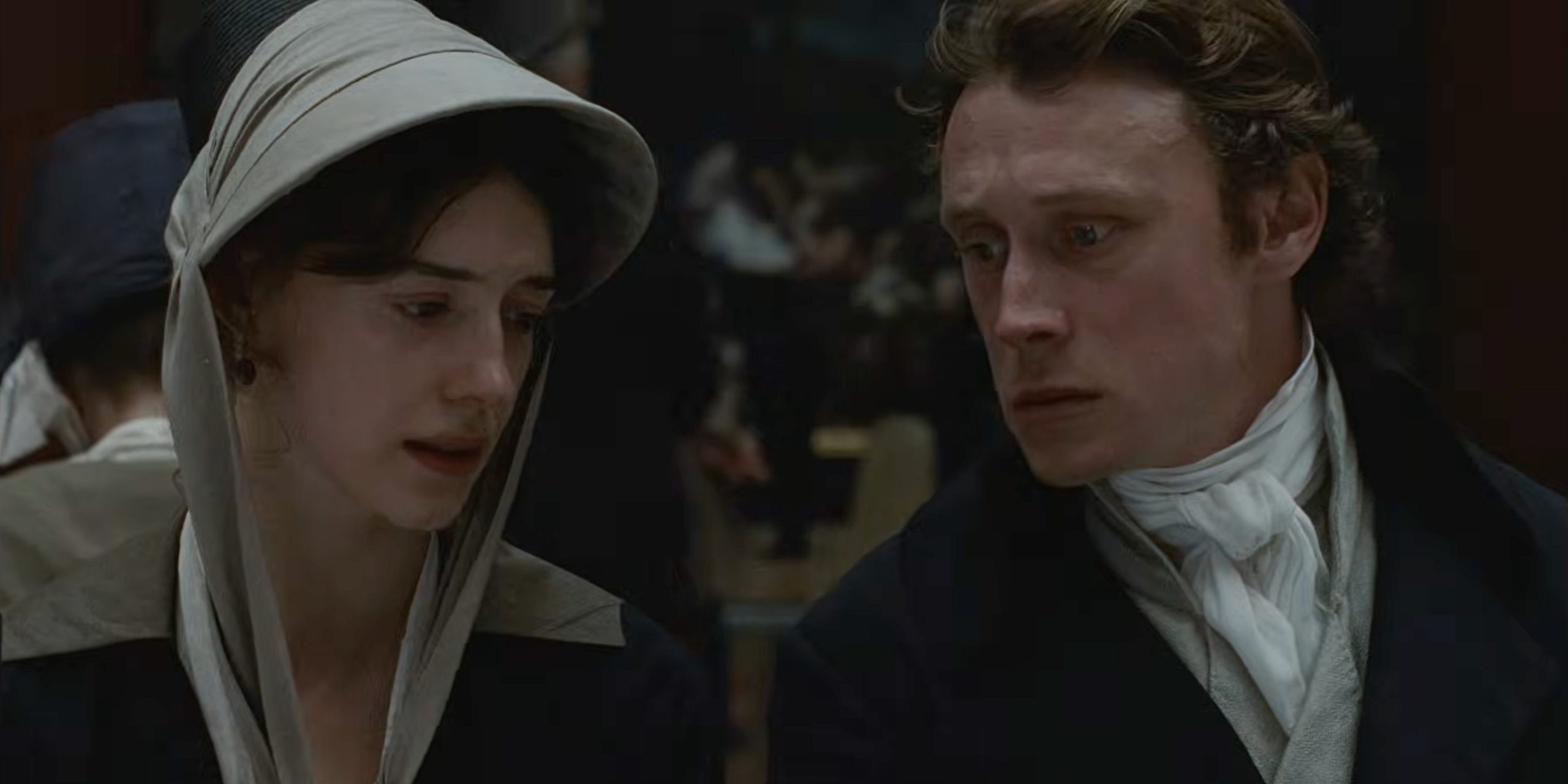
Sense And Sensibility (U)
It’s just over 30 years since Ang Lee made his film of the Jane Austen novel starring screenwriter Emma Thompson and Kate Winslet as the Dashwood sisters. Here, directed by Georgia Oakley, the follow-up to her award winning debut Blue Jean, writer Diana Reid gives it a fresh spin with Daisy Edgar-Jones as the sensible Elinor and Esmé Creed-Miles as the sense-challenged emotionally impulsive Marianne.
The plot is little altered, when Henry Dashwood dies he makes his son John (Tom Brooke) promise to use the inheritance to provide for his three half-sisters, Hamnet’s Bodhi Rae Breathnach as the younger Margaret, and step-mother (Caitríona Balfe), but his avaricious shrewish wife, Fanny (Stacy Martin), persuades her spinless husband to not offer any financial support, leaving them in dire straits, forcing them to move from the Sussex estate to Barton Park, a cheaper Devon cottage owned by her second cousin, John Middleton (Turlough Convery) with the girls’ only prospects being an advantageous marriage, a task to which, like finding them new lodgings, Middleton’s busybody mother-in-law Mrs Jenning (a marvellous Fiona Shaw with a pug permanently attached to her arm) views with relish. The girls, however, want to marry for love not money,
The objects of affection remain Fanny’s compassionate brother Edward Ferrars (a winkingly charming George MacKay turning into Hugh Grant), to whom Elinor takes an immediate fancy, and Willoughby (Frank Dillane), who owns a small estate and for whom Marianne falls after he comes to her aid when she sprains an ankle. Both men, however, have secrets, engagements that will compromise the sisters’ happiness. Elsewhere, Herbert Nordrum scores points as Colonel Brandon who reins in his ambitions regarding Marianne when he realises she’s not going to reciprocate (she sees him as “sincerely dull”) but still takes a concern in her welfare while Ceara Coveney as Mrs Jennings’ cousin Lucy Steele confides news that demolishes Elinor’s dreams.
While not given a contemporary look as such the sisters most certainly do not wear their hair in the tidy refined styles one might expect and for a period romantic drama, this is cast in definite shades of melancholy (there’s only one kiss in the entire film), textured with images of nature (it opens with a caterpillar crawling over Marianne’s finger) and earthy colours and to a great extent devoid of humour, though Eliot Sumner as Mr Palmer, burying himself in a newspaper to avoid his wife’s witless chatter does raise a chuckle.
Along with new backstory connecting Brandon and Willoughby, Oakley also includes the novel’s briefly mentioned duel scene, though I’m not persuaded it adds a great deal other than allowing Marianne to see Brandon does have passions after all. There’s also perhaps one folk dance scene too many.
Edgar-Jones and Creed-Miles bring a believable sisterly chemistry to their relationship, be in comforting or berating each other, both making the most of their close-ups, while Breathnach is no less engaging even if she’s offscreen for much of the film, though again Oakley has the sense and sensibility to resist turning Austen’s sharp social commentary into some modern day feminist message. Lee’s film remains the definitive adaptation but this is a worthy rival. (Cineworld 5 Ways, NEC, Solihull; Mockingbird; Odeon Birmingham, Broadway Plaza Luxe; Omniplex Great Park; Reel; Royal; Vue)
ALSO RELEASED
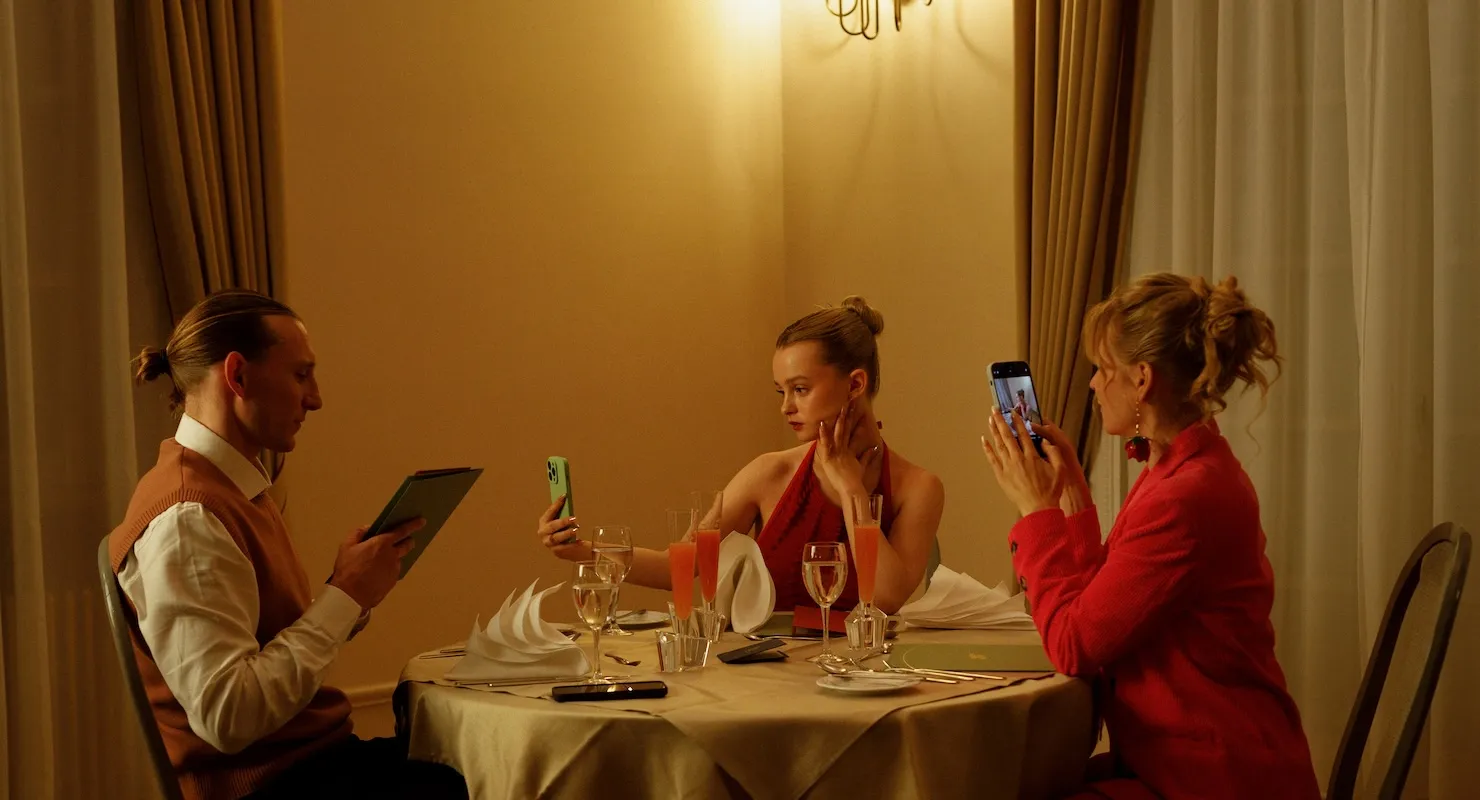
babystar (12A)
Nicknamed Nunki after a twinkling blue star in the Sagittarius region, beginning when she was in the womb, sixteen-year-old Luca (Maja Bons) is the anchor of the lifestyle vlog run by her German parents, make-up influencer Stella (Bea Brocks) and fitness influencer Chris (Liliom Lewald), participating in influencer commercials and the wholly artificial – and rehearsed – interactions for their viewers. Always on, there seems to be now life beyond what the camera shows, although Stella does have a secret (at least to her husband) cigarette habit.
However, when, concerned or her wellbeing, the slightly older Julie (Joy Ewulu) offers her a cigarette and a support system beyond the family and their corporate hangers-on, she begins to start questioning her self-identity. Things come to head when she learns her parents are looking to have another baby to expand their product, they in turn recruiting a tech wiz ((Verena Altenberger) to create a new AI best friend chat bot in her image which, of course, could become a substitute if the real Luca starts becoming an intransigent unwilling celebrity.
Directed and co-written by Joscha Bongard, bearing echoes of The Truman Show and interspersed with animation, it’s a sharply satirical take on social media, its isolation from real life and how it can make children both stars and victims, deftly employing third person and film within film sequences as Luca begins to explore her sexuality and her identity beyond the camera and the person curated and surveilled by her parents. On a wider platform, it’s also about teenage insecurity and rebellion, the feeling of abandonment a new baby can bring, and makes for compelling if unsettling viewing on both counts. (Mockingbird)
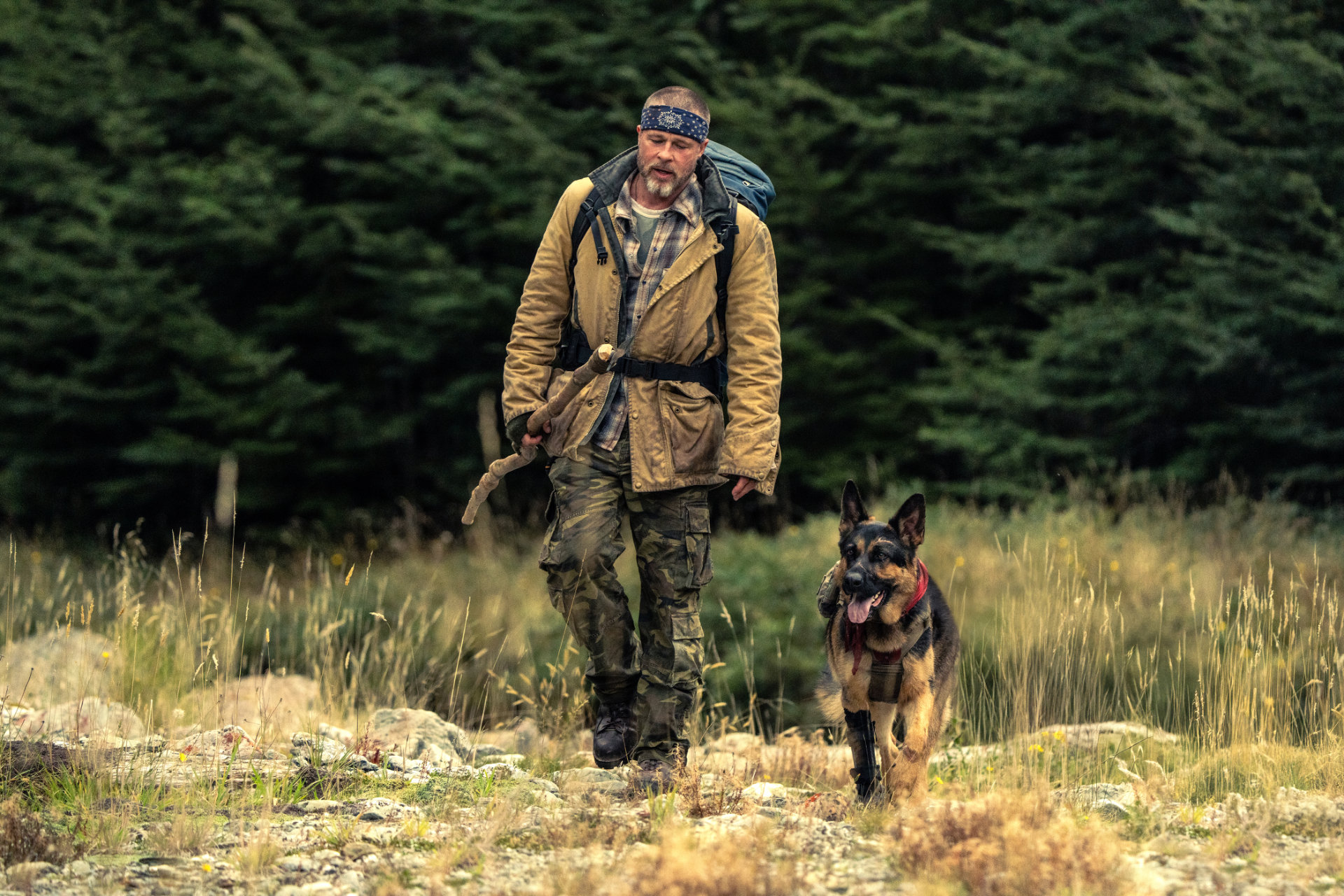
Heart Of The Beast (12A)
In the opening sequence, following a week later scene to which it will return, retired Special Forces officer James Belmont (Brad Pitt) is piloting his a small plane through the Alaska mountains (but shot in New Zealand) alongside Odin, the equally battle-scarred (titanium teeth, prosthetic leg, .PTSD nightmares) German Shepherd who he raised from a puppy and has been his combat dog through many missions. Now he’s just looking for some peace and quiet in nature. Pitching camp on a shore with the stars and a cooler of Belgian ale for company, catching salmon and brewing coffee, it’s idyllic. The solitude is briefly broken that night by the arrival of a former gold prospector (a heavily bearded superfluous J.K. Simmons) who shares a beer and rows off before dawn.
With a storm coming in, James and Odin take off only for him to suffer a heart-attack, sending the plane crashing into the waters, the latter dragging his master to safety. From this point, 58 miles from the nearest road, looking to find their way back to civilisation and pitching tent as they go, it becomes a wilderness survival movie as writer Cameron Alexander and director David Ayer (with whom Pitt worked on Fury) throw in pretty much every predator going (only snakes and gators missing) in a series of incidents that invariably wind up with Odin licking James’ face or he patting the dog’s head. And a couple more mini heart-attacks too.
There’s a tense moment as they have to navigate fallen trees over a ravine with the river rushing far below, but generally this doesn’t really offer much in the way of drama or suspense (there some fuzzy flashbacks to battle scenes) and, while it works hard to capture the mutual bond between man and dog without oozing Marley & Me sentimentality, it never really sparks the emotions it seeks to evoke. It’s not helped either by how Odin (played by Uber and his sons), while an impressive performer, lacks the expressiveness and range that earned Uggi in The Artist a Palm Dog at Cannes.
Ending where it began with Anna Lambe stopping her truck on the road as she’s faced with Odin, it’s strives for poignancy but only really leaves to pondering how quickly loyalty and allegiances can be transferred. Pitt is mostly solid but other than physicality the film doesn’t ask a great deal of him and while watchable enough, it lacks the heart of its title. Disappointing. (Cineworld 5 Ways, NEC, Solihull; Everyman; Mockingbird; Odeon Birmingham, Broadway Plaza Luxe; Omniplex Great Park; Reel; Royal; Vue)
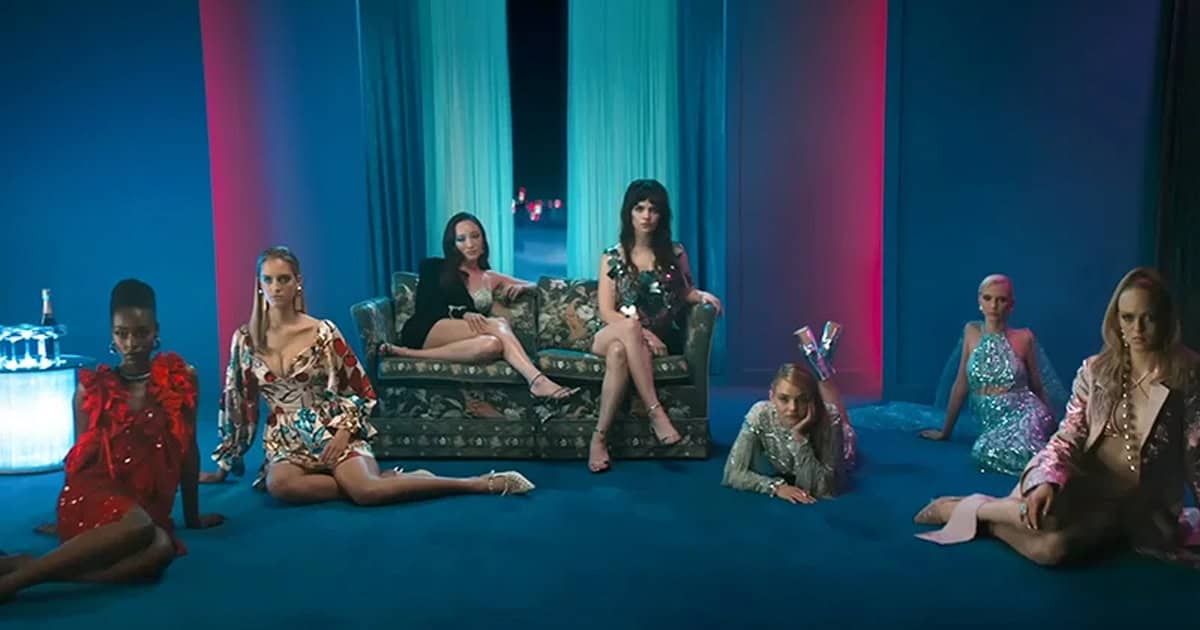
Her Private Hell (18)
Writer-director Nicolas Winding Refn could never be accused of subtlety, but his latest also takes coherence off the table. Set in some mist-shrouded futuristic city, actress Elle (Sophie Thatcher) invited her new influencer co-star Hunter (Kristine Froseth) to share the suite when her travel arrangements are disrupted by the mist. Elle, who has a strained relationship with her stepmother and former bestie Dominique (Havana Rose Lui)), is making a film with her lecherous father Johnny Thunders (Dougray Scoot), a Barbarella-ish sci fi adaptation of a sapphic graphic novel called Candyfloss, which involves she and other women in the cast being fitted with costumes by sinister dressmakers Ms S (Aoi Yomada) and Ms T (Shioli Kitsuna), and which she hopes will bring her and her father closer. However, having told the women about the legend of the Leatherman, a demonic murderer with diamond-encrusted gloves (S and T being his shape-shifting accomplices), who appears with the mist and can only be killed by cutting off his hands, he then departs, leaving her a golden hatchet as birthday gift, with Elle and Hunter witnessing the Leatherman rip out a neighbour’s chest and throw her through a window. At which point, the film introduces Private K (an expressionless Charles Melton), an American G.I. once stationed in Japan, who’s hunting the Leatherman convinced he was behind the disappearance of his daughter, and, as K’s drawn into a crystalline realm resembling the Candyfloss set, it just gets even more incomprehensibly barking mad. Oh, and there’s yakuza too.
To call the performances mannered would be an understatement, the almost all-female cast delivering the dialogue with a sort of transfixed bemusement as to what’s going on, leaving this as pretty much all dazzling Day-Glo style and bloody violence impenetrable substance, making David Lynch’s most bizarre excesses seem straightforward. Devoid of tension or humour (other than perhaps intentional camp), it’s a laborious, pretentious ordeal that only the most fervent Refn fan could possibly sit through, even they might find it a push. (Mockingbird)
Hope (15)
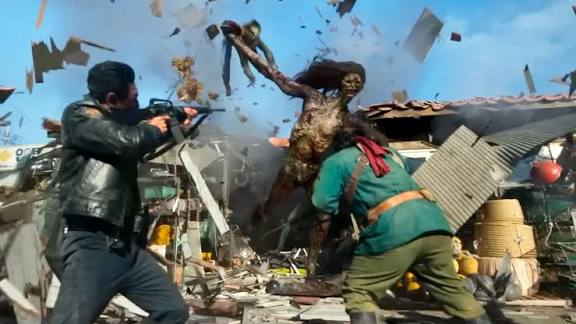
Directed by Na Hong-Jin, this South Korea monster movie has already set records back home and, following being feted at Cannes, seems certain to storm the box offices here and in America too. The somew2hat dim-witted police chief of Hope Harbor, a small village near the Korean Demilitarized Zone, where the mostly elderly population is asked to look out for spies and landmines, Bum-seok (Hwang Jung-min) is called out by his second cousin, Sung-ki (Zo In-sung) when a dead cow is found on the road with gaping wounds that are initially put down to a tiger, until more cattle and farm owner are also found dead. Returning to town, he discovers its been devastated with dozens of the locals massacred, and, joining up with colonel Nak-yeon (Lee Sang-hee), eventually finds the creature responsible is a seemingly indestructible 10 foot humanoid (Cameron Britton) looking like it wandered in from a Ray Harryhausen set. As with Jaws, Hong-Jin holds back that reveal for a tension-building 50 minutes.
As the plot develops and the narrative takes off on three different paths, further characters are introduced in the form of rookie police officer Sung-ae (impressive Squid Game star Jung Ho-yeon), eccentric hunter and carpenter Yang-bae (Eum Moon-suk) who says he has a baby-like alien corpse in his freezer and elderly local Hae-sul (Im Hyun-sik) who claims there are more monsters out in the woods. The discovery of a crashed alien spacecraft by Sung-ki and his fellow hunters, sends the film off on another direction again, as the dead child is revealed to be Xinertai, an infant of alien royal lineage and which the others(an almost unrecognisable motion capture and CGI, Alicia Vikander and Michael Fassbender as alien Empress J’aur and her subordinate Ma’veyyo with Taylor Russell as the third, Ai’dovor) are trying to find, giving the film an ambivalent emotional dimension about family and xenophobia, far beyond the initial set-up asking just who are the real monsters.
The CGI isn’t exactly state of the art and the dialogue is B-movie lite, but once in gear, the pace never flags over its two-and-a-half hour running time, as one explosive set piece follows another, reaching a peak with a Sung-ki fleeing on horseback while Ko Bum-seok and Im Sung-ae try and pull him into their speeding police car while taking aim at Ma’veyyo. A five-minute monologue about having diarrhoea in the woods and a viscerally graphic alien autopsy using a chainsaw are dubious icing on the cake. The end sets up a sequel, hope so. (Cineworld 5 Ways, NEC, Solihull; Odeon Birmingham, Broadway Plaza Luxe; Omniplex Great Park; Vue)
28 Years Later: The Bone Temple (18)
Nia DaCosta taking over directing duties from Danny Boyle, the fourth part of Alex Garland’s dystopian post apocalypse zombie franchise picks up directly from the end of 28 Years Later, with Spike (Alfie Williams) confronted by the non-infected Satanic cult known as The Jimmys, inspired by Jimmy Savile with their blonde wigs and blue tracksuits, with its psychopathic leader Sir Lord Jimmy Crystal (Jack O’Connell), who, with a Teletubbies fixation, claims to speak directly to Old Nick, his father, forcing him to fight and defeat one of his credulous ‘fingers’ as an initiation into the cult. In their twisted beliefs, they inflict his interpretation of ‘charity’ on their home invasion victims (characters returning from the earlier film for a clear Clockwork Orange nod) in horrifically brutal skin flaying ways, though not before one of them manages to dispatch the particularly sadistic Jimmima (Emma Laird).
It takes a while (and indeed the first half of the film is slow-going) to get round to reintroducing Dr Ian Kelson (an exuberantly unfettered Ralph Fiennes) who has created an ossuary memento mori monument to fallen humanity, the bone temple of the title. In the previous film, he encountered a smarter and stronger infected, an alpha he dubbed Samson (Chi Lewis-Parry) and here, through a combination of drugs and kindness, he manages to reach past his zombie state and tap into the humanity still buried within, potentially suggesting the virus can be treated and contained.
Eventually paths will cross, with Lord Jimmy persuaded that Kelson, whose skin is orange on account of the iodine he’s taken to fight off the virus, is actually Old Nick, the cult gathering at the site of the temple where the two opposing forces meet and strike a deal of sorts, one which will involve Kelson pretending to be Satan incarnate as, in a mind-boggling scene, he dazzled and terrifies the followers dancing and singing along to Iron Maiden’s Number Of The Beast (with somewhat eclectic musical tastes, his collection also includes Duran Duran’s Girls On Film) before finally recognising Spike behind the wig and mask.
With Erin Kellyman as Jimmy Ink, a cult disciple who is more questioning and less submissive and proves a friend to Spike it builds to a suitably powerful and violent climax involving an upended crucifixion and a Christ-like sacrifice for humanity, Garland’s frequently deranged and bonkers screenplay entails Crystal and the atheist Kelson in a discussion about religion and the way it is manipulated by its followers while also exploring themes of morality and spirituality.
Aside from Samson yanking a head from its body and scenes involving brains-eating and several naked Rage infected figures, there’s surprisingly little zombie action here, the focus being very much on human conflict and savagery. To which end, DaCosta conjures a dark and visceral aesthetic that is more concerned with intellectual ideas than horror tropes. Not that there’s isn’t plenty of graphic violence but there’s some sly humour too (including Fiennes referencing Spinal Tap) as she navigates the complex web of menace and emotion within which her film’s suspended.
Gathering momentum and power as it heads into the final stretch, it ends with Jimmy Ink and Spike being chased by infected and observed by two characters (and it’s not hard to guess who one is) which, bringing things back to the first film, sets up the fifth and as yet undated and unnamed final chapter and presumably revealing what happened to the healthy baby to which Samson’s mate (whose body Kelson disposes of in an early sequence) gave birth in the previous instalment. (Sky/NOW).
Anaconda (12)
Diving into self-referential meta waters, sharing a similar concept as Be Kind Rewind, director and co-writer Tommy Gormican, who made Nicolas Cage self-spoofing meta comedy The Incredible Weight of Massive Talent, asks when is a reboot not a reboot. The answer here being a film about making a reboot, Released in 1997, a Jaws knockoff giant snake horror with unintentionally hilarious dialogue, Jon Voight’s bizarre accent and an unconvincing animatronic snake, it’s since become a cult classic, and, for the sake of the plot driver here, was a college days favourite of buddies Griff and Doug, the former appearing alongside friends Claire and Kenny in the latter’s teenage amateur horror Quatch.
Years on, having moved to LA to become a movie star, Griff (Paul Rudd) once appeared in four episodes of SWAT and is now reduced to one liners in shitty daytime soaps. And he can’t even get through that. Doug, meanwhile, remained in Buffalo, got married (to Iona Sky), had a kid while his movie dreams shrank to making overly-plotted wedding videos. Everyone reuniting for his birthday, for which Griff has unearthed a VHS of Quatch, his friend suggests they get back together and reboot Anaconda, for which he claims to have secured the rights. Initially reluctant, having a follow your dreams while you still can epiphany, Doug eventually agrees, he directing, Griff starring alongside recently divorced ex-girlfriend lawyer Claire (Thandiwe Newton) who stumps up the finance and for whom he still carries a spark, and the ever unreliable Kenny (Steve Zahn), who insists he’s got his pills and drink issues under control, as cinematographer.
And so it’s off to the Amazon with the most basic of film equipment where they hook up Santiago (Selton Mello), the eccentric snake handler Kenny’s hired. Needing a boat, they wind up with one commandeered by supposed captain Ana (Daniela Melchior), first seen being pursued by men with gun in the opening sequence as part of the subplot about illegal goldmining. Naturally, everything goes wrong, starting with Griff accidentally killing Kenny’s snake, meaning they have to procure another, though going into the jungle at night to find doesn’t seem the best considered option. At one point, just to underline the premise for those not paying attention, Doug remarks “We came here to make Anaconda. And now we’re in Anaconda!”
While its gags about Hollywood aren’t anywhere near as sharp as The Studio, at one point in the final stretch, someone remarks about filmmakers making it up as they go along, and that certainly seems to be the case here (most notably in a scene where Kenny, who has public urination issues, having to piss on Doug’s leg when he’s bitter by a tarantula). And then there’s how the group encounters a film crew making their own Anaconda reboot (a couple of the original stars get to cameo), only to fall prey to the monster reptile (CGI but no more convincing than the original) lurking in the waters, while the subplot then throws up its own twists.
It’s funniest in the opening stretch, the laughs becoming more forced when it veers off into actually horror territory and tries to juggle ‘themes’, as Griff and Doug keep going about, of friendship, dreams and whatever, and descends into such ill-conceived slapstick as Black running from the snake with a wild hog strapped to his back.
The four leads work well together, sparking off one another, with Black for the most part less manic than usual and Rudd playing small tics to good effect, Zahn doing what Zahn does and Newton making the most of an underdeveloped role and demonstrating how to give good headbutt. Never especially hilarious or scary, even so it’s nowhere near as awful as it might have been. Which is a recommendation of sorts. (Sky/NOW)
Apex (15)
She may have had several stunt doubles, but Charlize Theron still gives a powerful physical performance in this survival prey vs predatory drama set in the Australian outback. Playing adrenaline junkie Saha, in the taut opening sequence she and husband Tommy (Eric Bana) are climbing Norway’s forbidding Troll Wall peak when a storm comes in and, she forced to cut the rope tying them together, an avalanche sends him to his death.
Cut to some months later as, holding Tommy’s lucky compass, she turns up at the fictitious Wandarra National Park on a pilgrimage of healing, and is warned by the ranger at the gas station that there’s been a string of disappearances, including families with young kids, in the region to where she’s headed. She’s then harassed by a pair of lascivious game hunters (Matt Whelan, Rob Carlton), ominously named Diesel and Ripper, before a third stranger, Ben (Taron Egerton with credible Aussie accent), intervenes, she asking him how to reach the Grand Isle Narrows. Given to possible routes she, naturally, chooses the hard but scenic way, starting out at Blackwater bay.
Arriving at night, she has another intimidating encounter with the hunters who are skinning kangaroo carcasses (a misdirection given they then vanish from the plot) and, in the morning sets out down the rapids by kayak, setting up camp only to awake in the morning to find her bag missing and, continuing down the river, eventually reaching the Narrows where she’s surprised to find Ben already there, explaining he lives in the area, where he makes the homemade jerky he supplies to local stores, and offering to share supplies – which, naturally, turn out to be the ones that were stolen. He then produces a crossbow and says she has until the song on the stereo ends to get a head start before he comes after her.
The feature debut by writer Jeremy Robbins and directed by Iceland Baltasar Kormákur, it’s firmly rooted in the same wilderness terror territory as things like Wolf Creek while also echoing Kormákur’s earlier thriller Beats, but with a two rather than four-legged predator. Once the chase begins, the film follows a fairly predictable course, embellished by a captured Sasha, chained to Ben, being taken to his man cave, discovering he’s a cannibalistic serial killer with ghoulish orthodontics and mummy issues that make Norman Bates seem well-adjusted and learning the grisly ingredients of his distinctive tasting jerky, building to a climax that moves from yet more fighting in the rapids to, she having broken his leg, a mirror of the tandem climb opening.
A virtual two-hander, while boasting some spectacular cinematography and wild water sequences, it’s basically standard B-movie fare with just a token subtext about grief, guilt and letting go, but Theron and Egerton deliver fully committed performances, even if he can be a tad over-manic, while Kormákur slowly builds the sense of dread before all hell breaks loose in the visceral climax. (Netflix)
Bad Apples (15)
In a scenario I suspect far too many teachers will identify with, Maria Spencer (Saoirse Ronan) works at a rural West Country junior school (somewhere near Bristol) looking to do her best for her students. However, as seen in the opening sequence in which he throws a trainer into an apple processing belt at a local cider mill, she’s having real problems trying to control the near feral Danny (Eddie Waller), who’s a constant disruptive presence in the class, attacking other pupils and trashing the room. She gets no support from her stern headmistress Sylvia (Rakie Ayola), who basically tells her to control things or else, inevitably placing increasing strain on Maria who lives alone, deputy head Sam (Jacob Anderson) being her ex, and plays a farming simulator game to escape the pressures.
Things come to a head when, the day before an Ofsted inspection she catches Danny vandalising cars and, in trying to stop him, accidentally knocks him out. When he wakes up, he accuses her of attacking him and threatens to go to the police. Panicking, she drags him to her home and locks him in the basement. Without him there, the inspection proves a huge success and suddenly Maria’s the school darling, even rekindling Sam’s attention. However, there’s still that matter of the boy in the basement, although, led by his overworked delivery driver father Josh (Robert Emms), who is initially suspected as being behind the disappearance, the search to find him (and most of the community aren’t in any hurry to do so) gradually winding down after several months.
With Maria securing Danny with a chain and harness and giving him one-to-one tutoring and a FIFA video game to pass the time (the place has no wi-fi), his tantrums gradually diminishing, it seems to be shaping up along the lines of the recent The Good Boy. Things take a turn however when needy and vindictive wannabe teacher’s pet Pauline (Nia Brown), who Danny pushed down the school stairs, breaking her arm, discovers what’s going on and blackmails Maria into giving her special treatment, including one of her dresses which, in defiance of the rules, she wears to school, Maria explaining it away as a project. Inevitably, at some point, a PTA meeting where Pauline insists on performing a tell all song in this case, it’s all going to come crashing down
The English language debut of Swedish director Jonatan Etzler, adapted from a novel by Swedish writer Rasmus Lindgren by first timer Jess O’Kane, it juggles audience sympathies as it peels away Danny’s behaviour to reveal him as an emotionally neglected boy in desperate need of attention and affection, something the surrogate mother-son bond that develops with Maria brings, not that he wouldn’t escape if he could. His relationship with Josh is paralleled with that between Pauline and her overbearing father Frank (Sean Gilder), throwing another theme into a narrative that juggles audience sympathies while mixing dark humour with psychological thriller.
Ronan is, naturally, terrific while newcomer Waller is both vulnerable and genuinely frightening as a junior school answer to the anti-Christ, with Brown no less disturbingly powerful as the sadistic and manipulative Pauline. However, Etzler rather overdoes the visual metaphor of rotting apples and as it heads into the last act it becomes clear that, even when Maria’s exposed, it doesn’t really know how to conclude it amoral tale, resorting to an unsatisfying open ending, but still leaving audiences with much to consider about today’s conveyor belt education system, its practitioners and the young generation they’re (mis)shaping into tomorrow’s citizens.(Cineworld 5 Ways, NEC, Solihull; Mockingbird; Odeon Birmingham, Broadway Plaza Luxe; Omniplex Great Park; Royal; Vue)
Bugonia (15)
The fourth teaming of director Yorgos Lanthimos and star Emma Stone, the title referring to an ancient Greek belief that bees spontaneously generate from the carcasses of dead oxen, adapted by The Menu screenwriter Will Tracy, this is a remake of 2003 South Korean film Save the Green Planet! but with a gender switch for two of the characters. As such, anyone who’s seen the original will be aware of the last act twist – which here ventures into the realms of 60s TV sci fi cheesiness but, with its final scenes scored to Where Have All The Flowers Gone, still packs a chillingly numbing punch, a conspiracy thriller rooted in the premise that just because you’re paranoid doesn’t mean they’re not after you, exercises a gripping cocktail of tense drama and black comedy.
Stone plays Michelle Fuller, the high profile power-dressing, subtly manipulative, coldly calculating CEO of pharmaceutical company Auxolith who’s abducted by bee-keeping conspiracy theorist eco-terrorist Teddy Gatz (Jesse Plemons), who works at the company’s warehouse, and his neurodivergent cousin Don (Aidan Delbis, himself autistic), who believes her to an Andromedan, part of an alien species that’s infiltrated the human race and is killing off the bees in keeping with Colony Collapse Disorder. Holding her captive in their basement, smearing her with antihistamine cream and shaving off her hair so she can’t communicate with the mothership, Teddy’s plan is to use her as a bargaining tool to force the aliens to leave Earth, giving her four days to admit the truth before the lunar eclipse allows her ship to enter the atmosphere undetected.
However, while clearly deranged and delusional, Teddy’s actions are also driven by a different motive in that his mother, Sandy (Alicia Silverstone), was a guinea pig for one of Auxolith’s drugs, leaving her comatose in a nearby hospital with Michelle covering things up. Initially vehemently refuting his alien claims but then deciding to play along, Michelle tries to turn things to her advantage, noting that the almost childlike Don, who, like Teddy’s has been injected with a “chemical castration” formula, seems uncomfortable with his cousin’s plans. During the torture (aptly set to Green Day’s Basket Case), Teddy, in full-on psychosis, becomes persuaded that she’s a member of the Andromedan royal family, and, out of respect, lays on assort of state dinner upstairs, only for taunting to see it end in a fight and a fork stabbing. Meanwhile, the police have launched a hunt and, adding another creepy layer, local sheriff Casey (Stavros Halkias) keeps coming round looking to make amends for having molested Teddy when he was his babysitter.
Things turn bloody with a suicide and a subsequent murder, before Michelle persuades Teddy his mother can be cured with anti-freeze, something that inevitably does not end well, she, playing to his fantasies and explaining that, after accidentally wiping out the dinosaurs, the experiment was designed by the Andromedans to help humans, which they created, evolve beyond their self-destructive nature.
Again rooted in themes of power struggle dynamics, class, entitlement and media manipulation, while more narratively straightforward than Lanthimos’s past two outings, it still runs the freak flag up the deadpan humour mast, gleefully allowing the cast to dive into its eccentricity and weirdness. Stone once more gives 110 percent to the character and narrative while Plemons, all lank hair and barely suppressed rage, is terrific, both engaging empathy and revulsion as you’re led to ask which truth is actually out there. (Sky/NOW)
The Choral (12A)
A fourth teaming of director Nicholas Hytner and writer Alan Bennett, this is a slight but gently comic and touching tale of the power of music to heal, comfort and inspire. The setting is the fictional Yorkshire village of Ramsden in 1916 where the war has seen many a young volunteer (conscription not yet introduced) go off never to return, 17-year-old postboy Lofty (Oliver Briscombe) delivering the dreaded messages to newly bereaved wives and mothers. It’s also taken its toll on the village choral society which, funded by mill owner Alderman Duxbury (Roger Allam), who’s recently lost his own son with his wife in permanent mourning, has seen its choir master having decided to enlist, thus requiring a replacement. To which end, committee member Joe Fytton (Mark Addy), the local photographer who snaps the lads before they ship out, suggests they approach organist turned conductor Dr. Henry Guthrie (Ralph Fiennes).
Aside from being an atheist and having no patriotic sensibilities (his reaction to a rendition of God Save The King is an eye rolling joy), the real problem, certainly as far as Duxbury’s concerned, is that he’s spent his recent years in Germany of his own volition. Nevertheless, reputation outweighs prejudice and he duly agrees to take up the position (though the local kids taunt him and the older members sneer), bringing with him his own conscientious-objector pianist, Horner (Robert Emmas), and despite the fact he annoyingly keeps referencing German philosophers and composers, things seem to settle down as he auditions for new singers, among them Bella (Emily Fairn), whose soldier boyfriend Clyde (Jacob Dudman) is MIA, Lofty and his chums Ellis (Taylor Uttley) and Mitch (Shaun Thomas), and, a real find, Mary (Amara Okereke) who loves singing while she collects for the Salvation Army. Guthrie’s somewhat less impressed by Duxbury, who sees himself as the choir’s star turn.
There’s also an unspoken reservation about Guthrie being a closeted homosexual, a somewhat unnecessary plot addition involving Horner’s crush and an ill-fated romance with a German naval officer that has him forever checking the papers for news of sea battles.
After making an approach to Edward Elgar to get permission, they eventually settle on performing his good vs evil parable The Dream of Gerontius which, as it develops, becomes a theatrical piece about the war and its casualties, enlisting wounded soldiers into the choir, among them Clyde who’s returned alive, minus an arm, much to the consternation of Bella who’s taken up with Ellis, and is chosen by Guthrie to replace Duxbury as the voice of good, he getting to sing the Satan part as compensation. As fate has it, Elgar (Simon Russell-Beale) is in the area for an investiture ceremony, and, while Guthrie demurs, Mary secretly invites him to come and check out their interpretation. His reaction, not quite what she’d hoped.
With a cast that also includes Alun Armstrong as the village’s funeral director and Lyndsey Marshal as the local prostitute with quite a client list, its ensemble nature sometimes struggles to incorporate all the different stories (the three boys turn 18 and get their call-up papers, Lofty looking to lose his virginity before he goes), but otherwise, anchored around a typically centred performance from Fiennes, it deftly balances the poignancy and the humour (Bennett’s often sharp wit in solid form) as the community bonds over common goals and tragedies. A touch rose-tinted with the cosiness of a light and warming Sunday evening BBC drama, it’s an undemanding joy, but a joy nonetheless. (Sky/NOW)
Coyote vs Acme (PG)
Originally due to be released in 2023 but then mothballed by Warner Brothers for tax reasons, it finally arrives via a new distributor to take its overdue place in the cinema spotlight. Directed by Dave Green and written by Samy Burch based on a New Yorker article of the same name by Ian Frazier, it adopts the interaction between animated characters and live actors pioneered by Who Framed Roger Rabbit with a suitably chaotic love letter to the Looney Tunes world.
After years of failing to catch Road Runner and being constantly blown up, etc., by the malfunctioning contraptions he’s using, Wile E. Coyote decides to sue their manufacturer, Acme, for negligence in providing him with faulty products. To which end, non-verbal and communicating through written signs, he hires Kevin Avery (Will Forte in the Jimmy Stewart role), a lazy, bottom feeder Albuquerque billboard lawyer who specialises in representing cartoon characters like Porky Pig in accident claims for a quick settlement. Avery’s always looking to take the easy route, Coyote is determined to stop at nothing. Representing the Acme Corporation is Avery’s devious law school rival and nemesis Buddy Crame (John Cena) and his assistant Bill Pellicano (P.J. Byrne).
Opening with a flashback in which Acme scientist Peter Lorre decides he can no longer in good conscience work on something called Project Sisyphus and is then literally ‘disappeared by Acme goons, gathering the evidence for their case (and surviving things like animated anvils falling from the sky in the process) it proceeds to the David and Goliath courtroom stand-off where, unsurprisingly, the judge ( Luis Guzmán), in Acme’s pocket, the case is summarily dismissed. Not that that’s the end of the fight though as Coyote, Avery and his relentlessly upbeat intern niece Paige (Lana Condor) set out to uncover what Project Sisyphus (a nod to Greek mythology and Albert Camus’ philosophical contemplation of the absurd) involved and why Acme are so keen to keep it hidden, eventually being revealed as running tests on cartoon character guinea pigs in order to iron out any problems with the products before putting them into the human market, .
An inspired hybrid of mismatched buddy movie, 70s conspiracy thrillers and courtroom drama, it’s a pointed Capra-esque political satire on contemporary America and corporate malfeasance and irresponsibility (think Erin Brokovich) along with celebration of the nobility of futility where the fight is always worth fighting and a poignant closing point about symbiotic frenemies relationships as embodied in that of Coyote and Road Runner, and, of course, Batman and The Joker.
Along with cinema in-joke references to things like It Happened One Night and Mr Smith Goes To Washington, with Acme headed up by Trump-like CEO Foghorn Leghorn, it’s stuffed with every Looney Tunes and Merrie Melodies character you can name, from test subjects like Pepé le Pew, an institutionalised Daffy Duck, Tweety Pie, Sylvester, Granny, Elmore Fudd and Yosemite Sam to Tasmanian Devil as the corporate’s incoherent PR. And, naturally, Bugs Bunny. Those with sharp eyes will note that Avery’s team members Sal Maltese (Tone Bell) and Dottie Jones (Martha Kelly) are named for Wile E. Coyote and Road Runner co-creators Michael Maltese and Chuck Jones while Avery is tip of the hat to legendary Looney Tunes animator Tex Avery
Consistently funny, ingenious and subversively satirical (though patently more for grown-ups than kids), it holds a fully deserved 95% approval rating on Rotten Tomatoes. Meep meep indeed. (Odeon Birmingham)
Crime 101 (15)
Adapted by writer-director Bart Laton from the Don Winslow novella, the 101 refers to the LA highway and the crime concerns a string of high end jewellery robberies along the route, the thief being Mike (Chris Hemsworth on terrific form) who leaves no traces and never harms anyone. On his trail but with no clues to follow is Lou Lubesnick (an understated Mark Ruffalo), a hangdog detective recently dumped by his long-term girlfriend (a cameoing Jennifer Jason Leigh) whose theory that it’s all the work of one man is dismissed by his fellow cops and superior who just want cases wrapped up. Mike literally works for Money (a grizzled Nick Nolte), who sets up the heists and takes his cut but, after a close call involving a jammed gun, Mike’s decided to call time, a decision compounded by having struck up a romance with Maya (Monica Barbaro), a music publicist who rear-ended his car and who is frustrated that she knows nothing about his background. Passing on a job he was doing for Money in Santa Barbara, considering it too risky, it’s carried out instead by motorbike-riding thug Ormon (Barry Keoghan who starred in Layton’s heist docu-drama American Animals), who, unlike Mike, has no compunctions about violence.
The net, however, is closing in with Lubesnick using DNA from a blood sample found in Mike’s abandoned car to uncover his real name and identity. Meanwhile there’s a plot intertwine involving Sharon Colvin (Halle Berry, feisty), an insurance broken for elite clients who’s pissed at being constantly passed over for partner and whom Mike tries to get onboard for a robbery involving a ton of cash, illegally important diamonds and his upcoming wedding at the Beverly Wilshire Hotel, the confidential details of which she has access to.
Inevitably summoning Michael Mann references, though this is more a study of characters adrift in a sea of corruption (Mike has issues about his line of work, Sharon about being a woman in a toxic man’s world and overshadowed by a younger rival, Lou with the department’s cover up of a shooting) than action movie, Layton still has a firm grip on the slowly building tension (even if there’s a couple of loose ends involving Money and Mike’s hacker) while the hotel room showdown by way of two characters engaged in deceiving each other while riffing on Steve McQueen and the chaotic car chases through LA (with its subtext scenes of homelessness and urban decay) get the pulse working overtime. After the Damon/Affleck Netflix thriller The Rip, this is shaping up to be a great year for 90s throwback crime thrillers. (Amazon Prime)
De Gaulle Part 2: Liberté (12A)
The sequel to Resistance, this opens in 1943 set variously on the battlefield, government offices, covert apartments with the liberation of France but De Gaulle (Simon Abkarian facing another battle to enable France may to determine its own political future rather than be in thrall to the Allies.
In terms of action, it mostly centres on the Free French forces under General Leclerc (Niels Schneider) and his largely African army battling the Germans in the Libyan desert, culminating in the African Campaign struggle for Ksar Ghilane. Meanwhile back in occupied France, Jean Moulin (Félix Kysyl) has been charged by de Gaulle to bring together the deeply divided different movements of the French Resistance, meaning he has to persuade Gaullists, communists, socialists, conservatives, trade unionists and independent resistance organisations to all accept a common political structure. This comes to a head on 27 May 1943, when Moulin brings together representatives of the major resistance organisations together to form the National Council of the Resistance which, while Roosevelt (Campbell Scott) questions his legitimacy, recognises de Gaulle as its political leader. Betrayed and arrested by the Gestapo and tortured by Klaus Barbie, Moulin dies before he can see his country liberated.
In the meantime, her lover Fernand having been executed for the assassination of Vichy figurehead Admiral Darlan, Livia has joined the underground movement while in Algiers, Roosevelt is favouring the more accommodating General Henri Giraud (Thierry Lhermitte),, who holds military power and has no issues about collaborating with collaborators, while, bolstered by the political legitimacy of the Resistance, de Gaulle refuses to compromise on the restoration of the French Republic, an obstinacy that both infuriates and amuses Churchill (Simon Russell Beale) with whom he maintained a lengthy ambivalent relationship.
The two generals eventually come together as co-presidents of the French Committee of National Liberation, an uneasy partnership that, de Gaulle objecting to the involvement of Vichy officials, soon devolves into a bitter political duel, with Roosevelt still resisting de Gaulle’s demands. However, with the D-Day landings and the subsequent liberation on Paris and then Europe, de Gaulle is now acclaimed as the leader of liberated France, refusing to see it as a buffer state administered by the USA.
Balancing epically staged battle scenes with close quarter political diplomacy and manoeuvring, it’s not as dry as it sounds and the core performances are never less than compelling, but, as with Part 1, it clearly has a very limited audience on these shores. (Omniplex Great Park)
Dead Man’s Wire (15)
In 1977, behind with his mortgage payments for an Indianapolis property that planned to develop into an affordable shopping centre, refused time to make payments, and suspecting his broker, Richard O. Hall, and his father where conspiring to defraud him, with the bank foreclosing and they buying the land for below its market value (though there was no evidence to substantiate this), Tony Kiritsis, a paranoid geek with a dodgy tache, turned up at Hall’s Meridian office with a shotgun fitted out with a dead man’s wire to the trigger. This was affixed to Hall’s neck so that if he tried to escape or the police shot at Kiritsis, the gun would blow Hall’s head off, Kiritsis demanding a settlement and a public apology from Hall Senior as events played out over three days.
Very much in the same veinas Dog Day Afternoon (indeed Al Pacino plays Hall’s loathsome father who mocks his son for having Stockholm syndrome), Network and The Sugarland Express, following a documentary and a podcast, his story is now given a feature film treatment by Gus Van Sant and writer Austin Kolodney with Bill Skarsgård as Kiritsis, Dacre Montgomery as Hall Junior and Colman Domingo as Fred Temple (based on WIBC-AM news director Fred Heckman), the local soul DJ (cue tracks by Roberta Flack, Barry White, Donna Summer and even Deodato’s Also Sprach Zarathustra) who Tony, and not the brightest spark he thinks he is, says is the only person he trusts and who serves as the film’s community representative and narrator.
The setting moving from Hall’s office to Tony’s shabby apartment, around which cops (many of whom were Tony’s acquaintances) and reporters (among them Myha’La as fictionalised twenty-something, Black local TV reporter Linda Page looking for a scoop), cluster, he enjoying his sudden fame but without any real idea of where his stunt is going. Indeed, things rather tail off following Hall’s release as the film tidies up what happened next, though there’s a sense of satisfaction at Meridian’s fate.
With a supporting cast that includes Neil Mulac as FBI hardhead Patrick Mullaney and Cary Elwes as the Indianapolis detective assigned to kill Tony, the film comes with a clear economic, political and cultural framework and labour and capital commentary that can’t but conjure thoughts of the 2008 subprime crisis while Gil Scott-Heron’s The Revolution Will Not Be Televised pointedly plays over the end credits. (Sky/NOW)
The Death Of Robin Hood (15)
Loosely based on the 17th-century ballad, A Gest of Robyn Hode, as was Sean Connery starrer Robin and Marian, set in 1247, this sombre, elegiac work by Michael Sarnoski, director of Pig and A Quiet Place: Day One, delivers a revisionist take on the UK’s most famous legend to present the outlawed Robin not as some champion of the poor but a murderous brigand who’d take from anyone and give it to himself.
Desensitised by a life of brutal violence but with a spark of humanity still within, having no time for the myths built around his supposed heroic deeds, this ageing Robin is played by an almost unrecognisable heavily bearded and shaggy-maned Hugh Jackman. He’s first seen in the Lake District wilderness sharing his fire and rabbit with a teenage drifter (Jade Croot) before coldly murdering her, she like many before her, having come seeking revenge for the deaths of her family. He’s subsequently reunited, after 15 years, with one of his former so called ‘merry men’, the no less vicious Little John (Bill Skarsgard) who has now taken on the identity of Edward, a farmer he killed, and wants his help in retaking his farm, wife Margaret and daughter, also Margaret (Faith Delaney), from those who’ve taken his land.
In the process of slaughtering them, John’s wife is killed, Robin shoots a fleeing boy, Hendrie, through the eye, the farm is burned by the boy’s family in revenge, Robin duelling with and killing the grandfather. John, his daughter and Robin escape but with the latter severely wounded, and is taken to an isolated nunnery tended (as in the poem but with a different outcome) by a Sister Brigid (Jodie Comer), a mysterious prioress healer with her own backstory connection to her patient, who used bloodletting to help him heal. Here, calling himself Randolph, he’s befriended by an unnamed leper (Murray Bartlett), subsequently revealed also as part of Robin’s past, and also takes the non-verbal Margeret, who’s escaped there after her father’s killed, under hjs wing,(recounting the familiar quarterstaffs battle on a bridge with her father from the legends) making her a bow and teaching her how to hunt. A young wounded boy, Arthur (Noah Jupe) later joins then, claiming to be searching for a lost sister but who Robin suspects to be linked to the dead Hendrie.
With Robin’s sins coming back to haunt him and he seeking some sort of judgement, redemption, reconciliation and peace, while there are decidedly blood action scenes, this is primarily a meditative character drama that seeks to find humanity in the darkest corners. There’s echoes of Eastwood’s Unforgiven but also, and equally of a Western persuasion, Alan Ladd classic Shane not to mention some plot similarities to Logan, Sarnoski also addressing how stories are told and evolve over time taking on lives of their own. It’s a dour, dark and measured journey to release and a spiritual salvation but, powered by sterling performances from Jackman, Comer and Webber, one that compels and lingers. (MAC)
The Dog Stars (15)
Ridley Scott’s 30th film (at 88 he also has three more in the works), scripted by The Revenant’s Mark L. Smith, this is an adaptation of Peter Heller’s dystopian sci-fi best seller set in a post-apocalypse 2035 where a flu virus has wiped out most of the world (though we only ever hear about America). One of the survivors is Hig (a soulful Jacob Eloridi), a former mechanic from Erie, Colorado, who lost his pregnant wife Melissa (Sai Bennett in flashbacks) and now lives with his canine companion Jasper (dog lovers shouldn’t get too attached to the character) and property-protecting right wing former Marine Bangley (Josh Brolin) in an airport hangar just outside of Denver. Bangley keeps a watchful eye out for marauding outsiders or ‘roaches’ (popping any who show their faces and burning the bodies) while Hig goes on regular scouting and foraging missions (an early scene has him confronting Ewan Bremner’s crossbow-armed hunter) in his yellow Cessna light aircraft, delivering supplies to an isolated Mennonite community (headed up by Benedict Wong).
Catching an intermittent signal on his plane’s radio, he resolves, much against Bangley’s advice, to head off in search of other survivors at Grand Junction, western Colorado’s largest city. Who be believes have managed to build ‘something better’ out of the ashes. However, en route his plane develops engine trouble and he ends up crash-landing near a homestead owned by father Pops (Guy Pearce) and his widowed daughter Cima (Margaret Qualley) with whom after the dad’s initial hostility, he forms a bond, they helping him clear the land so is repaired plane can take off again and, inevitably, a (half-heartedly developed) romance growing between him and Cima (they spend nights staring at the constellations that give the film its title). However, an attack by a tribe of marauders (the Wild West analogy unsubtly hammered out with them depicted as Injuns) forces them all to leave (cue a propellor blade decapitation), seeking out Grand Junction where, greeted by oddball former stewardess Darlene (Alison Janney offering some sinister comic relief), the initial utopia turns out to have a nasty hidden agenda. Meanwhile back in Erie, Bangley’s busy fighting off a horde of heavily tattooed ‘reapers’ who’ve breached his defences.
Predictable and sentimental with only sketches of political commentary as it stitches together survivalist and romantic narratives and a theme about learning to trust, its apocalypse backdrop feels sketchy at best (for a population wiped out we only ever see one skeleton and there’s no explanation offered as to why the survivors survived) while it seems even the end of civilisation can’t stop product placement for Coke, Sprite and McDonalds.
The performances are fine, the character dimensions less so but the dramatic tension coasts along pretty much on one level, punctuated by brief flare-ups like a buffalo stampede and the action set pieces. If this were by any other director it would be a flawed but watchable survivalist thriller, but by the man who made Alien, Blade Runner, The Martian and Thelma & Louise, it’s a minor and disappointingly workmanlike scattershot of cliches. (Mockingbird)
Don’t Let’s Go To The Dogs Tonight (15)
Adapted by first time director Embeth Davidz from part of Alexandra Fuller’s memoir of her childhood growing up in Rhodesia period to and during its transition to Zimbabwe, the title referring to an expression about things falling apart, with its limited release and lack of promotion, seems unlikely to draw more than a handful of punters. Which is a shame because, closer in tone and spirit to Chocolat than Out Of Africa, its easily one of the year’s best.
It’s 1980, on the eve of the election that brought Robert Mugabwe to power and saw the Black majority win back control of their own destiny, and also at the tail end of the terrorism that saw many white farmers and so-called Black collaborators, being murdered (the film doesn’t shrink from footage of atrocities). Herself born in South Africa, Davidtz plays Nicola Fuller, a horse-loving part-time policewoman married to soldier husband Tim (Rob van Vuuren) who tends the family farm (and sleeps with a machine gun) when he’s away on patrols. She has two daughters, awkward and insecure adolescent Vanessa (Anina Reed), who will at one point be sexually abused by her ‘uncle’, and the fiercely outgoing 8-year old tomboy Alexandra (Lexi Venter) or Bobo as she’s affectionately known. There were once two other children, guilt over the death of one of them weighing heavily on Bobo. To help on the farm, there’s two Black servants, the gruff Jacob (Fulami Shilubana) and Sarah (Zikhona Bali), who’s very much the nanny to the somewhat over-indulged Bobo, something she’s warned puts her in danger (compounding the images of armed patrols, hostile looks from local Blacks and scenes, shots through binoculars flashing in the distant hills are an early clue that things will turn nasty).
As the election night unfolds and the consequences are brought home, the alcoholic Nicola increasingly unravels. However, as with the book, the film is told and shot from Bobo’s perspective, soaking up everything she sees and hears and totally without a filter in what she says (such as how Africans don’t have last names), and who also provides the insightful and often amusing voice over and dialogue commentary (she speaks of her parents having sex as moving the furniture with their clothes off), talking of being afraid to go to the toilet at night lest a terrorist, riding her motorbike through the bush, smoking cigarettes and shooting bottles with her popgun. As such, Venter, who had never acted before, is a sensational find, her blonde hair matted, her face almost constantly smudged with dirt, her eyes darting, at once both vulnerable and a feral wild animal. In a just world, she’d be up there in the Best Actress nominees. With a soundtrack that includes South African artists Roger Whittaker and Clut and, inexplicably Chris de Burgh’s Patricia The Stripper, the film powerfully builds to a close and the end of the exile from Eden myth Sarah was telling Bobo. Do yourself a favour and go to the dogs. (Sky/NOW)
Enola Holmes 3 (12)
Helmed this time round by Adolescence director Philip Barantini, reunited with series scripter Jack Thorne, shorter than the two previous films, Millie Bobby Brown returns as Sherlock’s younger sister, picking up from Enola Holmes 2 as, now in her twenties, she agrees to marry her House of Lords lover Tewkesbury (Louis Partridge), despite her brother (Henry Cavill) cautioning what a change of name might mean to her independence and identity. The wedding’s set to take place in Malta, where his father, serving as an officer during the British occupation, married his mother, with Sherlock invited to walk her down the aisle, though he’s also there working on a case. However, while Tewksbury’s waiting at the church, Enola, who’s been having doubts regarding how a Lady’s position in society will sit with her detective passions, is rushing to the ceremony in a carriage when she’s stopped by Dr Watson (Himesh Patel, getting more to do this time round) who tells her Sherlock’s gone missing, likely kidnapped (Cavill spends much of the film tied up in a cave).
Throwing marital plans on the back burner, she sets out to try and find him, initially following the British Army sergeant she saw him checking out earlier, who is shot before she can question him, his last words being ‘wrath’, a clue to add to the word Khost, a city in Afghanistan, Sherlock had scrawled on the mirror during his abduction. Matters are further complicated when her future mother-in-law (Hattie Morahan) is also kidnapped and a woman Enola’s following, believing she’s Adeline Rathe, as opposed to wrath, is also shot and killed.
It comes as little surprise, especially given the film’s prologue, that criminal mastermind Moriarty (Sharon Duncan-Brewster) is behind all this and, without revealing too much, the narrative unravels a colonialism-critiquing tale of dodgy dealings in the name of the British Empire, prejudice, a missing treasure of looted gold, and some hidden secrets regarding the Tewskesbury family.
Again having Enola break the fourth wall and speak directly to the audience (though to a lesser extent), it also features Jason Watkins as Brigadier Sampson, Tewkesbury’s godfather and fellow officer friend of his late father, Joe Azzopardi as Mikiel Mizzi, part of the Malta liberation movement Partito Anti-Riformista, a last minute cameo return by Susan Wokoma as Enola’s mentor Edith, and, delightfully, the hugely entertaining return of Helena Bonham Carter as her on-the-run activist mother Eudoria.
The plot with all its misdirections, twist and turns and time outs for a couple of heart to hearts can get a bit knotted at times, echoing Eudoria’s observations that “A puzzle is always as mischievous as the setter” and “the answers we receive are rarely the answers we seek”, but it rarely stumbles in delivering action, wit, fun and another captivating turn from Brown, ending with a coda and a sunken galleon that suggests another game will soon be afoot. (Netflix)
Fall 2 (12A)
Four years on from the original Scott Mann and Jonathan Frank vertiginous thriller, while they provide the screenplay Peter and Michael Spierig take over directing duties for an equally vertigo-inducing sequel. Picking up the narrative shortly after events in the first film in which best friends Shiloh and Becky found themselves stranded atop a television broadcasting tower, the former falling to her death, this has sister Jax (Harriet Slater), tormented by guilt over things she said (Virginia Gardner in flashbacks) persuaded by Shiloh’s college friend Luce (Arsema Thomas) to honour her memory and bucket list by tackling the Devil’s Elbow plank walk on the side of the towering (fictional) Mount Kwan in Thailand, now declared illegal and permanently closed due to risks of earthquakes, rock slides and heavy rain.
A secret code phrase in a bar leads them to local guide Jon (Tom Brittney) who agrees, for a substantial fee, to take them climbing the restricted mountain and lead them to the dragon statue that will “eat your fears”, navigating the planks using a clip-in clip-out” method. However, barely into the walk, a rockslide cuts the girls off from Jon who, they presume has been swept to his death, while also breaking the walkway making it seemingly impossible to go forward or back to the iron ladder they ascended and from which Jax nearly fell. And so the first film’s stranded scenario is repeated as the pair, trapped on the mountain for days, have to try and work out how to survive.
Looking to not simply repeat the original, this contrives to introduce similar relationship disclosures with a revelation regarding who Luce actually is and, set up in the prologue, a drug smuggling plot (who in their right mind would think carrying drugs across a flimsy plank walkway on a mountain side was a good idea!) that leads to a last act fight that seems to belong to another film altogether.
With several dizzying POV shots, the stunts are well-executed, the tension’s nail-bitingly sustained (even if you might spend much of the time wondering who put the walkway there in the first place and how) and the character dynamics between the girls well-handled, the ending setting up Becky (a brief cameo by Grace Caroline Currey) with another challenge from Shiloh’s sketchbook, though that’s going to have its work cut out to not simply walk in the mostly identical steps that this does.(Cineworld 5 Ways, NEC; Odeon Broadway Plaza Luxe; Omniplex Great Park; Vue)
Frankenstein (15)
The most dramatic changes come, however, with the character of Elizabeth (the fittingly named Mia Goth, whose confession box moment about the sin of anger is rare comedic touch), who, in the novel is Victor’s childhood sweetheart bride, murdered by the Creature (a quietly graceful and tormented Jacob Elordi) when he refuses to create him a companion. Here though, will he lusts after her (that she also plays his late mother adds a Freudian subtext), she’s actually William’s betrothed and, while she still dies, it’s not at the Creature’s hands, for whom, something of a hottie despite his patchwork body, she has a decided emotional attraction. She also happens to be the daughter of German arms merchant Henrich Harlander (Christoph Waltz), the film’s version of Victor’s chum Henry Clerval, who funds Victor’s experiments (for an agenda revealed later), with William (Felix Kammera) overseeing the elaborate scenes assembling the machinery in an abandoned tower in which Victor channels lightning through the lymphatic system of the figure he’s stitched together from the body parts of assorted hanged criminals and soldiers killed in Crimean War. Pointedly he’s strapped to the machinery like a Christ on the Cross (prompting later thoughts of father, why have you forsaken me). Succeeding in bring him to life, he then chains him in the cellar, looking for some signs[of intelligence, frustrated that all the Creature can say is Victor. Until, following her visit, he adds Elizabeth to his vocabulary.
All this forms the first chapter, with the second, picking up from Victor’s destruction of his lab (during which, in another symbolic variation, he lost a leg), with the Creature recounting his story to the captain and, involving the blind old man (David Bradley), who thinks he’s the Spirit of the Forest, but with a different approach, how he learnt language – and the word friend – from listening to him being read to by his granddaughter from the likes of Paradise Lost and Genesis. Anyway, this is all about humanising someone who pretty much everyone else sees as a monster, though, of course, as somewhat heavily spelled out, the question is who is the real monster, the Creature (who’s horrified to find the notes depicting how he came to be) or, playing God, his Creator. Fathers, sons and forgiveness are the (un)holy trinity at work here.
One of the film’s most powerful elements his how life becomes a curse, the Creature here proving a Victorian Wolverine, both super strong and invulnerable to death (rising up and his flesh healing after being peppered by bullets and stabbed), condemned to an eternity of loneliness. Unlike the novel, the ending brings notes of contrition and redemption, with a final sunset scene that inverts that happy ever after motif. Often visually breathtaking (even if the scenes on the ice look like a stage set and some CGI wolves prove less than persuasive), it offers up a different kind of horror that is philosophically and existentially provocative but ultimately crushingly touching. (Netflix)
Hamlet (15)
Directed by Aneil Karia and written by Michael Lesslie this is based on and pruned down (no Yorick) from Shakespeare’s tragedy rather than a straight translation to the screen. As such, several liberties are taken with the text, structure and characters, the more things in heaven and earth speech, for example, being directed at Ophelia rather than Horatio. Indeed, Horatio is entirely absent from this interpretation, which is set in the South Asian community in contemporary London with Riz Ahmed in the title role.
It opens with him returned home for the funeral of his father (Avijit Dutt), the CEO of Elsinore, a property development empire, and the ritual washing of his corpse, and shocked to learn his mother, Getrude (Sheeba Chaddha), is set to marry her brother-in-law, Claudius (Art Malik), Hamlet’s patently unsavoury uncle, who has taken over the business. Also there for the Hindu funeral and wedding are Polonius (Tim Spall), Claudius’s fixer, and his son Laertes (Joe Alwyn), Hamlet’s best friend, and daughter Ophelia (Morfydd Clark), his sometime girlfriend.
A visitation by his father’s ghost (which it’s suggested is a ketamine hallucination) saying he was murdered sets the plot in motion, as, feigning madness (though there’s a strong suggestion he lost his mirth a while back|), Hamlet sets out on revenge and a plan to confirm Claudius’s guilt by having a troupe of travelling players enact a play at the wedding involving a king’s poisoning. Events largely follow the original with Hamlet stabbing Polonius, a grief ridden Ophelia drowning herself and Laertes seeking revenge, all building up to the body count climax which involves poisoned wine but no duel. Along the way, however, Lesslie transposes scenes and dialogue and totally reimagines the character of Fortinbras, who here, by way of social commentary, is the collective name for a tent city of those dispossessed by Elsinore, the leader of which saves Hamlet from being killed in a construction site reworking of the Rosencrantz and Guildenstern scenario. Shot by Stuart Bentley on digital video using jittery handheld camera, it takes in banging night clubs, ceremonial dhol drums, traditional dances and an array of Indian rituals and details, the screenplay and Lesslie’s authentic sounding new dialogue (though the references to kings and lords feel anachronistic here), largely keeping the iambic pentameter, giving it an urgency and mining the emotional intensity. And intensity is the keyword to Ahmed’s performance, often shot in stark close-up, as he unravels in his obsessiveness (the monologues are like feverish infernos, but at times the words are lost in the sound mix)), an inspired touch being having him deliver the to be or not to be speech while racing through the city’s nighttime streets in his car. Never less than claustrophobically atmospheric, it’s incredibly violent and makes a point of stressing Shakespeare’s word play in the cunt-ry matters line, and probably not ideal for school trips by A-level students, Somewhat shaky mid-way, it builds to a brutally desolate finale in which, while the line itself is never spoken, the rest is silence. (Sky/NOW)
The History Of Sound (15)
When America becomes involved in WWI, David is drafted (“Write. Send chocolate. Don’t die” says Lionel) and, when the conservatory closes, Lionel, who has poor eyesight, returns to Kentucky to tend to the family farm after his father’s (Raphael Sbarge) death. The pair reunited in 1919, when David returns from Europe and invited Lionel to join him on a commission to travel across Maine, camping in tents, collecting rural folk songs and recording them on wax cylinders (including a visit to an island where ex-slaves and Irish immigrants are facing eviction) before again parting ways, Lionel’s letters going unanswered. Things shift to 1923 with Lionel now living in Rome with a young cellist lover (Alessandro Bedetti),but, unhappy at singing in the local choir, taking up a job as a conductor at the University of Oxford where he briefly becomes involved with student socialite Clarissa Roux (Emma Canning) before his mother’s (Molly Price) illness forces a return to America and a trip to Maine and some unexpected revelations as to what happened to David (including a remarried wife, Belle, strikingly played by Hadley Robinson) as he seeks to discover what happened to those wax cylinder recordings, the film concluding in 1980 with Lionel, now an ethnomusicologist (and played by Chris Cooper), receiving a package that contains a piercingly poignant message from the past.
Given the time when the film is set, surprisingly there’s almost nothing about the risks their forbidden love would have posed, any romantic setbacks coming from themselves, both very much closeted, rather than society. Taken at a measured pace and anchored in the strong central performances, though it falters when O’Connor is offscreen and the narrative focus shifts, and with sparse renditions of songs such as The Unquiet Grave, All Is Well, Silver Dagger, The Snow It Melts The Soonest and Come All Ye Fair And Tender Ladies, many arranged and/or performed by Sam Amidon (though it ends to Joy Division’s Atmosphere), it’s a worthy addition to the queer cinema canon. (Sky/NOW)
Holy Days (12A)
Written and directed by Nat(halie) Boltt and adapted from a novel by New Zealand author Dame Joy Cowley, set in 1974, this is an undemandingly genial Kiwi road movie in which, in order to save their rundown convent from a scheme by duplicitous Bishop Chaylor (John Bach) to sell it to a property developer who intends to demolish it, three elderly nuns, ciggie-sneaking Sister Agnes (Judy Davis), good-natured Sister Mary Clare (Jacki Weaver) and Sister Luke (Miriam Margolyes), a dedicated gardener in the early stages of dementia, set off to recover the original deeds held by erstwhile convent member Patricia (Tanea Heke) showing they hold the rights to the Maori land on which it stands.
Joining them is young Brian (Elijah Tamati), whose Maori mother (Renaye Tamati), has passed and who is struggling to accept his father (Craig Hall) has got a new (younger) partner, Liz (Boltt), and who wants to visit his late mum’s sacred mountain, a replica of which he carries in a snow globe. He also happens to be Patricia’s nephew. Then they all have to get back home so they can be in residence and prevent the demolition.
A sentimental yarn about friendship and healing, it crawls along at much the same speed Agnes drives the car she’s stolen from the backstabbing boozy Father Findlay (Jonny Brugh) and lazily relies for its comedy on the notion of eccentric nuns doing silly and unlikely things, as well as losing dentures and farting in bed. The forced humour never much rises above the level of Brian’s malapropism saying Agnes should be prostituted for stealing the car, Luke waddling into the sea with her arse hanging out and frankly poor taste gags about her dementia memory lapses. There’s a ‘touching’ reunion between Brian and the spirit of his mother that sets up a reconciliation with dad and Liz but generally this is a drab, thinly written vanilla affair with the three stars decidedly on low wattage form with some embarrassing mugging and Tamati never called on to do more than look winsome and cute. There’s even not one but two gratuitous dance sequences as well as some utterly pointless stop motion animation. Nuns on the run it isn’t. (MAC)
Hoppers (U)
Following the underwhelming Elio, Pixar is relatively back on form with a family friendly film that puts a new spin on the whole anthropomorphised talking animals genre. It opens though with the rebellious young Asian-American Mabel Tanaka (Lila Liu) embarking on a one-girl animal liberation mission at her school before her mother drops other off with her park ranger grandma (Karen Huie) who, seated together on a rock overlooking the glade, teaches her about finding calm and serenity in the beauty of nature because “It’s hard to be mad when you feel like you’re part of something big”.
Years later, however, grandma having passed, that beauty is soon threatened by a plan by Beaverton’s up for re-election Mayor Jerry (Jon Hamm, developing different personality levels as the narrative progresses) to blow up the beaver dam and drain the glade in order to build a concrete highway overpass, displacing its many creatures in the process. And so Mabel (Piper Curda), now a 19-year-old college student, embarks on a eco-activist mission, although her attempt to get the community to sign her petition falls on deaf ears. Her activism means she’s neglecting her studies, annoying biology professor, Dr. Fairfax (Kathy Najimy) who, she discovers has invented a technology called ‘hopping’ which enables humans to transfer their consciousness into a robotic creature, enabling them to talk to the animals. Hijacking a robot beaver, Mabel ends up in the glade where the animals believe her to be a real beaver, grumpy bear Ellen (Melissa Villaseñor) and dopey beaver Loaf (Eduardo Franco), who she saves from becoming the former’s lunch, take her to meet King George (Bobby Moynihan), the almost hippie-like head beaver of the communal Superlodge with its ‘pond rules’ and discovers that Jerry has installed noise-emitting artificial trees which have driven the animals away. Destroying them, she and George bond over their backgrounds and ideals, and the animals gradually begin to repopulate the glade, all of which only further fuels Jerry’s efforts, leading George to summon a meeting of the Animal Council involving the laid back Amphibian (Steve Purcell, frog), self-important Fish (Ego Nwodin), slow-witted Reptile (Nichole Sakura as the three snake sisters), bad tempered Bird (Isiah Whitlock Jr, goose) and Insect (Meryl Streep relishing her role as a malevolent butterfly) rulers. Unfortunately, her accidentally killing the Queen who’s declared Jerry must be squished, makes Mabel and George targets by her vengeful and power-crazed son Titus (Dave Franco) and the other council members alongside Jerry, one attempt involving him being divebombed in a hair-raising mountain car chase by an apex predator shark named Diane (Vanessa Bayer). With Mabel now seeking to protect her former nemesis, this all leads the Council forcing Fairfax and her team (Aparna Nancherla, Sam Richardson) to build a robot Jerry for Titus to inhabit in his own single-minded agenda for the glade and the local humans.
Directed by Daniel Chong and written by Jesse Andrews, it carries a clear message about the need to respect the natural world and its inhabitants, work for community safety and protect the vulnerable, it manages to be both simultaneously sweet and red in tooth and claw (the certificate is a tad generous perhaps), in what’s to all intents and purposes a beaver version of Avatar, though a great deal more fun. (Disney+)
The Incomer (12A)
Ever since their parents died, for the past 30 years Isla (Gayle Rankin) and her manchild brother Sandy (Grant O’Rourke) have, the other inhabitants betrayed by mainlanders, lived a semi-feral existence alone on a remote Scottish island, living off seabirds, speaking to mythical creatures such as John Hannah’s selkie who wants to lure them into the sea as a sacrifice. Following their late father’s advice that the mainland is a dangerous world, any ‘incomer’ is duly disposed of by the siblings, wearing seagull-like feathery costumes to do so.
So, when, backed up by Bear Grylls wannabe colleague Callum (Emun Elliott), Tolkien-obsessed council land recovery coordinator Daniel (Domhnall Gleeson) arrives with orders from his scary boss Rose (Michelle Gomez) to relocate them to the mainland, by whatever means necessary, they’re forced to take steps to preserve their way of life. However, when Daniel increasingly falls for the siblings’ offbeat charms and their indigenous existence, things take an unexpected turn
A folklore horror comedy that draws on Lord Of The Flies, The Wicker Man, 1001 Arabian Nights and Midsommar and includes an amusing Lord of the Rings pastiche, written and directed by Louis Paxton and splashed with animation sequences, it’s a study of the effects of isolation , a finding your place in the world coming of age fabled, as well as the offering familiar opposition between civilisation and wilderness, peppered with such moments of colonialist-based humour as Sandy’s reaction to first tasting a banana. The resolution, as Rose and her gang arrive to take charge, is less well-handled, but otherwise audiences who took to Hunt for the Wilderpeople should find much to appreciate here. (Mon/Tue: Everyman)
Insidious: Out Of The Further (15)
Feeling increasingly that the franchise simply exists to keep Lin Shaye in work, written and directed by Jacob Chase, this is the sixth instalment and, on the plus side, doesn’t star one-dimensional carboard cut-out Patrick Wilson but does follow the familiar narrative of people being tormented by demonic spirits from the dream space dimension called The Further. This time round, set a few weeks after The Red Door, the protagonist is single mother dental hygienist Gemma (Amelia Eve), thereby setting up some scary body horror stuff for anyone with an aversion to dentist chairs and drills. One of her patients, an old man (Lester (Joseph Lopez. presents with a lot more than rotting teeth, attacks her and tears out strands of her hair while she’s scraping slime from his mouth, and turns out to be Lester, the chief of three demons, the other two being old hags, wandering the neighbourhood and entering the house she shares with her nine-year-old daughter, Maya (Island Austin). It’s worth mentioning that, as seen in the prologue, the same house was where her younger self witnessed her emotionally absent mother’s (Laura Gordon). brutal suicide and supernatural happenings. Twenty years on, given she’s experiencing terrifying dreams, understandably, her cop boyfriend (Brandon Perea) reckons she should sell up and move on. The problem being that, in a departure from the other films, Gemma has the power to enter The Further, something cult leader Cyrus (Sam Spruell) seeks to use to bring back the demons that attach themselves to her.
In its favour, it’s marginally better and more inventive than its recent predecessors, the horrors including turning Maya’s crawlspace into a Backrooms-like claustrophobic maze, but the resurfacing of Elise (Shaye), now a ghost communicating via tattoo artist and medium Clare (Maisie Richardson-Sellers) who helps people like Gemma escape The Further, here mainly headed by chief demon quickly puts in back on the same tired going through the motions path with an array of dodgy special effects. There’s some moments of humour, such as Gemma using fruit segments to illustrate The Further to Nick, and the early stages are actually quite scary, but by the time it reaches the sense-challenging end you can’t help feeling the filmmakers have got as bored with it as the audience will undoubtedly be. (Odeon Broadway Plaza Luxe; Vue)
Jay Kelly (15)
A sort of love letter to and starring George Clooney that draws lightly on both Fellini’s 8 ½ and Woody Allen’s Stardust Memories, director Noah Baumbach and co-writer Emily Mortimer (who also plays hairstylist Candy), is centred around a proposed tribute to beloved Hollywood star Kelly (Clooney). However, having just wrapped his most recent film, and having a midlife crisis, he wants to spend time with his youngest and increasingly estranged daughter, Daisy (Grace Edwards) before she leaves for college in Europe. However, while he envisions the two of them going on a trip, she wants to head off with her friends. To add to his emotional baggage, his loyal but long suffering co-dependent manager (Adam Sandler) tells him that Peter Scheider (James Broadbent), the director who gave Jay his break, has died, leaving him feeling guilty that when, his career in decline, Schneider asked him to lend his name to support a new film, he refused.
At the funeral, he runs into his cold college roommate, child psychologist Tim (Billy Crudup) and, while the reunion starts out amicably, resentment about how Jay stole both his girlfriend and the star-making role for which he was auditioning, leads to a brawl. The next day he drops out of his next film and books everyone on a flight to Europe where he now intends to participate in the award ceremony tribute in Tuscany, although this means Ron now has to rearrange things since, when Jay declined, he had the tribute transferred to his other client, Ben Alcock (Patrick Wilson).
The real reason Jay’s in Europe though is to ‘coincidentally’ find himself on the same train as Daisy whose movements his assistant Meg has been tracking via one of her friend’s credit cards. Travelling by train like any ordinary person while the fellow passengers recognise him, they pretty much treat him as one of them. Until he foils a handbag snatching and the incident goes viral, turning into a real-life action hero. On the other hand, Tim is suing for assault.
Throw in Jay inviting his estranged, loveless and libidinous father (Stacy Keach) to the lifetime achievement tribute (never expecting him to attend), his older daughter Jessica (Riley Keough), who still carries the scars of his putting career before his family (he walked out of a therapy session involving a letter she’d written about missing him), Ron’s wife Lois (Greta Gerwig) dealing with their own daughter’s abandonment issues and his former partner Liz (Laura Dern) talking about how they’ve subsumed their own lives and relationships to cater to Jay’s needs and problems, and you’ve got a whole tumble of emotional dramas playing out (flashback scenes have Jay stepping in to observe). Finally, it makes its way to Jay’s realisation that he’s confused paid loyalty for love (at one point he calls Ron “a friend who takes 15%”) with his final line at the tribute bringing new import to his frequent on-set “can we go again?”
Opening with Sylvia Plath’s quote “It’s a hell of a responsibility to be yourself. It’s much easier to be somebody else, or nobody at all”, it’s all about self-discovery and seeing who it is in the mirror looking back (at one point, Kelly stares into one reciting the names of Cary Grant and Clark Gable – both Clooney comparisons – interspersed with different intonations of his own name).
With a support cast that includes Louis Partridge as the younger Jay and Eve Hewson an old flame, Isla Fisher as Ben’s wife (Isla Fisher), Baumbach leavens the poignancy with gentle humour (a running gag involves cheesecake always being on Jay’s rider because he once said he liked it and every time he says he’s alone a minion is at hand to give him something) and commentary on the whole Hollywood/movie star illusion and reality.
A different film might have taken a harder All About Eve look at things, but with stand-out turns from Sandler and ever twinkle-eyed and grinning Clooney this is one of the better souffles. (Netflix)
Masters Of The Universe (12A)
Starting life as a Mattel toy figure in 1982, followed almost immediately by a comic book series, and, in 1983 an animated TV series, the franchise was effectively killed off with the irredeemably awful 1987 live action feature film starring Dolph Lundgren. Now almost 40 years later, it’s being revived and rebooted by Bumblebee director Travis Knight. And it’s an absolute joy.
Things open in Eternia and Castle Grayskull where young Prince Adam (Artie Wilkinson-Hunt), the son of King Randor (James Purefoy) and (formerly of Earth) Queen Marlena (Charlotte Riley), is getting combat training to “be a man” under Duncan – aka Randor’s general Man-At-Arms (Idris Elba) – when the planet is invaded by the skull-faced, blue-skinned evil Skeletor (Jared Leo), aided by his personal sorceress Evil-Lyn (Alison Brie), Duncan’s defeated by the cyborg Trap-Jaw (Sam C. Wilson) and the King and Queen captured. However, Adam, thanks to The Sorceress (Morena Baccarin), the guardian of Castle Grayskull, is sent to Earth along with the Sword of Power, which he unfortunately loses on his arrival.
Fast forward 15 years, and the sweet, mild-mannered Adam Glenn (Nicholas Galitzine) is working in HR with a He/Him nameplate, getting grief from his boss (Sasheer Zamata) for his constant obsession about trying to find the sword. But, thanks to a comic shop nerd, he eventually does, only to be attacked by a beast from Eternia and is rescued by his childhood friend and Duncan’s daughter Teela (Camila Mendes) who whisks him back to Eternia, which is suffering under Skeletor’s rule, reuniting him with characters he remembers from his youth such as Ram-Man (Jon Xue Zhang), Mekaneck (James Wilkinson) and Fisto (Jóhannes Haukur Jóhannesson) as well as Duncan who’s now become a pathetic drunk.
Skeletor’s forces again tracking them down, things really take off when this motley crew, along with Roboto (voiced by Kristen Wiig), a domestic robot fed up of cleaning floor, come together to take on Skeletor and Adam finally calls on and unleashes the power of the sword, transforming him into a ripped super strong hero clad only in a leather girdle and lionskin as he embraces his true self and destiny.
Their fortunes variously rise and fall as the film progresses, but while over two hours, it never feels remotely overlong, packed with plenty of action sequences, a couple of redemptive arcs, a father-daughter reconnection, the eventual appearance of talking tiger Cringer – subsequently Battle Cat, and that long-awaited He-Man proclamation. In similar manner to Guardians Of The Galaxy, it knowingly leans into its silliness without ever being smugly wink wink about it, and is peppered with nudge nude homoerotic innuendo about fisting and giving head with at one point Skeletor(Leto gloriously camping it up with English accent and villain cackling) telling Adam he wants to get his hands on “‘big, long sword dangling between your glorious thighs’. There’s also some teased sexual frisson between Adam and Teela, Lundgren puts in an amusing knowing cameo accusing Galitzine of stealing his spot and Brian May provides the Sword of Power guitar music. None of this would work though without the quality of the performances, the cast never sending themselves up but always with a sparkle in their eyes at being in on the joke. Mendes makes an impressive warrior woman with daddy issues, Elba is a sturdily reliable as ever, Leto seals every scene he’s in and, at times reminiscent of the young Brendan Fraser, and a disarmingly self-aware adorable Galitzin looks perfect in the role and there’s three credits scenes setting up the sequel, the final one briefly introducing He-Man’s sister, She-Ra. Given the dated franchise, expectations were low but this really is one of the most fun films of the year. (Amazon Prime)
Nurenberg (15)
The trial of high ranking Germans complicit in the horrors of the Holocaust was formerly dramatised in 1961’s Judgement At Nuremberg, but, directed by Stanley Kramer, the central focus was on respected jurist and legal scholar Ernst Janning, Here, in his gripping sophomore outing, a psychological thriller of sorts, his first film in 10 years, director and screenwriter James Vanderbilt has drawn on Jack El-Hai’s 2013 book The Nazi and the Psychiatrist and the relationship between American army shrink Douglas Kelly (Rami Malek), who was brough into evaluate the mental state of the prisoners, and Hitler’s Reichsmarschall, Hermann Göring (Russell Crowe on towering peak form), the highest-ranking surviving Nazi, who didn’t even figure in Kramer’s film, here first introduced imperiously surrendering to American troops and ordering them to carry his luggage.
The film follows the mechanism that brought the courtroom and trial into being, many of the higher ups just wanting to line the prisoners up against and wall and shoot them rather than affording them a propaganda platform, with Supreme Court Justice Robert H. Jackson (Michael Shannon) insisting the Allies should be better than their enemies and that they have their day in court, creating the concept of crimes against humanity in the process. There’s some interesting moral murkiness too, Kelley seeing an opportunity to make his name writing a book about his patients while, playing devil’s advocate, Göring argues that bombing Hiroshima and carpet bombing of German cities were as much war crimes as anything he and his fellow defendants, among them naval commander Karl Dönitz, propagandist Julius Streicher, labour leader Robert Ley and Hitler’s deputy Rudolf Hess (who tried to fake amnesia about the whole thing, are accused of.
While there are some dramatic inventions, the film is mostly true to the facts and includes numbingly horrific real footage of the concentration camp victims as part of the court proceedings, Vanderbilt also elaborating on the poignantly tragic real life backstory of Kelley’s translator Howie Triest (Leo Woodall), including how Kelley and Göring became essentially the film’s Clarice Starling and Hannibal Lecter, the former carrying letters to and from his wife and daughter in hiding. And, while it may seem like a narrative flourish, British prosector David Maxwell Fyfe (Richard E. Grant) really did turn the tables on Göring when, while having admitted he set up the concentration camps as forced labour but blaming Himmler for the exterminations, arguing that the Final Solution was a mistranslation of total solution, seemed to have crushed Jackson’s case, he goaded him into condemning himself through loyalty to Hitler.
There’s some solid support work from John Slattery as Burton C. Andrus, the Commander of the Nuremberg prison, and Colin Hanks as the shrink brought in to give a second opinion when it’s felly Kelley’s compromised, and Shannon is excellent as Nelson, constantly being outmanoeuvred by his prime accused and undermined by his superiors. However, the film’s beating heart is the psychological cat and mouse therapy sessions between its narcissistic bromance couple, Kelley with his internal struggles and the fiercely self-confident, quietly spoken and assured Göring (dramatically Crowe has the upper hand), insisting he’s never going to be hanged (in fact, he committed suicide on the night he was due to be executed, though whether he managed to do so by borrowing a palming magic trick Kelley showed him is uncertain).
Following the verdicts and the harrowing execution scenes, the film moves forward to a shamed and drunk Kelley trying to promote his book and, the film moving from historical observation to contemporary commentary, arguing that the crimes that were prosecuted remain a present danger as history never learns from itself, the talk of deportations and persecution ringing a very clear bell about the nature and actions of current American administration and, as Weist says earlier, the complicity of a nation that lets it happen. Never feeling its two and a half hours, it compels from start to finish. (Sky/NOW)
Based on (as in there’s a few additions and omissions) Homer’s epic and filmed with Imax cameras, as with Oppenheimer writer-director Christopher Nolan uses the story to explore wider themes, casting Odysseus’s story in a frame of PTSD and guilt following his role in the sacking of Troy, twenty years ago. Inevitably, in following Homer’s narrative it’s very much of an episodic nature, but told in non-linear fashion with its intermingling of flashbacks, memories, legends and dreams as, a perhaps willing captive of the nymph Calypso (Charlize Theron) who has obscured his memories by feeding him lotus roots, though the implication here is that it’s to assuage the pain rather than to make him forget his home.
Fronted by a terrific Matt Damon as Odysseus, it ticks off most of the episodes in the epic, the encounter with, blinding of and escape from Poseidon’s (non-CGI) son Cyclops (introducing a horror element), the giant armoured Laestrygonians (though not cannibals here), the witch Circe (Samantha Morton in full flow) who transforms his men into pigs (but doesn’t become Odysseus’s lover), the Sirens and the deadly twin perils of the whirlpool Charybdis and the multi-headed monster Scylla, his crew dwindling each time until all but he are killed, drowned by Poseidon after eating Helios’s sacred cattle, culminating in his meeting with the shades of all the dead he’s left in his wake.
Meanwhile back in Ithaca, wife Penelope (Anne Hathaway) has spent the last seven years fending off the army of suitors who have taken over the court, demanding she choose one of them as her new husband, chief among them being Antinous (Robert Pattinson in Oscar nomination form) who, chosen by lottery to fight against Troy, had his place taken by the young Sinon (Elliot Paige), the son of his servant, who, in turn is killed as part of the deception to smuggle Odysseus’s men into Troy inside the infamous wooden horse.
While everything’s going on back in Ithaca, Odysseus’s son and heir to the throne Telemachus (Tom Holland) has set off to learns news of his father, a voyage that leads him to Menelaus (Jon Bernthal), the king of Sparta, husband of Helen (Lupita Nyong’o), whose abduction triggered the war (though in reality it was about trade routes), the sister of Clytemnestra (Nyong’o again) who killed her husband, his brother, Greek commander King Agamemnon (Benny Safdie) after he sacrificed their daughter to get fair winds. While Telemachus is away, Antinous sends his men to kill him, inevitably leading to the reunion with a disguised Odysseus.
Those familiar with Homer will also recognise Eumaeus (John Leguizamo), Odysseus’s loyal blind servant, Tiresias (James Remar), the blind prophet from the Underworld and Athena (Zendaya), the Greek goddess who haunts Odysseus and later, tellingly, is shown to as one of her slaughtered Trojan priestesses. The massive supporting cast also includes Mia Goth and Logan Marshall-Green as twins Melano and Melanthius, the respectively disloyal servants of Penelope and Odysseus, Himesh Patel as Eurylochus, Odysseus’s second in command, and rapper Travis Scott as, connecting to the Greek oral tradition, is the Bard telling Odysseus’s story. Oh and yeh, there’s Odysseus’s faithful old hunting dog, Argos, cast on a dung heap awaiting his master’s return for one sentimental last wag of the tail.
All this is captured in visually and physically dynamic form with any number of bloody and violent set pieces, even if there are several cultural anomalies (would a Greek refer to his mum and dad rather than mother and father?), the supernatural elements presented as embellishments in the telling. What it lacks, however, is any real emotional heft as we witness rather than feel the characters’ pain and torments. On the other hand, with much talk about violating Zeus’s law, a sacred hospitality bond between hosts and strangers, it drives home the consequences of war and, like Oppenheimer, the cost to both the innocent and the perpetrators, ending with the resonant note about how history forgets the mistakes it makes. (Cineworld 5 Ways, NEC; Odeon Birmingham, Broadway Plaza Luxe; Omniplex Great Park; Vue)
One Battle After Another (15)
Best Film and Director Oscar winner, following 2014’s Inherent Vice, this is the second Paul Thoms Anderrson film to be influenced by a Thomas Pynchon novel, namely 1990’s political allegory Vineland about a former 60s radical who, twenty years later, now spends his days drinking and smoking. Working from this basic premise, Anderson has expanded things considerably for a mix of comedy, action and drama that runs for over two and a half hours.
Set in a fascist America where police and the military have become fused, it opens with insurgency guerilla group French 75 (actually a cocktail made from gin, champagne, lemon juice and sugar) which includes Junglepussy (rapper Shayna McHayle), Mae West (Licorice Pizza’s Alana Haim), badass Deandra (Regina Hall) and cerebral Howard (Paul Grimstad) aka Billy Goat, and led by the uncompromising Perfidia Beverly Hills (R&B star Teyana Taylor) and her explosives expert lover Bob Ferguson (Leonardo Di Caprio), nicknamed Ghetto Pat, liberating a bunch of Mexican immigrants from a San Diego holding centre where she captures and sexually humiliates Captain Steven Lockjaw (Sean Penn), a military creep who’s turned on by Black women. Despite his racist views, he subsequently has sex with her, though he’s in the submissive position, and several bombing and bank robbery montages later, a very pregnant Perfidia (the image of her spraying round from her Uzi is unforgettable) is captured by Lockjaw, strongarmed into selling out her fellow activists, goes underground in a witness protection programme he arranges but escapes to Mexico.
Fast forward 16 years to the strains of Steely Dan’s Dirty Work, and Bob, who got out of the game when their daughter was born, now slobs around in a plaid bathrobe and a beanie, drinking, taking drugs and playing a tough love daddy (no phones, no parties) to the teenage Willa (Chase Infiniti) who believes her mother died a hero to the cause. At which point, Lockjaw re-enters their lives. Desperate to become a member of the Christian right white supremacists cabal, Christmas Adventurers Club (Tony Golwyn among the leaders), he’s told them he’s never had carnal relations with a woman of colour. Which means eliminating the incriminating evidence that Willa represents. To which end, sending the militia to Baktan Cross, rounding up migrants as a pretext for finding Bob and Willa, the film basically becomes a catch and rescue chase movie by the two dysfunctional fathers, one from the left, one from the right, with the abducted Willa at the centre, her karate Sensei (Benicio Del Toro), who happens to run an immigrant underground railway, joining forces with Bob.
The narrative’s packed with car chases (the final act involving a three car roller coaster across the desert highway), betrayals, shoot-outs, ICE-like raids (the film was made before Trump returned to power but carries a political immediacy) and locations that include a convent of radical nuns. Scored to nerve lacerating effect by Jonny Greenwood, there’s plenty of dramatic and emotional tensions but equally Anderson laces things with absurdist comedy, notably in a telephone exchange between Bob, who’s trying to find the group’s rendezvous, and a by the book operative who insists he gives him a password Bob’s weed-fogged brain’s long since forgotten.
As a befuddled flawed but very humanised father DiCaprio, gives his best turn since The Revenant while Penn, with weathered features, menacing steely scowl and a semi-limping gait deservedly won Best Supporting Actor, their core performances given solid and striking support by Infiniti in her film debut and, though she’s only in the first act, Taylor (Jena Malone) also gets to cameo as the voice of the greeting code.
Narratively sprawling, overflowing with provocative ideas and disturbing images of contemporary America and undeniably overlong, even so it never once feels didactic or out of Anderson’s control. (Sky/NOW)
Peaky Blinders: The Immortal Man (15)
The final chapter in Tommy Shelby’s story follows an arc of redemption and salvation for both Tommy (Cillian Murphy as magnetic as ever) and his estranged illegitimate son Duke (a complex Barry Keoghan). His father, sequestered in self-exile in his country estate where brother Arthur’s buried, tended only by Johnny Dogs (Packy Lee), haunted by possibly opium fuelled visions of ghosts from the past, notably daughter Ruby, and writing a book, Duke has become the new leader of the Peaky Blinders, implementing a far more brutal regime.
Set against a WWII backdrop that in the opening scenes entails the bombing of the BSA munitions factory in Small Heath and Duke, facilitated by a corrupt Chief Constable, subsequently stealing the arms, the plot entails a Nazi plan to flood Britain with forged banknotes to bring about economic collapse and victory for Germany. As such, Cockney fascist sympathiser Beckett (Tim Roth chewing scenery), treasurer of the British Union of Fascists, is in charge, recruiting loose cannon Duke (“The world don’t give a fuck about me and I don’t give a fuck about the world”) as his treasonous weapon of choice to facilitate the mission.
Having refused to his MP sister Ada’s (Sophie Rundle) plea for him to come back and sort his son out, after being visited by Kaulo Palmer (Rebecca Ferguson), the Romany psychic twin sister of Zelda, Duke’s dead mother, Tommy’s persuaded to return to Birmingham, dressed in signature hat and coat and at one point riding a horse, and confront his living ghosts in an attempt to find the peace denied him. What unfolds, punctuated by another Shelby family death, sees Tommy and Duke working together through their issues to foil Beckett’s plot, Steven Knight’s screenplay careful to keep you guessing as to whether betrayal is on the cards in its Greek-tragedy styled father-son narrative.
Despite some expositionary dialogue and flashbacks to bring both devotes and newcomers up to speed in regard to Tommy’s history, director Tom Harper keeps the pace and tension on a fairly direct course, revisiting franchise Birmingham landmarks like the Garrison pub, the canal docks and warehouses while, the latter stretch, moving to Liverpool, with Stephen Graham, last seen in 2022, returning as Tommy’s scouse counterpart Hayden Stagg, building to big explosive shoot out and the final closure.
Soundtracked by music from Fontaines DC, Girl In The Year Above and, naturally Nick Cave and the Bad Seeds, along the way there’s several highpoints, not least Tommy’s return to the Garrison giving a mouthy soldier a grenade lesson on who he is, a father and son fight in a muddy pig stye (earlier the site of a grisly body disposal) and some emotional heft involving sex between Tommy and Kaulo – or maybe Zelda – and his confession (to himself rather than anyone else) as to his role in Arthur’s death. It doesn’t have the depth and character development you get from an extended series, but, tight and efficient in its execution, it’s a worthy bringing down of the curtain, while leaving it open for a next generation follow-up. (Netflix)
Practical Magic 2 (12A)
The original released 28 years ago to poor box office returns but a later cult following, the sequel, directed by Susanne Bier, now reunites Sandra Bullock and Nicole Kidman as the Owens witch sisters, sensible repressed Sally and ditzy Gillian. Their lives have inevitably changed over the years, Gillian’s a forever single one night stand kid of girl while having lost two husbands on account of the family curse that targets those they love, the older Sally has subsequently steered clear of romance, rejected magic and cast a spell over her twentysomething daughters Kylie (a so so Joey King doing her best with some awful lines) and Antonia (Maisie Williams) making them forget they they’re in a family of witches. However, when Kylie’s boyfriend Gideon (Xolo Maridueña) is critically injured shortly after she confesses her love, the over-indulged and resolutely single Gillian forces her sister to tell the girls the truth, thereby causing a rift between Sally and Kylie.
Meanwhile, among the belongings of her great aunt Jet (Dianne Weisst), who passes over on the evening of her birthday (always keep an ear out for that death watch beetle) she finds the Book of Ravens (lifted by her aunt from Sally’s library) which contains a spell to break the ancient family curse (originally misguidedly cast by ancestor Maria Owens), but can’t prise open the relevant pages. This leads her to travel to England, and specifically rural Thornfield, the village where Maria was born, Lockland Manor (where her mother was burned), duly followed, after a tip from aunt Franny (Stockard Channing) by Sally and Gillian, their paths crossing respectively, with Thomas Lockland (Solly McLeod) and heavily tattooed (and subsequent romantic interest) Ian Wright (Lee Pace), an academic with a dark arts background who also comes from Thornfield (cue connection to Tom), mother and daughter both rediscovering/re-awakening their powers.
With a narrative (cobbled together by Akiva Goldsman, Georgia Pritchett and Kelly Marcel) that tumbles through themes of contrived ancestral connections, mother-daughter/sibling relationships, the way the past impacts the present and the power of love, it’s as clunky as the running gag about the sisters dragging their oversized luggage everywhere. At 130 tedious minutes it’s also way overlong but still manages to relegate Williams to Gideon’s hospital room (she’s a doctor) for most of the film and sideline Pace whenever he’s surplus to the action, notably the inevitable but underwhelming climax where Sally, Gillian and Kylie get to do that my blood, your blood, our blood thing to take on the power-seeking villain. Bullock and Kidman are mostly fun to watch despite the script and it may well tap into dormant fan interest, but, decidedly devoid of movie magic, it seems pretty much certain to follow at least one of the original’s outcomes. (Cineworld 5 Ways, NEC, Solihull; Everyman; Mockingbird; Odeon Birmingham, Broadway Plaza Luxe, West Brom; Omniplex Great Park; Reel; Royal; Vue)
Pressure (12A)
Most will know that Operation Overlord, aka D-Day, took place on June 6 1944, few, however, will know that it was originally intended for June 5 and that a rehearsal six weeks earlier, codenamed Operation Tiger, had been a catastrophe with several hundred American soldiers accidentally killed by friendly fire. Even fewer are likely to be aware that the invasion was almost put on hold because of weather conditions and that the go ahead was ultimately down to Group Captain James Stagg, the Scottish chief meteorologist for the operation, recruited on June 2 by General Eisenhower who charged him with providing a favourable forecast.
Stagg has featured in previous D-Day films, but, directed by Hotel Mumbai’s Anthony Maras and based on the stage play by co-writer David Haig, this is the first in which, brilliantly played by Andrew Scott with a professional stoic brusqueness, he takes centre stage. Assuming meteorological command of the British-U.S. team at the Supreme Headquarters Allied Expeditionary Force headquarters in Hampshire, he clashes with the egotistical and bombastic Colonel Irving Krick (Chris Messina), leader of the American team and Eisenhower’s long-serving but less qualified meteorologist, Stagg basing his forecasts on meteorological intelligence compiled from numerous weather stations and predicting two storms headed for the English Channel which would make any landings unfeasible, while Krick relies on “analogue forecasting” based on historical patterns indicating calm weather.
General Montgomery (Damian Lewis) is insistent that the invasion goes ahead, Eisenhower (a pitch perfect Brendan Fraser both blustery and vulnerable), while desperate to get troops on the ground before the Germans get wind of things, is, haunted by guilt over the earlier failure, more inclined to err on the side of caution. As such, the film mostly circles around the operations room arguments and confrontations with Kerry Condon as First Lieutenant Kay Summersby, Eisenhower’s private secretary and confidante, the voice of reason looking to keep the peace and offering Stagg comfort when he learns his pregnant wife is missing after a bombing raid.
As the clock ticks down, with Stagg noting that Krick has omitted data that didn’t fit his predictions, June 5 is postponed with June 18 the next likely opportunity, a date furiously rejected by Montgomery. However, an unexpected rare shift in weather patterns, recorded by Irish citizen observer Maureen Sweeney, provided a gap in the weather for the morning of June 6 with history telling the rest, although the film shows Eisenhower readying two statements, one for success and one for failure. The end credits note that when asked about the success of D-Day, he said it was because the Allies “had better meteorologists than the Germans”.
With direction that captures the tension inside the claustrophobic command room and a screenplay that treats all involved as human beings with all the emotional baggage that brings rather than one dimensional historical figures, speaking of responsibility and the courage to speak the truth even when it’s not what those in power want to hear, this is far more dramatic and involving than you might expect from people talking about barometric pressures while also chiming with present day climate concerns in the wake of the El Nino predictions. There’s also reconstructed footage of the actual landings and the inflatable tanks and planes used to fool the Germans (more of which will be seen in the upcoming Fortitude). As war movies go, this really does raise the isobar. (Cineworld 5 Ways, NEC, Solihull; Everyman; Mockingbird; Odeon Birmingham, Broadway Plaza Luxe. West Brom; Omniplex Great Park; Reel; Royal; Vue)
Project Hail Mary (12A)
Having previously adapted The Martian, Drew Goddard now turns his hand to another Andy Weir lost in space novel, directed with consummate flair by Phil Lord and Christopher Miller with Ryan Gosling again proving the dictionary definition of charismatic. As molecular biologist Ryland Grace, it opens with him awakening, shaggy haired and bearded, after some light years in hypersleep to find himself aboard a spacecraft in a distant star system with his two fellow astronauts having died. Initially confused and amnesiac, he gradually pieces things together remembering, via flashbacks, that he’s a middle school teacher who’s been co-opted by ultra-composed government agent Eva Stratt (a cooly classy Sandra Hüller) to study Astrophage, a microorganism emanating from an infrared line from the Sun to Venus called the Petrova line that’s causing the Sun and surrounding starts to dim, which will result in a globally catastrophic cooling of Earth within 30 years. However, there is one star, Tau Ceti, that’s not been infected and, using Astrophage as fuel source (albeit rather volatile as an explosion subsequently shows) the plan is to travel there and find out why it’s immune in the hope of saving Earth and the rest of the universe. Adopting the football term for one last outside chance, dubbed Project Hail Mary (full of Grace, geddit) with only enough fuel for a one way journey it’s a suicide mission, the crew’s scientific findings being sent back to Earth.
Despite his reluctance (‘I put the “not” in “astronaut”’), with no family or attachments Grace is forcibly made to take the place of the original science officer who’s killed in the explosion, and now finds himself alone, Until, that is, he discovers another spacecraft manned by another sole survivor on a similar mission, this turning out to be a spidery rock-like alien Grace decides to call Rocky. Working out that his species sees through echolocation, Grace finds a way to communicate, Rocky eventually given a computerised voice, as they work together to save their respective planets.
A near perfect cocktail of irresistible charm, top shelf humour (a hilarious Meryl Streep gag included), soulful emotional depth, sharp sensitivity and massive blockbuster action with eye-popping visuals, its themes of odd couple bromance, courage, sacrifice draw on a whole package of influences that take in ET, Close Encounters, Silent Running and Short Circuit. Other than the flashbacks and the scenes involving Rocky (puppeteered and voiced by James Ortiz), this is very much a one man show, one which Gosling commands with a masterful class that seems certain to earn a 2027 Oscar nomination. There are arguably one too many endings before the final amusing scene, but it never feels the two and a half hour running time. (Amazon Prime)
Rabbit Trap (15)
Writer-director Bryn Chainey makes his feature debut with a Welsh horror that, set in 1976, is big on atmosphere but fuzzy on coherent narrative. Relocated from London to a remote Welsh cottage, sound recordist Darcy (Dev Patel) and his alternative musician wife Daphne (Rosy McEwen) are capturing sounds from nature to transform them into avant garde electronic music for her next album. Out in the woods, he’s surprised by an encounter with a nameless androgynous child (a creepy Jade Croot echoing a young Barry Keoghan) from a mysterious background who traps rabbits and offers to teach them more about the area and its folklore legends of the Tylwyth Teg, fairies who steal children from human families, leaving changelings in their place, and the fine line between those worlds, he gradually and then intensely inserting himself ever more into their relationship, treating Daphne as a surrogate mother, questioning why they aren’t already parents.
As supernatural dread builds, with a faerie ring introduced into proceedings, the film becomes frustratingly more narratively abstract and incoherent, compounding the underdeveloped nature of Darcy (who suffers nightmares about his father) and the deeply melancholic Daphne, despite strong turns by Patel and McEwen, and ultimately dissolving into an unresolved finale weighed down by symbolism and cryptic suggestion. (Sky/NOW)
Regretting You (12A)
The second feature adaptation of a Colleen Hoover novel following last year’s It Ends With Us, directed by John Boone who made The Fault In Our Stars this (not in the same league as either but vastly better than The Notebook) is firmly in similar soapy romantic melodrama/mother-daughter tearjerker territory. The trigger event comes early when a car crash takes the lives of Chris Grant (Scott Eastwood) and Jenny Davidson (Willa Fitzgerald), respectively the hunky husband and party girl younger sister of sensible-headed Morgan Grant (Kate Middleton lookalike Allison Williams), who likes to design houses, leaving behind her bereaved aspiring actress nearly 17 daughter Clara (McKenna Grace) and widowed new father Jonah (Dave Franco). As flashbacks show, he’s her longtime best friend who’s carried an unspoken crush since they were at high school 17 years earlier (de-aged but still looking then like their older selves), geekily mooning into her eyes (and she his) but never revealing his feelings when she got together with his best friend Chris. And also got pregnant.
Even if you don’t know the book, anyone familiar with the genre will see what’s coming and it’s not long before Morgan and Jonah realise their respective partners were having an affair, casting into doubt the parentage of his baby son Elijah who’s mostly cared for by his never seen mother. Both decide to say nothing about all this to Clara, who’s not only wracked by grief but also riddled with guilt for reasons explained later. She’s comforted by aspiring filmmaker Miller (Mason Thames), the chivalrous cool boy in school who’s in an off girlfriend relationship and we first meet as (in a whimsical running joke) he enlists her help to relocate a city limits sign so that a pizza company will deliver to his cancer-afflicted grandfather (Clancy Brown). At some point Clara will learn the truth about her dad and aunt and will also catch her mother and Jonah in a clinch (their first kiss), throwing more emotional hand-wringing into the mix.
Largely down to the strong performances and chemistry, the film’s actually better than this makes it sound, even if the tone is somewhat inconsistent and any tears or lumps in the throat are genuinely earned. Even so, you’re left wondering just how much trauma therapy’s going to be needed to sort everyone’s complicated family relationships out and, more to the point, if you’ve seen the trailer, why the line that gives the film its title isn’t actually in the film itself, thereby losing its arguably most reach for a tissue moment. (Sky/NOW)
Resident Evil (15)
For fifteen years and six films the franchise adaptation of the video game was a career support system for director Paul W.S. Anderson and his actress wife Milla Jovovich, coming to a close with The Final Chapter while, involving neither of them, 2021’s Welcome To Racoon City and the subsequent Netflix series proved the nails in the franchise coffin.
Now, however, Weapons director Zack Cregger has rebooted it with events not based on the actual games but paralleling and updating Resident Evil 2 and starring a terrific Austin Abrams, who played a homeless drug addict in Cregger’s previous film, as Bryan, a bumbling everyman medical courier, who has to take on a viral outbreak of infected monsters in Raccoon City during a delivery.
Although he’s come to the end of his shift, he agrees – for double pay and despite a snowstorm and an ill-equipped vehicle – to make one more night-time run, ferrying a package from one hospital to another. En route, a woman (Andrea Miltnerová), clearly off her head, walks out into the road in front of his car and, she catatonic, he bundles her in so he can take her to the hospital too. However, he’s pulled over by a police officer (Johnno Wilson) who takes her and orders him to follow, but then the shit quickly hits the fan, when the cop’s car crashes, he’s killed and the woman attacks Bryan, forcing him to shoot her with the sheriff’s gun. His own car undrivable, he heads for a nearby house where, in short order, he’s attacked by and kills a dog, a man and his wife (the same woman as before), their corpses sprouting tentacles, as does a girl he finds hiding in an RV., who bites him before he can shoot her.
Coming to the rescue are Umbrella employees Paul (Paul Walter Hauser) and Maxine (Kali Reis), who explain that there’s been a virus outbreak that’s mutating its victims into monsters and the package he’s carrying contains the final part of the cure. Inevitably, when they do get to Racoon City, all hell breaks loose and phone messages with his never seen girlfriend Michelle (Sara Paxton) over an unplanned pregnancy are the least of his problems.
Balancing mounting tension with a streak of humour (a running gag about bullet-resisting padlocks for one and Bryan complaining about his wet socks) and awash both blood and gore, the monsters, the amalgam, an acid vomiting infected and a maternity ward of mutating sacs (resonating with his ambivalence to parenthood), are especially inspired, there’s some effective jump scares, misdirects, creaking floorboards, and, in a nod to the games, a first person shooter perspective with Bryan muttering how he’s not a real gun guy, shouting out “I’m only good at guns in games”. Meanwhile, that bite’s looking increasingly worrying. A perfect Friday night scream fest for game afficionados and general horror fans alike, it builds to a final moment for a Resident Evil movie where a sequel isn’t an inevitability, it’s a must. (Cineworld 5 Ways, NEC, Solihull; Everyman; Odeon Birmingham, Broadway Plaza Luxe, West Brom; Omniplex Great Park; Reel; Royal; Vue)
The Rip (15)
Directed and written by Narc’s Joe Carnahan, channelling Michael Mann and Antoine Fuqua, and taking its title for an operation where police seize stolen items, this reunites Matt Damon and Ben Affleck on screen for the first time since 2023’s Air, here as, respectively, Lieutenant Dane Dumars and Detective Sergeant J.D. Byrne, jaded cops from the Tactical Narcotics Team of the Miami Police Department. It opens with one of their colleagues, Captain Jackie Velez (Lina Esco), being gunned down while on a case, with Internal Affairs and the FBI, here led by Byrne’s brother Dale (Scott Adkins), suspecting an inside job. Following a tip, ), ostensibly suggesting it’s a drug search Dumars and his team, Byrne Mike Ro (Steven Yuen), Numa Baptiste (Teyana Taylor) and Lolo Salazar (Catalina Sandino Moreno) visit a house in a cartel controlled neighbourhood, occupied by the late homeowner’s granddaughter, Desi Molina (Sasha Calle), who turns out to be a police informant, and, with the aid of a money sniffer dog (yes, that’s real) discover $20 million in drug cartel cash hidden in the attic. What follows is a taut tale in which, Dumars refusing to follow protocol and confiscating everyone’s phone, it teases the possibilities of corruption and betrayal, DEA Agent Matty Nix (Kyle Chandler) telling Byrne that Dumars may have been involved with Velez’s death, leading to a siege, shoot outs, and an ingenious series of misdirection twists. Steeped in film noir moral murkiness and fuelled by vociferous performances by the heavily bearded Damon and Affleck, their chemistry again igniting the screen, it cranks up the tension as you try and work out who’s dirty and who isn’t (Dumars has tattoos across his knuckles, acronyms for “Are we the good guys?” and “We are and always will be”) as, with a frantic car chase, it builds to a fierce finale. Ripping stuff. (Netflix)
Runner (15)
Not to be confused with Gal Gadot’s abysmal straight to streaming The Runner, the race against the clock to save a sick child premise applies to both. Here, filming in Australia, stuntman turned director Scott Waugh delivers an old school mismatched buddy action road movie with Alan Ritchson as Hank Malone, a Francophile former Navy SEAL and recovering alcoholic who, mourning his daughter’s death and the collapse of his marriage, has renounced violence. He now works as a courier, his latest assignments being to transport a rare endangered parakeet subject of a custody dispute and assist motormouth medical courier Ben (Owen Wilson) get a liver to a dying girl and her mother (Leila George) in a Brisbane hospital. However, what should have been an easy run becomes one full of fights, guns and explosions when ruthless cartel bad guy Damian Zaldívar (a scenery chewing Rodrigo Santoro) sets out to relieve them of it to save his drug lord mother (Cecilia Toussaint). There’s also a cartel mole in the hospital.
If you’ve ever seen similar films, you can easily predict where all this goes, the plot (working from a 30 year-old script) involving Hank and Ben teaming up, shootouts, high speed chases, a visit to Hank’s ex and more of the usual. Ritchson does his familiar stoic tough guy as he variously uses a spinning car tire and bicycle parts as weapons and Wilson offers another of his jovially flip laid back characters, the pair sparking decent chemistry despite their very different acting styles as it rattles along despite the contrivances and some dodgy CGI. Delivered at a brisk pace and a tight running time, the bloody violence interspersed with humour and silliness, it’s a fun enough throwback that could easily have been a Reacher one-off. (Cineworld 5 Ways, NEC, Solihull; Odeon Broadway Plaza Luxe;Vue)
Shaun The Sheep: The Beast Of Mossy Bottom (U)
Having tackled the sci fi genre with Farmageddon, Aardman now pitches up everyone’s favourite stop-motion woolly wonder in what, while a month early, is sure to become a Halloween staple.
In the run-up to the big event, everyone on Mossy Bottom Farm are getting into the spirit. Fondly remembering his old cowboy get-up, the Farmer (John Sparkes) has got two tickets to Mossingham’s Halloween Hoedown but is too afraid to ask romantic interest the Vet (Nina Sosanya) to be his date on account of his receding hairline. Meanwhile Shaun (Just Fletcher) and the flock have been secretly cultivating a pumpkin patch for the celebrations, proudly displaying a drawing by Timmy. However, when an incident involving the Famer and his goat turns them all to mush, Shaun, having discovered a book called Home Made Science in the abandoned windmill decides to play mad scientist and, with a Heath Robinson contraption that Wallace would have been proud of, whip up a potion that, poured on a surviving seed, will make them grow again at a rapid rate. This he decants into Farmer’s discarded hair tonic bottle, which, in turn, trusty dog Bitzer (Sparkes) returns to his owner, who decides to apply it to his scalp.
It works rather better than anticipated, producing not only a crop of large pumpkins but an impressive ginger mane on the Farmer. Unfortunately, it carries on working, both the pumpkins and Farmer’s hair continuing to expand at an alarming fate until the latter finds himself transformed into a hairy horror, inevitably being mistaken for some monster when the villagers see him and decide to put an end to him.
The Vet, meanwhile, having tranked him, reckons he’s a Bigfoot and hatches a plan to send him ‘home’ to Bigfoot Island (just a few miles away from Bighand Island). And so, it’s down to Shaun and the other sheep to find a way to reverse the process and save all concerned.
The dialogue as ever consisting of wordless grunts and mumbles, it’s a love letter to silent movie comedy and classic horror films, Frankenstein being the most obvious reference (the mob cornering the Beast in the windmill, one of the sporting a Jason mask from Friday 13th) ), but the opening moments playfully feature a nod to Thriller as the flock emerge from the barn, while homages to Nosferatu, The Wolfman and, in an inspired sound gag, the Psycho shower scene music are also included to put a smile on adults’ faces. Likewise are such hilarious throwaways about The Archers, The Wombles, social influencers, a hairdressers called Barber Black Sheep, unintelligible parking signs and parcel delivery couriers, and even a riff on the waxing scene from The 40-Year-Old Virgin. And if you want to read in messages about tolerance and diversity (there’s even a lesbian wedding couple) and the dangers of GM techniques, then it will happily respond. Spooky – though not scary- Halloween fun for the kids and the grown-ups alike. Bleat a path to its door. (Cineworld 5 Ways, NEC, Solihull; Odeon Birmingham, Broadway Plaza Luxe, West Brom; Omniplex Great Park; Royal; Vue)
The Sheep Detectives (PG)
Adapted from Three Bags Full by German crime author Leonie Swann by Craig Mazin (a distinct family friendly contrast to his work on Chernobyl, The Last Of Us and Scar Mobie and Hangover sequels) with Kyle Balda making his live-action directorial debut after helming Despicable Me 3 and two Minions movies, this is a sort of ovine Babe mixed with a woolly The Thursday Murder Club homage to Agatha Christie’s mysteries.
Set in the fictional English village of Denbrook, it stars Hugh Jackman as George Hardy, a shepherd who lives in an American-styled trailer, raises his motley flock for wool not meat, treats ailments with his patented blue medicine and reads detective stories to them every night. Of course, he doesn’t think for a moment they understand what he’s saying. But he’s wrong. As we quickly learn, they not only understand English but can speak it too, albeit only among themselves.
A loner with a past, the sheep are George’s family and he has given all of them names, primarily accident-prone elderly sage Mopple (Chris O’Dowd) who remembers everything, the imperious Sir Richfield (Patrick Stewart), snow-white prima donna Cloud (Regina King), twin rams Reggie and Ronnie (Brett Goldstein) forever butting heads, and nut-brown Shetland ewe flock leader Lily (Julia Louis-Dreyfus) who always manages to solve the murders before George gets to the reveal. There’s also lone wolf, so to speak, Sebastian (Bryan Cranston) who, like an unnamed lamb, has been ostracised as he was born in the winter.
So, when, one morning, George is found murdered (Jackman does get further appearances as flashback and ghost) and faced with the shocking reality that the dead don’t just transform into clouds as she and the others have always believed, Lily takes on the role of Miss Baarple as she, Mopple and Sebastian set out to find the killer.
There are, of course, a number of usual suspects, local butcher Ham Gilyard (Conleth Hill), rival farmer Caleb Merrow (Tosin Cole), Reverend Hillcoate (Kobna Holdbrook-Smith), and nosy innkeeper Beth Pennock (Hong Chau) along with Rebecca Hampstead (Molly Gordon), an American who turns up with George’s no-nonsense lawyer Lydia Harbottle (Emma Thompson) and is revealed to be the daughter he once put up for adoption (as well as his South Africa-based son) and who, given George’s recently revised will, clearly has a strong motive.
Caught up in all this are journalist Elliot Matthews (Nicholas Galitzine) who initially tuned up to cover the village cultural festival (just three stalls actually) and now finds himself with a potential name-making scoop, and somewhat bumbling local copper Tim Derry (Nicholas Braun), who the intrepid trio have to somehow nudge in the direction of the clues as he tries to prove he’s capable of doing the job. The human cast have a certain cartoonish nature but, rendered in perfectly detailed digital animation down the last wisp of wool, the core sheep come with more in-depth personality.
Naturally, there’s any number of red herrings as suspicion shifts from one villager to the next before, in true never the one you think tradition, the real killer’s unmasked. As such, there’s plenty of gentle humour involving the sheep’s antics (and a punning play on being ‘sheep’), but where the film really scores is in how it addresses the underlying themes of death, fellowship, family, communal memory and the necessity of grief as part of the healing process. A particularly poignant touch is in how the sheep can collectively blank out unpleasant memories or experiences (hence the notion of sheep clouds) while Lily’s embracing of Sebastian and the unnamed lamb as part of the flock has its own emotional weight. A shear delight. (Amazon Prime)
Sinners (15)
Directed by Original Screenplay Oscar winner Ryan Coogler, set in the 1932 Jim Crow era Mississippi over 24 hours, at its most basic, this is a Black take on Robert Rodriguez’s vampire horror From Dusk To Dawn but with considerably more thematic and allegorical layers about racism, family and cultural appropriation or, as Delroy Lindo’s scene-stealing blues piano playing drunk Delta Slim puts it “white folks like the blues just fine; just not the people who make it”.
Opening with gifted young bluesman, Sammie (R&B singer-songwriter Miles Caton making an impressive acting debut) aka Preacher Boy, staggers into his preacher father’s church, his face scarred and clutching the broken neck of a guitar, dad having warned him that if you dance with the devil one day he’ll follow you home.
Flashback then to introduce his cousins, the goateed Smoke twins, nicknamed in one of several blues legend puns as the blue-capped Smoke (the more volatile of the two) and red-capped, gold-toothed Stack (both played by Coogler regular go-to and Best Actor Oscar winner Michael B. Jordan on compelling double duty),back in Clarkesdale after fighting in WWI and working for the mob in Chicago. Their plan is to get rich by opening a juke joint in the sawmill they’ve bought, with stolen mob money, from local white landowner Hogwood (David Maldonado) who protests rather too forcefully that the Klan no longer exists. To which end they set about recruiting help for the opening night, starting with Sammie and his dobro then adding Slim, sharecropper Cornbread (Omar Benson Miller) as bouncer, Chinese grocery store owners Bo (Yao) and Grace (Li Jun Li) to paint the logo and supply the catfish to go with the 500 bottles of Irish beer they’ve acquired, and Smoke’s occult-dabbling spiritual healer ex-lover Annie (a strikingly soulful Wunmi Musako) to cook. Along the way, at the railway station Stack’s also confronted by his well-heeled, mixed-race former lover Mary (Hailee Steinfeld, who gets to sing Dangerous, her first new music in two years) who’s still pissed that he never returned for her as he promised and that neither of them attended the funeral of her mother who raised them when they were orphaned. While at the station, Sammie also encounters Pearline (the fiery Jayme Lawson), a young woman stuck in a loveless marriage, with palpable sparks striking between then. She’ll come to the opening night and also take to the stage to sing a smoulderingly erotic blues number. Despite being advised by Cornbred not to come in, Mary also turns up as old flames are passionately – and ultimately fatally – rekindled.
All this is a slow build-up that initially feels like some period anti-hero gangster movie with assorted dysfunctional relationships, motivations and desires. But then it switches gear as an Irish folk singer called Remmick (a manic Jack O’Connell), smoke steaming from his body knocks on the door of Klan couple Bert (Peter Dreimanis) and Joan (Lola Kirke) begging they hide him from a posse of Choctaws. Bad move, because he’s a vampire and quickly turns them both into followers. The pace and action gathers when the three of them arrive at the club asking to be invited in (true to lore vampires can’t enter of their own accord) and play. Rebutted, they wander off but stay close, to be found singing Will Ye Go, Lassie Go? when Mary rather foolishly ventures out to talk to them. She now turned, one of the twins soon follows suit along with more of the guests and workers, ultimately erupting into a blood bath feeding frenzy as Remmick’s now swollen legion of memory-sharing followers burst in to be met with garlic, silver and wooden stakes.
To reveal who survives until sunrise would be a spoiler, but suffice to say there’s hard decisions to be made about loved ones before a bizarre hallucinatory vision about Annie and Smoke’s dead baby and the mid-credits scene with bluesman Buddy Guy as the older and successful Jamie getting two visitors from the night.
With allusion to the blues being the devil’s music, there’s times when it feels Coogler’s brought more to the thematic table than the film can support, be it the wages of sin, the nature of freedom, disenfranchisement, racism, money, power and more. Nevertheless, he never loses his grip on either character or action, delivering to remarkable musical set pieces, one with Remmick and his cult, now with numerous Black vampires, doing a wild Irish jig to Rocky Road to Dublin and the other inside the club where Sammie’s guitar playing crosses time and space in a number that blurs cultures and eras (a voiceover relates how music can pierce the veil between life and death and summon timeless spirits, among them evil ones, who Annie calls the ‘haints’) to involve an electric guitar player, a hip-hop DJ, a breakdancer, West African ceremonial dancers, women in traditional Oriental dress and a girl in contemporary gear. At two hours plus, it’s a tad overextended, but every second is invested with a molten intensity.(Sky Cinema/NOW)
Spider-Man: Brand New Day (12A)
The year’s biggest movie with $1.15 billion and counting, after the triple Spider-Man shenanigans of No Way Home, incoming director Destin Daniel Cretton steers clear of any multiverse connections (though there’s still several MU cameo crossovers) with Peter Parker (Tom Holland at his most compelling) now nursing a broken heart and living a lonely solitary life after the death of Aunt May (Marisa Tomei) and Dr Strange’s spell erasing everyone’s knowledge of his secret identity, in particular, to keep them safe, best friend Ned Leeds (Jacob Batalon) and, more pointedly, love of his life MJ (Zendaya, quietly entrancing). He now lives in a shabby attic room with his screens and technology (Naomi Watts voices his AI assistant) and goes about his crime-fighting in a quasi-partnership with NY detective Jean DeWolff (Liza Colón-Zayas), his answer to Batman’s Commissioner Gordon, liaising with her by phone as he monitors crime reports.
In short order, the opening sequence has him taking down The Scorpion (Michael Mando), ninja outfit The Hand and Tombstone (Marvin Jones III), though some will return later, but the plot kicks in when he battles to stop a tank that’s rampaging through the city, which sees his path cross again with The Punisher (Jon Bernthal), and ends up breaking into the Department of Damage Control, an organisation that polices those with super powers and seeks to reverse engineer them, only to find its driver is an elderly old dear who, it turns out, has been possessed by someone with telepathic powers who can mentally jump from person to person. They cannot, however, get inside Peter’s head.
Consulting (in amusing scene in which he bristles at his suit being called a leotard and, sporting mask and trunks, joins her in her office swimming pool) Yelena Belova (a slyly funny Florence Pugh), the Black Widow of the New Avengers, who tells him there have been repeated attacks on the DODC, headed up by Bill Metzger (Tramell Tillman), by someone looking for something called V-Max which they believe to be locked inside a vault.
On top of his mental anguish heartbreak at losing MJ (he’s written a letter explaining everything which he never gives her and bumps into her at a party where she’s with her new boyfriend) Peter’s having an arachnid mutation equivalent of teenage hormone changes, getting angry for no reason, suffering headaches, heightened senses and, distressingly, shooting organic webs (a bit like spontaneous ejaculation) out of his wrists, something to which he understandably reacts with revulsion.
Looking to understand and control what’s happening to him, he seeks the advice of Bruce Banner (Mark Ruffalo), now teaching quantum mechanics at Empire State University, who has devised an inhibitor to stop him becoming The Hulk (of course, the monster eventually emerges, more brutal than ever) Peter looking to build one of his own. All of which is basically a prolonged set up to the reveal of the telepathic nemesis (Sadie Sink of Stranger Things fame) though disclosing her name would spoil the intake of breath when you learn it (suffice to say Marvel buffs may have already sussed, and, while the character’s somewhat at odds with the established MU, she will be part of Avengers: Secret Wars) and the reason why she’s attacking the DODC.
With a firmer grip on the action that he had in Shang-Chi, Cretton delivers all the web-spinning dynamics you could wish for, Peter often undergoing some punishing beatings and even hospitalised with a gunshot wound at one point (setting up an amusing moment with Bernthal) but also balancing the physical thrills with adult emotional poignancy (a scene where MJ apparently remembers Peter is cruelly devastating) and humour (much again courtesy of Batalon),
The dialogue in the early going is a tad stilted, but relaxes as things progress with the third act bringing an empathetic rapprochement between hero and ostensible villain and Peter ultimately coming to understand that, while loneliness hurts, life is not meant to be lived alone. How that web is woven only time and the sequel will tell. (Cineworld 5 Ways, NEC, Solihull; Odeon Birmingham, Broadway Plaza Luxe; Omniplex Great Park; Vue)
Spinal Tap II: The End Continues (15)
Back in 1984, director Rob Reiner and stars Christopher Guest, Michael McKean and Harry Shearer created an instant cult class with a spoof documentary about a fictional heavy metal band who were as clueless as they were loud and whose drummers had a habit of dying. Now, 41 years later they reunite for a sequel, reprising their role as filmmaker Marty DiBergi, guitarists Nigel Tufnel and David St. Hubbins and bassist Harry Smalls.
Following an acrimonious split, the members have gone their separate ways, Smalls composed a rock opera called Hell Toupee and now runs a glue museum, St. Hubbins plays in a mariachi band and composes for naff commercials and phone on hold music, while Nigel has set up a shop in Berwick-Upon-Tweed selling or exchanging (according to weight) cheese and guitars. The film opens with Marty telling how, after not speaking to one another for 15 years, the band made a comeback with a one-off concert in New Orleans in a slot vacated by Stormy Daniels. It seems that Hope Faith (Kerry Godliman), the daughter of their late manager Ian Faith has discovered that the band are contractually obliged to play one more show. Thus, Marty follows proceedings, interviewing the individual members and those who worked with them, including groupie Jean Cromie Schmit (June Chadwick) who’s become a nun after mistaking The Police’s Every Breath You Take for the voice of God, former artist liaison manager turned Buddhist Bobbi Flekman (Fran Drescher) and incompetent promotions man Artie Fufkin (Paul Shaffer), as preparations are put in place for the much-anticipated reunion. To which end, Hope enlists the services of tone-deaf shyster PR man Simon Howler (dryly hilarious Chris Addison) whose clients include a Nicaraguan K-pop boy band, and who suggests one or two of the band dying on stage would cement their legacy.
Living in a house that holds regular ghost tours and serve roast alligator, finding a drummer willing to risk the curse (they’re turned down by Lars Urich, Questlove and Chad Smith) proves a problem until the slot’s eventually filled by young lesbian rocker Didi Crockett (Valerie Franco) whose drum kit is coloured in tribute to the two late Stumpys while Caucasian Jerry (C. J. Vanston) comes aboard as the keyboardist. Rehearsals are fraught with tensions between Derk and Nigel resurfacing, an argument about a chord change sees Paul McCartney offering his thoughts (Big Bottom, which features as a duet by Garth Brooks and Trisha Yearwood, is apparently “almost literature”) and siding with Nigel (David subsequently calling him a toxic personality) while, a long-time fan, Elton John drops by and sings Flower People, before agreeing to join them for Stonehenge at the concert. Finally, the old childhood friends reconciled, all’s set for the big night, complete with a full-sized Stonehenge prop this time, but, as ever, things inevitably don’t go to plan.
Adopting the same deadpan poker faced buts elf-aware approach as the original, it’s packed with a flood of stingers, some of which may or may not be improvised, and silliness, notably Nigel revealing how he as a slot inside his Union Jack guitar where he stores cheese and a grater in case he fancies a nibble mid-tune and how he received a Rock and Roll Hall of Fame rejection letter saying “Fuck off, Sincerely yours”. Then there’s Derek’s new song about music and mortality called Rockin’ The Urn. It may not go quite up to 11 as the original did, but it’s still a brilliant send-up of rock’s so often self-serious nature. And it has the best visual fart gag of the year. (Sky/NOW)
Steve (15)
Adapted with a character focus shift by Max Porter from his 2023 novella Shy, Cillian Murphy reteams with Small Things Like These director Tim Mielants and again shows why he’s regarded as one of the greatest actors of his generation. Here, set in 1996, a time of social care resources being cut to the bone, he plays the titular Steve, headmaster of Stanton Wood, a private reform school for troubled youths with mental health issues and violent tendencies who would otherwise be locked up in a detention centre.
The film’s rhythm and busy handheld camerawork (part SD Betacam, part film) mirroring the drum and bass drive to which several of the teens (a mix of actors and non-professionals) listen, Murphy plays Steve, still recovering from a tragic car accident that left him riddled with guilt and substance and drink abuse, as a bundle of nervous energy and anxiety, his emotional pain echoed in that of those in his charge, primarily Shy (a breakout turn by Jay Lycurgo), a shy, smart and introverted teen who, following a phone call from his mother in the wake of another volatile explosion, sinks into a depression as heavy as the backpack in which he keeps his collection of rocks. But, living life like a permanent and physical rap battle, all of the boys are likely to kick off at any point and for any reason, the most volatile being Jamie (Luke Ayres), always ready to poke the bear, Ash (Joshua Barry) and Tyrone (Tut Nyuot), the latter having had his privileges revoked following sexually inappropriate behaviour towards new teacher Shola (Simbi Ajikawo).
All this unfolds over the course of single chaotic day, one in which a TV crew, with an insensitive director and presenter, are filming a segment for a clearly negatively-biased news piece about Steve and his work at the school, several altercations erupt among the boys, and Steve and his staff, among them deputy head Amanda (Tracey Ullman) and tough love therapist-counsellor Jenny (a measured Emily Watson), that the trust have sold the school and it will be closing by Christmas, causing Steve to erupt in rage just like the boys in his care. But they still have to put on an upbeat front for the cameras and a visit by condescending pompous local MP Sir Hugh Montague Powell (Roger Allam), who gets verbally taken down by Ask in one of the film’s funniest moments.
The boys inevitably play to the cameras, massing behind a window and pretending to masturbate, and responding to such banal questions as what would your 1996 self say to your 1990 self with lines like “Always carry a blade”. These, however, are offset by a piercingly poignant interview with Shy (“Sometimes you want to be four years old and start again but not fuck it up this time”) and Steve’s interview on how he feels about the boys the presenter calls society’s waste product.
It’s clear throughout that, while battling with being underpaid and under resourced, all the teachers passionately care for and are fiercely committed to the boys, for whom they are their likely last chance, walking a fine line between tolerance and discipline, friendship and authority. Pitched somewhere between the rawness of Alan Clarke’s Scum and the sentimentality of To Sir, With Love, it seems to be leading to a tragic denouement but, switching between the school and Steve returning to wife and kids at home pulls back from the brink for notes of salvation, redemption and hope. It’s the only time the film doesn’t feel real. (Netflix)
Teenage Sex And Death At Camp Miasma (15)
Their follow-up to I Saw The TV Glow, writer/director Jane Schoenbrun takes on the slasher genre with a horror comedy that uses it to explore queer awakening and discovery, and the self-repression of female sexual desire.
It starts out straightforward enough with queer filmmaker Kris Williams (Hannah Einbinder), her previous work including a remake of Psycho from the shower curtain’s perspective, hired to direct a reboot of Camp Miasma (the word means oppressive or depressing), a transphobic slasher franchise from the 80s that, over the course of innumerable sequels, has seen is quality and audience dramatically dwindle. Having watched it when she was younger, she’s keen to return it to its former glory(gory) and even more so to cast it’s original star, Billy Presley (a tour de force Southern drawling Gillian Anderson), reprising her lead role as the final girl. Presley refused to participate in any of the sequels and basically dropped off the map. However, travelling to the Pacific Northwest, where she finds her hotel desk clerk had a role as a cop in the films, Kris discovers Billy (all Norma Desmond and ready for her close-up) is living as a recluse in a cabin, stacked with franchise ephemera along with product placement gummies, Starbursts, Skittles and Rolos, at the abandoned summer camp where the series was filmed, but is warm and welcoming (albeit a touch unsettling) although fixated on the film’s transgender ghostly killer who, raised as both boy and girl by hermaphrodite parents, was drowned by the campers and returned from the lake to take revenge. Bizarrely wearing a large air vent cabinet over his head, he was known as Little Death (Jack Haven), which, as the French term for an orgasm, along with the fact he slaughters his victims with a decidedly phallic spear and that Kris confesses her discomfort with sex and her polymorphous love triangle, should give you a good ideas as to where the film is going.
Having watched the original movie together, up to the point of Billy’s sex scene, when the power goes out, the pair have sex, with Billy explaining how she learned to orgasm and enjoy sex, fantasising Little Death watching her have sex, as in the film while Kris confesses to a similar fantasy as a sexualized final girl.
At this point, things get seriously weird as it turns meta meta with a movie within a movie within a movie with Kris pitching the idea that the Camp Miasma films (all flesh and fluids says Billy) represent how Little Death imagines the world with all the films generated by him (VHS copies spewing out of a vagina-shaped contraption). Travelling into the literal and metaphorical Miasma, Kris is then pursued by Little Death, climaxing (ahem) with him attacking her and Billy as they have sex.
As surreal and transgressive as it is blood-soaked with decapitations, dismemberings and, yes, penetrations, drawing influences and referencing 80s slashers like Friday the 13th (cue a picture of Jason Voorhees) and the pop culture they spawned, laced with sly innuendo (Billy asks “do you like dipping sauce?” over the pair’s KFC dinner), and with a visual Red Riding Hood reference, it’s probably best to just surrender to it and leave the head scratching until much later. You’ll even learn what a split diopter is. (Until Sun: Mockingbird)
Tony (15)
Celebrity chef and TV personality, Anthony Bourdain committed suicide in 2018.leaving behind his bestselling memoir Kitchen Confidential: Adventures in the Culinary Underbelly where he described his young self as a “spoiled, miserable, narcissistic, self-destructive and thoughtless young lout, badly in need of a good ass-kicking”. It’s those formative years (covered in two chapters in the book) that, following on from the recent Nirvanna, director and co-writer Matt Johnson unfolds here, albeit taking many creative liberties and, while there’s some cocaine snorting, glossing over Bourdain’s heroin habits.
Distilling everything into just the summer of 1975, turned down for a writing fellowship (his pitch included saying his great American novel would be written in the mode of Kerouac on a continuous piece of paper), but telling everyone (in particular his forever unimpressed judgemental mother Dagmara Dominczyk) he got it, 19-year-old misfit Tony (The Holdovers break-out star Dominic Sessa looking more like Bob Dylan than Timothée Chalamet) sets off from New Jersey for Cape Cod in Massachusetts, following his not especially interested high school crush Nancy (an excellent Emilia Jones). Who’s working at a pizzeria, claiming this is where the fellowship is being held,
Here, on his uppers, he get a job as dishwasher.- manual labour something he sees as beneath him – at The Flagship, the seafood restaurant he was thrown out of run, by a deeply religious, stickler for punctuality unnamed chef (Antonio Banderas) and staffed by a dysfunctional bunch of slobs (Stavros Halkias), misogynists and druggies (notably Leo Woodall as alpha male soon to be best buddy – and bad influence – Sal),. Taking pity on him, Chef allows him to sleep in a hammock on his porch, regularly waking him with a bucket of seawater and becomes his mentor introducing him to the culinary arts (notably how to shuck an oyster) and setting him on his culinary path, Tony introducing lobster thermidor to the menu to impress Nancy (who he would eventually marry).
Managing to be both snottily unlikeable and vulnerably sympathetic, Sessa is terrific as the egotistical arrogant Tony, throwing words like boketto and, pointedly, providence into the conversations and finally, as some kind of rite of passage, managing to operate a potato slicer, while Banderas is all passion and discipline, patiently making his own ketchup and then pouring it into empty Heinz bottles as a fuck you to marketing. At one point he tells Tony the story of 17th century French cook François Vatel, who literally fell on his sword because he didn’t have enough fish for his banquet to Louis XIV. The point is never explained, but is absolutely clear.
The dynamic falters from time to time with the third act restaurant fire and Tony’s attempt at reparations and subsequent moral awakening somewhat clumsily handled, but, shot by One Battle After Another cinematographer Michael Bauman, it’s ultimately an engaging coming of age tale: only at the end, as, entering the Culinary Institute of America, he prepares to embark on his future career, does Tony call himself Anthony Bourdain. It’s not quite a gourmet biopic, but you won’t leave feeling underfed. (Mockingbird)
Train Dreams (12)
Based on an award-winning novella by Denis Johnson and directed by Clint Bentley from a screenplay by Sing Sing director Greg Kwedar with a touch of the Terrence Malick, set in the early years of the last century, narrated by Will Patton and set over several decades, this maps a changing America through the eyes and life of Robert Grainier (Joel Edgerton), an introspective itinerant logger and railroad worker. Arriving in Idaho on the Great Northern Railway in 1917 as an orphaned child, he spends his younger years without direction or purpose, labouring alongside migrants of various ethnicities. During his time on the Spokane International Railway, he witnesses a Chinese worker thrown of the bridge, suspected of horse stealing, and, not interfering, the man’s silent ghost will continue to haunt him, Robert believing he’s now cursed.
His life changes, though, when he meets Gladys Olding (Felicity Jones), with whom he falls in love, marries, builds a cabin on the Moyie River and has a daughter, Kate. However, seasonal logging work takes him away from home and his daughter growing for long periods, during which time he crosses paths with a variety of characters, among them Arn Peeples (William H Macy given a scene-stealing monologue) with whom he becomes friends but is killed by a falling branch. There are other deaths too, a worker is killed by a vigilante avenging the murder of his brother and others killed by a falling tree, their graves poetically marked by boots nailed to a tree.
Struggling to find works in the post-World War I economy, he and Gladys take up farming and he builds a lumber mill, but, while he’s away, a wildfire puts an end to his happiness and, while he rebuilds the cabin, his life is now empty and, though he returns to logging, the new technology is rendering his kind redundant. Instead, he becomes a carriage driver, which brings him to contact with Claire Thompson (Kerry Condon) of the United States Forestry Service. Despite what you might expect, no romance develops and he continues to live alone in the vain hope his wife and daughter might return, he even has hallucinatory dreams of Kate.
The years pass, Robert witness to such events as John Glenn’s flight into space and even decides to fly a biplane, the people and events of his life rushing through his mind as he circles and loops through the skies. Eventually it ends in 1968 as he passes peacefully in his sleep.
Similar in theme and structure to Forest Gump, Days Of Heaven and The Tree Of Life, it’s an elegant and elegiac work, documenting the lives of those who worked to change a nation, to open up new horizons and who often tragically suffered as a result. It’s a quietly meditative affair, anchored by a magnificent soulful performance from Edgerton (Jones has less to do, but is effective in her scenes) and the breathtaking cinematography by Adolpho Velos. You should take a ride down its tracks. (Netflix)
Twinless (15)
Opening with an offscreen car fatality and the subsequent funeral for his extroverted gay brother Rocky, in whose shadow he always lived, the guests awkward in paying their respects to his lookalike and his mother (Lauren Graham), the more introverted and less intelligent (not the brightest tool in the shed he says of himself) Roman (Dylan O’Brien) joins a Portland support group for those who have lost an identical twin. Here he meets and befriends Dennis (director James Sweeney), a shy young gay man, with whom he grows platonically close through their co-dependency. He introduces Dennis to a colleague, looking to perhaps hook him up. Likewise, Dennis introduces him to his fellow worker Marcie (Aisling Franciosi), a romance developing of which Dennis becomes curiously jealous.
Then Sweeney upends everything you think you know, revealing a connection between Dennis, who didn’t have a twin, and Rocky (O’Brien) that totally recasts his relationship with Roman, while Marcie becomes aware of several inconsistencies in what Dennis has told him about himself. Entailing graphic gay sex and biting black humour, Sweeney executes this all brilliantly, pulling you further into the two men’s stories, their grief and emotional wounds and needs with both himself and O’Brien, in his contrasting twin roles (with and without moustache), delivering mesmerising and emotionally involving performances in a storyline that navigates bereavement, trauma, sibling disparities and bonds, and anger management. Wholly original, it’s a genuine delight. (Sky/NOW)
Weapons (18)
Writer/director Zach Cregger’s follow-up to Barbarian has the same intricately constructed, slow-burn creepiness and knotted twists, playing out in character chapters, returning to the same events to offer different perspectives before tying it all together in the final moments.
The fulcrum of the plot is that at exactly 2.17am, 17 children from a single smalltown Pennsylvania town third-grade school class get up and leave their homes, running with arms out as if playing aeroplanes, and just disappear. All the children that is bar one, young Alex (a mesmerisingly calm and composed Cary Christopher), a regular target of the class bullies, who duly turns up the next day. The class teacher, borderline alcoholic Justine (a suitably nervy fragile Julia Garner), quickly becomes the scapegoat for the angry parents, most notably Archer (Josh Brolin), though she insists she’s as shocked and upset as anyone. That doesn’t stop her becoming the target of understandable parental grief and rage, getting threatening phone calls and someone (clearly Archer) painting the word witch on her car in bright red letters. The school principal, Marcus (Benjamin Wong) forces her to take a leave of absence and warns her not to approach Alex. Naturally, she does only to find the windows of his house all papered over and, peering through a crack, two motionless figures sitting inside.
Justine is the first chapter, followed by Archer, a builder who starts seeing a pattern in the trajectory of the disappearances, then Paul (Alden Ehrenreich), a married cop with self-worth issues unable to resist either the drink or Justine. The remaining chapters put the focus on James (Austin Abrams) a junkie that Paul busts and who accidentally stumbles on the answer to the disappearance riddle while attempting to rob Alex’s parents, Marcus and finally Alex, for the big reveal involving his visiting disturbingly oddball aunt, Gladys (a chilling Amy Madigan), who has a very dark agenda of her own wherein the film lays bare its Grimm colours; suffice to say the accusation levelled at Justine is misdirected.
Tapping into the American zeitgeist unease, teasing things out with the interlinked characters as the tension builds to the violent and richly metaphorical climax but largely avoiding jump scares (even if he does overdo the it’s just a dream horrors), Cregger may eventually lay bare the mechanics but he deliberately never offers any motivation behind what’s happening. Evil just is. In the final stretch he also uncorks some a dark and grim humour, well aware that the climactic scenes while shocking and horrific can only be played for intentional almost silent movie slapstick laughs.(Sky/NOW)
The Whisper Man (15)
The title referring to a serial child kidnapper and killer who left his victims with bags over their heads and their fingernails trimmed, adapted from a book by crime novelist Steve Mosby aka Alex Cross and sporting 90s thriller clothes, it’s directed by James Aschcroft, the follow up to The Rule of Jenny Pen. Here, Robert De Niro wanders on autopilot through a streaming pay day as Pete Willis, a retired Jersey detective who caught Frank Carter (Michael Keaton in a couple of chilling scenes), the original killer of the title, but never found the remains of his last victim. However, when a young boy, Neil, vanishes and a tape recording points to a copycat, he becomes involved in the investigation when Jake (Acston Luca Porto), the sensitive grandson he’s never seen, the son of his recently widowed estranged crime novelist son Tom (Adam Scott), also disappears in similar circumstances, Tom having heard his son reciting the whisper man rhyme. Working with Willis is lead detective Amanda Beck (Michelle Monaghan) who’s keen to follow in his footsteps, but Carter will only talk to Willis.
It plays out in generic procedural mode with a two parallel daddy issues and mythologised fathers plotline: could the new killer be Carter’s son, Frank Jr (Owen Teague) trying to impress his abusive father, or an accomplice who was never identified. As such, with Hamish Linklater as Norman Collins , a collector of murder mementos who’s revealed to have a link to Carter, it works solidly if unexceptionally enough. However, the introduction of Jake’s imaginary friend, a girl in a blue jumper, with Tom saying he too had such a friend, called Mr Night, who would visit and kiss him on the forehead before he went to sleep, adds a supernatural element that sits poignantly but awkwardly with the rest of the narrative.
With a damp spot answer to Chekov’s gun and the aforementioned daddy issues resolved in the last act, involving a shock twist as to why Carter’s keen to be reunited with his son, it’s a contrived but watchable enough time filler. (Netflix)
Screenings courtesy of Cineworld 5 Ways & Odeon Broadway Plaza Luxe
CINEMAS
Cineworld 5 Ways – 181 Broad St 0871 200 2000
Cineworld NEC – NEC 0871 200 2000
Cineworld Solihull – Mill Ln, 071 200 2000
Everyman – The Mailbox 0871 906 9060
MAC – Cannon Hill Park 0121 446 3232
Mockingbird – Custard Factory 0121 224 7456.
Odeon Birmingham, 0871 224 4007
Odeon Broadway Plaza Luxe – Ladywood Middleway 0333 006 7777
Odeon West Bromwich – Cronehills Linkway, West Bromwich 0333 006 7777
Omniplex Great Park, Rubery www.omniplexcinemas.co.uk/cinema/birmingham
Reel – Hagley Rd, Quinton, Halesowen 0121 421 5316
Royal – Birmingham Road, Maney, Sutton Coldfield 0121 492 0673
Vue Star City – Watson Road 08712 240 240