
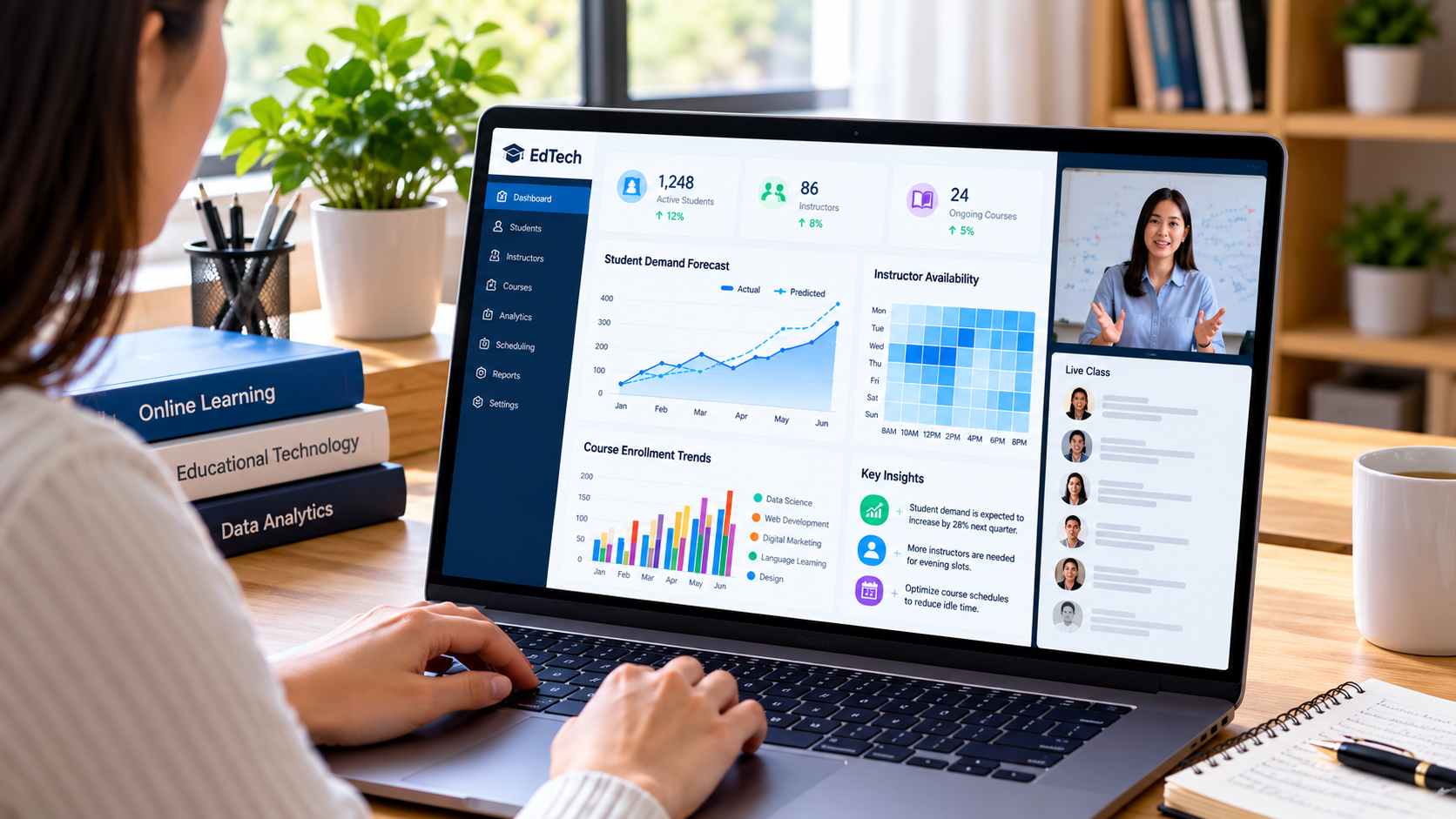
An online learning platform may have hundreds of registered students yet struggle to fill a Monday morning class. Meanwhile, a popular evening course develops a waiting list because too few instructors are available. These mismatches are not simply scheduling problems. They arise when student demand changes faster than a platform can adjust its teaching capacity.
Predictive analytics offers a more informed approach. By examining historical patterns alongside current activity, education businesses can estimate future enrollment, anticipate busy periods, and plan instructor schedules before shortages appear. The objective is not to predict every booking perfectly, but to make better staffing decisions with the information available.
Understanding What Predictive Analytics Can Forecast
Predictive analytics uses past and present data to estimate likely future outcomes. For education platforms, a useful forecast goes beyond counting registered users.
A platform might estimate how many students will request a particular subject, which time slots will attract the most bookings, and how often learners may cancel or reschedule. It can also compare demand across regions, learner levels, and course formats.
Forecasts should distinguish expressions of interest from confirmed enrollment. Ten students viewing a course page do not necessarily represent ten future bookings. Historical conversion rates help put that interest into perspective.
Turning Student Activity Into Demand Forecasts
Reliable forecasts start with relevant, well-organized information. Common inputs include:
- Enrollment and booking history: Which subjects attract students, and when?
- Attendance and cancellations: How many reserved places translate into actual sessions?
- Seasonal patterns: Do school terms, examinations, or holidays affect demand?
- Waitlists and search activity: Where might unmet demand be developing?
- Time zones and preferred hours: When can students realistically attend?
Consider an online mathematics platform approaching an examination period. Earlier years may show an increase in revision bookings during the final weeks. If current searches and waitlists point in the same direction, the platform can prepare additional classes.
However, patterns are not guarantees. A new curriculum, pricing change, or marketing campaign may alter demand. Forecasts therefore need regular updates rather than relying entirely on last year’s figures.
Matching Instructor Availability With Expected Demand
Knowing how many learners may arrive is only half the challenge. Platforms must also understand who is qualified and available to teach them.
For EdTech businesses working with tutors or freelance educators across countries, capacity planning should consider subject expertise, teaching language, time zone, contracted hours, planned leave, and reasonable workload limits.
A forecast predicting 120 learners for a course does not automatically establish the number of teachers required. If classes accommodate 12 students, that demand could mean ten group sessions. The platform must still account for lesson length, preparation time, cancellations, and whether instructors can teach at the requested hours.
Using Forecasts to Make Better Scheduling Decisions
Platforms can start with simple weekly forecasts before investing in advanced machine-learning systems. A practical workflow is to predict bookings by subject and time slot, compare them with instructor capacity, and flag likely shortages or unused hours.
Managers can then test scenarios.
What happens if registrations rise by 15%?
Can existing instructors absorb the change?
Would opening another class reduce waiting times without leaving other sessions underfilled?
The goal is to support decisions, not automate them blindly. A scheduling coordinator may know that a particular instructor needs extra preparation time or that a new course requires more individual attention than historical data suggests.
Measuring Accuracy and Protecting Trust
Predictions should be checked against actual results. Useful measures include forecast error, class fill rates, student waiting times, cancellations, and instructor utilization. Comparing these figures over several weeks reveals where a model consistently overestimates or underestimates demand.
Responsible data practices matter equally. Platforms should collect only necessary information, restrict access, protect personal records, and explain how student data supports planning. Forecasts may also reflect historical inequalities, so teams should examine whether scheduling decisions disadvantage particular learner groups or instructors.
Conclusion
Predictive analytics helps online education platforms move from reactive scheduling toward evidence-based planning. Its greatest value comes from connecting demand estimates with real instructor constraints, then revising plans as new information arrives.
Used carefully, forecasting can reduce avoidable staffing gaps, improve class availability, and support a more consistent learning experience without treating teachers or students as numbers alone.