
Guaranteed rent in London pays landlords a fixed monthly sum for an agreed term, whether or not the property is occupied. An operator takes on the letting, the tenants and the day to day management.
The model has gained fresh appeal since 1 May 2026, when the Renters’ Rights Act abolished Section 21 and made new tenancies periodic. Open ended tenancies and tougher possession rules leave many landlords wanting predictable income.
This guide explains how the arrangement works, how London rents compare, which checks protect you and where the model differs from traditional letting.
Key Takeaways
- Guaranteed rent protects your income over a fixed term, whether the home is let or empty.
- Section 21 ended in May 2026, and every new tenancy is periodic from day one.
- London’s average rent reached £2,338, up 3.5% over the year to September 2026.
- Confirm redress scheme membership, deposit handling, insurance and lender consent before you sign.
- Operators earn a margin from the gap between your rent and tenant rent, so compare offers.
How Does Guaranteed Rent Work for Landlords?
A guaranteed rent contract hands an operator the right to let your property for a set period. The operator pays you an agreed sum each month, then lets the home on to occupiers and keeps the tenant rent.
Under this structure, the operator usually takes on three jobs:
- Finding, vetting and placing tenants in the property.
- Handling repairs, inspections and compliance paperwork.
- Paying you on schedule, even when a tenant pays late.
A scheme such as the Wextons one follows a clear sequence:
- Agree the monthly figure and the contract term in writing.
- Sign the agreement and receive the advance payment, which is three months at Wextons.
- The operator places tenants, collects their rent and manages the home.
- Regular inspections check the condition of the property.
- At the end of the term, the property returns to you.
Property Redress, an approved consumer redress scheme for lettings, describes the model as an individual or company taking an interest in a property and guaranteeing a fixed rent in return.
| Not the same as insurance: rent guarantee insurance repays lost rent after a tenant stops paying, while guaranteed rent is a management contract where the operator carries the letting risk. |
What Changed for Landlords on 1 May 2026?
Phase one of the 2025 legislation came into force at the start of May. The reforms reshape how every landlord in England ends and manages a tenancy.
- Section 21: no fault notices are abolished, so possession needs a statutory ground.
- Tenancies: new assured tenancies are periodic from the start, and existing shorthold tenancies convert.
- Rent in advance: landlords cannot ask tenants for more than one month upfront.
- Penalties: councils can fine up to £7,000 for lesser breaches and up to £40,000 for serious or repeated ones.
Landlords who want the full picture on notices and possession can read this guide to eviction laws in the UK.
Every possession claim now runs through Section 8 and a specific statutory ground. That raises the value of an operator who already knows the correct process and keeps records in order.
For a landlord weighing a fixed income, the practical effect is simple. A tenancy no longer ends on a notice date, so the operator, not you, deals with the tenants for the length of the contract.
What Do London Rents Look Like in 2026?
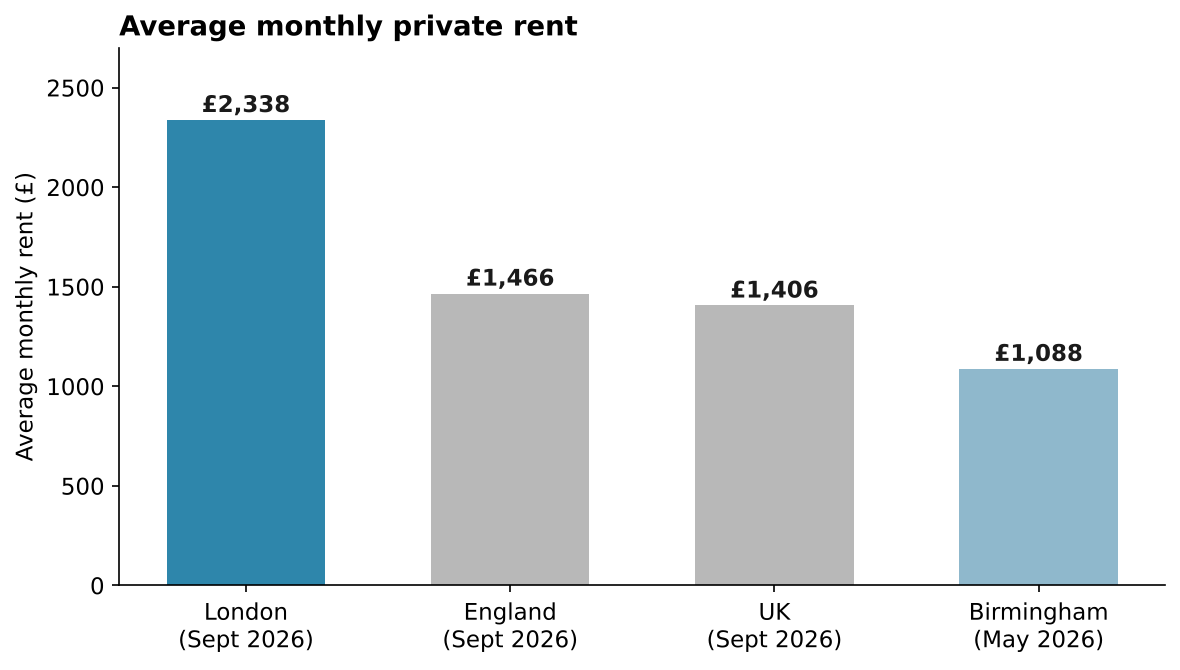
Guaranteed payments follow local rents. The latest ONS private rent bulletin puts the UK average at £1,406 a month in September 2026, up 3.8%. London reached £2,338, the highest of any English region, with annual growth of 3.5%.
London therefore sits about 66% above the UK average, a gap of £932 every month. A landlord letting at the London average would collect roughly £28,056 over twelve months.
Rents are also climbing. ONS figures put the London average at £2,273 in February 2026, so September’s level is £65 higher in seven months. Operators price their offers against this moving market, which is why a written quote matters.
London, England and UK figures are ONS averages for September 2026. The Birmingham figure is the May 2026 average reported by Grapevine.
Birmingham readers will notice the contrast. Grapevine’s 2026 Birmingham property market review puts the city average at £1,088, so London rents run at more than double.
Use these averages as a sense check. Ask each operator how its monthly figure compares with local market rent for your postcode area, and request the reasoning in writing.
| Worth knowing: guaranteed payments are set property by property, so request a written monthly figure before you compare any two offers. |
What a London Guaranteed Rent Scheme Offers
Wextons, an Ilford based agency, runs a scheme for London landlords. The main terms are easy to scan:
| Feature | Wextons guaranteed rent |
| Contract term | 1 to 5 years |
| Commission | 0% |
| Rent in advance | Three months, across all your properties |
| Payment | Fixed monthly rent, tenanted or vacant |
| Services | Tenant vetting, inspections, maintenance and compliance |
Wextons says the scheme suits four groups of owners:
- New landlords.
- Owners who live far from their property.
- Investors with several homes or HMOs.
- Build to rent developers wanting fewer void periods.
Owners of converted buildings should first confirm how the property is classed, as this MUFB guide for landlords explains.
One Google reviewer highlighted how quickly a tenant was found:
“From day one, his service was exceptional” and “he secured a tenant within just 24 hours”. Sufyan Khan, Google review
What to Check Before Signing a Guaranteed Rent Agreement
The Property Redress landlord guide sets out the questions worth asking any operator. The table turns them into a checklist.
| Check | Why it matters | Question to ask |
| Redress scheme | Operators should belong to a consumer redress scheme | Which scheme do you belong to? |
| Payment risk | Confirm what happens if tenant rent stops or the home sits empty | Who covers the shortfall? |
| Legal landlord | The operator often becomes the immediate landlord of the occupiers | Who is named in the tenancy? |
| Deposits | Deposits must be protected where the law requires | Who takes, protects and serves the information? |
| Insurance | Your policy should cover commercial letting and subletting | What cover do you hold, including professional indemnity? |
| Lender and lease | Your mortgage lender should allow it, and a lease should permit subletting | Have you seen my lender and lease terms? |
| Exit | Occupiers keep their rights when your agreement ends | What happens if tenants remain at the end? |
Budget for the costs you would otherwise carry yourself, which this overview of first time landlord costs breaks down.
Keep copies of the contract, inspection reports and payment records. Clear paperwork settles most disputes about who agreed what, and it helps if a council or redress scheme asks questions later.
| Before you sign: ask for the term, break clauses and rent review process in writing, and have a solicitor read the contract. |
Guaranteed Rent vs Traditional Letting
The two routes trade control against certainty. The comparison below shows where each one differs.
| Feature | Guaranteed rent | Traditional managed let |
| Income | Fixed sum agreed upfront | Varies with rent and voids |
| Empty months | Operator pays during the term | Landlord absorbs the loss |
| Possession | Operator manages tenants; contract terms apply | Landlord needs a Section 8 ground |
| Tenant choice | Operator decides | Landlord or agent decides |
| Term | Fixed when you sign | Periodic, with no end date |
A short video weighs the advantages and drawbacks of these schemes:
Video: “Guaranteed Rent Schemes: The Pros And Cons”, https://www.youtube.com/watch?v=K46_ESE_8fo
Match the route to your priorities:
- Guaranteed rent fits landlords who want a steady monthly figure and little involvement.
- Traditional letting suits owners seeking full control over tenants, rent levels and repairs.
Traditional letting can pay more when demand is strong, because you keep the full market rent. Guaranteed rent gives up some of that upside in return for certainty and fewer decisions.
Your Questions Answered
What is guaranteed rent?
It is a contract in which an operator pays a landlord a set amount every month for an agreed period. The operator then lets the property to occupiers and manages the tenancy.
Is guaranteed rent safe for landlords?
Safety depends on the operator. Confirm its redress scheme, insurance cover, the named landlord and the exit terms. Property Redress publishes a landlord checklist covering each of these points.
How long do guaranteed rent contracts last?
Terms vary by operator. Wextons offers contracts from one year up to five, paying the agreed rent monthly whether the property is tenanted or vacant.
What happens to tenants when the agreement ends?
Tenants keep their legal protections after your agreement with the operator finishes. Possession must follow the correct legal route, so ask the operator how it handles handovers.
Does the 2025 Act affect guaranteed rent?
Yes. Section 21 has gone, new tenancies are periodic and councils hold stronger enforcement powers. Operators and owners both need a clear record of who handles each legal duty.
Making Your Choice
Guaranteed rent suits landlords who value certainty over the highest possible yield. The fixed sum removes void risk during the term, while the operator handles daily management.
Rent levels, contract length and operator quality all differ, so no single scheme fits every owner. Reading the small print costs far less than a poor match.
Compare written offers, test every operator against the checklist above and keep a solicitor involved. With Section 21 gone, a well chosen scheme can make landlord income easier to predict.
References
Office for National Statistics, Private rent and house prices, UK: March 2026 and October 2026, https://www.ons.gov.uk/economy/inflationandpriceindices/bulletins/privaterentandhousepricesuk/october2026 and https://www.ons.gov.uk/economy/inflationandpriceindices/bulletins/privaterentandhousepricesuk/march2026
Property Redress, Rent to rent or guaranteed rent guide for landlords, 2025, https://www.propertyredress.co.uk/resources/rent-to-rent-or-guaranteed-rent-guide-for-landlords
Wolverhampton Council, Renters’ Rights Act information for landlords and tenants, https://www.wolverhampton.gov.uk/housing/private-rented-housing/renters-rights-information-landlords-tenants
Crawley Borough Council, Guide to the Renters’ Rights Act 2025, https://crawley.gov.uk/housing/private-housing/guide-renters-rights-act-2025-0
Fact Check: All statistics and data points in this article were verified against original sources as of 16 November 2026. Sources are listed in the References section.