
Yes, you need a selective licence if your rental sits in one of 25 Birmingham wards. It costs £700 per property, lasts up to five years, and letting without one can bring a civil penalty of up to £40,000.
Rental property licensing requirements are tightening across England, and Redbridge Council in east London now proposes a second scheme covering 12 more wards.
Rules differ by street, property type and landlord role, and mistakes get expensive fast. This guide explains which licences exist, how Birmingham’s scheme works, why other councils are following and what happens when a landlord gets it wrong.
Key Takeaways
- Birmingham requires selective licences across 25 of its 69 wards.
- Each licence costs £700 and lasts for a set term of five years.
- Civil penalties are capped at £40,000, and tenants can reclaim rent for a maximum of 24 months.
- Every rented home needs a separate licence that cannot pass to a buyer.
- Checking your ward takes minutes and prevents costly penalties.
Which Licences Can Apply to a Birmingham Rental?
England has three types of property licensing. Mandatory HMO licensing applies nationwide to larger shared houses. Councils then add two optional schemes on top.
| Licence type | What it covers | Who sets it |
| Mandatory HMO | Shared homes with five or more people from two or more households | National law |
| Additional licensing | Smaller HMOs, usually three or more unrelated sharers | Local council |
| Selective licensing | Most other privately rented homes in a designated area | Local council |
Owners of converted houses should check whether the building counts as an HMO, as this MUFB guide for landlords explains.
A council cannot designate an area freely. The government guidance for councils lists the grounds: low housing demand, anti social behaviour, poor housing conditions, high migration, deprivation or crime.
Schemes last a maximum of five years after a consultation of at least 10 weeks. Since 23 December 2024, councils no longer need Secretary of State confirmation before launching one.
How Birmingham’s Selective Licensing Scheme Works
The scheme details on the council’s website confirm a start date of 5 June 2023 and coverage of 25 of the city’s 69 wards. When approved, it covered more than 40,000 private rented properties, the largest scheme in the UK at that point.
The main rules for landlords are:
- Cost: £700 per licence, with no discount for multiple properties.
- Duration: five years, counted from the grant date.
- Scope: one licence for each rented property in a covered ward.
- Empty homes: no licence is needed while a property stands vacant.
- Transfers: the licence stays with the applicant, so buyers and agents apply afresh.
- Approval: licences are never granted automatically, so apply early.
Three exemptions exist: properties already licensed as HMOs, properties managed by educational establishments, and homes let by registered social landlords such as housing associations.
Overseas landlords can hold a licence, assessed case by case. The council usually expects a local person to manage the property.
How Birmingham’s Fee Compares
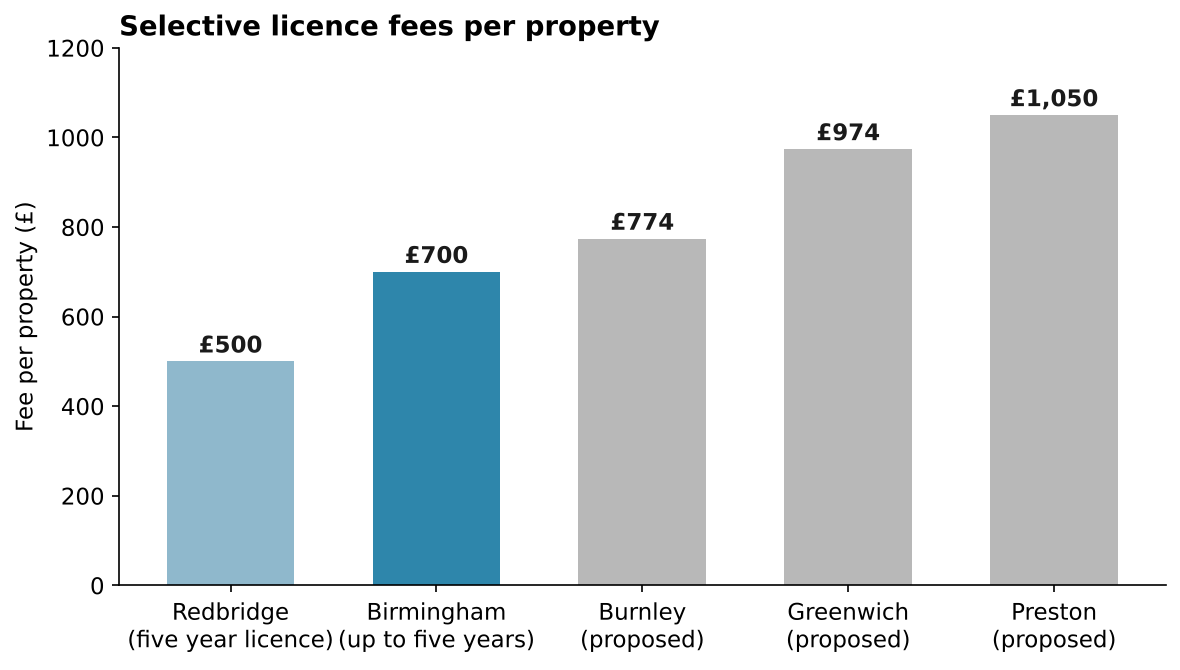
Fees vary widely between councils, as the chart shows.
Redbridge and Birmingham fees are in force or published by the councils; Burnley, Greenwich and Preston figures are proposals under consultation.
Budget for the fee alongside the other costs first time landlords face. Redbridge’s first scheme began in December 2016, and its second would take coverage to about 79% of the borough.
Why Councils Keep Expanding Licensing
Councils adopt licensing to raise standards in private renting, and recent consultations show the pace picking up. Greenwich proposes a scheme covering 18 wards, Burnley proposes redesignating existing areas and adding a new one, and Preston proposes a five year licence at £1,050.
Redbridge follows the same path. Councillor Farah Hussain, the borough’s cabinet member for housing, describes the aim as raising housing standards so tenants live in safe, well managed homes.
The proposed wards include Aldborough, Mayfield, Roding, Goodmayes, Loxford and Seven Kings, among others. The first Redbridge consultation drew 900 responses over twelve weeks. Resident feedback of that kind shapes where schemes land and which conditions they carry.
What Licence Conditions Cover
Conditions turn a licence from a fee into a safety standard. Birmingham’s rules include:
- Smoke alarms on every floor used as living accommodation.
- Carbon monoxide alarms in living rooms and bedrooms containing a fixed combustible appliance, other than a gas cooker.
- Furniture and furnishings that meet fire regulations.
- A named licence holder, who is the person controlling the property, usually whoever collects the rent.
Conditions elsewhere can also cover property management, tenant behaviour and overcrowding. Landlords of flats should also review the fire safety duties in flats that apply to shared buildings.
Redbridge sets comparable conditions: a gas safety certificate, working smoke alarms, safe electrical appliances and clear guidance for tenants on storage and rubbish disposal.
| Tip: Birmingham keeps a public register, so tenants can search whether a property is licensed. Gaps are easy to spot. |
Penalties for Letting Without a Licence
Penalties rose on 1 May 2026, when the Renters’ Rights Act came into force. Councils now have three routes.
| Route | Maximum | Detail |
| Civil penalty | £40,000 | Raised from £30,000; an alternative to prosecution |
| Prosecution | Unlimited fine | Brought by the council in the magistrates’ court |
| Rent repayment order | 24 months of rent | Doubled from 12 months; reaches superior landlords |
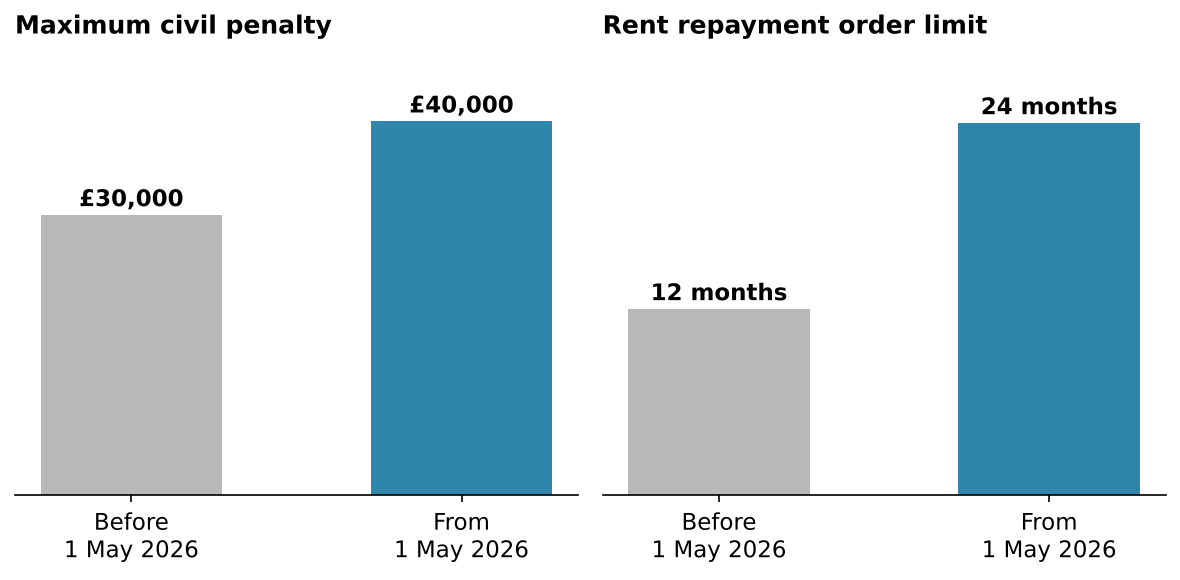
Penalty limits before and after the 2026 reforms.
A rent repayment order can cost more than a fine. On a tenancy at £1,000 a month, the maximum order reaches £24,000.
What Else Changed This Year
The same date abolished Section 21 no fault evictions. Background on notices and possession appears in this overview of eviction rules for landlords.
Liability also widened. Action can target the person managing or controlling an unlicensed property, and superior landlords higher up a chain of sublets can face repayment orders.
Common Mistakes to Avoid
- Paying twice for a home that holds an HMO licence, which falls outside the selective scheme.
- Assuming a sale carries the licence to the buyer.
- Paying for a vacant property, which needs no licence while empty.
- Letting before approval arrives, because silence from the council never counts as consent.
- Applying once for several homes, when every property requires its own licence.
Councils can pursue whoever manages or controls an unlicensed property, so landlords, managing agents and head landlords should each confirm who holds the licence. Writing that name into every management agreement removes doubt later.
How to Check Your Property and Apply
- Use the council’s ward checker to confirm your property’s ward.
- Confirm who the licence holder will be.
- Gather the names of anyone with an interest in the property, such as a mortgage lender or freeholder.
- Send in the form and settle the £700 fee.
- Contact the council if you hear nothing within 28 days.
- Keep alarms and safety certificates current.
A visual walkthrough helps first time applicants. This video guide covers registering for mandatory, additional and selective licensing:
Video: “Landlord Licensing: How to guide”, https://www.youtube.com/watch?v=SbpXPWQIaow
Many owners hand the paperwork to a managing agent, who can hold the licence as the person in control of the property. One landlord described the benefit on Trustpilot:
“Reliable, and rent paid on time. I have not had any reason to use another company to manage my properties since using Letting International. All necessary services, e.g. safety certificates, at competitive prices.”
| Quick check before you let: confirm the ward, settle the licence holder, test every alarm and keep proof of payment on file. |
Common Questions About Landlord Licensing
Do I need a licence to rent out a house in Birmingham?
A selective licence is required when the property falls inside a covered ward and holds no HMO licence. Shared homes elsewhere in the city may still need an HMO licence.
How much does a Birmingham landlord licence cost?
The fee is £700 for each property, and no reduction for larger portfolios. Each licence runs for five years at most, and every home you let in an affected ward needs its own.
What is the penalty for renting without a licence?
Councils can issue a civil penalty capped at £40,000, prosecute for an unlimited fine, or back a repayment order worth two years’ rent.
Can a letting agent hold the licence?
Yes. The licence holder is whoever controls the property and usually collects the rent. That can be an owner, managing agent, property manager or leaseholder.
Does a new owner inherit an existing licence?
No. Each licence belongs to the person who applied, so incoming owners or agents must submit a new application and pay the full fee.
Before You Let Your Property
Birmingham’s scheme asks for one thing: a valid licence before the tenant moves in. That single step protects your income, your reputation and your tenants. The cost is modest next to a £40,000 penalty or a repayment order covering two years.
Redbridge, Greenwich, Burnley and Preston all point the same way: more schemes, fees ranging from £500 to £1,050 and firmer enforcement.
Check the ward, name the licence holder and keep safety checks current. Councils across England are tightening their rules, so reviewing your portfolio now protects landlords and tenants alike.
References
Birmingham City Council, Selective licensing, 2026 — https://www.birmingham.gov.uk/info/20175/private_housing/2649/selective_licensing
Birmingham City Council, Selective licensing further information, 2026 — https://www.birmingham.gov.uk/info/20175/private_housing/2649/selective_licensing/5
GOV.UK, Selective licensing in the private rented sector: a guide for local authorities, 2024 — https://www.gov.uk/government/publications/selective-licensing-in-the-private-rented-sector-a-guide-for-local-authorities
Propertymark, Licensing expands as penalties increase under Renters’ Rights Act, 2026 — https://www.propertymark.co.uk/resource/licensing-expands-as-penalties-increase-under-renters-rights-act.html
Local Government Lawyer, Birmingham to introduce largest selective licensing scheme for private rented properties in UK — https://localgovernmentlawyer.co.uk/housing-law/397-housing-news/51673-birmingham-to-introduce-largest-selective-licensing-scheme-for-private-rented-properties-in-uk
Fact Check: All statistics and data points in this article were verified against original sources as of 13 November 2026. Sources are listed in the References section.