
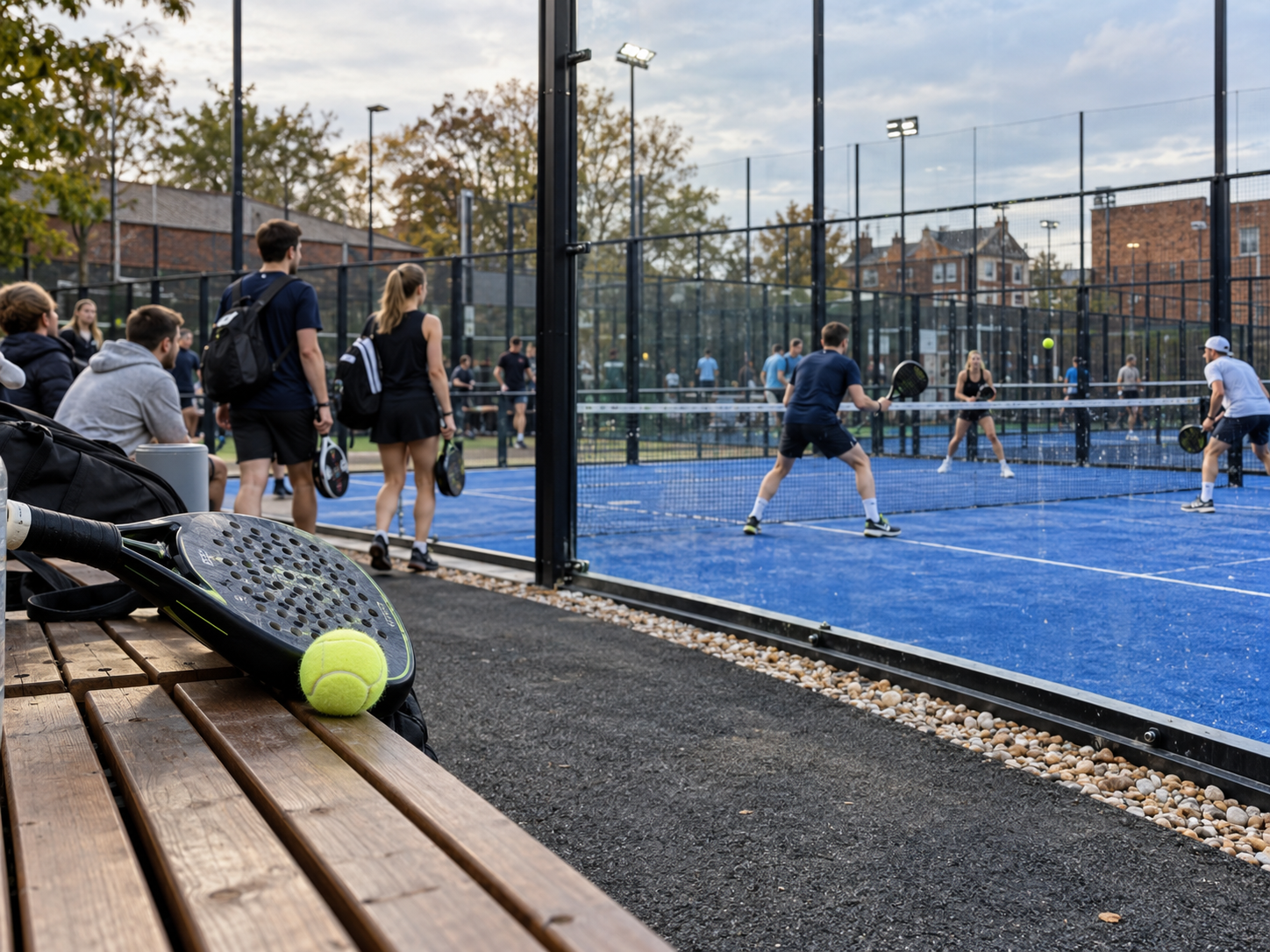
Padel has moved quickly from curiosity to credible part of Birmingham’s sporting landscape.
New courts are appearing across the city and wider West Midlands, from university campuses to established leisure facilities. More people are discovering the sport, more venues are making space for it and the question is gradually changing.
For clubs, it is no longer only a matter of giving people somewhere to play. As the number of venues increases, they also have to give players a reason to choose one court over another — and then a reason to come back.
“The first stage of padel growth is largely about creating enough places for people to play. The next stage is about competition between venues,” says Paul Rudman of Matchpoint Marketing, a specialist agency focused on padel marketing. “As more courts open, padel marketing becomes increasingly important. Clubs need to be visible locally, communicate what makes their offer different and turn people trying the sport into regular players.”
Birmingham’s padel footprint is expanding
There are already clear signs of that expansion across Birmingham and the surrounding area.
In Sandwell, Grapevine Birmingham previously reported on three indoor courts at Tipton Sports Academy, introduced following a £155,000 investment. The venue later held an open padel day with coaching tasters, practice matches and activities designed to introduce more local people to the sport.
Central Birmingham has gained more provision too. Aston University announced three new courts on its campus through a partnership with The Padel Loft, with the facility opening in May 2026 for students, staff and the wider public. Aston described it as Birmingham’s most centrally located padel facility.
Elsewhere, established sports and leisure venues across the region are increasingly making room for padel alongside more traditional activities.
Individually, these are new courts. Collectively, they point towards something more significant: a local market in which players increasingly have options.
And once players have options, having four glass walls and a booking system is no longer much of a marketing strategy.
More courts change the challenge for clubs
For players, greater choice is overwhelmingly positive.
A facility closer to home or work makes the sport easier to fit into everyday life. Indoor and covered courts reduce the chances of a British weather forecast deciding the result before anyone has picked up a racket. Coaching gives beginners a route into the sport, while leagues, social sessions and competitions provide reasons to keep playing.
For operators, though, increasing supply gradually changes the commercial equation.
When there are relatively few courts available, demand can do much of the work. As more venues open, potential players can compare where they play rather than simply booking wherever they can find a slot.
Location still matters, but so do court quality, ease of booking, coaching, social sessions, pricing, membership options, opening hours and the atmosphere surrounding the club.
The product therefore becomes more than the court itself.
The real opportunity is creating regular players
Padel has one important advantage over many leisure activities: it is inherently social.
It is normally played in doubles, beginners can start relatively quickly and each match naturally brings four people together. That gives clubs an opportunity to build communities rather than simply sell court time.
But attracting someone for one game and turning them into a regular player are two very different jobs.
A newcomer who enjoys an introductory session needs an obvious next step. That might be beginner coaching, a social game at the right level, a league, an event or simply an easy way to find three other people who are equally keen and equally available on a Tuesday evening.
Good clubs can create that progression deliberately.
Coaching can give beginners the confidence to continue. Social sessions can connect players who might otherwise struggle to organise games. Leagues and competitions give established players something to work towards. Regular communication can make players aware of those opportunities before their racket disappears into the back of a cupboard.
The commercial effect follows naturally: more reasons to participate create more reasons to return.
Standing out will matter more as the market matures
Birmingham’s padel scene is unlikely to develop as one uniform market.
A university facility serving students and city-centre workers has different opportunities from a suburban racket club. A large dedicated centre may be able to organise leagues and events at a scale that a smaller community venue cannot. Another club may find its strongest audience among beginners, families or corporate groups.
That means differentiation does not have to mean being bigger, cheaper or louder than everyone else.
One venue might become known for competitive play. Another might build a strong beginner community. Coaching may be central to one club, while another develops its identity around social events, convenience or a particularly strong membership culture.
Those positions do not need to exclude other players. They simply give people a clearer reason to choose.
That distinction becomes more important once “we have padel courts” stops being unusual enough to do all the promotional work by itself.
Local visibility becomes part of the competition
Growing choice also changes how players discover clubs.
Someone who becomes interested in padel may search for somewhere nearby, compare several venues, look at coaching options, check social media, ask friends or encounter a club through an event.
That gives operators several opportunities to win — or lose — attention before the player ever reaches the booking page.
A club may have excellent courts and coaching, but those strengths have limited commercial value if potential players cannot find them or do not immediately understand what the venue offers.
As the market becomes busier, clubs also have to work harder to be discovered locally and to explain clearly what makes their offer different.
The aim is not simply to generate more noise around padel. Birmingham is unlikely to suffer from a shortage of people telling everyone that padel is growing.
The more useful challenge is making sure the right local players understand why a particular club is right for them.
Birmingham is entering padel’s next phase
The continued appearance of new facilities is good news for a sport that needs accessible courts if participation is going to keep growing.
It also changes what successful club management looks like.
During the early stages of a developing sport, operators are primarily solving a supply problem: people want to play and there are not enough places to do it.
As provision increases, the questions become more familiar to any leisure business. How do players discover the venue? Why do they choose it instead of another one? What brings them back after their first session? How does an occasional booking become a regular habit?
Birmingham’s expanding network of facilities suggests the local padel story is entering that next phase.
The competition will still take place on court. Increasingly, though, clubs will also be competing for attention, loyalty and a lasting place in Birmingham’s growing padel community.