

Films showing this week either in cinemas or on streaming platforms
FILM OF THE WEEK
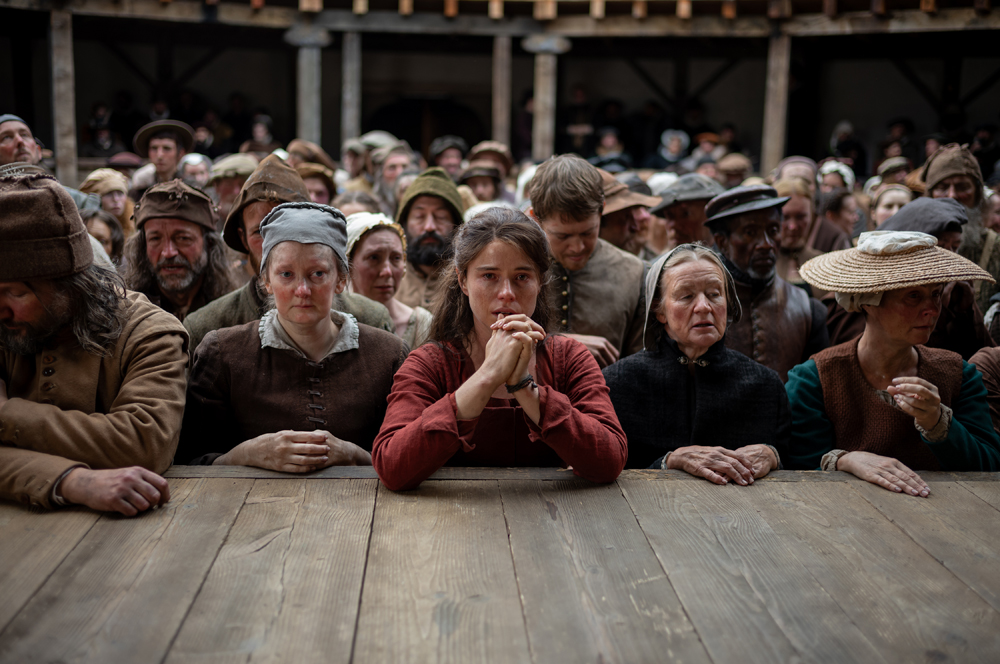
Hamnet (12A)
Working as a Latin tutor to pay off his father’s debts, Shakespeare (Paul Mescal, giving his best and most expressive performance to date) is captivated on seeing a slightly older woman in the forest summoning a hawk to her falconry glove and, following her to ger barn, learns her name is Agnes Hathaway, the pair exchanging a kiss before she bids him leave. First seen lying foetal-like at the base of a tree, local superstitious rumour believes her to be the daughter of a forest witch, she having learnt herbal cures from her late mother, one of which she applies to a cut on Shakespeare’s forehead.
Their relationship grows, the pair meeting in the forest where he beguiles her with the legend of Orpheus and Eurydice, the account of the Underworld chiming with the forest cave to which she is drawn. In turn, she reads his palm, foretelling great success, but also seeing herself on her deathbed surrounded by two children.
Despite the reservations of their families, Emily Watson plays his disapproving mother Mary she becomes pregnant, they marry and Agnes gives birth to Susanah (Bodhi Rae Breathnach) in the woods. His father John (David Wilmot), aggressively opposed to his literary ambitions Agnes realises he will have to go to London in order to make his name in the theatre community. To which end, he duly des, leaving his wife and daughter in Stratford where she gives birth, this time at home in agony when Mary refuses to let her got to the woods – and the source of her feminine energy, to twins, a boy, Hamnet (an endearingly cute Jacobi Jupe), and a girl, Judith (Olivia Lynes), the latter stillborn, but revived by the sheer power of her mother’s will.
The siblings grow with a close bond, Agnes predicting her son will follow his father into the theatre, Will, having become so successful he can afford to buy the biggest house in Stratford. Life is good and the family happy, the three children amusing their parents with a performance as the three witches from Macbeth.
However, dark times lies ahead. Agnes’s beloved hawk dies and is duly buried in a forest ceremony, she telling the children about the bird’s spirit carrying their wishes, a story Hamnet subsequently relates to Judith when (as foreshadowed by a puppet play her father sees in London) she contracts the plague, he lying beside her declaring he wants to take her place. And so it comes to pass, she recovering and, his mother unable to cure him, the now 11 Hamnet sickening and dying after imagining himself behind a cloth on stage set calling for her. Returning to find his son dead, William almost immediately heads back to London, putting a strain on the marriage, while Agnes, alone with only her mother-in-law and brother Bartholomew (Joe Alwyn), finds herself no longer able to predict fortunes and he, quoting his to be or not to be speech, briefly contemplates suicide.
The essential nuts and bolts are historically true. Anne/Agnes and William did have three children, with the boy, Hamnet, a name interchangeable at the time with Hamlet, dying from the plague. On to this, however, Zhao and co-writer Maggie O’Farrell, who wrote the book on which it is based, have grafted a story of grief, coming to terms with loss and of healing through honouring their memory. It’s as raw and an exposed nerve and richly underpinned with resonant nature imagery and symbolism (the notion of the cave as a portal beyond death resurfaces potently in the final scenes), moving to a climax when, Mary having given her a print notice announcing the debut performance of the Tragedie of Hamlet in London, Agnes, accompanied by her brother, travels to see it, angered at what she thinks is her husband’s exploitation of their son’s death. What she finds, he frustrated at the inability of his actors to deliver the lines, and playing the ghost himself in pancaked white make-up, is something entirely different, a soul cry of pain and love in tribute to Hamnet (in an inspired stunt casting Hamlet is played by Jupe’s older brother Noah) which, to the accompaniment of Max Richter’s On the Nature of Daylight, wordlessly climaxes with Agnes (Buckley a masterclass in cathartic silent facial expression as she finally dissolves into a smile) at the edge of the stage, fantasising her son’s farewell into the next life back through that cave, she and the other spectators reaching out to touch the hands of the dying prince in perhaps the finest, most moving five minutes of cinema you will see this year. The rest is silence, says Hamlet. Well apart from the sobs filling the auditorium. (Cineworld 5 Ways, NEC, Solihull; Everyman; Mockingbird; Odeon Birmingham, Broadway Plaza Luxe; Omniplex Great Park; Reel; Royal; Vue)
ALSO RELEASED
Giant (12A)
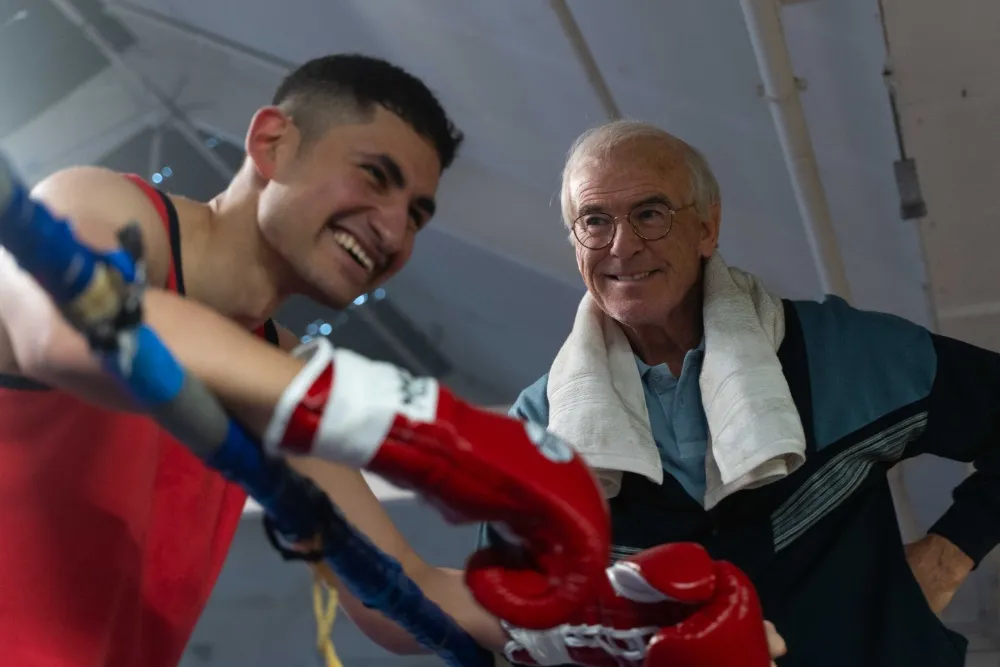
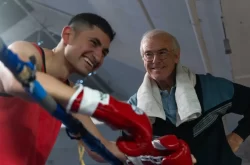
Those familiar with the world of boxing, will know that Prince Naseem ‘Naz’ Hamed was the UK’s answer to Muhammed Ali, a Muslim boy from Sheffield and migrant Yemeni parents who, in the late 90s, became a world champion. Here, in the hands of writer-director Rowan Athale and adapted from Nick Pitt’s book The Paddy And The Prince (and with Sylvester Stallone as executive producer) , the film follows his rise to fame guided by his veteran Irish boxing trainer Brendan Ingle (Pierce Brosnan) and, fuelled by Hamed’s ego, the subsequent rift when he sought to downplay his mentor’s input. While echoing familiar pugilist movie tropes (and a sort of narrative reversal of Christy), the title clearly a reference to the trainer not the fighter, it’s basically Prince Harry and Falstaff with boxing gloves.
It opens in 1997 with Hamed’s US debut and his match against Kevin Kelley, before backtracking to early-80s Sheffield, with the young Hamed (a film stealing Ghaith Saleh), a cocky seven-year-old subjected to constant racist taunts and bullying who uses his fists and fleet footedness to defy the world around him. Using his nimble footwork to avoid the bullies, he’s spotted from the top of a bus by Ingle, who runs a gym training the local youth, who recognises his natural talent, takes him under his wing and coaches him to use his brash arrogance and lethal fists to carve a name for himself.
Promoting him with a series of cheesy but media-friendly stunts (he’s touted as the beast from the Middle East), as the years pass and the wins pile up, Hamed (played by Ali Saleh at 12 and subsequently Amir El-Masry) rises to the top and is taken on by promoter Frank Warren (an unsubtle Toby Stephens). However, in the process, Naz becomes increasingly persuaded that his success his solely down to his own efforts, as arrogant outside the ring as he is within it, gradually, with the urging his brother Riath (Arian Nik) who’s now also his manager and insists Naz’s talent are a gift from Allah, edging Ingle out, reducing his commission and, in a climactic scene, declaring him a delusional old man, leading to Ingle’s tell-all book in an attempt to set the record straight.
The dialogue can sometimes stumble into clumsy exposition and, a recurring figure throughout his career, Olivia Barrowclough’s journalist never seems to age, but there’s enough dramatic sharpness and keen wit to compensate while a twinkle-eyed Brosnan is on top form and El-Masry works well with his somewhat one-note character, even if the supporting cast (which includes Katherine Dow Blyton as Brendan’s wife) are largely functional at best. The boxing sequences are generally persuasive, albeit cumulatively truncated and rolled out as a series of montages, and while the final scene between the two men is finely handled, there’s just too many false conclusions along the way. Never a knockout, but worth going a few rounds. (Cineworld 5 Ways, NEC, Solihull; Mockingbird; Odeon Birmingham, Broadway Plaza Luxe; Omniplex Great Park; Royal; Vue)
Peter Hujar’s Day (12A)
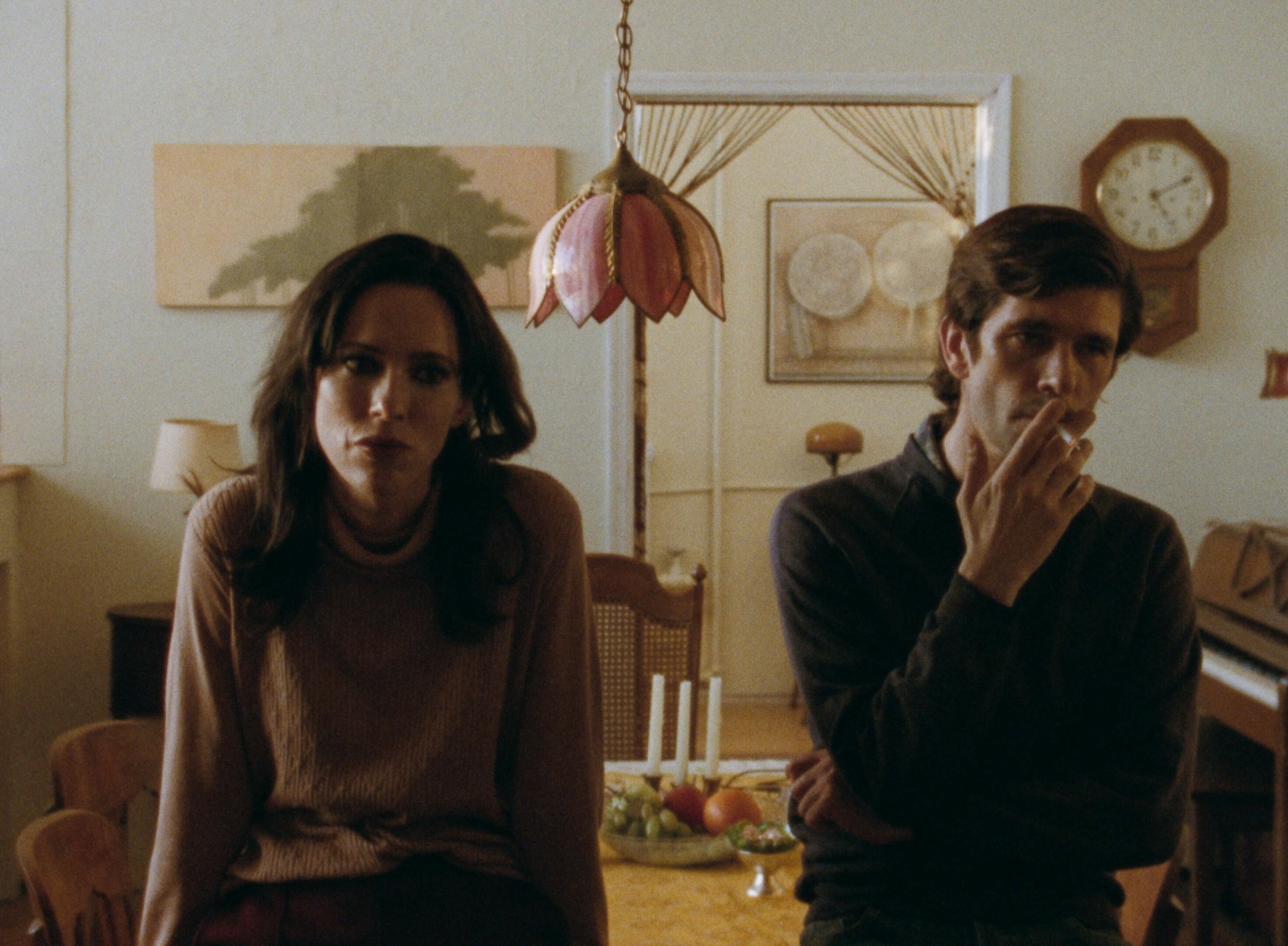
In 1974, as part of a proposed book featuring interviews with artists about how they spent the previous day, Dec. 18, author Linda Rosenkrantz taped a conversation at her Manhattan apartment with her gay friend Peter Hujar who, part of the hip New York scene, would be posthumously recognised as a major photographer of the 70s and 80s. The book never materialised and the tape recordings was lost, but a typed transcript was later discovered and published in 2021 and that now serves as foundation of Ira Sach’s verbatim-cinema chamber piece, filmed either within or on the roof of the apartment to look as though it was shot at the time on grainy 16mm.
A two-hander with Rebecca Hall as Rosenkrantz and Ben Whishaw as Hujar, she quizzing and listening as he recounts in a stream of consciousness what he at the time thought was a boring day but which, on reflection, was anything but. Largely centrering on an assignment to photograph Allen Ginsberg for the New York Times (the eccentric poet chanting in the middle of the shoot and suggesting Hujar perform oral sex on William Burroughs), his recollections include having two Chinese meals for $7.43, fretting over a lack of sleep (Rosenkrantz blames a poor diet and too many cigarettes) and unpaid commissions, and playing Bach on a harpsichord, all punctuated by a stream of name dropping, among then Susan Sontag and Fran Lebowitz as well as Topaz Caucasian, a fictional musician everyone thought was real. At one point, in a throwaway anecdote, he tells Rosenkrantz how, on a shoot in Brazil, the photographer Maurice Hogenboom stood back to look at something, fell off a cliff and died.
Almost like a condensed New York version of James Joyce’s Ulysses with Hujar the Leopold Bloom figure, it’s played low key and relaxed, edits aside flowing fluidly like the conversation it’s recording, capturing moments of wry humour and the unexpected self-insights his recollections throw up, she prompting to dig out more memories of what felt like the mundane everyday and, in the course, capturing the essence of the time and the scene of which they were both a part.
While very much the silent witness half of the double act, the softly-spoken Hall captures her character’s sharp wit but it’s the effortless performance by Whishaw as chainsmoking, neurotic, morose and disarmingly sweet Hujar that, despite its lack of anything resembling drama, engages you in this vicarious rambling eavesdropping like a podcast from a forgotten era. (Mockingbird)
Anaconda (12A)
Diving into self-referential meta waters, sharing a similar concept as Be Kind Rewind, director and co-writer Tommy Gormican, who made Nicolas Cage self-spoofing meta comedy The Incredible Weight of Massive Talent, asks when is a reboot not a reboot. The answer here being a film about making a reboot, Released in 1997, a Jaws knockoff giant snake horror with unintentionally hilarious dialogue, Jon Voight’s bizarre accent and an unconvincing animatronic snake, it’s since become a cult classic, and, for the sake of the plot driver here, was a college days favourite of buddies Griff and Doug, the former appearing alongside friends Claire and Kenny in the latter’s teenage amateur horror Quatch.
Years on, having moved to LA to become a movie star, Griff (Paul Rudd) once appeared in four episodes of SWAT and is now reduced to one liners in shitty daytime soaps. And he can’t even get through that. Doug, meanwhile, remained in Buffalo, got married (to Iona Sky), had a kid while his movie dreams shrank to making overly-plotted wedding videos. Everyone reuniting for his birthday, for which Griff has unearthed a VHS of Quatch, his friend suggests they get back together and reboot Anaconda, for which he claims to have secured the rights. Initially reluctant, having a follow your dreams while you still can epiphany, Doug eventually agrees, he directing, Griff starring alongside recently divorced ex-girlfriend lawyer Claire (Thandiwe Newton) who stumps up the finance and for whom he still carries a spark, and the ever unreliable Kenny (Steve Zahn), who insists he’s got his pills and drink issues under control, as cinematographer.
And so it’s off to the Amazon with the most basic of film equipment where they hook up Santiago (Selton Mello), the eccentric snake handler Kenny’s hired. Needing a boat, they wind up with one commandeered by supposed captain Ana (Daniela Melchior), first seen being pursued by men with gun in the opening sequence as part of the subplot about illegal goldmining. Naturally, everything goes wrong, starting with Griff accidentally killing Kenny’s snake, meaning they have procure another, though going into the jungle at night to find doesn’t seem the best considered option. At one point, just to underline the premise for those not paying attention, Doug remarks “We came here to make Anaconda. And now we’re in Anaconda!”
While its gags about Hollywood aren’t anywhere near as sharp as The Studio, at one point in the final stretch, someone remarks about filmmakers making it up as they go along, and that certainly seems to be the case here (most notably in a scene where Kenny, who has public urination issues, having to piss on Doug’s leg when he’s bitter by a tarantula). And then there’s how the group encounters a film crew making their own Anaconda reboot (a couple of the original stars get to cameo), only to fall prey to the monster reptile (CGI but no more convincing than the original) lurking in the waters, while the subplot then throws up its own twists.
It’s funniest in the opening stretch, the laughs becoming more forced when it veers off into actually horror territory and tries to juggle ‘themes’, as Griff and Doug keep going about, of friendship, dreams and whatever, and descends into such ill-conceived slapstick as Black running from the snake with a wild hog strapped to his back.
The four leads work well together, sparking off one another, with Black for the most part less manic than usual and Rudd playing small tics to good effect, Zahn doing what Zahn does and Newton making the most of an underdeveloped role and demonstrating how to give good headbutt. Never especially hilarious or scary, even so it’s nowhere near as awful as it might have been. Which is a recommendation of sorts. (Cineworld 5 Ways, NEC, Solihull; Odeon Birmingham, Broadway Plaza Luxe; Omniplex Great Park; Reel; Royal; Vue)
Avatar: Fire and Ash (12A)
The third in what is now scheduled to be a five part saga, this continues the narrative but feels more of an extended second part of The Way Of Water than a film in its right. Decidedly bloated (at over three hours) with lengthy sequences that (especially in the early going) feel largely unnecessary, it picks up the story following the death of Neteyam (Jamie Flatters, appearing as a spirit), the eldest son of the Sully family, with brother Lo’ak (Britain Dalton, also serving as narrator) grieving and feeling guilt (though this isn’t greatly developed), while his father, human turned Na’vi Jake (Sam Worthington), now part of the Metkayina clan, is burying his by concentrating on matters at hand. His wife, Neytiri (Zoe Saldana), on the other hand, has developed a hatred of humans, which throws up a bit of a problem in relation so teenage Spider (Jack Champion), who they rescued and took in after the death of his father, Colonel Miles Quaritch (Stephen Lang, saddled with the worst of the dialogue), Jake’s former commander and now resurrected obsessive avatar recombinants nemesis. The rest of the family, should you need reminder, are youngster Tuktirey (Trinity Jo-Li Bliss) and, the crucial figure in this chapter, adopted daughter Kiri (Sigourney Weaver, who gets a cameo in her former human role) who has latent powers and a connection to Pandora goddess spirit Eywa.
The narrative encompasses to main strands. The first involves the Ash People from the aggressive volcano-dwelling Mangkwan led by the ferocious Varang (a striking Oona Chaplin), setting in motion the film’s first spectacular battle when they attack a fleet of flying Na’vi merchant ships (captained by David Thewlis’s Peylak) carrying the Sulley family. This being Varang’s first encounter with guns (the Mangwan are a sort of Pandoran war-painted equivalent of Native American tribes fighting with bows and spears), she immediately gets a hard on for them and the destruction they can bring. This will eventually see her cross paths and join forces with Quaritch (prompting him to ‘go native’). The second concerns Spider who, when the battery powering the mask he needs to survive Pandora’s air, is saved by Kir who uses her filament hair extension to connect to the planet to forge a symbiotic bond whereby he’s able to breathe. This thus makes him invaluable to Parker Selfridge (Giovanni Ribisi), the former head administrator for the RDA mining operation, and Quaritch’s successor General Ardmore (Edie Falco) who see him as the solution to human colonisation. To which end, Quaritch, with Varang’s help, is out to track him down in a mix of both professional and personal motives.
All of this serves to set up a further series of battles, during one of which Neytiri is wounded, including various captures and escapes (including wife, Spider and Jemaine Clement’s marine biologist saving Jake from execution) and a whaling group led by robot-armed Scoresby hunting the sentient Tulkans, before climaxing in the stunning kitchen sink and all final showdown between the different forces, some of the core supporting characters not living for the next sequel. One and perhaps two of the villains may well survive for the as yet untitled Part 4.
Along with the core cast, there’s several returning names, among them Cliff Curtis as Tonowari, chieftain of the pacifist reef people, Kate Winslet as his pregnant wife Ronal, Bailey Bass as their daughter and Lo’ak’s love interest Tsireya, CCH Pounder as Neytiri’s mother and Matt Gerald as Quaritch’s recombinant right hand man Wainfleet.
Alongside themes of family there’s a lot more world building here as well as expanding on elements and creatures from the first to films, but, while it may keep you engaged (the visuals and the colossal imagination at work certainly help) the overly convoluted and repetitive plot again highlights Cameron and writers Rick Jaffa and Amanda Silver’s weakness as story tellers, at times recycling whole chunks from the previous film. Nonetheless, this is real epic big a screen as possible filmmaking, and, while probably not an entry point for franchise newbies, will undoubtedly have Avatar addicts transfixed. (Cineworld 5 Ways, NEC, Solihull; Everyman; Odeon Birmingham, Broadway Plaza Luxe, West Brom; Omniplex Great Park; Reel; Royal; Vue)
Ballad Of A Small Player (15)
After the widescreen expanse of All Quiet On The Western Front and Conclave, director Edward Berger takes a more intimate low key approach to this character study about dislocation and self-destructive addiction. Giving another standout performance, Colin Farrell plays an Irish con artist gambler who, hiding out in Macau, China’s answer to Vegas, where the locals refer to him as a gweilo or hungry ghost, passes himself off as British aristo Lord Freddy Doyle, complete with precisely clipped accent. Living in a decadent Chinese casino-hotel, with three days to settle his 145,000 hotel bill, he’s on a losing streak and saddled with huge gambling debts he can’t pay off, wiped out at baccarat by a foul-mouthed old dear (Deanie Ip) at the only casino that’ll still extend him credit, but, in his supposedly Savile Row leather yellow gloves, is still looking for the win that will turn things around.
Into his life comes Fala Chen (Dao Ming), who, like a drug dealer feedings junkies, lends money to losers at exorbitant rates, but has decided to get out of the game after her latest mark took a dive from the rooftop, she inheriting his debt. The pair hang out in her houseboat and he wakes to find her gone and numbers written on his palm. Also entering his orbit is frump in designer glasses Cynthia (Tilda Swinton), who, calling herself Betty, is a private detective hired to recover the money he stole from her elderly client, She spots him a stake and suddenly his fortunes change, now he just can’t lose.
Visually striking and vibrantly coloured, adapted by Rowan Joffe from Lawrence Osborne’s novel, it’s a thoughtful meditation on self-loathing, end of rope desperation, compulsion, guilt and redemption, Farrell going all-in on a rollercoaster that variously sees him having a heart attack and wolfing down lobster, sweating out anxiety and almost maniacally exulting in his luck. Though she disappears (for reasons explained later) in the second half, Ming makes for a suitably haunting femme fatale while Swinton digs into her character’s quirks with a sly wink in her eye. With supporting turns from Anthony Wong relating an anecdote about a gambler who dies and goes to what he thinks is Heaven and Alex Jennings as the friend and fellow gambler who know who Doyle really is, both imparting the message that winning kills you quicker than losing, this might not ever play an ace but it holds high enough cards to keep you in the game. (Netflix)
Black Bag (15)
A blackly comic espionage mole hunt spin on Mr and Mrs Smith, with the husband and wife spies rather than assassins, written by David Koepp and directed (and filmed) by Steven Soderbergh, the title referring to secrecy, buttoned-up George Woodhouse (Michael Fassbender sporting Harry Palmer-styled black spectacles and a dab hand in the kitchen in a nod to The Ipcress File ) and the sexier Kathryn St. Jean (Cate Blanchett) work for Britain’s National Cyber Security Centre, headed up by a steely Arthur Steiglitz (Pierce Brosnan). Apparently ace at detecting lies, George has been charged with investigating someone from the agency leaking to the Russians details of a virus called Severus which can cause nuclear reactors to meltdown and kill thousands (though never stated the Ukraine war is the backdrop). He’s got one week to identify the traitor and a list of five suspects. One of whom is his wife.
Also in the narrative melting pot of suspects is erotic fiction fan agency therapist Dr Zoe Vaughan (Naomie Harris) who’s dating gaming-obsessed Col James Stokes (Regé-Jean Page), and uncouth alcoholic Freddie Smalls (Tom Burke) who’s resentful of being passed over for promotion and involved with the volatile Clarissa Dubose (Marisa Abela), a relative data expert rookie with daddy issues. The agent who gave him the dies of a suspicious heart attack.
Two dinners are pivotal, the first where he serves chana masala laced with a truth serum to everyone but his wife turns into Who’s Afraid Of Virginia Woolf series of confessions and a steak knife through someone’s hand but reveals nothing about the leak. The second, after administering polygraphs, is of an Agatha Christie drawing room nature with a gun on the table awaiting whoever lies. In-between all this, it seems that both George and Kathryn are being set-up to distrust and spy on each other, especially when he discovers his wife has been keeping things from him in her own black bag.
While a car blows up and there’s a last act gunshot, this follows more of a cerebral John LeCarre spy thriller path rather than Bourne or Bond territory, meaning there’s a lot of clever sparring dialogue and psychological misdirections and manipulations, while the audience tries to figure out who’s the one behind the leak. Tongue-in-cheek with several nods to other films in the genre, the whole traitor plot is really a bit of a MacGuffin with the film more accurately an examination of truth and trust (and the difference between them) in relationships where lying is a stock in trade as several layers of duplicity are exposed. As such the chemistry between the different couples really works (and also in the power play therapy session between Zoe and Kathryn), Fassbender and Blanchett especially, Soderbergh slickly navigating the screenplay and keeping you involved and guessing up to the last moment. No big bangs maybe, but intelligently explosive all the same. (Sky Cinema/NOW)
Blue Moon (15)
Opening in November 1943 with a scene in which he collapses drunk in an alley and subsequently dies, directed by Richard Linklater and written by Robert Kaplow, this hen flashes back to March 31 of that year as famed lyricist (Blue Moon, The Lady Is a Tramp, Manhattan, Bewitched, Bothered and Bewildered, My Funny Valentine) Lorenz Hart (Ethan Hawke, playing six inches shorter with a comb over) attends the opening night of Oklahoma!, the new Broadway musical (and arguably the greatest) by his former creative partner Richard Rodgers (they wrote 28 shows together, among them Pal Joey) and Oscar Hammerstein II. Slipping away before the interval, the rest of the film takes place at Sardi’s restaurant, where the opening night celebrations will take place as Hart has his own pity party.
Newly sober (though soon falling off the wagon), a cynical Hart holds forth to bartender Eddie (Bobby Cannavale), with whom he a mutual love for Casablanca, and enlisted piano player Morty (Jonah Lees), bad-mouthing the play (hating the ! and terming it Okla-homo on account of its lasso-twirling cowboys) while they commiserate with him being sidelined (on account of his drinking-fuelled unreliability) by Hammerstein.
Enter Elizabeth Weiland (Margaret Qually), the 20-year-old Yale art student and aspiring production designer with whom, 27 years her senior, he’s infatuated (the screenplay was inspired by their letters), despite being patently gay and proclaiming himself ‘omnisexual’, and reckons this is the night he will win her love, despite her previously saying she didn’t not love him “in that way”. Finally, Rodgers (Andrew Scott) arrives with Hammerstein (Simon Delaney), Hart naturally changing his tune to sing the musical’s praises, Rodgers, well-aware of his actual disdain and barely concealing his irritation, suggesting they collaborate on a revival of A Connecticut Yankee while Hart pitches his (patently rubbish with singing cannibals) idea for a musical about Marco Polo fuelled by his unrequited feelings for Elizabeth, who, as she later reveals in an intimate tete a tete confessional, has just been dumped by her college boy lover.
Very much a theatrical chamber piece and driven by a terrific vinegar, heartache and camp turn from Hawke (in his ninth collaboration with Linklater), his self-destructive Hart pitiable rather than sympathetic, it’s a both brittle and emotionally lacerating work that digs into fake showbiz schmoozing (you never know when you might need a job) and the pain of love unreturned. There’s a couple of amusing asides, Hart being critically dismissed by Hammerstein’s young protégé, a certain Stephen Sondheim, and, in a chat with essayist E. B. White (Patrick Kennedy), fancifully suggesting he inspired the name and spelling of his debut children’s novel’s mouse hero, Stuart Little, as well as brief cameo appearances by legendary photographer Weegee (John Doran) and future Butch Cassidy director George Roy Hill (David Rawle). It’s a small masterpiece. (MAC)
Christy (15)
A box office disaster, while overlong at 135 minutes with uneven pacing, director David Michôd’s contribution to the boxing movie genre isn’t as awful as that might suggest. Opening in 1989 in West Virginia. it doggedly tells the true story of Christy Salters, later Christy Martin (Sunny Sweeney) who, spotted winning a local female boxing competition by much older coach James Martin (Ben Foster), is taken under his wing as trainer, manager and later husband and, boxing in all pink (Martin’s suggestion), goes on to rack up an impressive series of wins, most by a knockout. By 1993, they’ve to Apopka, Florida, and opened a gym, she eventually coming to the attention of legendary – if somewhat shady – promotor Don King (Chad Coleman), who signs her to a contract, his first female fighter, and arranges fights that elevate her to the next level, becoming the first female boxer to feature on the cover of Sports Illustrated, her Las Vegas match against Deirdre Gogarty the first female boxing competition to be shown on pay-per-view television.
One of her fights is against out lesbian Lisa Holewyne (Katy O’Brian), whom she will eventually marry (prior to Martin, Christy had a closeted relationship with her high-school girlfriend Rosie, played by Jess Gabor) and who, in 2003, Jim hires to train her for a match against Muhammed Ali’s daughter Laila (Naomi Graham). When she loses, things go quickly downhill, finding herself in an increasingly toxic relationship with the controlling, abusive Jim who gets her into a cocaine habit and forces her to take part in filmed sex acts. When she threatened to leave him after finding out he was stealing money from her wins and had sent the videos to her family, friends and the boxing world as well as outing her, he stabbed and shot her, leaving her for dead.
All this is doggedly detailed, accompanied by an array of changing hairstyles, as well as taking in her homophobic mother (Merritt Wever) who dismisses her talk of abuse as being crazy, her supportive ring men Jeff (Bryan Hibbard) and Miguel (Gilbert Cruz) and a reconciliation with Rosie. As such, there’s not a great deal of room for character depth, motivation (Christy fights because she’s good at it) or examination of gender roles amid the formulaic boxing and domestic violence movie tropes, meaning that, despite fully committed performance from Sweeney, too often, unlike Martin, the film punches below its weight. (Until Wed: MAC)
Code 3 (15)
The title relating to an emergency response requiring lights and sirens, pitched somewhere between straight drama and a tag along reality documentary, director Christopher Leone works from a screenplay by himself and former paramedic Patrick Pianezza as the film follows Randy (Rainn Wilson) as a burnt-out cynical paramedic on his final 24- hour emergency ambulance shift after 18 years before he takes up an uneventful 9-5 job (with lunch breaks) in insurance, his controller Shanice (Yvette Nicole Brown) having persuaded him to see out the shift. Along with his regular partner Mike (Lil Rel Howery), his only friend and the only co-worker who can tolerate him, behind the wheel, they’re also babysitting Jessica (Aimee Carrero), a young trainee along for her first night, enthusiastic and believing she can make a positive impact. Randy long stopped harbouring any such delusions, the night proceeding to offer up a series of incidents that explain why he’s had enough of mopping up life’s tragedies with few thanks and less money.
Breaking through the fourth wall as he talks direct to camera, the night will see the crew attending a multiple fatality car crash, a half-naked mentally ill homeless man screaming about how he’s “Satan and his only messenger”, so he can get a hot meal, being vomited on and attacked by someone they’ve just saved from an overdose, being threatened by a deranged woman with a gun, being patronised and insulted by overworked asshole Dr. Serano (Rob Riggle) and Mike calming down a psychotic Black veteran with PTSD shouting how he’s the President before a couple of trigger happy cops shut him up for good.
A scathing indictment of America’s healthcare system, while powerfully and at times gruesomely dramatic, it’s also frequently wildly funny, albeit mostly gallows style humour (the scene where a woman in a diner asking Randy whats the worst thing he’s ever seen is an hilarious elaborate wind up, involving a baby and a microwave, unless, of course, he’s not making it up). But more than anything it’s about the humanity of trying to care for those whose lives are in their hands, their best friend on their worst day, whether they want you to or not. If you can’t laugh as an escape valve in the face of it all, then you might as well just kill yourself.
Wilson delivers one of his best performances and his chemistry with Howery rings with authenticity while Carrero both provides the audience foil and a last act twist as Serano gets smacked down. A film that’s impossible to shake off, and perhaps one that will afford a little perspective when you’re complaining how long the ambulance takes to arrive. (Apple TV)
Eleanor The Great (12A)
Scarlett Johannasen makes a credible directorial debut with as film that, as a rabbi argues, sometimes a lie can be the best way to tell the truth. When Holocaust survivor Bessie Stern (Rita Zohar), her friend of seven decades and roommate in the 12 years since the former’s husband died, 94-year-old Eleanor Morgenstein (June Squibb) leaves Florida and moves to New York City to live with her divorced and always busy daughter Lisa (Jessica Hecht) and good-natured grandson Max (Will Price). Feeling she’s in the way (Lisa keeps going on about finding residential care), she drops into the local Jewish Community Center where, through a misunderstanding, she finds herself in a support group for (many actual) Holocaust survivors. Rather than admitting her mistake and saying she was born and bred in America, when called upon to speak she starts recounting Bessie’s story of escaping from Poland as if it were her own, a sort of posthumous vicarious catharsis, a way to honour her memory, to speak things Bessie about her had only ever told her, the harrowing death of her brother included, and as a way to feel a sense of belonging. Her story grabs the interest of Nina Davis (Erin Kellyman), a queer NYU journalism student who’s recently lost her Jewish artist mother and the daughter of TV news commentator Roger Davis (Chiwetel Ejiofor). Nina strikes up a friendship with Eleanor, making her the subject of her article and incorporating her “survivor testimony” into a class project. When Eleanor announces her intention of have a very belated bat mitzvah, Davis, himself struggling with his wife’s death and unable to emotionally connect with Nina, sees this as a perfect story for his New York news segment. Which is when, exposed by Lisa, the deception unravels as Eleanor’s true story is revealed, leaving public humiliation and broken relationships in its wake.
Working from a warmly sentimental screenplay by Tory Kamen, its problem is in trying to juggle to many themes: the horror of the Holocaust, dysfunctional family relationships, the loneliness of old age, processing grief and the vexed question about when you put your elderly parent into care, something Eleanor curiously accedes to despite her previous protests. As such, Johannsen never quite has a clear and direct focus on the film’s messages; however, it works very effectively as a character study, nonagenarian Squibb giving yet another mesmerising performance as the not always wholly sympathetic (though the film ultimately lets her off the hook) and caustically waspish Eleanor (seen early exercising her tongue on an unhelpful young supermarket worker who presumes to tell her all pickles taste the same). She also has a persuasive rapport with Kellyman as the friendship develops beyond the initial impetus. A flawed but impressive and quietly moving directorial debut, it will be interesting to see where Johannsen goes next. (MAC)
Eternity (12A)
Who would you choose to spend eternity with? That’s the premise underlying this throwback to Golden Age of Hollywood screwball romantic comedies (there’s a reference to Montgomery Clift) by openly queer director and co-writer David Freyne. Attending a family gender reveal party with Joan (Betty Buckley)), his wife of 65 years, grumpy Larry (Barry Primus) chokes on a pretzel and dies. The next thing he knows, he’s arrived by train at somewhere called The Hub, a sort of purgatory waystation, where his Afterlife , Anna (an engagingly warm Da’Vine Joy Randolph), explains that, now looking like his younger self (Miles Teller) when he was happiest, here the dead have a week to choose where they want to spend eternity (there is no heaven or hell) from the hundreds of available options, among them Men Free World (currently full), Famine Free Ireland, Queer World, Infantilization Land and Weimer World” (“Now with 100 percent less Nazis!”). But whichever you choose is final and any attempt to leave sends you to The Void.
Shortly after, Larry sees the younger looking Joan (Elizabeth Olsen), who was dying of cancer, and is given the opportunity for them to both spend eternity together. However, there’s a slight hiccup in that the bartender he was having drinks with turns out to be Luke (Callum Turner), Joan’s first husband who, marrying when she became pregnant, died in the Korean War and has been waiting at the Hub for her for 67 years (illogically, since the dead don’t age, dyeing his hair to keep looking young). Now she has to choose between them, Anna and her own AC Ryan (John Early) respectively advocating for Larry and Luke.
An afterlife spin on the classic love triangle, it follows a fairly predictable path with both men trying to outdo the other in professing their love and reminding Joan of their time together, she having to choose between the man who helped her through her grief and with whom she spent most of her life, and the man for whom she was grieving and a life she never had. The screenplay likewise has the audience rooting for one or the other, though both are seen as having selfish and less likeable sides in their attempts to win over their spouse, while sympathising with Joan’s predicament. In light of which, she’s given permission to try out an eternity with each of them (a mountain, a beach), visiting the Archives in which she’s shown tableaux from her two love stories. There’s also the sense of a growing attachment between Anna and Ryan, both of whom have their own reasons for not moving on as the film develops, while the film also introduces Joan’s friend Karen (Olga Merediz), who’s going to Paris Land and reveals that she was happiest in her 70s after her husband died and she got to come out of the lesbian closet. On a similar note one of the husbands also reveals a same sex dalliance.
All three stars deliver engaging and emotionally nuanced performances, although the squabbling between the men can become tiresome, and the script sprinkles humour and poignancy in its bittersweet relationship observations. But, at 114 minutes, its decidedly overlong with the last act offering three successive different resolutions before its literal walk off into the sunset. (Apple TV)
Fackham Hall (15)
Following on the heels of The Naked Gun! revival, co-written, among others, by Jimmy Carr and his brother and directed by Jim O’Hanlon this, its title best heard with a Cockney accent, turns its spoof eye on Downton Abbey and similar period dramas (throwing in chimney sweep Mary Poppins gag along the way) with a murder mystery sidebar.
Set in 1931, Fackham Hall is a sprawling stately home (one of the rooms is called the masturbatorium), owned by Lord Davenport (Damien Wise) and his wife Prudence (Katherine Waterston). However, all four of their sons (George, John, Paul and little Ringo) having met tragic ends, if death by wanking n can be called tragic, they need to marry their youngest daughter Poppy (Emma Laird), off to her first cousin (the Hall’s motto is incestus ad infinitum), the smarmy chauvinistic Archibald (Tom Felton) who, since daughters can’t inherit, is now heir to the estate.
When Poppy does a runner at the wedding, to go and live with a muck seller, the attention turns to the second best choice, her sister Rose (Thomasin McKenzie) – setting up a Titanic voiceover line by ‘newcomer’ Hayley Mills at the end – who, at 23, is otherwise regarded as a dried up spinster. Trouble is, she’s fallen for Eric Noone (Ben Radcliffe), pronounced no one, an orphan pick-pocket whom she encounters when she knocks him off his bike while clandestinely driving her father’s Rolls Royce. It’s an instant attraction, reinforced by a shared love of books (he mentions Heathcliffe, she reads tales of forbidden love like One Shade Of Gray), he securing a place as houseboy among the below stairs staff, led by housekeeper Mrs McCallister (Anna Maxwell Martin) and butler Tim McMullan (Cyril), his predecessor Alexa, fired for listening.
Despite the wedding being called off, all the guests, among them Davenport’s old army buddy Darvesh (Ramon Tikaram), J.R.R.Tolkien (Jason Done) who’s taking notes for a book he’s planning, and Great Aunt Bonaparte (Sue Johnston), and characters named Rose Seller andf Lady Gaga, are invited to stay over. Following a shooting outing (Archie proving spectacularly inept) in which he comes to his aid, Eric is promoted to Davenport’s valet (a task that literally has him serving as his hands). However, things turn dark when Davenport is found dead in his study, at which point enter Inspector Watt (Tom Goodman-Hill), prompting a riff on the classic Abbott and Costello ‘who’s on first’, sporting a (fake) Kenneth Branagh Poirot moustache, setting up the film’s suspects in a drawing room scene, with Eric clearly in the frame as the killer. And, of course, there’s that forgotten letter that reveals all.
There’s industry in jokes such as the twin Bechdel Sisters, who only talk about men. in a nod to Alison Bechdel who created a metric for evaluating gender inequality in film, one of the several issues addressed here. But, more importantly, from start to finish, in the grand tradition of Airplane!, it’s rife with visual gags (often wonderfully vulgar) and verbal puns (a map sports such locations as Ricki Lake and Phoebewaller Bridge, while there’s a men’s outfitters named Tailor Swift) and, while some fall flat, most are laugh out loud funny. Carr also gets some of the most hilarious moments as the local vicar whose run-on line readings display an unfortunate lewd sense of punctuation. Great Fackham fun. (Odeon Broadway Plaza Luxe)
Five Nights At Freddy’s 2 (15)
Based on the successful video game, the original was a surprise hit back in 2023, but, while dedicated gamers might get some satisfaction, the sequel is a low point on which to end the year’s horror movies (though Silent Night, Deadly Night might yet lower the bar further). To avoid a stampede at the end, a voice over intro says to hang on for an end credits surprise before the film opens back in 198 at the very first Freddy Fazbear’s Pizza restaurant where Charlotte (Audrey Lynn-Marie), a friendless loner who just wants to see her favourite animatronic, witnesses a young boy being abducted by someone dresses as the Teddy Bear mascot. The grown-ups dismissing her pleas for help, through warned not to by Vanessa, she ventures into the back, saves the boy but, in front of everyone, dies at the hands of William Afton, the serial killer (Matthew Lillard) who was revealed and killed in the first film. However her spirit bonds with the Marionette, her kabuki-styled animatronic favourite. Fast forward 20 years, and Vanessa (Elizabeth Lail), the killer’s (apparently now ex) cop daughter, who shot her father, is plagued by nightmares about him and has struck up a friendship with Mike (Josh Hutcherson), the former security guard at Freddy’s. He lives with his kid sister, Abby (Piper Rubio, who’s clearly not taken acting lessons in the interval), who befriended the first film’s mascots, which were revealed to be inhabited by the spirits of Afton’s victims (among them Mike’s brother Garrett), and now misses her old pals, especially Chica (voiced by Megan Fox). Mike’s said he’ll fix them but has no intention of doing so. So, having been humiliated by her science teacher Mr Berg (Wayne Knight) over her robotics project, she decides to revive them herself.
Meanwhile, the team of a TV ghost hunter show she watches arrives at the original Freddy’s to film a show guided round by a security guard going by the name of Michael (Freddy Carter), posing as the real Mike, and wind up dead with presenter Lisa (Mckenna Grace) now becoming The Marionette’s new engine.
Again directed by Emma Tammi and written by video game creator Scott Cawthorn, it stumbles along in largely incoherent fashion, seemingly making it up as it goes, as the murderous mascots are freed from the parameters that kept them within Freddy’s and set off into town to murder the grown up who rebuffed Charlotte all those years ago while Mike and Vanessa (who has more than one secret in her past) race to keep Abby safe from The Marionette.
Never remotely scary and, since the robots work at a leadenly slow pace their victims, who always act foolishly, naturally have to keep falling over so they can catch up, with any gore (evil Chica squeezes out Berg’s brains but you never see it) kept off-screen, it somehow manages to end up with the prototype mascots inexplicably left in Freddy’s basement, the derelict restaurants all also inexplicably still having full electric power) saving the day.
Given the generally poor quality of the acting (Skeet Urich seems to reading from cue cards as the father of one of the earlier victims), the slapdash direction and lacklustre logic-challenged screenplay with its nonsensical twists, the animatronics, again created by the Jim Henson workshop, are again the only saving grace. And, oh yeh, that surprise, guess who/what’s making a comeback on Five Nights 3! (Odeon Broadway Plaza Luxe)
Frankenstein (15)
The most dramatic changes come, however, with the character of Elizabeth (the fittingly named Mia Goth, whose confession box moment about the sin of anger is rare comedic touch), who, in the novel is Victor’s childhood sweetheart bride, murdered by the Creature (a quietly graceful and tormented Jacob Elordi) when he refuses to create him a companion. Here though, will he lusts after her (that she also plays his late mother adds a Freudian subtext) , she’s actually William’s betrothed and, while she still dies, it’s not at the Creature’s hands, for whom, something of a hottie despite his patchwork body, she has a decided emotional attraction. She also happens to be the daughter of German arms merchant Henrich Harlander (Christoph Waltz), the film’s version of Victor’s chum Henry Clerval, who funds Victor’s experiments (for an agenda revealed later), with William (Felix Kammera) overseeing the elaborate scenes assembling the machinery in an abandoned tower in which Victor channels lightning through the lymphatic system of the figure he’s stitched together from the body parts of assorted hanged criminals and soldiers killed in Crimean War. Pointedly he’s strapped to the machinery like a Christ on the Cross (prompting later thoughts of father, why have you forsaken me). Succeeding in bring him to life, he then chains him in the cellar, looking for some signs[of intelligence, frustrated that all the Creature can say is Victor. Until, following her visit, he adds Elizabeth to his vocabulary.
All this forms the first chapter, with the second, picking up from Victor’s destruction of his lab (during which, in another symbolic variation, he lost a leg), with the Creature recounting his story to the captain and, involving the blind old man (David Bradley), who thinks he’s the Spirit of the Forest, but with a different approach, how he learnt language – and the word friend – from listening to him being read to by his granddaughter from the likes of Paradise Lost and Genesis. Anyway, this is all about humanising someone who pretty much everyone else sees as a monster, though, of course, as somewhat heavily spelled out, the question is who is the real monster, the Creature (who’s horrified to find the notes depicting how he came to be) or, playing God, his Creator. Fathers, sons and forgiveness are the (un)holy trinity at work here.
One of the film’s most powerful elements his how life becomes a curse, the Creature here proving a Victorian Wolverine, both super strong and invulnerable to death (rising up and his flesh healing after being peppered by bullets and stabbed), condemned to an eternity of loneliness. Unlike the novel, the ending brings notes of contrition and redemption, with a final sunset scene that inverts that happy ever after motif. Often visually breathtaking (even if the scenes on the ice look like a stage set and some CGI wolves prove less than persuasive), it offers up a different kind of horror that is philosophically and existentially provocative but ultimately crushingly touching. (Netflix)
The Friend (15)
When her friend, one-night lover, former professor and best-selling author and much married mentor Walter (Bill Murray) with a penchant for sleeping with his younger students, commits suicide, Iris (Naomi Watts), a middle aged singleton creative writing teacher living alone in a small fixed rent New York apartment and struggling with writer’s block, finds she’s expected to take on Apollo, his 180lb Great Dane. Navigating the thorny network of Walter’s widow (Noma Dumezweni) and two former wives, the rich narcissistic Tuesday (Constance Wu) and Elaine (Carla Gugino), as well as Val (Sarah Pidgeon), the adult daughter with whom he recently reconciled and with whom she’s compiling a book of his correspondence, some 30,000 emails, Iris finds herself on her own journey of grief and self-reawakening, she and Apollo each other’s emotional support. There’s also the problem that the apartment block doesn’t allow pets and unless she rehomes it she’ll be evicted.
Adapted from Sigrid Nunez’s 2018 best-seller, it’s framed by scenes of Walter’s fateful encounter with the abandoned Apollo in Brooklyn Bridge Park, a story he regularly rehashed over dinner parties, it’s a touching and very New York story about healing and companionship that has echoes of Neil Simon. Watts is predictably wonderful but even she’s eclipsed by Bing who plays Apollo, initially refusing to eat or get in the apartment lift, lays claim to her bed, destroys the apartment when she’s out and spends the time just staring into space. He only perks up when, as Walter did, being read to. The question being how do you explain death to a dog.
As such, it shares a spirit with things like Hachi: A Dog’s Tale, A Dog’s Purpose, Marley And Me and even Greyfriar’s Bobby, pitching the right degree of sentimentality (you just know she goes from dog hater to dog lover) as well as some gentle if slightly black humour. The final act which has her talking to his ghost about the novel she’s writing based on him, doesn’t really come off, but otherwise this is a lovely heartwarmer. (Sky Cinema/NOW)
Goodbye June (12)
A parent dying of cancer’s certainly a different approach to an uplifting Christmas movie, but that’s pretty much all that can really be said about Kate Winslet’s directorial debut. Working from the first screenplay by her son Joe Anders, it centres around the family dynamics when June (Helen Mirren) collapses in the kitchen in the weeks before Christmas and is readmitted to hospital where her doctors say the chemo hasn’t worked and her cancer has spread. She’ll be lucky to make it to Christmas.
Set in Bristol almost entirely within her hospital room (presumably she’s a private patient given the degree of care and the fact it gets decorated with festive trimmings fridge and a couch), June’s surrounded by her curmudgeonly emotionally distant husband Bernie (Timothy Spall) and her children, anxiety-prone son Connor (Johnny Flynn), who still lives at home, and her three daughters, successful businesswoman Julia (Winslet) who’s married to an offscreen partner and struggling to manage career, three children and the financial needs of her siblings, resentful organic obsessive short-fused younger stay at home sister Molly (Andrea Riseborough) who’s wed to the bumbling Jerry (a barely used Stephen Merchant) and, flying in from Germany, the eldest, unwed dippy new age birth counsellor Helen (Toni Collette). She’s pregnant (via a business arrangement) while both Molly and Julia have an assortment of offspring, notably Julia’s cute as a button son Benji (Benjamin Shortland), who tag along for visits and provide the cast for the film’s cringingly heart-tugging sentimental nativity finale.
Electing to say in hospital rather than go home, and administered to by her saintly nurse, the unsubtly named Angeli (Fisayo Akinade who gets to form a loudly telegraphed connection with Flynn), she’s determined to use her last days to reconcile Molly and Julia. who’ve been at each other’s throats for years.
As such, there’s a lot of sibling sniping, everyone’s fed up with everyone, before the big tearful cathartic outpouring of resentments and reconciliations, but, while the acting’s as solid as you’d expect (though Collete does go somewhat large) and Winslet’s direction is able enough, nothing really feels authentic with at karaoke scene involving Bernie singing Ray Charles that feels clunkily contrived and emotionally manipulative. There’s little character development and virtually no backstory to the overly generic and cliched screenplay which never quite balances its comedic and emotional beats, but, if you feel the need for a weepie to go with the season’s sentiments, this is passable enough (Netflix)
Hedda (15)
Candyman director Nia DaCosta takes a swerve into classical territory with this updated five act (with title cards) and no suicide take on Ibsen’s dour Hedda Gabbler (also embracing Chekhov’s gun in act one maxim), relocated from Norway to 1950s England and given a racial makeover with an awards buzz performance from a finely-accented Tessa Thompson (who starred in DaCosta’s Crossing The Line) as the scheming but vulnerable Hedda, an illegitimate manipulative free spirit who’s just wed well-born but bland academic George Tesman (Tom Bateman) and persuade him to purchase the sprawling mansion where she’s throwing a lavish (but no flowers) party. The reason being that, in debt up to his eyeballs, she needs Tom to be appointed to a newly vacant professorship, hence inviting the movers and shakers, specifically his superior, Professor Greenwood (Finbar Lynch), to get them on his side. Among the guests is also Judge Brack (Nicholas Pinnock), who facilitated the house purchase and who Hedda is screwing. Unfortunately, so too is the self-invited Eileen Lomborg (Nina Hoss), a gender switch from the play as Hedda’s former lover and classicist who is also after the job on the back of her new book on sexuality, the only manuscript of which she’s brought with her. A now sober alcoholic, Hedda intends to use her Dionysian get together to push her off the wagon and humiliate herself out of the running. But she also still carries a torch, something complicated by the presence of Eileen’s naïve new lover, and co-author Thea Clifton (Imogen Poots), herself an old friend of Hedda.
Opening with Hedda being interviewed by the police about a shooting, it then unfolds in flashback, with not one but two guns, one Hedda’s late father’s (the key to the case of which she wears around her neck) and one wielded by the professor who comes across his young wife Tabitha (Mirren Mack) having it off in the garden with Eillen’s lothario chum David (Jamael Westman).
Subtly examining the constraints on being both Black and a woman (one of the guests remarks their hostess is “duskier than I thought she would be”) forced into socially imposed roles with a below stairs scene involving Kathryn Hunter affording a class commentary, it’s a slow and sensual smoulder that underlines what a good adaptation should be. (Amazon Prime)
Highest 2 Lowest (15)
Spike Lee reunites with Denzel Washington for a reimaging of Akira Kurosawa’s 1963 noir High and Low, itself based on Ed McBain’s King’s Ransom, in which a shoe company executive is forced to choose between certain financial ruin and saving his chauffeur’s son when a kidnapper mixes up their two sons. Transplanted from Yokohama to New York, here the man facing the moral dilemma is David King (Washington), the founder of Stacking’ Hits Records and acknowledged by the like of Quincy Jones as having the “best ears in the business” (magazine covers of him adorn his office along with images of Aretha, Stevie Wonder and others. However, the hits aren’t coming any more and, having previously sold his majority interest. he’s looking to buy it back to avert a rival label buyout that he says will see new artists being shed and the music used in commercials. His plan means he has to buy out his partner’s (Wendell Pierce) share, to which end, despite his philanthropist wife Pam’s (Ilene’s Hadera) reservations, he puts up most of his personal assets, including his penthouse home in Brooklyn’s trendy Dumbo neighbourhood and Black art collection (Jean Michel Basquiat’s Now’s the Time and Kehinde Wiley’s Investiture of Bishop Harold as the Duke of Franconia among them) as collateral.
However, the day the deal is due to go through, he gets a call saying his son Trey (Aubrey Jospeh), a promising basketball player he dropped off at practice, has been kidnapped with a ransom of $17.5 million in Swiss 1,000-franc notes for his safe return. Contacting the cops, although it could risk the business deal he and Pam agree to pay. But then comes the twist. Trey is found safe and it turns out that, in a mistake confusing their headbands, the kidnapper has instead abducted the son of King’s ex-con Muslim convert driver and best friend confidant Paul (a dramatically nuanced Jeffrey Wright), Trey’s best friend and fellow athlete Kyle (Wright’s real life son Elijah), racist white cop Detective Higgins (Dean Winters) suggesting Paul staged it himself.
The question now is whether King will stay pay the ransom, warned that refusing to do so will harm his and the label’s image. He does, eventually, agree, but the handover of the money, in a backpack containing a tracer, does not go as expected when, an emergency stop as he’s standing between subway train car carriages end route to Yankee Stadium sees it fall to the street, resulting in a lengthy chase involving it being passed between an extended series of moped riders weaving between a Puerto Rican Day Parade (an indulgent excuse to feature Latin Jazz bandleader Eddie Palmieri, Anthony Ramos and Rosie Perez appearing as themselves) before being retrieved only to find the money gone.
Kyle’s duly returned and King’s the hero of the hour, Stacking’ Hits records now back in the charts. But, with those who lent the $17.5 million demanding repayment within two weeks because he broke the terms of the contract by using it as the ransom, he’s determined to track down the kidnapper and recover his money. Kyle’s recalling of hip hop number he heard while being held captive and a demo tape of upcoming artists Trey compiled for his father to listen to, leads him and Paul to ex-convict and aspiring rapper Yung Felon (APAP Rocky) and one of two outstanding rap battle styled face off scenes as he first confronts him at a recording studio and then in prison where Felon, whose crime has made his music a global phenomenon, tries to convince King to sign him. The final showstopping scene explains the film’s title, it being a number written by Sula (rising British soul star Aiyana-Lee in her film debut) a young singer-songwriter discovered by Trey, who auditions for the Kings for their new independent label.
A fairly straightforward thriller with some social commentary on the changing times injected, it’s not up there with Lee’s best, but, despite some unnecessarily prolonged sequences (it opens with a full rendition by Norm Lewis of Oh, What A Beautiful Morning’ from Oklahoma as the camera slowly zooms in on King’s balcony), it sustains the momentum and narrative with Washington delivering a performance as fluid and flexible as an improvised jazz riff. (Apple TV)
A House Of Dynamite (15)
Director Kathryn Bigelow’s first feature since 2017’s disappointing Detroit, written by Noah Oppenheim, told Rashomon-style, returning to the same scenario from different perspectives, this is a white knuckle nuclear nightmare thriller that’s prompted the Pentagon to blusteringly refute its suggestion that America’s nuclear deterrence is little more than a coin toss.
The premise is as simple as it is chilling. A nuclear missile has been launched from an unknown location by an unknown country, possibly North Korea, undetected until mid-flight, and is due to strike Chicago in twenty minutes. The first scenario has Capt. Olivia Walker (Rebecca Ferguson), the intelligence analyst oversight officer for the White House Situation Room, learning of the missile and initiating communication between her office, the Pentagon, assorted armed forces command and, eventually, the President as the threat level is raised to DEFCON 2. Out at Fort Greely, Alaska, Maj. Daniel Gonzalez (Anthony Ramos) launches two ground-based interceptors, neither of which succeed in brining it down. Meanwhile, the Secretary of Defence (Jared Harris), whose daughter is in Chicago, initiates the protocol evacuation od designed federal evacuees, among them Federal Emergency Management Agency official Cathy Rogers (Moses Ingram) while, rushing to the Presidential Emergency Operations Center, Deputy National Security Advisor Jake Baerington (Gabriel Basso) advises the President (Idris Elba, not seen until the third act) not to make any impulsive retaliations until the source of the launch can be attributed, Russia and China both denying responsibility. As the seconds tick away, a call has to be made.
The film then backtracks to Nebraska where STRATCOM commander Gen. Anthony Brady (Tracy Letts) is informed of the launch and B-2 bombers are scrambled in readiness, Russia, China and Iran having mobilised their forces in anticipation. NSA advisor Ana Park (Greta Lee) says its possible that North Korea could have used a submarine but that there was no awareness of them having such capability. Barrington contacts the Russian foreign minister seeking to have them stand down, but the clock’s ticking and the President is advised to consult with his nuclear aide, Lt Cmdr. Robert Reeves (Jonah Hauer-King) who holds the briefcase with the launch codes.
Finally, in scenario three from which the film takes its title, the focus turns to the President who, having been earlier evacuated from a basketball event, who, now airborne and overwhelmed by events, regards non-retaliation as a nonstarter, Barrington advising the only options are surrender or suicide. Of course, there’s always the chance it might not detonate.
What happens next is never shown, it doesn’t need to be, the film’s frightening cautionary depiction of what might become mutually assured destruction, especially given the nuclear sabre rattling from Putin, more than enough to leave audiences unnerved by the inexorableness of everything, shaken and too stressed to sleep and face what nightmares it might bring. (Netflix)
The Housemaid (15)
After a series of box office disappointments, Sydney Sweeney needs something to fan the flames of her screen star status. This is a welcome inferno. Directed by Paul Feig working from a script by Rebecca Sonnenshine based on brain surgeon Freida McFadden’s 2022 novel, it’s a throwback to the domestic thrillers of the 80s and 90s with a postfeminist edge, knowingly indulging in over the top melodramatics and dialogue.
It opens with Millie (Sweeney) arriving for an interview for a housemaid position for the pampered Nina Winchester (Amanda Seyfried) and Andrew (Brandon Sklenar), her wealthy tech entrepreneur husband with a killer smile (as regularly noted by his forbidding mother Elizabeth Perkins) at their security gated three-storey mansion with its spiral staircase in upscale New York, the job entailing cleaning, housekeeping and a little light cooking. The interview goes well, even if Nina seems a bit on the energetically manically eager side. Driving away, she ditches her glasses, worn only to make an impression, assuming, her whole resume a lie, she’ll never hear from Nina again. She does, however, and is invited to take up the job straight away, moving in and living in a small and sparsely furnished attic room with a window that doesn’t open and a door that locks from the outside, a live in position that rather catches Andrew and his initially somewhat sullen and brattish young stepdaughter Cecilia (Indiana Elle) off-guard.
Familiarity with the genre, naturally leads you to assume you’re into class war Single White Female interloper territory, especially when it’s revealed that Millie, who’s been living in her car, is out on parole and needs the job to avoid going back to prison. But then, the film turns the tables when Nina erupts in a rage, accusing Millie of having thrown away the notes she’d written for an upcoming PTA speech, screaming in her face and trashing the kitchen. So, maybe it’s Nina, a cold as ice harridan, not Millie who’s the psycho, after all, as one of the bitchy PTA women confides, she did spend time in a mental hospital after attempting to kill herself and drown Cecelia in the bath. She’s forever asking Millie to do something and then denying it and blaming her for following instructions. One such is booking tickets and a hotel weekend away for a Broadway play Andrew wants to see, and then saying she and Cecelia are actually going away on those dates. The tickets refundable, Andrew suggests he and Millie use them anyway, the pair rather inevitably ending up in bed together. And she missing a flood of texts from Nina. All of which winds up with yet another shouting match, Nina being thrown out and Millie and Andrew becoming lovers. Which, now skirting Fatal Attraction, is when the next major twist unfolds.
Cleverly pulling you in with false footing misdirection as to who is manipulating who, it steadily builds the anticipation and tension (though the exposition voice over in the final act feels less convincing) amid the various relationships (which include Michele Morrone as Enzo, Nina’s Italian groundskeeper), it navigates themes of power and control while, eventually, taking a turn into the bloody and visceral. The final interrogation moments feel awkwardly contrived, while the coda sets up a direction swerve follow on that suggests a whole new vigilante path for Millie’s housemaid career sequel, but overall this should clean up nicely. (Cineworld 5 Ways, NEC, Solihull; Everyman; Odeon Birmingham, Broadway Plaza Luxe, West Brom; Omniplex Great Park; Reel; Royal; Vue)
Jay Kelly (15)
A sort of love letter to and starring George Clooney that draws lightly on both Fellini’s 8 ½ and Woody Allen’s Stardust Memories, director Noah Baumbach and co-writer Emily Mortimer (who also plays hairstylist Candy), is centred around a proposed tribute to beloved Hollywood star Kelly (Clooney). However, having just wrapped his most recent film, and having a midlife crisis, he wants to spend time with his youngest and increasingly estranged daughter, Daisy (Grace Edwards) before she leaves for college in Europe. However, while he envisions the two of them going on a trip, she wants to head off with her friends. To add to his emotional baggage, his loyal but long suffering co-dependent manager (Adam Sandler) tells him that Peter Scheider (James Broadbent), the director who gave Jay his break, has died, leaving him feeling guilty that when, his career in decline, Schneider asked him to lend his name to support a new film, he refused.
At the funeral, he runs into his cold college roommate, child psychologist Tim (Billy Crudup) and, while the reunion starts out amicably, resentment about how Jay stole both his girlfriend and the star-making role for which he was auditioning, leads to a brawl. The next day he drops out of his next film and books everyone on a flight to Europe where he now intends to participate in the award ceremony tribute in Tuscany, although this means Ron now has to rearrange things since, when Jay declined, he had the tribute transferred to his other client, Ben Alcock (Patrick Wilson).
The real reason Jay’s in Europe though is to ‘coincidentally’ find himself on the same train as Daisy whose movements his assistant Meg has been tracking via one of her friend’s credit cards. Travelling by train like any ordinary person while the fellow passengers recognise him, they pretty much treat him as one of them. Until he foils a handbag snatching and the incident goes viral, turning into a real-life action hero. On the other hand, Tim is suing for assault.
Throw in Jay inviting his estranged, loveless and libidinous father (Stacy Keach) to the lifetime achievement tribute (never expecting him to attend), his older daughter Jessica (Riley Keough), who still carries the scars of his putting career before his family (he walked out of a therapy session involving a letter she’d written about missing him), Ron’s wife Lois (Greta Gerwig) dealing with their own daughter’s abandonment issues and his former partner Liz (Laura Dern) talking about how they’ve subsumed their own lives and relationships to cater to Jay’s needs and problems, and you’ve got a whole tumble of emotional dramas playing out (flashback scenes have Jay stepping in to observe). Finally, it makes its way to Jay’s realisation that he’s confused paid loyalty for love (at one point he calls Ron “a friend who takes 15%”) with his final line at the tribute bringing new import to his frequent on-set “can we go again?”
Opening with Sylvia Plath’s quote “It’s a hell of a responsibility to be yourself. It’s much easier to be somebody else, or nobody at all”, it’s all about self-discovery and seeing who it is in the mirror looking back (at one point, Kelly stares into one reciting the names of Cary Grant and Clark Gable – both Clooney comparisons – interspersed with different intonations of his own name).
With a support cast that includes Louis Partridge as the younger Jay and Eve Hewson an old flame, Isla Fisher as Ben’s wife (Isla Fisher), Baumbach leavens the poignancy with gentle humour (a running gag involves cheesecake always being on Jay’s rider because he once said he liked it and every time he says he’s alone a minion is at hand to give him something) and commentary on the whole Hollywood/movie star illusion and reality.
A different film might have taken a harder All About Eve look at things, but with stand-out turns from Sandler and ever twinkle-eyed and grinning Clooney this is one of the better souffles. (Netflix)
Written and directed by Mike Flanagan, adapted from Stephen King’s Twilight Zone/Inception-like short story, this unfolds in three acts, told in reverse. In Act Three, Thanks Chuck, it appears to be the end times as, amid a series of worldwide natural disasters, the shutting down of the internet and a spate of suicides, middle school teacher Marty Anderson (a lovely understated turn by Chiwetel Ejiofor) tries to persuade his students and their parents (among them David Dastmalchian as a grieving single father) that they should still study. During a phone call with his worried ex-wife nurse Felicia (Karen Gillan), he explains Carl Sagan’s theory of the cosmic calendar, that all of existence can be compressed into one year, and we’re heading to midnight Dec 31. His neighbour (Matthew Lillard) tells him of sink holes opening up and talks about how bees have all but disappeared. Marty’s also perplexed by TV ads and posters, including in the windows of houses he passes, featuring a man’s picture and the words “Charles Krantz: 39 Great Years! Thanks, Chuck!” When all telephone service and electricity go down, he goes to Felicia’s house and, in a beautifully poignant moment, they sit together in the night as the stars vanish from the skies. Just before this we finally meet Chuck (Tom Hiddleston), a 39-year-old who’s dying of a brain tumour, his wife Ginny (Q’orianka Kilcher) and teenage son Brian (Antonio Raul Corbo) at his hospital bedside.
Nine months earlier, in Act Two, Buskers Forever, he’s on his way to a banking conference when he encounters a street drummer busker Taylor Franck (Taylor Gordon) and is compelled to start dancing on the spot and, as a crowd gathers, invites Janice (Annalise Basso), who’s sad after being dumped by text, to join him in an improvised routine, briefly interrupted by a headache. The three go their separate ways and, as his health declines, he has the epiphany that God made the world just for that impromptu moment.
The first act, I Contain Multitudes, takes us back to his childhood where variously played by Cody Flanagan (age 7), Benjamin Pajak (age 11) and Jacob Tremblay (age 17), orphaned in a car crash, he goes to live with his paternal grandparents Albie (Mark Hammill) and Sarah (Mia Sara), the latter instilling in him his love of dance while former slowly becomes an alcoholic. At school (where Marty works) he’s captivated by Walt Whitman’s poem A Song of Myself and the line “I contain multitudes”, his teacher explaining that as we grow everything that happens and everyone we meet become part of the universe within our mind. He’s also intrigued as to why Albie forbids him from entering the house’s locked cupola. When Sarah suddenly dies, Chuck joins and becomes the star of his school’s dance extracurricular program “Twirlers and Spinners”, teaching them to moonwalk, where he has a crush on the older and taller Cat McCoy (Trinity Bliss) with whom he shares a euphoric moment at the Fall Fling. His dance ambitions are, however, discouraged by Albie who wants him to follow in his accountant footsteps. When his grandfather eventually dies, Chuck finally unlocks the cupola and sees a ghostly vision from the future.
Narrated throughout by Nick Hofferman, by now (given how recurring people from his childhood don’t seem to age as he does), it should be clear that what we are presented with at the start is not the end of the actual universe, but the end of Chuck’s and, consequently, the multitude his mind contains. As such, for all the cosmic mystery trappings, it’s ultimately a sentimental carpe diem message about embracing those around you while they’re here and living your life to the fullest, although it could be argued that, in not pursuing his terpsichorean dreams, Chuck doesn’t.
With support turns by Carl Lumbly as Marty’s elderly mortician friend Sam Yarborough, Flanagan’s wife Kate Siegel as Chuck’s idealistic teacher and Heather Langenkamp as the Krantzs’ neighbour Vera, while Hiddleston gets star billing and the dance sequence deserves to rank alongside the Gosling/Stone hilltop routine in La La Land, it’s actually the three younger actors, Pask especially, who carry the film. You really need to see it twice, aware of the construction, to fully appreciate and involve in its emotional heart, but it’s definitely a life less ordinary than it might first appear. (Netflix)
Marty Supreme (15)
Loosely inspired by table tennis champion Marty Reisman, opening in 1952, director Josh Safdie’s first solo feature, co-written with his Uncut Gems screenwriter Ronald Bronstein (who gets a voice cameo), part underdog sports movie, part commentary on American capitalism, sees another stellar Oscar contending performance from Timothée Chalamet as Marty Mauser a wiry, monobrow, pencil-moustachioed Jewish New Yorker with geeky sp0ecs and acne scars who lives in the Lower East Side Jewish community apartment of his mother Rebecca (Fran Drescher) and works as a shoe salesman (he brags he could sell shoes to an amputee) for his uncle Murray (Larry “Ratso” Sloman). His dream though is to become a champion table tennis player, a sport yet to take hold in America, to which end he persuades co-worker Lloyd to go along with a staged robbery to get the $700 his uncle owes him and pay for a trip to London to take part on the British Open and defeat the Hungarian defending champion, Bela Kletzki (Géza Röhrig).
An inveterate motor mouth hustler, he gets his hotel upgraded to the Ritz where he spots and seduces former film star Kay Stone (Gwyneth Paltrow in a well nuanced cameo), none of whose films he’s seen, largely to prove he can, while simultaneously cockily getting himself on the radar of her bigoted ink magnate husband Milton Rockwell (Kevin O’Leary). Meanwhile, unbeknownst to him (but as signalled in the opening credits in which a stream of sperm fertilises an egg that transforms into a ping pong ball), his friend Rachel (Odessa A’zion) who’s married to the abusive Ira (Emory Cohen) and with whom he had a quickie in the shop stockroom, is pregnant.
Marty defeats Kletzki, but loses to deaf Japanese player Koto Endo (real life deaf champion Koto Kawaguchi), with Marty rejecting Rockwell’s subsequent offer of a sponsored promotional match in Tokyo as he would be required to lose so as to please the Japanese market. Mauser and Kletzki team up as a double comedy act touring with and opening for the Harlem Globetrotters playing with frying pans and the soles of their sneakers (in reality from 1949 to 1951 paired with Douglas Cartland, though whether they ever played against a seal as here seems unlikely). However, returning to New York, he’s arrested for the theft from his uncle before escaping in a ping-ponging plot that variously entails his friend Dion (Luke Manley) coming up with signature orange Mauser table tennis balls, Marty and his taxi driver buddy Wally (Tyler Okonma as Tyler the Creator making his debut), a skilled player with whom he works barroom hustles, and, in a noirish subplot, falling foul of gangster Ezra Mishkin (Abel Ferrara) whose arm he accidentally crushed when a bath collapsed and whose dog, Moses, he paid them to take to the vets only for their intended hustle to go wrong and the dog running off.
Things get worse when he and Rachel do track Moses down, looking to scam the reward, but are sent packing by the man (Penn Jilette) who now has him, all ending in a kidnapping, a shootout and a frantic race to the hospital with Rachel in labour. Adding to the confusion and chaos, Marty learns he’s been banned from the upcoming World Championship until he pays a $1500 fine, which of course he hasn’t got, there’s a carnal open air reunion with Kay (both vulnerable and manipulative) on her comeback opening night that again sees his fortunes turn tables, eventually leading him to beg Rockwell to let him play the rigged match against Koto, to he can get to Tokyo for the championships, but at the cost of an ass paddling public humiliation. And there’s still further twists to come before the touching and, perhaps, self-knowledge, responsibility and ego transcending final scene.
As energetic as the plot, Chalamet is like quicksilver in the way he navigates the arrogantly brash and brattish Marty’s assorted hustles and cons managing to make him both amorally objectionable (he cracks an Auschwitz gag in talking down an opponent, but excuses it by saying he’s Jewish himself) but equally magnetic in his self-assured no compromise pursuit of his (American) dream and recognition by any means necessary. At one point he remarks “ “I have a purpose. You don’t. And if you think that’s some kind of blessing, it’s not”.
He’s well matched though by A’zion, whose Rachel can play her dupes and marks as easily and perfectly as he in getting what she wants, while the support cast also includes supermarket chain owner John Catsimatidis as Dion’s father, Sandra Bernhard as Marty’s neighbour Judy, David Mamet as Kay’s stage director, fashion designer Isaac Mizrahi as her publicist and Levon Hawke as one of Marty and Wally’s marks. Safdie sets all this to an anachronistic 80s soundtrack that embraces Tears For Fears, New Order and Peter Gabriel (aptly, I Have The Touch) as well as a synth score by Daniel Lopatin, and while the constant scene and plot shifts can be at times exhausting to follow, the electric way it traces Marty’s arc is indeed a supreme filmmaking feat. (Cineworld 5 Ways, NEC, Solihull; Everyman; Mockingbird; Odeon Birmingham, Broadway Plaza Luxe; Omniplex Great Park; Reel; Royal; Vue)
Mission: Impossible: The Final Reckoning (12A)
Directed by Christopher McQuarrie and produced by star Tom Cruise, the sequel and conclusion to 2023’s Dead Reckoning, to all intents and purposes it’s also the last of the long-running eight-film franchise. As such, while arguably not as good as Fallout, it ends with a huge popcorn explosion of action, stunts and emotional punches. However, in determining to pay homage to the preceding fil
ms – and Cruise’s daredevil stunts – much of the early going is a bit of a blurry mess of expeditionary flashbacks to pivotal scenes and characters, something that even extends to later in the film with a scene involving Eugene Kittridge (Henry Czerny), the former IMF director now CIA head and a connecting flashback clip from the first film of John Voight as IMF founder Jim Phelps.
For those needing quick catch-up before the action finally kicks in after an hour or so, at the end of the last film Ethan Hunt (Cruise) and his team, technical expert Benji (Simon Pegg), computer whizz Luther (Ving Rhames), pickpocket turned agent – and teased romantic interest – Grace (Haley Attwell) and new French assassin addition Paris (Pom Klementieff) were outsmarted by Gabriel (Esai Morales) who’s the human liaison to The Entity, an AI programme with the capability of taking control of cyberspace and over all the world’s nuclear arsenals with the aim of eradicating humankind and who, it’s revealed, actually owes its existence to Hunt’s past mistakes. So basically, there’s just four days left to save the world, to which end former CIA director now President Erika Sloane (a regal Angela Bassett) assign (on the sly) Hunt and his team the responsibility of stopping The Entity, all of which will involve using the cruciform key Ethan acquired in the previous films to unlock the Petkova, a source code located in a Russian nuclear sub sunk in the Bering Sea, while the rest of the team try and figure out its location with the help William Donloe (Rolf Saxon), a CIA analyst last seen in the first film who now lives in Alaska with his Inuit wife.
So cue a lengthy underwater sequence and risk of death by decompression, a run in with Russian troops, an internal plot to override Sloane for their own Entity agenda, a dying Luther’s ‘poison pill’ that needs to be paired with the Petkova, a knife fight in white shorts, two tense bomb defusing moments, and, of course, the much touted stunt involving two bi-planes filmed up-lose with the wind gusting through Cruise’s hair (Attell amusingly notes how the longer style suits him).
A supporting cast that includes Shea Whigham’s US Intelligence agent Jasper Briggs, Theo Degas as his former partner now on Hunt’s team, Janet McTeer’s Secretary of State, Hannah Waddingham as the Rear Admiral commanding the aircraft carrier loaned to Hunt, Holt McCallany’s Secretary of Defence and Nick Offerman as the Chairman of the Joint Chiefs of Staff all do solid work and while well self-aware of the preposterous nature of its plot, the tsunami of adrenaline sweeps away any quibbles. As characters are fond of saying “It’s all been leading up to this” and, while it’s hard to ignore the near messianic glorification of Cruise/Hunt for whom “every living soul on Earth is his responsibility”, when he says “I ask you to trust me, one last time”, it’s not a mission you should turn down. (Sky Cinema/NOW)
Night Always Comes (15)
Mostly set over a single night in a Portland, Oregon neighbourhood and adapted from Willy Vlautin’s novel, Vanessa Kirby stars as mid-30s Lynette, whose life is a litany of bad choices, demeaning jobs, escort sex work and rap sheets. She lives with her selfish, irresponsible mother Doreen (Jennifer Jason Leigh) and Downs syndrome older brother Kenny (Zack Gottsagen), of whom she’s fiercely protective, and they’re being threatened with eviction from her run-down childhood home – and Kenny being taken back into care – unless they can secure a purchase. However, on the day they’re due to sign at the bank, Doreen doesn’t turn up and Lynette finds she’s spent the $25.000 down payment on a new car. She now has until 9am the next morning to come up with the money.
Over the course of the day she attempts to raise the cash, including asking a former client, Scott (Randall Park), she’s still seeing for sex and when he refuses and a visit to friend and fellow escort Gloria (Julia Fox) doesn’t yield the $3000 she’s owed, she enlists her ex-con fellow worker Cody (Stephen James) to steal the safe belonging to Gloria’s senator lover. Inevitably, that too goes pear-shaped, and, still short $6000 and now accompanied by Kenny, ending with her first trying to get Cody to sell the Mercedes she impulsively stole from Scott and then visiting Tommy (Michael Kelly), the ex-boyfriend who got her into sex work when she was 16, hoping to offload the coke from the safe, he putting her in contact with dealer, Blake (Eli Roth). That too ends badly. And to cap it all, Doreen tells her she never wanted o but the house in the first place and is moving out with Kenny.
One of those long night of the soul affairs, Kirby (who also produces) delivers a compelling performance as the abrasive, desperate but good-hearted Lynette but is poorly served by a heavy handed and unsubtle screenplay, clumsy social commentary and poor support cast characterisation where the night may end but it feels the film never will. (Netflix)
Nosferatu (15)
There’s a certain degree of déjà vu among the cast of writer-director horror maestro Robert Eggers’ revision of the F.W. Murnau 1929 silent horror based on Bram Stoker’s Dracula and the 1923 Tod Browning adaptation. As real estate agent Thomas Hutter (based on Stoker’s Jonathan Harker), Nicholas Hoult recently played Renfield to Nic Cage’s Dracula while, as Albin Eberhart Von Franz, based on Stoker’s Abraham Van Helsin, Willem Dafoe previously starred in Shadow Of A Vampire, about the making of the original Nosferatu, as Max Schreck, the actor who portrayed Count Orlock, Murnau’s renaming of Dracula. Blood it seems is indeed thicker than water in the casting department.
Character names aside and with some excisions, while largely following Stoker’s narrative, it opens with the young Ellen (Lily Rose-Depp) praying to find relief from her loneliness, her cry of ‘come to me’ answered by a shadowy figure (its silhouette on the windblown curtain a nod to Murnau) that manifests as a terrifying monster that attacks her, leaving her in a seizure and setting up the call of psychosexual desire across time and distance that underpins what follows. Cut then to winter in 1883 Wisborg, Germany, with upcoming estate agent Thomas Hutter (Nicholas Hoult) being charged by his employer, Herr Knock (Simon McBurney) with travelling to the Carpathian Mountains in Transylvania to sign a contract with the elderly and eccentric Romanian Count Orlock who wishes to purchase Schloss Grünewald, a decrepit Wisborg stately mansion. Hutter’s new bride, Ellen, is fearful, telling him of her terrifying dream prior to their wedding in which she married Death in front of a congregation of corpses, and disturbingly found herself enjoying it. Looking to boost his fortunes, Thomas ignores her pleas to stay at home and, leaving her in the care of his friend Friedrich (a Murnau nod) Harding (Aaron Taylor-Johnson), and his wife Anna (Emma Corin), sets off for his fateful date with the devil.
Warned by the local Romani not to venture to Orlock’s home, he witnesses or dreams the peasants impaling what they claim is a vampire’s corpse, before continuing his journey, being met by an unmanned coach and horses that transports him to the foreboding castle to be greeted by the Count (Bill Skarsgård) who (seen only in glimpses) insists on being addressed as befits his title, rasps in deep and low resonating tones (he speaks the extinct Dacian language), has skeletal fingers and long fingernails and generally exudes an icy sense of dread. It’s not long before he discovers the Count’s true nature, an undead blood drinker (Thomas himself becoming a victim) who sleeps in his coffin by day and, more frighteningly, has an obsession with Ellen, purloining the locket containing her hair. Thomas, though weakened, manages to escape but by now Orlock, through the ministrations of Knock, who, a la Renfield, he has made his servant), is in a crate full of plague rats aboard a ship bound for Wisburg (as opposed to Whitby).
Meanwhile, Ellen is suffering from sleepwalking and seizures and Knock incarcerated as a raving madman who feeds on living creatures (pigeon fanciers, look away now), to which end Ellen’s physician Wilhelm (another Murnau nod) Sievers (Ralph Ineson), enlists the help of his mentor, Albin Eberhart Von Franz (Dafoe), a scientist ostracized for his occult beliefs, who deduces both are under the spell of a Nosferatu, something Harding dismisses as nonsense.
Things gather to a head as Orlock, now ensconced in Schloss Grünewald, appears in a dream telling Ellen that he tricked Thomas into signing divorce papers and that she has three nights in which to affirm the covenant she made with him as a child, or he will kill Thomas and wipe out Wisborg with the plague, Anna and her two young daughters serving as bloody proof of his powers. Orlock has to be destroyed, but the only way to do this involves a willing sacrifice.
Shot in dark, drained and muted tones with a pervasive ominous soundscape, it ratchets up the gothic horror as it goes, but beyond the core vampire element Eggars (who researched Eggers French neurologist Jean-Martin Charcot’s work on hysteria) delves into disturbing themes of sexual desire, the (linked) stigma of mental illness and its treatment, corruption and decay, and the fear yet allure of the Other. Visually chilling with its use of shadows and the way Orlock (brilliantly played by a prosthetics-laden Skarsgård) is, until the final scenes, never fully seen as the grotesque, corpse-grey, balding, moustachioed nightmare, it exerts a relentless grip as it builds to the climax. Even if a poker-faced Dafoe at times feels a little melodramatic in the way he delivers the expositionary dialogue and Taylor-Johnson’s a tad hammy as the devastated sceptic sunk into necrophilia, the performances from Hoult as the frantic husband and a mesmerising turn from Rose-Depp who apparently did all her own carnal-driven convulsions, are triumphant. Repulsive and intoxicating. (Sky/NOW)
Nurenberg (15)
The trial of high ranking Germans complicit in the horrors of the Holocaust was formerly dramatised in 1961’s Judgement At Nuremberg, but, directed by Stanley Kramer, the central focus was on respected jurist and legal scholar Ernst Janning, Here, in his gripping sophomore outing, a psychological thriller of sorts, his first film in 10 years, director and screenwriter James Vanderbilt has drawn on Jack El-Hai’s 2013 book The Nazi and the Psychiatrist and the relationship between American army shrink Douglas Kelly (Rami Malek), who was brough into evaluate the mental state of the prisoners, and Hitler’s Reichsmarschall, Hermann Göring (Russell Crowe on towering peak form), the highest-ranking surviving Nazi, who didn’t even figure in Kramer’s film, here first introduced imperiously surrendering to American troops and ordering them to carry his luggage.
The film follows the mechanism that brought the courtroom and trial into being, many of the higher ups just wanting to line the prisoners up against and wall and shoot them rather than affording them a propaganda platform, with Supreme Court Justice Robert H. Jackson (Michael Shannon) insisting the Allies should be better than their enemies and that they have their day in court, creating the concept of crimes against humanity in the process. There’s some interesting moral murkiness too, Kelley seeing an opportunity to make his name writing a book about his patients while, playing devil’s advocate, Göring argues that bombing Hiroshima and carpet bombing of German cities were as much war crimes as anything he and his fellow defendants, among them naval commander Karl Dönitz, propagandist Julius Streicher, labour leader Robert Ley and Hitler’s deputy Rudolf Hess (who tried to fake amnesia about the whole thing, are accused of.
While there are some dramatic inventions, the film is mostly true to the facts and includes numbingly horrific real footage of the concentration camp victims as part of the court proceedings, Vanderbilt also elaborating on the poignantly tragic real life backstory of Kelley’s translator Howie Triest (Leo Woodall), including how Kelley and Göring became essentially the film’s Clarice Starling and Hannibal Lecter, the former carrying letters to and from his wife and daughter in hiding. And, while it may seem like a narrative flourish, British prosector David Maxwell Fyfe (Richard E. Grant) really did turn the tables on Göring when, while having admitted he set up the concentration camps as forced labour but blaming Himmler for the exterminations, arguing that the Final Solution was a mistranslation of total solution, seemed to have crushed Jackson’s case, he goaded him into condemning himself through loyalty to Hitler.
There’s some solid support work from John Slattery as Burton C. Andrus, the Commander of the Nuremberg prison, and Colin Hanks as the shrink brought in to give a second opinion when it’s felly Kelley’s compromised, and Shannon is excellent as Nelson, constantly being outmanoeuvred by his prime accused and undermined by his superiors. However, the film’s beating heart is the psychological cat and mouse therapy sessions between its narcissistic bromance couple, Kelley with his internal struggles and the fiercely self-confident, quietly spoken and assured Göring (dramatically Crowe has the upper hand), insisting he’s never going to be hanged (in fact, he committed suicide on the night he was due to be executed, though whether he managed to do so by borrowing a palming magic trick Kelley showed him is uncertain).
Following the verdicts and the harrowing execution scenes, the film moves forward to a shamed and drunk Kelley trying to promote his book and, the film moving from historical observation to contemporary commentary, arguing that the crimes that were prosecuted remain a present danger as history never learns from itself, the talk of deportations and persecution ringing a very clear bell about the nature and actions of current American administration and, as Weist says earlier, the complicity of a nation that lets it happen.
Never feeling its two and a half hours, it compels from start to finish, every second earning its inevitable Oscar nominations and, in many ways, this year’s equivalent of Oppenheimer. (Sky/NOW; Omniplex Great Park)
These days, it’s fair to say there are Wes Anderson audiences and then everyone else. Droll, deadpan, mannered, witty and idiosyncratic, they are, perhaps, the archly meta absurdist equivalent of Peter Greenaway. The follow-up to Asteroid City, again co-written with regular collaborator Roman Coppola, it reunites him with Benicio del Toro from The French Dispatch, here taking the lead role, alongside recurring Anderson faces such as Tom Hanks, Willem Dafoe, Scarlett Johannson, Hope Davis, F.Murray Abraham, Jeffrey Wright, Bryan Cranston, Rupert Friend, Mathieu Almeric and Bill Murray (as God) alongside newcomers to his universe, Michael Cera, Riz Ahmed, Richard Ayoade and Kate Winslet’s daughter Mia Threapleton.
Dedicated to Anderson’s late father-in-law, Lebanese construction mogul Fouad Mikhael Malouf, it’s a satire on capitalism that takes in themes of family, religion, mortality, redemption and more along the way, del Toro stars as Zsa-zsa Korda, a 50s European arms-dealer industrialist of no particular nationality trying to bankroll a byzantine three-part public works project, the “Phoenician Land and Sea Infrastructure Scheme (the plans for which are separated into shoeboxes) as his legacy, while, in America, a secret business and political cartel of his enemies (headed by Friend as Excalibur) are looking to sabotage it and someone is also trying to assassinate him. Case in point being a mid-air explosion on his private jet which, like previous attempts, he walks away from relatively unscathed. It does, though, prompt him to reconcile with his estranged pipe-smoking novice nun daughter Liesl (Threapleton) – he also has nine young sons – who he’s not seen for six years, put his dealings in order and make her his heir, something which she’s reluctant to do, not least because she thinks he may have murdered her mother (rumours are he killed all his wives, among them Charlotte Gainsbourg),
Persuaded to go along, they and Korda’s new personal assistant Bjorn (a hilarious Michael Cera), a Norwegian entomologist geek and the boys’ tutor who may not be all he claims to be and has a crush of Liesl, head out to try and make deals with various associates to cover the funding gap, these lining up as Prince Farouk (Ahmed), American railway tycoon associates Reagan (Cranston) and Leland (Hanks) who negotiate by way of a basketball challenge in an underground railway, shady fez-wearing French nightclub owner Marseilles Bob (Almeric), their meeting interrupted by Sergio (Ayoade) and his a gang of liberal-minded revolutionaries, American shipping magnate Marty (Wright) from whom he gets a blood transfusion after taking a bullet, cousin Hilda (Johannson) who’s building a desert kibbutz and to whom he proposes a marriage of convenience, and, finally, his duplicitous Germanic half-brother Uncle Nubar (Benedict Cumberbatch, who starred in Andersons Henry Sugar short) who may be behind the assassination attempts and Liesl’s real father.
With Jason Watkins always ready as the notary to stamp the agreements, all of this labyrinthine mix of espionage , conspiracy and business dealings is punctuated with trademark Anderson quirkiness, such as Korda handing out gifts of own-brand grenades and, after each brush with death, his visions of appearing before a celestial tribunal (which includes Dafoe, Abraham and Murray) – filmed in black and white –to account for his dodgy life and dealings.
The cast is firmly committed to Anderson’s aesthetic with everyone delivering their dialogue in pitch perfect form, del Toro while Threapleton is comedic joy as Liesl opens herself up to the temptations of booze, sex and opulent ceremonial daggers. Not, perhaps, up there with The Grand Budapest Hotel in the grand scheme of Andersonworld, but devotees will love it – and, who knows, it could pull in a fair few converts too. (Sky Cinema/NOW)
Relay (15)
A paranoia thriller written by Justin Piasecki and directed by David MacKenzie, the title refers to a real-world service that “allows those who are deaf, hard of hearing, blind or have a speech disability communicate with others by phone using a device to place and receive calls, typing out their messages on a machine which are then relayed by an operator who’s sworn to confidentiality. Here, Riz Ahmed is Ash, a New York loner and, as we learn later, recovering alcoholic, who, as ‘Tom’, uses the service to help whistleblowers who’ve changed their mind return the incriminating evidence, they signing a NDA in return for a pay-off and he retaining a safety copy. Demanding they follow his instructions to the letter, he never meets his clients and their only contact is via the relay service. The first we see of how this works is when he brokers a deal between Hoffman (Matthew Maher) and McVie, the CIO of Optimo, a big pharma company for whom he worked, Ash secretly keeping tabs until he’s assured he’s safe.
Facilitated by a lawyer who declines to take her case on, his next client is Sarah (Lily James) who’s discovered that the genetically engineered grain her company sells to farmers in developing countries has seriously toxic side effects, but they’re selling it regardless and are about to be bought out by a corporate in a deal worth billions. With just a few days before the deal goes through, having been ostracised, transferred, finally harassed and stalked, she steals the evidence but then, wary of her safety has a change of mind. Thus bringing her into contact with Ash, whose name she doesn’t know and who she never meets.
This time, however, things don’t go as smoothly, the firm having hired a team of enforcers, headed by Dawson (Sam Worthington) and Rosseti (Willa Fitzgerald) to put on the pressure and identify her contact so as to recover the goods without paying anything. With strong turns from James and Ahmed, he with very few speaking lines, although the logic doesn’t bear close scrutiny, McKenzie has crafted a tense and atmospheric cat and mouse game that plays more to psychological aspects than action (though there’s some intricate manoeuvrings involving the postal services) as Ash and Sarah develop a deeper connection as well as some shared musical tastes. Unfortunately, it comes with a generic third act twist that contrivedly and unconvincingly turns it all on its head (and adds a shootout) and doesn’t play fair with what’s gone before. Even so, this is distinctive and original enough to warrant discovering. (Amazon Prime)
Sentimental Value (15)
Some years after their parents, acclaimed (but now struggling) Norwegian film director Gustav Borg (Stellan Skarsgård) and psychotherapist Sissel, divorced, he leaving Norway and she raising their two daughters, Nora (Renate Reinsve) and the younger Agnes (Inga Ibsdotter Lilleaas) in the family home until her recent death. Nora is now a stage and television with crippling stage fright (declaring herself 80 per cent fucked up) and having an affair with married colleague Jakob (Anders Danielsen Lie), who she gets to slap her before she go on stage for a production of The Seagull, while Agnes, who’s married with a young son, Erik, works as a historian.
Gustav returns unexpectedly returns for the funeral (though not attending the service), his long-estranged daughters assuming it’s to sell the house, which he still owns. His actual purpose, however, is to seek some sort of reconciliation and, more importantly, try and persuade Nora to star in his first feature film in 15 years (Agnes had appeared in an early one when she was a child). The script inspired by his mother Karin, a member of the Norwegian resistance movement who was tortured during the Nazi occupation and committed suicide in the family home when he was seven. His plan is to shoot the film in the actual home, the climactic scene recreating the suicide, with Nora playing her grandmother.
When she refuses to even read the script, he turns to American film star Rachel Kemp (Elle Fanning), her casting persuading Netflix to stump up the financing (a case of art mirroring life perhaps), although he’s not happy working with them and the control they want to exercise. Initially, however, all seems to be going well. Rachel is moved after watching the film in which Agnes appeared and develops a close bond with Gustav, who has her dye her hair the same colour as Nora’s, but, not speaking Norwegian, grows increasingly uneasy and self-conscious about her accent while their relationship further exacerbates the rift between him and Nora, he compounding matters by suggesting her internal rage about him has blocked her from finding love (pointedly she says she recognises herself in him). His casting of Erik (to whom he gifts such wildly inappropriate DVDs as The Piano Teacher and Gaspar Noé’s rape drama Irreversible) to play his younger self without consulting Agnes also sparks issues, he reminding her how he cast her to make a connection and she reminding how little time he spent with her otherwise. She does, however, delve into the national archives find out more about her grandmother, concluding Gustav’s a victim of generational trauma, and reads his script, coming to realise it’s allegorically about his broken relationship with Nora (Gustav unable to address this directly) rather than Karin, with whom she shares a dark parallel, and that her sister really should take the role.
Directed by Joachim Trier and co-written with Eskil Vogt, it clearly addresses themes of fractured family dynamics, sisterhood, reconciliation, trauma and healing, digging beneath the scars to get at the emotions they hide. Skarsgård is on top form as an egotistical, selfish but also lonely and guilt-ridden man facing his sunset years estranged from those to whom he should be close, his performance matched by that of Reinsve (who starred in Tier’s The Worst Person in the World) capturing the anger, hurt and myriad emotional conflicts of her character while both Fanning and Lilleaas are rock solid in the slightly lesser involved roles. Closing with a deeply affecting dialogue free film within a film sequence (there are several earlier transitions between film and flashback), it’s a slow burn towards acceptance and forgiveness, but these flames have a real heat. (Cineworld 5 Ways; Mockingbird; Odeon Broadway Plaza Luxe; Omniplex Great Park)
Sinners (15)
Directed by Ryan Coogler and an Oscars frontrunner, set in the 1932 Jim Crow era Mississippi over 24 hours, at its most basic, this is a Black take on Robert Rodriguez’s vampire horror From Dusk To Dawn but with considerably more thematic and allegorical layers about racism, family and cultural appropriation or, as Delroy Lindo’s scene-stealing blues piano playing drunk Delta Slim puts it “white folks like the blues just fine; just not the people who make it”.
Opening with gifted young bluesman, Sammie (R&B singer-songwriter Miles Caton making an impressive acting debut) aka Preacher Boy, staggers into his preacher father’s church, his face scarred and clutching the broken neck of a guitar, dad having warned him that if you dance with the devil one day he’ll follow you home.
Flashback then to introduce his cousins, the goateed Smoke twins, nicknamed in one of several blues legend puns as the blue-capped Smoke (the more volatile of the two) and red-capped, gold-toothed Stack (both played by Coogler regular go-to Michael B. Jordan on compelling double duty),back in Clarkesdale after fighting in WWI and working for the mob in Chicago. Their plan is to get rich by opening a juke joint in the sawmill they’ve bought, with stolen mob money, from local white landowner Hogwood (David Maldonado) who protests rather too forcefully that the Klan no longer exists. To which end they set about recruiting help for the opening night, starting with Sammie and his dobro then adding Slim, sharecropper Cornbread (Omar Benson Miller) as bouncer, Chinese grocery store owners Bo (Yao) and Grace (Li Jun Li) to paint the logo and supply the catfish to go with the 500 bottles of Irish beer they’ve acquired, and Smoke’s occult-dabbling spiritual healer ex-lover Annie (a strikingly soulful Wunmi Musako) to cook. Along the way, at the railway station Stack’s also confronted by his well-heeled, mixed-race former lover Mary (Hailee Steinfeld, who gets to sing Dangerous, her first new music in two years) who’s still pissed that he never returned for her as he promised and that neither of them attended the funeral of her mother who raised them when they were orphaned. While at the station, Sammie also encounters Pearline (the fiery Jayme Lawson), a young woman stuck in a loveless marriage, with palpable sparks striking between then. She’ll come to the opening night and also take to the stage to sing a smoulderingly erotic blues number. Despite being advised by Cornbred not to come in, Mary also turns up as old flames are passionately – and ultimately fatally – rekindled.
All this is a slow build-up that initially feels like some period anti-hero gangster movie with assorted dysfunctional relationships, motivations and desires. But then it switches gear as an Irish folk singer called Remmick (a manic Jack O’Connell), smoke steaming from his body knocks on the door of Klan couple Bert (Peter Dreimanis) and Joan (Lola Kirke) begging they hide him from a posse of Choctaws. Bad move, because he’s a vampire and quickly turns them both into followers. The pace and action gathers when the three of them arrive at the club asking to be invited in (true to lore vampires can’t enter of their own accord) and play. Rebutted, they wander off but stay close, to be found singing Will Ye Go, Lassie Go? when Mary rather foolishly ventures out to talk to them. She now turned, one of the twins soon follows suit along with more of the guests and workers, ultimately erupting into a blood bath feeding frenzy as Remmick’s now swollen legion of memory-sharing followers burst in to be met with garlic, silver and wooden stakes.
To reveal who survives until sunrise would be a spoiler, but suffice to say there’s hard decisions to be made about loved ones before a bizarre hallucinatory vision about Annie and Smoke’s dead baby and the mid-credits scene with bluesman Buddy Guy as the older and successful Jamie getting two visitors from the night.
With allusion to the blues being the devil’s music, there’s times when it feels Coogler’s brought more to the thematic table than the film can support, be it the wages of sin, the nature of freedom, disenfranchisement, racism, money, power and more. Nevertheless, he never loses his grip on either character or action, delivering to remarkable musical set pieces, one with Remmick and his cult, now with numerous Black vampires, doing a wild Irish jig to Rocky Road to Dublin and the other inside the club where Sammie’s guitar playing crosses time and space in a number that blurs cultures and eras (a voiceover relates how music can pierce the veil between life and death and summon timeless spirits, among them evil ones, who Annie calls the ‘haints’) to involve an electric guitar player, a hip-hop DJ, a breakdancer, West African ceremonial dancers, women in traditional Oriental dress and a girl in contemporary gear. At two hours plus, it’s a tad overextended, but every second is invested with a molten intensity.(Sky Cinema/NOW)
Song Sung Blue (12A)
Having crossed paths two years earlier, in 1989, both divorced with kids, Vietnam veteran, recovering alcoholic and jobbing mechanic Mike Sardina and single mum hairdresser Claire Stengal teamed up as Lightning & Thunder, a Milwaukee Neil Diamond tribute band (or Experience as Mike has it), subsequently marrying and going on to create a substantial following that led to them opening for Pearl Jam before his heart attack and she losing her leg below the knee when she was crushed against her wall by a drunken driver (incredibly the incident almost repeated itself later) put an end to their rising star. However, they made a comeback and went on to perform a sold out show in July 2006, Mike subsequently dying from a head injury he’d suffered prior to going onstage, never getting to meet his idol in person.
Their story was originally told in a documentary of the same name by Greg Kohs and is now given a semi-fictionalised revisit by writer-director Craig Brewer. although, to quote I Am I Said, “except for the names and a few other changes… the story’s the same one”. Here Mike (Hugh Jackman), who always takes his guitar to his 12-step AA meetings, and Claire (Kate Hudson in an Oscar nomination talked up performance) meet at a Wisconsin State Fair tribute act show where she’s doing Patsy Cline and he’s refusing to sing as anyone but himself. After the show, she suggests he sings Neil Diamond songs. He goes home, practices and an act and a marriage are born.
Booked into a bikers’ bar as opposed to the proposed motorhome-convention, things don’t get off to a good start, not least down to his stubborn refusal to open with the crowd-pleasing Sweet Caroline (declaring Diamond was about far more than that) and insisting on Soolaimon from Tap Root Manuscript. However, thanks to the steady support of his dentist-cum-manager Dr. Dave Watson (Fisher Stevens) and low rent casino booker Tom D’Amato (Jim Belushi), who drives everyone around in a guided tour bus, with Claire on keys and a backing band that includes Mark Shurilla (Michael Imperioli) as Buddy Holly impersonator turned guitarist, James Brown impersonator Sex Machine (Mustafa Shakir) and Mike’s vocal backing outfit The Esquires, their following grows to the point that they’re invited to open for Pearl Jam with (as actually happened) Eddie Vedder (John Beckwith) joining them to sing Forever In Blue Jeans.
But that’s when tragedy strikes, leaving Claire struggling with her injury, sinking into depression and fighting with Mike, who she believes is having affairs, and eventually winding up in a psychiatric hospital, while he, getting a job hosting karaoke nights at a Thai restaurant whose owner (Shyaporn Theerakulstit) is a Diamond fan, struggles to continue without her, his daughter Angelina (King Princess) insisting he keep up his AA meetings. There’s yet more domestic grief when Claire’s daughter Rachel (Ella Anderson) gets pregnant but, eventually things return to an even keel leading up to them playing a show for those who couldn’t get tickets for Diamond’s concert that same night (in reality, he didn’t play Milwaukee until two years later), Mike trying to heal his head wound with glue, refusing to not perform and looking forward to the meet and greet with Diamond later, setting up his poignantly sad passing.
It’s a bittersweet but uplifting watch that sparks real chemistry between Jackman and Hudson, both doing their own singing (she gives a moving funeral rendition of I’ve Been This Way Before), with terrific lengthy renditions of such hits as Holly Holy, Brother Love’s Travelling Salvation Show, Play Me, Cherry, Cherry, Cracklin’ Rosie (practised in his underwear), and, of course the title track and Sweet Caroline. Avoiding being either kitsch or cheesy, it’s a warm and deeply felt story about both the love they shared for one another and the songs they sang, and the purpose that both gave them. It reaches out and touches you. Bom, bom, bom. (Cineworld 5 Ways, NEC, Solihull; Odeon Birmingham, Broadway Plaza Luxe; Omniplex Great Park; Reel; Royal; Vue)
Speak No Evil (15)
A remake of the unrelentingly grim 2022 Danish film (an in-joke nod concerns a Danish trio obsessed with food), complete with title, plot and even large chunks of dialogue, but with a change from the original’s devastatingly nihilistic ending, Eden Lake writer-director James Watkins’s thriller cautions that kindness to strangers may have an ulterior – and sinister – motive. Their marriage having problems since he lost his job and she quit hers in PR, not to mention a dash of infidelity, holidaying in Italy with their anxiety-prone (she can’t bear to be separated from her stuffed rabbit) 11-year-old daughter Agnes (Alix West Lefler), might just be the tonic Americans Ben (Scoot McNairy) and Louise (Mackenzie Davis) need. Life certainly brightens up when they’re befriended by retired doctor Paddy (James McAvoy) and his wife Ciara (Aisling Franciosi), who have their own young child, the mute (his tongue apparently shorter than the norm) and distant Ant (Dan Hough), who invite them out for meals, ward off the annoying Danes and are generally friendly, solicitous and outgoing to a fault. When it’s time to go, Paddy invites them to come visit their farm in the West Country and, while Louise is hesitant, she agrees and off they duly go,
Everything seems great. Their hosts are charming and considerate, even if they seem to forget Louise is vegetarian (she nevertheless accepts a slice of their prize goose, as it would be rude not to given it was roasted in their honour). Paddy plies Ben with his homemade cider and, in touch with his alpha male, takes him out in the wilds for some primal scream therapy, their kids hang out together and the foursome go for a dinner of locally sourced food at a friend’s restaurant. But something feels off, and not just that Paddy happily lets Ben pay the bill or that they wind them up faking under the tablecloth fellatio and Paddy saying he’s not actually a doctor when Louise cuts herself.
Louise is put off by the stained bed blankets and resents Ciara calling Agnes out on her table manners, but is apologetic when told the reason. At one point, Louise having found Agnes in the couple’s bed, they pack up and leave before dawn, forced to return for the forgotten toy. Again Ciara offers a reasonable explanation. And, as Louise tells herself, they are British after all. Nevertheless, it’s harder to ignore red flags like the bruises Ant shows Agnes, or how Paddy loses his cool when his son can’t dance in time to Cotton Eye Joe, later saying he’d had too much to drink.
Things take a turn for the terrifying, however, when Ant, whose previously showed Agnes Paddy’s watch collection and passed her an indecipherable message, steals the keys to the locked barn and reveals its and his secrets. Now, it’s a case of trying to get away as soon as they can, Ben forcing himself to man up. But Paddy, who’s professed he prefers the hunt to the kill (someone says he likes playing with his food), and Ciara aren’t about to let that happen.
The core cast are all in solid for, but this is very much McAvoy’s show as he brilliant channels Paddy’s passive-aggressive and controlling nature, his forced smile and predatory eyes speaking volumes, before going full over the top berserker in the last act as Watkins switches from uneasy dark social comedy of manners to full on visceral Straw Dogs intensity. And you’ll never hear The Bangles’ Eternal Flame the same way again. (Sky Cinema/NOW)
The SpongeBob Movie: Search For Squarepants (PG)
The fourth big screen outing by the titular sea sponge is a coming-of-age story of sorts as SpongeBob (Tom Kenny) learns he’s finally reached the minimum height (cue lots of Big Guy proclamations and song) required to ride the Shipwreck Big Guy rollercoaster at Captain Booty Beard’s Bikini Bottom’s amusement park. However, when it comes to the crunch, he’s too scared to get on, telling Patrick (Bill Fagerbakke) he’s already promised to take his debut ride with Mr. Krabs (Clancy Brown). Krabs says he first has to prove his courage, presenting his own certificate of fearlessness earned from confronting the Flying Dutchman (Mark Hammill gleefully relishing the villain role). In looking to earn his own swashbuckler citation, SpongeBob and Patrick accidentally summon the green and ghostly Flying Dutchman himself who promises to help our gullible hero gain his “intestinal fortitude” and takes them off on his schooner for a voyage into the Underworld (literally via Davy Jones Locker) and a series of video game-style challenges. His real intent, however, is to use them to break the curse by shifting it to SpongeBob so he can (and does) return to human (and non-animated) form. However, learning what’s happened, Mr Krabs, Squidward (Rodger Bumpass) and SpongeBob’s pet sea snail, Gary are following on a rescue mission.
While taking the same ADHD approach as previous films with a constant stream of gags, puns and silliness, it lacks a steady narrative depth and cuts back on both the number of colourful characters and the celebrity guest voices with only brief cameos by George Lopez as fish news anchor JK Fishlips, rapper Ice Spice as an amusement park employee and Regina Hall as the Flying Dutchman’s assistant Barb. Nonetheless, its target audience will find it frantic fun enough though whether they’ll clock reference to things like the Matrix and Apocalypse Now or appreciate the gag where SpongeBob literally shits a brick is another matter. (Cineworld NEC, Solihull; Mockingbird; Odeon Broadway Plaza Luxe; Omniplex Great Park; Vue)
Steve (15)
Adapted with a character focus shift by Max Porter from his 2023 novella Shy, Cillian Murphy reteams with Small Things Like These director Tim Mielants and again shows why he’s regarded as one of the greatest actors of his generation. Here, set in 1996, a time of social care resources being cut to the bone, he plays the titular Steve, headmaster of Stanton Wood, a private reform school for troubled youths with mental health issues and violent tendencies who would otherwise be locked up in a detention centre.
The film’s rhythm and busy handheld camerawork (part SD Betacam, part film) mirroring the drum and bass drive to which several of the teens (a mix of actors and non-professionals) listen, Murphy plays Steve, still recovering from a tragic car accident that left him riddled with guilt and substance and drink abuse, as a bundle of nervous energy and anxiety, his emotional pain echoed in that of those in his charge, primarily Shy (a breakout turn by Jay Lycurgo), a shy, smart and introverted teen who, following a phone call from his mother in the wake of another volatile explosion, sinks into a depression as heavy as the backpack in which he keeps his collection of rocks. But, living life like a permanent and physical rap battle, all of the boys are likely to kick off at any point and for any reason, the most volatile being Jamie (Luke Ayres), always ready to poke the bear, Ash (Joshua Barry) and Tyrone (Tut Nyuot), the latter having had his privileges revoked following sexually inappropriate behaviour towards new teacher Shola (Simbi Ajikawo).
All this unfolds over the course of single chaotic day, one in which a TV crew, with an insensitive director and presenter, are filming a segment for a clearly negatively-biased news piece about Steve and his work at the school, several altercations erupt among the boys, and Steve and his staff, among them deputy head Amanda (Tracey Ullman) and tough love therapist-counsellor Jenny (a measured Emily Watson), that the trust have sold the school and it will be closing by Christmas, causing Steve to erupt in rage just like the boys in his care. But they still have to put on an upbeat front for the cameras and a visit by condescending pompous local MP Sir Hugh Montague Powell (Roger Allam), who gets verbally taken down by Ask in one of the film’s funniest moments.
The boys inevitably play to the cameras, massing behind a window and pretending to masturbate, and responding to such banal questions as what would your 1996 self say to your 1990 self with lines like “Always carry a blade”. These, however, are offset by a piercingly poignant interview with Shy (“Sometimes you want to be four years old and start again but not fuck it up this time”) and Steve’s interview on how he feels about the boys the presenter calls society’s waste product.
It’s clear throughout that, while battling with being underpaid and under resourced, all the teachers passionately care for and are fiercely committed to the boys, for whom they are their likely last chance, walking a fine line between tolerance and discipline, friendship and authority. Pitched somewhere between the rawness of Alan Clarke’s Scum and the sentimentality of To Sir, With Love, it seems to be leading to a tragic denouement but, switching between the school and Steve returning to wife and kids at home pulls back from the brink for notes of salvation, redemption and hope. It’s the only time the film doesn’t feel real. (Netflix)
The Thursday Murder Club (12)
Adapted from the Richard Osman series of novels and directed by Chris Columbus, this is very much the sort of cosy Sunday afternoon elderly amateur detective fare as (obliquely referenced here) typified by Rosemary & Thyme, Miss Marple and, currently, Only Murders In The Building, the title referring to a bunch of pensioners in Cooper’s Chase, a retirement home with emotional support llamas on the site of an old convent, who regularly assemble to try and solve cold cases.
It features a stellar lead cast lining up as former MID operative Elizabeth (Helen Mirren whose role as The Queen provides an in joke), former trade unionist figurehead Ron (Pierce Brosnan and wandering accent), erstwhile psychiatrist Ibrahim (Ben Kingley) and, the latest recruit, nurse Joyce (Celia Imrie with a running gag about making cakes), their latest case being the 1973 murder of a young woman who was stabbed and, witnessed by her boyfriend Peter Mercer, pushed from her bedroom window, ostensibly by a masked man, and Mercer’s subsequent disappearance. The case was investigated by Penny Grey, who founded the Club and now lies comatose in the home’s hospice wing attended by her devoted veterinarian husband (Paul Freeman).
While this is the film’s launch pad, it’s put on the backburner until the final stretch, as a series of present day murders occupy the group’s attention, starting with rough round the edges builder Tony Curran (Geoff Bell) one of the investors in the property, who’s at odds with his unethical partner Ian Ventham (David Tennant), who, strapped for cash and facing an expensive divorce, wants to dig up the cemetery and turn the place into luxury flats, kicking out the residents in the process. Eliciting the help of newly arrived policewoman Donna (Naomi Ackie), the foursome proceed to follow assorted clues to arrive at the identity of the killer/s (some poignancy thrown in as to the motivations), their investigations unearthing presumed dead gangster Bobby Tanner (Richard E Grant) and variously involving Ron’s boxing champion turned TV celebrity son Jason (Tom Ellis), DCI Hudson (Daniel Mays, Polish immigrant handyman Bogdan (Henry Lloyd-Hughes), Elizabeth’s dementia-afflicted author husband Stephen (Jonathan Pryce) and Joyce’s financier daughter Joanna (Ingrid Oliver).
It’s self-aware and lightly handled, perhaps too much so, to appeal to the grey pound audience (though Imrie does get to say what the fuck), and, to be fair, the whodunnit(s) leaves you guessing until the end, while the cast, a sly twinkling Mirren doing most of the heavy lifting, give watchable performances without ever really themselves. There’s no bite to trouble the dentures, but it’ll go down nicely with a cuppa and a couple of biscuits. (Netflix)
Train Dreams (12)
Based on an award-winning novella by Denis Johnson and directed by Clint Bentley from a screenplay by Sing Sing director Greg Kwedar with a touch of the Terrence Malick, set in the early years of the last century, narrated by Will Patton and set over several decades, this maps a changing America through the eyes and life of Robert Grainier (Joel Edgerton), an introspective itinerant logger and railroad worker. Arriving in Idaho on the Great Northern Railway in 1917 as an orphaned child, he spends his younger years without direction or purpose, labouring alongside migrants of various ethnicities. During his time on the Spokane International Railway, he witnesses a Chinese worker thrown of the bridge, suspected of horse stealing, and, not interfering, the man’s silent ghost will continue to haunt him, Robert believing he’s now cursed.
His life changes, though, when he meets Gladys Olding (Felicity Jones), with whom he falls in love, marries, builds a cabin on the Moyie River and has a daughter, Kate. However, seasonal logging work takes him away from home and his daughter growing for long periods, during which time he crosses paths with a variety of characters, among them Arn Peeples (William H Macy given a scene-stealing monologue) with whom he becomes friends but is killed by a falling branch. There are other deaths too, a worker is killed by a vigilante avenging the murder of his brother and others killed by a falling tree, their graves poetically marked by boots nailed to a tree.
Struggling to find works in the post-World War I economy, he and Gladys take up farming and he builds a lumber mill, but, while he’s away, a wildfire puts an end to his happiness and, while he rebuilds the cabin, his life is now empty and, though he returns to logging, the new technology is rendering his kind redundant. Instead, he becomes a carriage driver, which brings him to contact with Claire Thompson (Kerry Condon) of the United States Forestry Service. Despite what you might expect, no romance develops and he continues to live alone in the vain hope his wife and daughter might return, he even has hallucinatory dreams of Kate.
The years pass, Robert witness to such events as John Glenn’s flight into space and even decides to fly a biplane, the people and events of his life rushing through his mind as he circles and loops through the skies. Eventually it ends in 1968 as he passes peacefully in his sleep.
Similar in theme and structure to Forest Gump, Days Of Heaven and The Tree Of Life, it’s an elegant and elegiac work, documenting the lives of those who worked to change a nation, to open up new horizons and who often tragically suffered as a result. It’s a quietly meditative affair, anchored by a magnificent soulful performance from Edgerton (Jones has less to do, but is effective in her scenes) and the breathtaking cinematography by Adolpho Velos. You should take a ride down its tracks. (Netflix)
Wake Up Dead Man: A Knives Out Mystery (15)
As penned by authors such as John Dickson Carr, Dorothy L Sayers and Agatha Christie, locked room detective mysteries are ones where solving the murder seems impossible. Indeed, Carr’s novel The Hollow Man is a crucial element in Ryan Johnson’s third Knives Out offering.
An outstanding Josh O’Connor plays the Rev. Jud Duplenticy, a former boxer, who once killed someone in the ring, turned New York Catholic priest albeit with a sometimes foul mouth, who’s assigned by Bishop Langstrom (Jeffrey Wright) to the backwater rural parish of Chimney Rock to serve at Our Lady of Perpetual Fortitude after punching out a deacon. He’s to be assistant pastor to Monsignor Jefferson Wicks John Brolin), the firebrand grandson of Reverend Prentice Wicks, who forced Jefferson’s ‘harlot whore’ mother, Grace (Annie Hamilton), to remain at the church with the promise of receiving his inheritance, only for it to go missing following his death, Grace ransacking the church looking for it, destroying the crucifix, which her son has refused to replace.
Jud takes issue with Wicks’s incendiary preaching, targeting specific members of the flock, which has driven away all but a group of loyal parishioners, Wheelchair-bound cellist Simone Vivane (Cailee Spaeny) looking for a miracle, failing MAGA-friendly sci-fi novelist Lee Ross (Andrew Scott), scheming lawyer Vera Draven (Kerry Washington) whose adoptive stepson Cy (Daryl McCormack) is a failed politician and aspiring influencer who’s always filming everything around him and posting YouTube videos, alcoholic doctor Nat Sharp (Jeremy Renner) whose wife and kids left him, fiercely devout and devoted longtime church housekeeper Martha Delacroix (Glenn Close, given a scene stealing exit), who witnessed the older Wicks’s death when she was a girl, and groundskeeper Samson Holt (Thomas Haden Church), her adoring admirer.
Refusing to temper his sermons, during his Good Friday service Wicks retires into a storage closet to regather his energy and is almost immediately found dead, stabbed in the back by a knife fashioned from a devil’s head lamp adornment, suspiciously similar to the one Jud stole from a local bar. Although Police chief Geraldine Scott (Mila Kunis) has Jud down as prime suspect, he was after all caught on video threatening to cut him out of the church like a cancer, with nobody in the congregation near Wicks when he died, this is thus a locked room mystery.
Enter, after the lengthy prelude, atheist private detective Benoit Blanc (Daniel Craig with longer hair and more stylish suits), who recruits Jud to assist his investigations, which reveals that Wicks, who is buried in the family mausoleum, disavowed his blindly loyal followers congregation and had apparently found where the fortune was hidden and was planning to enter politics with Cy, who, it transpires, was his illegitimate son.
As things unfold and the murder mystery becomes increasingly convoluted, Jud steps back preferring to focus on his ministry (at one point he cuts off Blanc to comfort a comfort-seeking stranger on his phone), there’s an apparent rising from the tomb, another murder and everyone’s revealed to have had a motivation for Wicks’ death. Naturally, it all builds to the obligatory drawing room – or in this case pulpit – explanation as to what actually happened, ingeniously rendering the impossible possible, and who was responsible, Blanc bathed in light streaming through the stained glass windows.
Less flippant than the previous two films, though not without some sharp humour (notably Wicks confessing his masturbatory regimen to Jud), it turns a critical eye on such issues as misogyny, the abuse of power (Wicks is Trump in vestments and at one point someone says “Give me four years, you could be president”), religious hypocrisy, right wing extremism and themes of sin, guilt, greed and God, while also poking fun at the conventions of detective mysteries. O’Connor and Close arguably deliver the stand-out performance but the whole – and again Joseph Gordon-Levitt has a voice cameo – are note perfect as Johnson slyly misdirects to raise suspicions as to their possible guilt. Originally conceived as a trilogy, Johnson and Craig have said they are considering ideas for a fourth. Here’s hoping they sharpen their knives on the whetstone sooner rather than later. (Netflix)
Wicked: For Good (PG)
On the point of striking a deal to join forces with the Wizard and Glinda in exchange for his freeing the flying monkeys, Elphaba pulls back and, with Fiyero’s help, escapes, thus setting things up for Morrible to use Nessa as bait to lure her into a trap. At which point, conjuring a change in the weather, enter a fatal shack and a girl from Kansas to whom Glinda has given those enchanted shoes. With Glinda and Elphaba coming to blows, the latter escaping thanks to a sacrifice by Fiyero and vowing to live up to her reputation, it’s all set up for the big finale.
It continues to spin L. Frank Baum’s original story, upending some elements and restyling others, offering deeper insights into both Elphaba and Glinda (a childhood flashback suggest she’s always been a bit of a fraud), though the introduction of Dorothy, who’s only ever seen from behind or the side, is somewhat of a confused contrivance, not least since we’re told she’s travelling with three companions she’s met in Oz, but while there’s a backstory for both the cowardly lion (Colman Domingo) and the tin man, the Scarecrow’s is utterly muddled and, not lacking a brain and unexplained until the final moments, makes no narrative sense. On top of which the major twist in regard to the Wizard and Elphaba is so brusquely handled as to lose any ironic potency.
The major problems though lie in the pacing and the music. While, turning decidedly darker than the certificate suggests, the last act is dynamic and emotionally powerful, the first two really drag until that death by shack. And, although Grande and Erivo deliver powerful vocal performances to complement the shared poignancy and intensity of their dramatic moments, the songs are undercooked and mostly unmemorable, with only Erivo’s No Good Deed and the climactic cathartic mutual influence friendship For Good making any real impression, and even that’s over-extended, complete with a coda reprise. That said, along with its core performances, there’s enough colour, emotional dynamic, and themes of sisterhood, friendship, redemption and authoritarian repression to see it through its two hours plus and keep you over the rainbow. (Odeon Broadway Plaza Luxe; Omniplex Great Park; Vue)
Zootropolis 2 (PG)
Six years on from the first film, director Byron Howard now pairs with Jared Bush, who also wrote both screenplays (the pair also voice mountain goats), for a busier and perhaps even better sequel that reunites ultra-enthusiastic rabbit cop Judy Hopps (Ginnifer Goodwin) and former loner con artist fox Nick Wilde (Jason Bateman) who, after saving Zootopia from its crooked sheep mayor Dawn Bellwether (Jenny Slate) are, despite being personality opposites, now partners in the city’s police force.
Taking it upon themselves to apprehend a crooked customs anteater smuggler (John Leguizamo), the mayhem they cause has Chief Bogo (Idris Elba) ordering them attend Partners in Crisis therapy sessions if they want to continue working together. However, during the botched mission, Judy found some shed snake skin, leading her to suspect one might have found smuggled its way into Zootopia, where, reptiles haven’t been seen in decades. Clues lead her to deduce that it might be plotting to sneak into the Zootenial Gala, being hosted by the Lynxley family, the descendants of the city’s founder father Ebenezer, to steal his 100 year old diary containing the plans for the climate controlled zones he designed.
Covertly attending the gala, while Judy befriends Pawbert (Andy Samberg), the awkward youngest lynx, Nick spots a hooded figure on the chandelier which turns out to be a blue pit viper. In the resulting chaos in which the snake kidnaps Lynxley patriarch Milton (David Strathairn) and steals the journal, Judy and the viper come face to face, he revealing himself to be Gary De’Snake (Ke Huy Quan) and telling her the book contains proof as to Zootopia’s actual origins. But then Gary’s taken by a mysterious figure.
And so, the film develops into a chase across the city’s different zones between the duplicitous Milton, who’s accused Judy of abetting the viper, his son Cattrick (Macaulay Culkin) and daughter Kitty (Brenda Song), and, helped by Tundratown’s Arctic shrew answer to Vito Corleone and joined by beaver conspiracy theoriest Nibbles Maplestick (Fortune Feimster),Nick, Judy and Gary, who are also being hunted by assorted Zootopia cops, in a search for a long hidden snowbound mountain hiding place containing some vital patent proof. Twists, revelations, lies, double crosses and poignant confessions about true inter-species feelings ensue.
Working from a central message about putting aside differences with a xenophobia thread involving a hidden outcast reptile community in Marsh Market, there’s Chinatown-like film noir elements here (including a nod to The Shining) that are likely to prove decidedly scary for the young audiences, but, then, like the Inside Out films, this really isn’t targeted at them, but rather at older punters who will revel in the almost constant stream of cultural puns (Ewe Tube, Only Herders in the Building) and even a quite literal Tube transportation system and the plethora of celebrity voice cameos that include Shakira as a pop star gazelle, Ed Sheeran as Ed Shearin, June Squib as Judy’s grandmother, Josh Gad as a cop IT expert, Patrick Warburon as narcissistic blonde-maned action hero stallion turned mayor Bryan Winddancer and even brief spots from Danny Trejo, Alan Tudyk, Jean Reno, Dwayne Johnson and Michael J Fox (as a, er, fox). Plus the fabulous car chase return of Raymond S. Persi as Flash Slothmore.
Exploding with action and bursting with humour, the animation is top rate as is the attention to both detail and character development, this makes a strong case as the animation of the year, the closing scenes and end credits sequence promising further adventures to come. (Cineworld 5 Ways, NEC, Solihull; Odeon Birmingham, Broadway Plaza Luxe; Omniplex Great Park; Reel;Vue)
Screenings courtesy of Cineworld 5 Ways & Odeon Broadway Plaza Luxe
CINEMAS
Cineworld 5 Ways – 181 Broad St 0871 200 2000
Cineworld NEC – NEC 0871 200 2000
Cineworld Solihull – Mill Ln, 071 200 2000
Everyman – The Mailbox 0871 906 9060
MAC – Cannon Hill Park 0121 446 3232
Mockingbird – Custard Factory 0121 224 7456.
Odeon Birmingham, 0871 224 4007
Odeon Broadway Plaza Luxe – Ladywood Middleway 0333 006 7777
Odeon West Bromwich – Cronehills Linkway, West Bromwich 0333 006 7777
Omniplex Great Park, Rubery www.omniplexcinemas.co.uk/cinema/birmingham
Reel – Hagley Rd, Quinton, Halesowen 0121 421 5316
Royal – Birmingham Road, Maney, Sutton Coldfield 0121 492 0673
Vue Star City – Watson Road 08712 240 240