




Films showing this week either in cinemas or on streaming platforms
FILM OF THE WEEK
The Running Man (15)
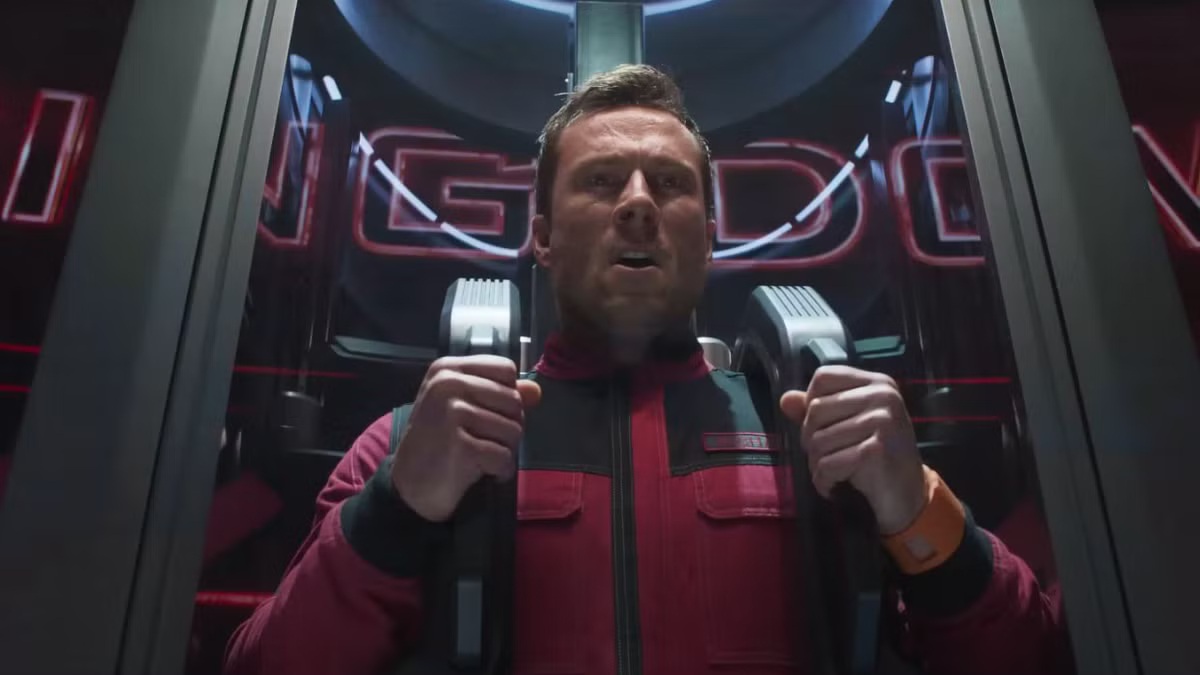
An early Stephen King novel under his Richard Bachman name, incidentally set in 2025, this was first adapted in 1987 an Arnold Schwarzenegger vehicle, to whom an amusing nod is given by having his face on the $100 bills in this new closer to the book version from director and co-writer Edgar Wright. The premise remains the same, a televised game has contestants (characterised as Hopeless Dude, Negative Man and Final Dude) having to survive being killed by a crew of hunters, except instead of them being criminals looking to earn their freedom, they’re now trying to stay alive and win a billion dollars to turn their lives around. The names of the central characters remain the same, except here Ben Richards (Glen Powell, all easy going Tom Cruise-lite charisma) isn’t a cop framed for a massacring unarmed food rioters, but a blue collar grunt whom, fired umpteen times for insubordination (i.e., calling out unsafe work practices), needs money to buy medicine for his sick daughter and so his wife (Jayme Lawson) can give up working a second job in a sleazy nightclub.
So, he auditions to become a contestant in one of the NRI TV network’s myriad of games, (Spin The Wheel is a particularly nasty joy) having promised that he won’t take part in the game of the title. However, sensing a rating puller in his fuck you attitude (“the angriest man to ever audition”), network president Dan Killian (a scenery chewing Josh Brolin with almost luminously white teeth) assigns him and two others (Katy O’Brian’s queer punk and Martin Herlihy scrawny slacker) barely seen before being offed, as the contestants. Now Ben, assuming a variety of disguises, has to avoid the five Hunters on his trail – and indeed the entire bloodthirsty nation – led by passive aggressive cold blooded killer McCone (Lee Pace) in his mask and sunglasses for 30 days, earning a bonus for any Hunter he kills, but having to regularly post in a video recording of himself. To which end, he’s helped by old anarchist buddy Molie Jernigan (William H. Macy, again soon to disappear from the storyline, and a couple of rebels, anti-establishment videos radical Bradley Throckmorton (Daniel Ezra) aka The Apostle and Elton Parrakis (Michael Cera) who lives with his demented fascist mother (Sandra Dickinson) in an ingeniously booby-trapped house.
Meanwhile back in the studio, the show’s host Bobby “Bobby T” Thompson (Colman Domingo) is whipping the Colosseum-like studio and viewing audience into a frenzy with doctored fake news versions of Ben’s videos, making him out as some murderous asshole. Making a late appearance is Emilia Jones as Amelia Williams, a civilian he takes hostage and whose pro-game attitudes get to take a turnaround once she realises how everyone’s being played and manipulated.
Moving between moments of quiet to ones of explosive action (including Powell dangling naked from a YMCA building), its anti-authority vision of a dystopian future isn’t exactly subtle in exploring how society is manipulated by media for political agendas even if, come the third act, Wright, as ever, has a tendency to go over the top favouring spectacle over social commentary. Nevertheless, he and Powell do a sterling job in having you rooting for Ben (the soundtrack includes Underdog by Sly & The Family Stone and, inevitably, Keep On Running) to not just survive but bring down the smug Killian (even if the principles abandoning final moments feel contrived), blending grit, pain, poignancy and not a little humour (there’s a cherishable Kardashian-styled reality show satire), as it heads to the finish line. It may not be as smart or cutting as it thinks, but it is undeniable good fun. (Cineworld 5 Ways, NEC, Solihull; Everyman; Mockingbird; Odeon Birmingham, Broadway Plaza Luxe, West Brom; Omniplex Great Park; Reel; Royal; Vue)
ALSO RELEASED
Christmas Karma (PG)
Even discounting the reliably insufferable Danny Dyer as a hammy geezer Cockerney cabbie called Colin in a festive jumper warbling his version of The 12 Days Of Christmas, this is a real turkey leftovers. hence the desperate marketing attempt to remind that 23 years ago director Gurinder Chadha made Bend It Like Beckham (discounting the multiple films that followed), which can only backfire if you stand the one against the other. Yet another reworking of A Christmas Carol this at least comes with a unique approach by giving it a vaguely Bollywood musical spin, with Scrooge recast as Eshaan Sood (Kunal Nayyar), a Tory voting Hindu financier and moneylender who, in his childhood, was, along with thousands of other Asians, expelled from Uganda by Idi Amin, the subsequent poverty and racism he and his family endured in London accounting for his present day tight-fistedness, an obsession with money that, as in Dickens, cost him his one and only romance.
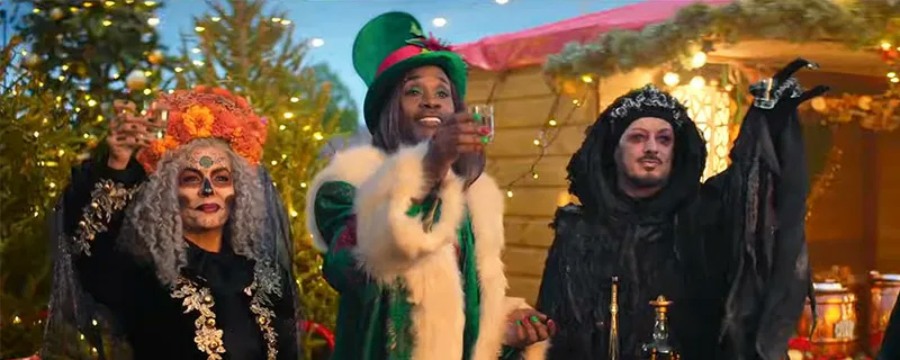
As per the familiar tale, after an assorted of churlish deeds (among them being rude about a children’s carol choir) and boorish behaviour to his nephew Eddie (Bilal Hasna) and guitar playing employee Bob Cratchit (Leo Suter) , the ghost of his dead partner Marley (Hugh Bonneville) warns him he will be visited on Christmas Eve by three spirits Christmas past (Eva Longoria fresh from a Day Of The Dead festival), present (Billy Porter’s R&B singer in garish green with his soul sister backing singers) and future (Boy George, the Christmas Karma Chameleon, who just gets to point and sing a bit) who will attempt to get him to change his ways by guiding through their different time zones.
Despite the Indian make-over, while Priyanka Chopra sings Last Christmas (Desi Version) over the credits along with cast and crew and celebrated Bhangra singers Jassi Sidhu and Malkit Singh get to do their turn, given this is a commercial world the bulk of the songs are by Gary Barlow, some of his blandest. And then there’s a breakdancing Santa, a cost of living rap and the everyone getting together for a fairground song and dance finale before a coda back in Uganda. Tiny Tim’s still there (he’s got life-threatening tumours in his legs), but now, while a bit financially strapped, his parents (mum’s played by Pixie Lott) aren’t exactly rubbing a couple of lumps of coal together for heat but have a decently appointed gaff in what looks like Notting Hill, With appearances by Allan Corduner as Mr. Fezzywig, Tracy-Ann Oberman as his wife, Rufus Jones as Rupert Holly and rapper Eve as herself, it looks rather cheap and is for the most part poorly (or over) acted (Nayyar wanders around looking bewildered) and sung. To be fair the final new leaf redemption section does have an engaging emotional warmth, but getting there requires exercising a real sense of charitable seasonal spirit. (Cineworld 5 Ways, NEC, Solihull; Odeon Birmingham, Broadway Plaza Luxe; Omniplex Great Park; Reel; Royal; Vue)
Hedda (15)
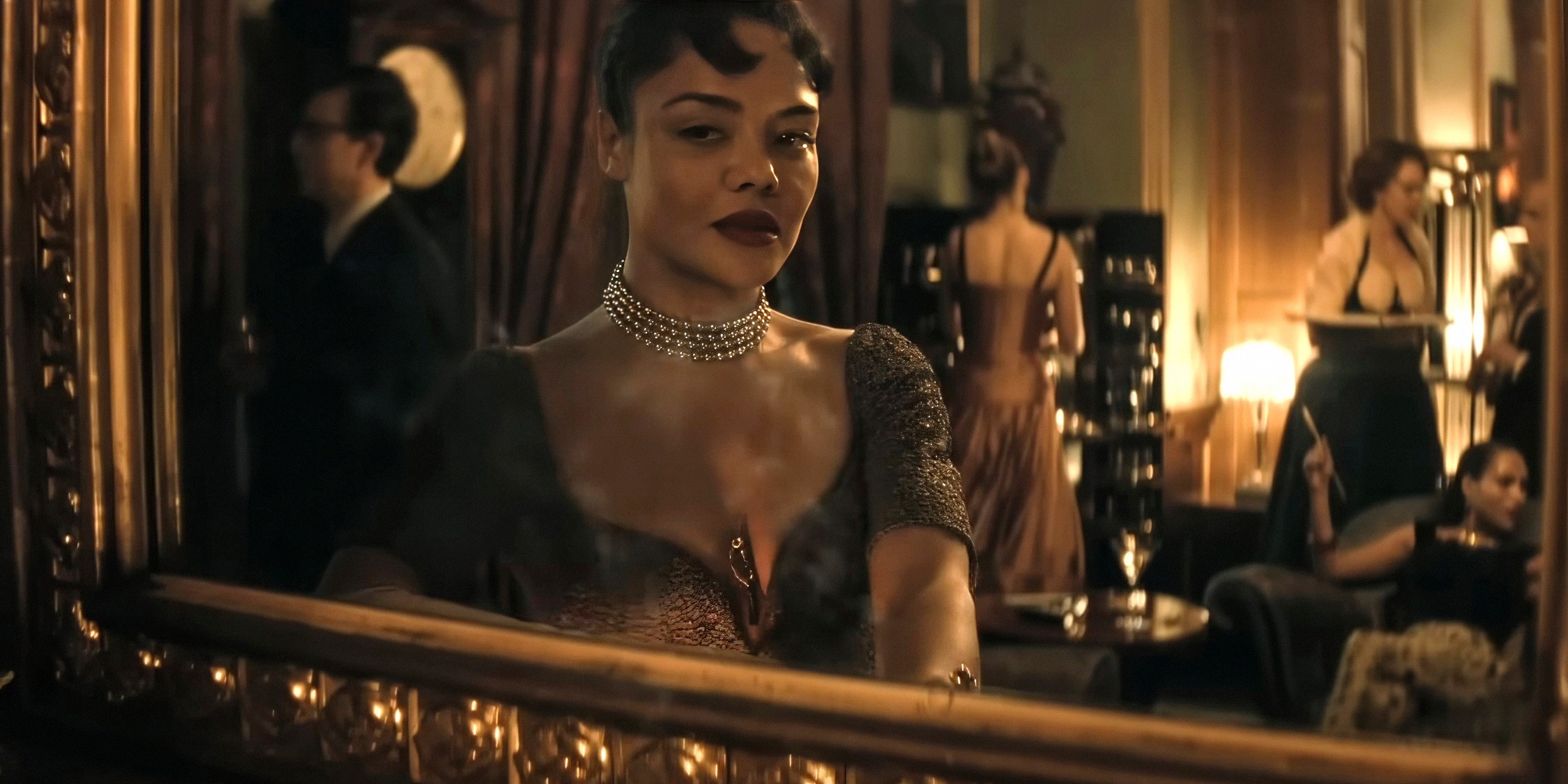
Candyman director Nia DaCosta takes a swerve into classical territory with this updated five act (with title cards) and no suicide take on Ibsen’s dour Hedda Gabbler (also embracing Chekhov’s gun in act one maxim), relocated from Norway to 1950s England and given a racial makeover with an awards buzz performance from a finely-accented Tessa Thompson (who starred in DaCosta’s Crossing The Line) as the scheming but vulnerable Hedda, an illegitimate manipulative free spirit who’s just wed well-born but bland academic George Tesman (Tom Bateman) and persuade him to purchase the sprawling mansion where she’s throwing a lavish (but no flowers) party. The reason being that, in debt up to his eyeballs, she needs Tom to be appointed to a newly vacant professorship, hence inviting the movers and shakers, specifically his superior, Professor Greenwood (Finbar Lynch), to get them on his side. Among the guests is also Judge Brack (Nicholas Pinnock), who facilitated the hous epirchase and who Hedda is screwing. Unfortunately, so too is the self-invited Eileen Lövborg (Nina Hoss), a gender switch from the play as Hedda’s former lover and classicist who is also after the job on the back of her new book on sexuality, the only manuscript of which she’s brought with her. A now sober alcoholic, Hedda intends to use her Dionysian get together to push her off the wagon and humiliate herself out of the running. But she also still carries a torch, something complicated by the presence of Eileen’s naïve new lover, and co-author Thea Clifton (Imogen Poots), herself an old friend of Hedda.
Opening with Hedda being interviewed by the police about a shooting, it then unfolds in flashback, with not one but two guns, one Hedda’s late father’s (the key to the case of which she wears around her neck) and one wielded by the professor who comes across his young wife Tabitha (Mirren Mack) having it off in the garden with Eillen’s lothario chum David (Jamael Westman).
Subtly examining the constraints on being both Black and a woman (one of the guests remarks their hostess is “duskier than I thought she would be”) forced into socially imposed roles with a below stairs scene involving Kathryn Hunter affording a class commentary, it’s a slow and sensual smoulder that underlines what a good adaptation should be. (MAC)
Keeper (15)
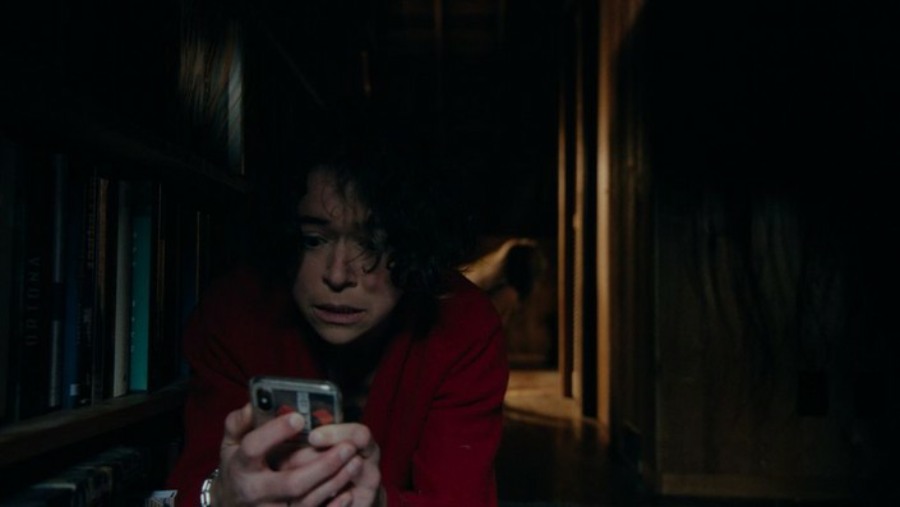
Director Osgood Perkins’s third horror in two years, and shot from a screenplay by Nick Lepard while The Monkey was stalled during the writers’ strike, this is firmly in WTF territory as, telling her friend she’s off to spend a weekend in a cabin in the woods (never a good omen) with new surgeon boyfriend Malcolm (Rossif Sutherland), who she’s been with for a year after a series of failed romances, Liz (a decent Tatiana Maslany), a sardonic artist, starts to feel uneasy from the moment she gets there. Not much helped by the intrusion of Malcolm’s neighbour, his no boundaries cousin Darren (Birkett Turton) with his Eastern European model girlfriend Minka (Eden Weiss) and that only the bathroom door has a lock. There’s also that cake left by the caretaker which he insists she eats, even though she dislikes chocolate. That night, she gets up and wolfs the rest of it down. When Malcolm has to return to the city to deal with a comatose patient, left on her own, things start to get really creepy. Darren returns and she starts having hallucinations – or maybe not – of scary and shadowy figures, one with a bag over her head, another clearly dead. A miniature Minka among them. And, despite Malcolm professing his love and assuring her he’s not married with a secret family, the black and white photo she finds tells a different story.
Shot with some unusual angles and superimpositions, it’s technically interesting but the confused narrative never seems sure exactly what sort of horror it is or about, though it involve the cousins’ younger selves killing a strange woman they see in the woods (and bearing an eerie resemblance to Liz) but not before she births offspring that will turn up drooling heads on elongated necks, with its central thread being some sort of vampiric/eternal life Faustian bargain. It’s like a collection of sketched out idea stitched together to see what works.
What is fairly obvious from the opening sequence showing different women at the smiley starts and terrified end of a relationship is that its intended as a parable of toxic masculinity, with Liz eventually delivering the female empowerment twist even if it takes forever to get to its foregone conclusion. After Longlegs and The Monkey, this is minor Perkins but there’s enough quirks and creeps to entertain until next year’s Young People hopefully puts him back on track. (Cineworld 5 Ways, NEC, Solihull; Everyman; Odeon Birmingham, Broadway Plaza Luxe. West Brom; Omniplex Great Park; Royal; Vue)
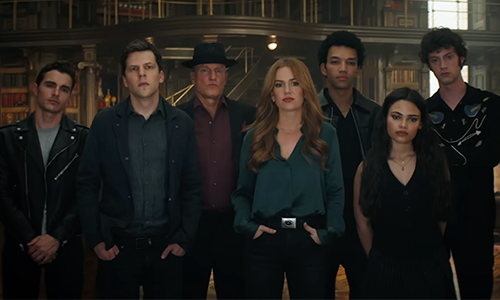
Now You See Me: Now You Don’t (12A)
Incoming director Ruben Fleischer reignites the franchise after almost a decade, reuniting the estranged Four (and eventually five) Horsemen and adding a new trio of younger magicians to the mix for a film that seeks to do nothing but entertain. Set ten years on from the previous film the new illusionists are brash Bosco (Dominic Sessa), pickpocket June (Ariana Greenblatt) and quiet and shy Charlie (Justice Smith) who use deepfakes and holograms as wealth redistribution Robin Hoods who, following their latest trick, giving a crypto conman his comeuppance, are approached by only mildly less arrogant former Horseman Atlas (Jesse Eisengerg) who’s received a tarot card that’s led him to them so, working for The Eye, he can recruit them for a mission to steal the Heart, the world’s largest diamond. It’s currently owned by Veronika Vanderburg (Rosamund Pike relishing her villain role), the head of a South African diamond company which secretly launders money for arms dealers and criminals. The plan being to infiltrate the private party where it;s being exhibited and steal is by way of assorted disguises, props and misdirection. When things don’t go as smoothly as hoped, the four are rescued from their pursuers in a surprise appearance from the three other original Horsemen, mentalist Merritt McKinney (Woody Harrelson), card trickster Jack Wilder (Dave Franco) and escape artist Henley Reeves (Isla Fisher), all of whom also received mysterious Tarot cards.
What ensues is a slick of complex caper that, after escaping the police, involves the seven hiding out at a sprawling estate with various illusory rooms and being reunited with Thaddeus Bradley (Morgan Freeman), the former grandmaster of The Eye, with some of them captured during a police raid, and, later, Lula (Lizzy Caplan), Jack’s on-off girlfriend and Henley’s replacement in the second film. Meanwhile, while extending assorted ruthless methods to recover the diamond, Vandenburg’s also getting calls from an unknown number with a man using a voice changer telling her he’ll expose her unless she gives him the diamond.
With locations that range from Brooklyn and Netherlands to France and the dazzling opulence of Abdu Dhabi (for a race car chase), Fleischer pulling his own sleights of hand in crafting the numerous VFX illusions (and, naturally, explaining Ocean’s Eleven style how at least some of the tricks were done) taken at a pace that never gives you time to ask how, with the score at times deliberately evoking Mission:Impossible, and peppered with plenty of acerbic and snarky lines before a twist reveal that you might have seen coming if the misdirection wasn’t as good as it is. A last minute cameo setting up a fourth film involving all eight Horsemen, this really is big screen magic. (Cineworld 5 Ways, NEC, Solihull; Everyman; Odeon Birmingham, Broadway Plaza Luxe; Omniplex Great Park, West Brom; Reel; Royal; Vue)
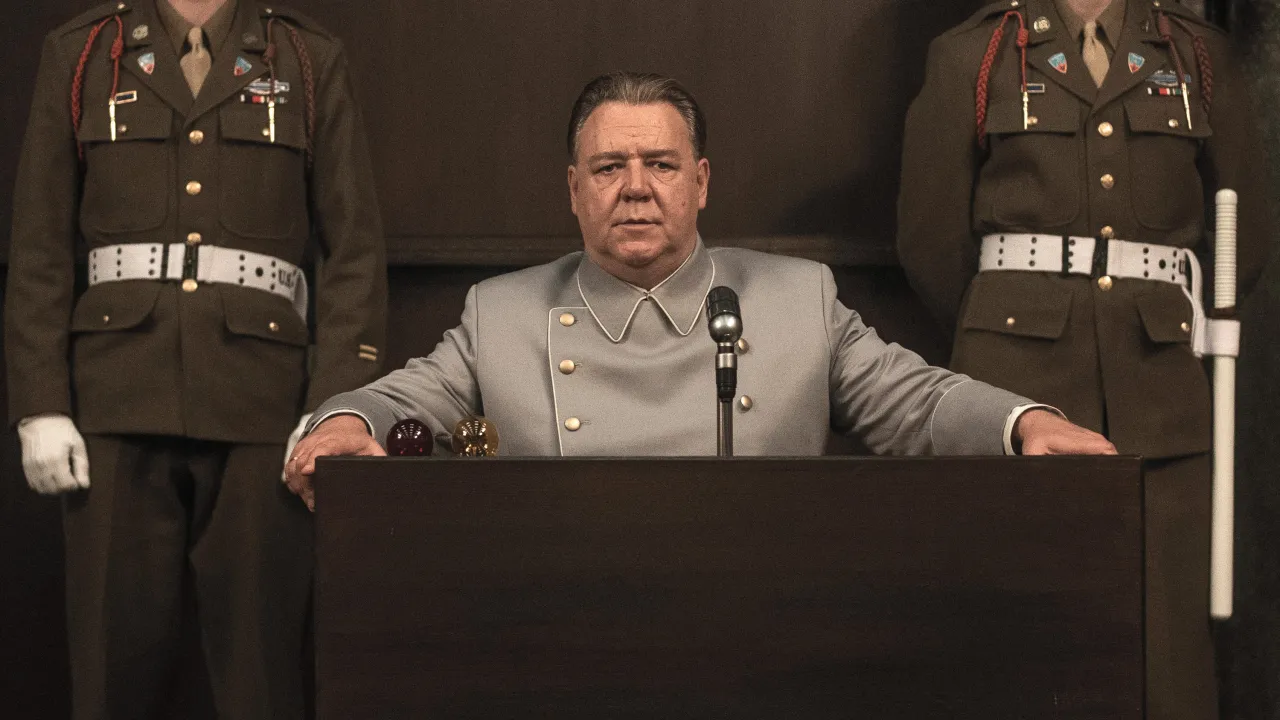
Nurenberg (15)
The trial of high ranking Germans complicit in the horrors of the Holocaust was formerly dramatised in 1961’s Judgement At Nuremberg, but, directed by Stanley Kramer, the central focus was on respected jurist and legal scholar Ernst Janning, Here, in his gripping sophomore outing, a psychological thriller of sorts, his first film in 10 years, director and screenwriter James Vanderbilt has drawn on Jack El-Hai’s 2013 book The Nazi and the Psychiatrist and the relationship between American army shrink Douglas Kelly (Rami Malek), who was brough into evaluate the mental state of the prisoners, and Hitler’s Reichsmarschall, Hermann Göring (Russell Crowe on towering peak form), the highest-ranking surviving Nazi, who didn’t even figure in Kramer’s film, here first introduced imperiously surrendering to American troops and ordering them to carry his luggage.
The film follows the mechanism that brought the courtroom and trial into being, many of the higher ups just wanting to line the prisoners up against and wall and shoot them rather than affording them a propaganda platform, with Supreme Court Justice Robert H. Jackson (Michael Shannon) insisting the Allies should be better than their enemies and that they have their day in court, creating the concept of crimes against humanity in the process. There’s some interesting moral murkiness too, Kelley seeing an opportunity to make his name writing a book about his patients while, playing devil’s advocate, Göring argues that bombing Hiroshima and carpet bombing of German cities were as much war crimes as anything he and his fellow defendants, among them naval commander Karl Dönitz, propagandist Julius Streicher, labour leader Robert Ley and Hitler’s deputy Rudolf Hess (who tried to fake amnesia about the whole thing, are accused of.
While there are some dramatic inventions, the film is mostly true to the facts and includes numbingly horrific real footage of the concentration camp victims as part of the court proceedings, Vanderbilt also elaborating on the poignantly tragic real life backstory of Kelley’s translator Howie Triest (Leo Woodall), including how Kelley and Göring became essentially the film’s Clarice Starling and Hannibal Lecter, the former carrying letters to and from his wife and daughter in hiding. And, while it may seem like a narrative flourish, British prosector David Maxwell Fyfe (Richard E. Grant) really did turn the tables on Göring when, while having admitted he set up the concentration camps as forced labour but blaming Himmler for the exterminations, arguing that the Final Solution was a mistranslation of total solution, seemed to have crushed Jackson’s case, he goaded him into condemning himself through loyalty to Hitler.
There’s some solid support work from John Slattery as Burton C. Andrus, the Commander of the Nuremberg prison, and Colin Hanks as the shrink brought in to give a second opinion when it’s felly Kelley’s compromised, and Shannon is excellent as Nelson, constantly being outmanoeuvred by his prime accused and undermined by his superiors. However, the film’s beating heart is the psychological cat and mouse therapy sessions between its narcissistic bromance couple, Kelley with his internal struggles and the fiercely self-confident, quietly spoken and assured Göring (dramatically Crowe has the upper hand), insisting he’s never going to be hanged (in fact, he committed suicide on the night he was due to be executed, though whether he managed to do so by borrowing a palming magic trick Kelley showed him is uncertain).
Following the verdicts and the harrowing execution scenes, the film moves forward to a shamed and drunk Kelley trying to promote his book and, the film moving from historical observation to contemporary commentary, arguing that the crimes that were prosecuted remain a present danger as history never learns from itself, the talk of deportations and persecution ringing a very clear bell about the nature and actions of current American administration and, as Weist says earlier, the complicity of a nation that lets it happen.
Never feeling its two and a half hours, it compels from start to finish, every second earning its inevitable Oscar nominations and, in many ways, this year’s equivalent of Oppenheimer. (Cineworld 5 Ways, NEC, Solihull; Odeon Birmingham, Broadway Plaza Luxe; Omniplex Great Park; Vue)
NOW SHOWING
Anora (18)
Written and directed by The Florida Project’s Sean Baker, this catapults Mikey Madison from supporting character roles to Oscar winner as Anora (the Hebrew word for light or grace) aka Ani Mikheeva, a stripper of Uzbek heritage living in Brooklyn’s Russian-speaking neighbourhood Brighton Beach. Materialistic and looking to the world of lap dancing at her upscale Manhattan strip club. So, as the only one of the girls who speaks passable Russian, she’s introduced to Ivan ‘Vanya’ Zakharov (Mark Eydelshteyn, Russia’s Timothée Chalamet), the spoiled, gangly, immature hard partying son of a wealthy Russian oligarch who lives in his parents’ lush gated mansion where he spends his time getting high, drinking and playing video games. Though vehemently denying she’s a prostitute, she takes up his lucrative offer for several bouts of sex, he then offering her $15,000 to stay with him for a week and pose as his girlfriend. This in turn finds them and his entourage flying to Las Vegas where he proposes (not least so he can get a green card and stay in America) and they end up getting hitched in one of the wedding chapels. So far so whirlwind romance as Ani quits her job to play shag-happy wife. However, when word gets out that Vanya’s ditched his clueless Russian-Armenian minders, Garnick (Vache Tovmasyan) and Igor (Yura Borisov), whose job it is to clean up the messes he makes, and rumours spread on Russian social media, his Orthodox priest godfather Toros (Karren Karagulianis) is ordered by Vanya’s domineering mother Galina Zakharovato (Darya Ekamasova) to find him and get the marriage annulled, she and her husband Nikolai flying over to America to take him back home. However, when his minders turn up, a coked-up Vanya does a runner and, after a lengthy apartment-trashing tussle (there’s a lovely moment as Igor tries to restrain Ani while respecting her personal space), they, Tonos and Ani set out to try and track him down, she reluctantly agreeing to $10000 in return for the annulment but hoping to convince everyone their love is real.
A cocktail of After Hours, Uncut Gems and Pretty Woman, with copious scenes of energetic screwing and liberal doses of black comedy, it’s a tad overlong to get going with perhaps more naked, gyrating lap dancing than are strictly necessary, but once the tragi-comic farce is underway it crackles with real energy and emotion. As the panicking Tonos, his beleaguered brother Garnick and tough but placid enforcer Igor, Karagulianis, Tovmasyan and Borisov (at times suggesting an Armenian Ewan McGregor) make for a wonderful comedic hapless trio and, while neither of the two central characters are especially likeable (both in it for what they can get), Eydelshteyn is immensely watchable as the brattishly entitled and shallow Vanya while Madison sets the screen alight as the smart, unsentimental but vulnerable Ani, giving the touching final shot a real hammer to the heart. (Sky Cinema)
Back In Action (12)
The title carrying a double meaning in that this is Cameron Diaz’s first film in 10 years, reaming with her Annie remake co-star Jamie Foxx, himself returning after being hospitalized, directed by Seth Gordon it’s a generic thriller that mines a familiar narrative involving kids who don’t know their parents are spies. Or at least they were. Fifteen years ago, more than platonic partners, she discovering she’s pregnant, CIA agents Emily (Diaz) and Matt (Foxx) narrowly escaped from a plane crash after apparently being betrayed by Baron (Andrew Scott, making the most of a thin role), an MI6 agent.
Resolving to retire, they’ve given up espionage and forged new lives and workaday mundane careers, now living in Atlanta with their two kids, snarky Alice (McKenna Roberts) and her younger rule-following techie brother Leo (Rylan Jackson). However, when a video of Matt losing his cool in a disco after discovering Alice isn’t actually studying with friends goes viral, their old handler Chuck (Kyle Chandler) turns up warning them their cover’s blown. But no sooner has he done so than he’s shot and the pair have to quickly grab the kids and hit the road, being pursued by both Polish KGB agent turned terrorist Balthazar Gor (Robert Besta) and his mercenary henchmen and Baron, who’s still nurturing a running gag crush on Emily, both believing they have the master-key, which they stole during Gor’s kiddies’s birthday party for his daughter, that will give its owner the ability to control any system in the world and which was never recovered from the plane wreckage. All of which means, clearly enjoying being back in the game, they have to, to the confusion of the kids, adopt new names and head to London to seek help from her long-estranged mother, Ginny (Glenn Close), a still formidable former British spy who’s living with her wannabe MI6 agent toyboy Nigel (an amusingly bumbling Jamie Demetriou as a nascent Johnny English).
Unfolding into a road movie with a series of brawls, parenting messages and boat and motorbike chases along the way, while it may be relentlessly rote there are some enjoyable spins, such as the couple improvising weapons out of a petrol pump, a bottle of Diet Coke and a tube of Mentos, an amusing joke at the expense of Jason Bourne and fights staged to Papa’s Got a Brand New Bag at the Tate Modern and Dean Martin’s Ain’t That a Kick in the Head as they literally kick thugs in the head. Trading off one another, Diaz and Foxx have palpable chemistry, Close sinks her teeth into the ham while Roberts and Jackson step up to the not exactly demanding mark as the kids finding mum and dad aren’t the bores they seemed. Undemanding fun, but fun nevertheless. (Netflix)
Ballad Of A Small Player (15)
After the widescreen expanse of All Quiet On The Western Front and Conclave, director Edward Berger takes a more intimate low key approach to this character study about dislocation and self-destructive addiction. Giving another standout performance, Colin Farrell plays an Irish con artist gambler who, hiding out in Macau, China’s answer to Vegas, where the locals refer to him as a gweilo or hungry ghost , passes himself off as British aristo Lord Freddy Doyle, complete with precisely clipped accent. Living in a decadent Chinese casino-hotel, with three days to settle his 145,000 hotel bill, he’s on a losing streak and saddled with huge gambling debts he can’t pay off, wiped out at baccarat by a foul-mouthed old dear (Deanie Ip) at the only casino that’ll still extend him credit, but, in his supposedly Savile Row leather yellow gloves, is still looking for the win that will turn things around.
Into his life comes Fala Chen (Dao Ming), who, like a drug dealer feedings junkies, lends money to losers at exorbitant rates, but has decided to get out of the game after her latest mark took a dive from the rooftop, she inheriting his debt. The pair hang out in her houseboat and he wakes to find her gone and numbers written on his palm. Also entering his orbit is frump in designer glasses Cynthia (Tilda Swinton), who, calling herself Betty, is a private detective hired to recover the money he stole from her elderly client, She spots him a stake and suddenly his fortunes change, now he just can’t lose.
Visually striking and vibrantly coloured, adapted by Rowan Joffe from Lawrence Osborne’s novel, it’s a thoughtful meditation on self-loathing, end of rope desperation, compulsion, guilt and redemption, Farrell going all-in on a rollercoaster that variously sees him having a heart attack and wolfing down lobster, sweating out anxiety and almost maniacally exulting in his luck. Though she disappears (for reasons explained later) in the second half, Ming makes for a suitably haunting femme fatale while Swinton digs into her character’s quirks with a sly wink in her eye. With supporting turns from Anthony Wong relating an anecdote about a gambler who dies and goes to what he thinks is Heaven and Alex Jennings as the friend and fellow gambler who know who Doyle really is, both imparting the message that winning kills you quicker than losing, this might not ever play an ace but it holds high enough cards to keep you in the game. (Netflix)
Black Bag (15)
A blackly comic espionage mole hunt spin on Mr and Mrs Smith, with the husband and wife spies rather than assassins, written by David Koepp and directed (and filmed) by Steven Soderbergh, the title referring to secrecy, buttoned-up George Woodhouse (Michael Fassbender sporting Harry Palmer-styled black spectacles and a dab hand in the kitchen in a nod to The Ipcress File ) and the sexier Kathryn St. Jean (Cate Blanchett) work for Britain’s National Cyber Security Centre, headed up by a steely Arthur Steiglitz (Pierce Brosnan). Apparently ace at detecting lies, George has been charged with investigating someone from the agency leaking to the Russians details of a virus called Severus which can cause nuclear reactors to meltdown and kill thousands (though never stated the Ukraine war is the backdrop). He’s got one week to identify the traitor and a list of five suspects. One of whom is his wife.
Also in the narrative melting pot of suspects is erotic fiction fan agency therapist Dr Zoe Vaughan (Naomie Harris) who’s dating gaming-obsessed Col James Stokes (Regé-Jean Page), and uncouth alcoholic Freddie Smalls (Tom Burke) who’s resentful of being passed over for promotion and involved with the volatile Clarissa Dubose (Marisa Abela), a relative data expert rookie with daddy issues. The agent who gave him the dies of a suspicious heart attack.
Two dinners are pivotal, the first where he serves chana masala laced with a truth serum to everyone but his wife turns into Who’s Afraid Of Virginia Woolf series of confessions and a steak knife through someone’s hand but reveals nothing about the leak. The second, after administering polygraphs, is of an Agatha Christie drawing room nature with a gun on the table awaiting whoever lies. In-between all this, it seems that both George and Kathryn are being set-up to distrust and spy on each other, especially when he discovers his wife has been keeping things from him in her own black bag.
While a car blows up and there’s a last act gunshot, this follows more of a cerebral John LeCarre spy thriller path rather than Bourne or Bond territory, meaning there’s a lot of clever sparring dialogue and psychological misdirections and manipulations, while the audience tries to figure out who’s the one behind the leak. Tongue-in-cheek with several nods to other films in the genre, the whole traitor plot is really a bit of a MacGuffin with the film more accurately an examination of truth and trust (and the difference between them) in relationships where lying is a stock in trade as several layers of duplicity are exposed. As such the chemistry between the different couples really works (and also in the power play therapy session between Zoe and Kathryn), Fassbender and Blanchett especially, Soderbergh slickly navigating the screenplay and keeping you involved and guessing up to the last moment. No big bangs maybe, but intelligently explosive all the same. (Sky Cinema/Now)
The Black Phone 2 (18)
Director Scott Derrickson returns for a compelling sequel to his 1978-set creepy 2021 horror that saw Colorado teenager Finney Blake (Mason Thames). with the help of ghostly previous victims, kill the Grabber (Ethan Hawke), the masked child killer who’d abducted and imprisoned him in a basement with a disconnected black phone on which he heard voices talking to him. Four years on both in real time and setting, the sequel is essentially the same story, except this time, rather than It, the touchstone is Nightmare On Elm Street, the Grabber returning from beyond the grave and coming for his victims in their dreams, or, more specifically, in the dreams (shot in fuzzy Super 8) of Finn’s younger sister Gwen (Madeleine McGraw) who has inherited her late mother’s psychic gift/curse of communicating with the dead and regularly has to be awakened from her sleepwalking by Finn.
As such, while Thames gets his moments as the traumatised Finn working through his psychological scars by smoking dope and taking out his aggression on boys at school, and still getting calls on disconnected phones, refusing to help whoever’s on the line, it’s McGraw who is the sequel’s focus. Digging into the Blake family past, Derrickson and co-writer C. Robert Cargill open proceedings in the 50s at Alpine Lake, a winter Christian youth camp, with the young Hope (Anna Lore) calling on the lakeside phone across time to, as is eventually revealed, her future daughter Gwen. More too is revealed about her adult suicide, turning her husband (Jeremy Davies sporting a bizarre beard and hairdo) to alcoholism. The core narrative is set at the camp where, in Gwen’s dreams, she sees the mutilated dead bodies of young boys floating to the surface of the frozen lake, carving letters into the ice. So, she persuades boyfriend Ernesto (Miguel Mora, a plot addition rather than actual character), who romances her with Duran Duran tickets, and Finn to drive there as volunteer counsellors, only to find themselves snowed in by a blizzard with the only other ones there being camp supervisor Armando (Demián Bichir), his cowgirl niece Mustang (Arianna Rivas) and hypocritical judgemental Christian couple Kenneth (Graham Abbey) and Barbara (Maev Beaty) who see Gwen as the devil’s child. And, of course the Grabber’s ghost.
It turns out that the three boys Gwen’s seeing in her dreams all went missing when they attended the camp, their bodies never found, prompting the familiar plot about Gwen needed to help put their souls to rest, they, having been victims of the Grabber, himself, in his earthly former life, having been a camp counsellor too. As such, the bulk of the action takes place in Gwen’s dreams where, a la Freddy Krueger, if the now facially mangled Grabber harms or kills her, her sleeping body manifests the wounds or the impact of his assault (cue characters horrified to see her being tossed around by invisible hands), though, unusually for a slasher/horror, nobody dies except those already dead.
Exploring the nature and effects of generational damage and the trauma of surviving violence, in addition to some grisly body horror it sounds potent emotional notes in the psychic connection between Gwen and her mother, with an impressive McGraw doing the film’s heavy lifting and while Thames and Hawke have relatively less to do the latter does get to showboat in the extended climax skating across the lake with his axe. It’s hard to see how it might be contrived to have the phone ring a third time, but for now you really should answer the call. (Odeon Broadway Plaza Luxe; Omniplex Great Park)
Brides (15)
Inspired by the case of London schoolgirl Shamima Begum, who, with two friends, left home to join Islamic State in Syria, working from Suhayla El-Bushra’s screenplay, first-time director Nadia Fall (a playwright and artistic director of the Young Vic) barely touches on the political dimension, indeed, ISIS are never mentioned and it barely scratches the surface of radicalisation. Instead, set in 2014, she delivers a compassionate portrait of teenage female friendship in the story of two British seaside town Muslim 15-year-olds, devout (a reaction to her Westernised mother and her no-good white boyfriend) but naïve Somali-born Doe (Ebada Hassan) and loud-mouthed, less devout British-Pakistani best friend Muna (Safiyya Ingar), looking to escape from a life of domestic turmoil, abusive father figures and racist social exclusion where anti-Muslim graffiti meets their eye wherever they go.
Persuaded by social media videos promising a better life, they decide to go to Syria to become ISIS brides, Muna seeking acceptance by any means necessary while Doe is more drawn to the cause, but also wants to reconnect with her crush, Samir (Ali Khan), who’s already made the trip out of a sense of Islamic duty. The journey will test their friendship, especially given Duo wants to text Samir and call her mother, something Muna, wary of the repercussions, is adamant she doesn’t.
Things go wrong from the start. Their online contact fails to meet them in Istanbul and then their passports and tickets are stolen. It’s patently a dangerous scenario but Fall leavens things with playfulness (a game of laser tag) humour (spraying each other with perfumes in a store) and poignancy that underline the girls’ innocence while the camera captures the exotic air of Turkey with its bazaars, mosques and whirling dervishes.
The characters friends but very different personalities, Hassan and Ingar deliver terrific performances that fully draw you into their lives, hopes and disappointments, very human figures rather than the media’s portrayal as incipient terrorists. Likewise, there’s warmth and good Samaritan human kindness in the bus station clerk (Cemre Ebuzziya) who befriends them and takes them to eat and sleep at her family home (though they end up stealing from her) and the widowed father who lets them tag along with him and his children.
The constant flashbacks, mostly involving Doe, do rather disrupt the narrative, but as we see how they first became friends and then how that friendship is tested, it becomes utterly compelling, making the final moments all the more wrenching. (Vue)
Bugonia (15)
The fourth teaming of director Yorgos Lanthimos and star Emma Stone, the title referring to an ancient Greek belief that bees spontaneously generate from the carcasses of dead oxen, adapted by The Menu screenwriter Will Tracy, this is a remake of 2003 South Korean film Save the Green Planet! but with a gender switch for two of the characters. As such, anyone who’s seen the original will be aware of the last act twist – which here ventures into the realms of 60s TV sci fi cheesiness but, with its final scenes scored to Where Have All The Flowers Gone, still packs a chillingly numbing punch, a conspiracy thriller rooted in the premise that just because you’re paranoid doesn’t mean they’re not after you, exercises a gripping cocktail of tense drama and black comedy.
Sone plays Michelle Fuller, the high profile power-dressing, subtly manipulative, coldly calculating CEO of pharmaceutical company Auxolith who’s abducted by bee-keeping conspiracy theorist eco-terrorist Teddy Gatz (Jesse Plemons), who works at the company’s warehouse, and his neurodivergent cousin Don (Aidan Delbis, himself autistic), who believes her to an Andromedan, part of an alien species that’s infiltrated the human race and is killing off the bees in keeping with Colony Collapse Disorder. Holding her captive in their basement, smearing her with antihistamine cream and shaving off her hair so she can’t communicate with the mothership, Teddy’s plan is to use her as a bargaining tool to force the aliens to leave Earth, giving her four days to admit the truth before the lunar eclipse allows her ship to enter the atmosphere undetected.
However, while clearly deranged and delusional, Teddy’s actions are also driven by a different motive in that his mother, Sandy (Alicia Silverstone), was a guinea pig for one of Auxolith’s drugs, leaving her comatose in a nearby hospital with Michelle covering things up. Initially vehemently refuting his alien claims but then deciding to play along, Michelle tries to turn things to her advantage, noting that the almost childlike Don, who, like Teddy’s has been injected with a “chemical castration” formula, seems uncomfortable with his cousin’s plans. During the torture (aptly set to Green Day’s Basket Case), Teddy, in full-on psychosis, becomes persuaded that she’s a member of the Andromedan royal family, and, out of respect, lays on assort of state dinner upstairs, only for taunting to see it end in a fight and a fork stabbing. Meanwhile, the police have launched a hunt and, adding another creepy layer, local sheriff Casey (Stavros Halkias) keeps coming round looking to make amends for having molested Teddy when he was his babysitter.
Things turn bloody with a suicide and a subsequent murder, before Michelle persuades Teddy his mother can be cured with anti-freeze, something that inevitably does not end well, she, playing to his fantasies and explaining that, after accidentally wiping out the dinosaurs, the experiment was designed by the Andromedans to help humans, which they created, evolve beyond their self-destructive nature.
Again rooted in themes of power struggle dynamics, class, entitlement and media manipulation, while more narratively straightforward than Lanthimos’s past two outings, it still runs the freak flag up the deadpan humour mast, gleefully allowing the cast to dive into its eccentricity and weirdness. Stone once more gives 110 percent to the character and narrative while Plemons, all lank hair and barely suppressed rage, is terrific, both engaging empathy and revulsion as you’re led to ask which truth is actually out there. (Cineworld 5 Ways; Odeon Broadway Plaza Luxe; Vue; Until Mon: Mockingbird)
The Choral (12A)
A fourth teaming of director Nicholas Hytner and writer Alan Bennett, this is a slight but gently comic and touching tale of the power of music to heal, comfort and inspire. The setting is the fictional Yorkshire village of Ramsden in 1916 where the war has seen many a young volunteer (conscription not yet introduced) go off never to return, 17-year-old postboy Lofty (Oliver Briscombe) delivering the dreaded messages to newly bereaved wives and mothers. It’s also taken its toll on the village choral society which, funded by mill owner Alderman Duxbury (Roger Allam), who’s recently lost his own son with his wife in permanent mourning, has seen its choir master having decided to enlist, thus requiring a replacement. To which end, committee member Joe Fytton (Mark Addy), the local photographer who snaps the lads before they ship out, suggests they approach organist turned conductor Dr. Henry Guthrie (Ralph Fiennes).
Aside from being an atheist and having no patriotic sensibilities (his reaction to a rendition of God Save The King is an eye rolling joy) , the real problem, certainly as far as Duxbury’s concerned, is that he’s spent his recent years in Germany of his own volition. Nevertheless, reputation outweighs prejudice and he duly agrees to take up the position (though the local kids taunt him and the older members sneer), bringing with him his own conscientious-objector pianist, Horner (Robert Emmas), and despite the fact he annoyingly keeps referencing German philosophers and composers, things seem to settle down as he auditions for new singers, among them Bella (Emily Fairn), whose soldier boyfriend Clyde (Jacob Dudman) is MIA, Lofty and his chums Ellis (Taylor Uttley) and Mitch (Shaun Thomas), and, a real find, Mary (Amara Okereke) who loves singing while she collects for the Salvation Army. Guthrie’s somewhat less impressed by Duxbury, who sees himself as the choir’s star turn.
There’s also an unspoken reservation about Guthrie being a closeted homosexual, a somewhat unnecessary plot addition involving Horner’s crush and an ill-fated romance with a German naval officer that has him forever checking the papers for news of sea battles.
After making an approach to Edward Elgar to get permission, they eventually settle on performing his good vs evil parable The Dream of Gerontius which, as it develops, becomes a theatrical piece about the war and its casualties, enlisting wounded soldiers into the choir, among them Clyde who’s returned alive, minus an arm, much to the consternation of Bella who’s taken up with Ellis, and is chosen by Guthrie to replace Duxbury as the voice of good, he getting to sing the Satan part as compensation. As fate has it, Elgar (Simon Russell-Beale) is in the area for an investiture ceremony, and, while Guthrie demurs, Mary secretly invites him to come and check out their interpretation. His reaction, not quite what she’d hoped.
With a cast that also includes Alun Armstrong as the village’s funeral director and Lyndsey Marshal as the local prostitute with quite a client list, its ensemble nature sometimes struggles to incorporate all the different stories (the three boys turn 18 and get their call-up papers, Lofty looking to lose his virginity before he goes), but otherwise, anchored around a typically centred performance from Fiennes, it deftly balances the poignancy and the humour (Bennett’s often sharp wit in solid form) as the community bonds over common goals and tragedies. A touch rose-tinted with the cosiness of a light and warming Sunday evening BBC drama, it’s an undemanding joy, but a joy nonetheless. (Cineworld 5 Ways, NEC, Solihull; Everyman; Odeon Birmingham, Broadway Plaza Luxe; Omniplex Great Park; Reel; Royal; Vue)
Companion (15)
After a spate of films sounding warning notes about AI, writer-director Drew Hancock impressively flips the narrative from perpetrator to victim in a cautionary tale about technology and relationships woven with a commentary on toxic masculinity.
Meeting romcom cute in a supermarket, Iris (Heretic’s Sophie Thatcher) is in a relationship with underdog nice guy Josh (The Boys’ Jack Quaid), though there’s something uneasy about how, docile and submissive, she professes she’s wants to ensure all his wants and desires are fulfilled. Her opening voice-over sets you up for that’s to come as she says the two most important moments of her life where when she met him and when she killed him.
They’re off on weekend getaway to a remote luxury home owned by adulterous billionaire Russian Sergey (Rupert Friend with bristling moustache and thick accent), joined by Josh’s standoffish ex Kat (Megan Suri), who’s also Sergey’s girlfriend, and, also in their first flush of romance, mutually besotted gay couple by catty Eli (Harvey Guillén) and the hot but dim, anxious to please Patrick (Lukas Gage), who coincidentally also have their own meet-cute, although Iris feels uncomfortable and unwelcomed in their company. Well, not that unwelcomed by Sergey who, alone by the lake, attempts to rape her. We next see her walking back into the house, covered in his blood. At which point the film upends everything to reveal that Iris is in fact a humanoid, a lifelike fuckbot companion Josh is renting (flashbacks show her being delivered and programmed – her intelligence, level of aggression, voice, etc., all remotely controlled), theoretically programmed to not harm humans.
It turns out that killing Sergey, apparently a drugs dealer, also throws a spanner in the works regarding the real reason the others are there, namely to steal $12million. But, as events spiral out of control into a cat and mouse battle of wits and survival between them and Iris, that’s not the only secret being hidden, but to reveal more would spoil the thrills as they unfold.
Thatcher is terrific in the way she handles Iris coming to terms with who or what she is (learning her tears are just fed from an internal reservoir), gaining Josh’s smartphone app controls and trying to become autonomous and overcome the restrictions of her programming and the feelings with which she’s been implanted. Playing counter to his character in The Boys, Quaid is also compelling in Josh’s mix of spinelessness and ruthlessness, and while Suri’s character is less developed, Guillén and Gage throw some clever curves as things develop.
Sporting an ingenious screenplay and working with themes of manipulation, appearances and reality, control, emotional abuse, the weaponisation and commodification of feelings and , it consistently takes off in unexpected directions, fusing moments of comedy with ones of sudden violence and horror. (Apple TV; Sky Cinema)
Conclave (12A)
Peter Straughan’s take on the Robert Harris novel , despite a seemingly unpromising plot pivoting round the election of a new Pope, directed by Edward Berger this is a grippingly tense thriller about faith and the nature of and desire for power and unequivocally one of the year’s best films, its success in America a welcome reminder that, amid the familiar CGI-littered blockbusters, there’s still an audience for intelligent, thought-provoking filmmaking.
The central figure is the conflicted Cardinal Lawrence (an inscrutable, nuanced turn by Ralph Fiennes), who, when the Pope dies in his room in Domus Sanctae Marthae, is charged with overseeing the conclave, an assembly of fellow cardinals who, sequestered in the Sistine Chapel, charged with electing his successor (a problematic task foreshadowed by the difficulty in removing the Papal ring). It’s not a position Lawrence, whose resignation from his post as Dean of the College of Cardinals amid his crisis of faith in the church the Pope had refused, welcomes and he certainly harbours no ambitions for the position himself. That’s not the case, however, for the narrow-minded Tedesco (John Tuturro lookalike Sergo Castellitto) who wants to return the Papacy to the old, pre-liberal days with everything in Latin, or Tremblay (an almost salivating John Lithgow),who lusts for the power it brings. Lawrence’s fellow liberal friend Bellini (an edgy Stanley Tucci) claims he’s not a viable candidate, but for the sake of the Church, would rather himself than his rivals. Also in contention is the equally conservative and homophobic Nigerian Adeyemi (Lucian Msamati).
Amid the conspiratorial machinations, matters are complicated by Lawrence learning that Tremblay apparently had a meeting with the Pope just before he died and was apparently sacked for conduct unbecoming, though he insists this never happened. There’s also an incident with Adeyemi and a nun from Nigeria who was flown in to the Vatican at the express wish of one of his rivals. With all the cardinals secluded from any outside communication and forming their own cliques, as a web of secrets unfolds, there’s also the surprise arrival of the soft-spoken Mexican cardinal Benitez (Carlos Diehz) who wasn’t on the list and whose posting in Kabul was unknown to all and who, it transpires, had a planned visit to Switzerland paid for by the late Pope. All of this is being quietly observed by the head nun, Sister Agatha (Isabella Rossellini, scene stealing in an almost dialogue-free role).
As Lawrence stars digging into the rumours, while becoming increasingly worried that he’s getting votes himself, working with Bellini to try and stave off the election of either Tremblay or Tedesco, more hidden secrets come to light and there’s more coldly calculated backstabbing, as, bolstered by a tremendous score from Volker Bertelmann, Berger ratchets up the suspense to nail-biting levels while the screenplay throws up provocative debates about the state of the Roman Catholic Church in present times, as well as a sudden .intrusion by political events beyond the Vatican walls.
Amid the raft of outstanding performances, Fiennes gets a terrific sermon, declaring that he fears certainty to be the biggest threat to faith and encouraging the cardinals to embrace doubt while, amid the sea of red robes and detailed rituals, there’s some riveting visual moments, most notably an overhead shot of the cardinals gathering in the courtyard with white umbrellas that could easily become an iconic poster. Climaxing with a twist you’ll never see coming, it’s a masterclass in filmmaking and storytelling. (Amazon Prime)
Code 3 (15)
The title relating to an emergency response requiring lights and sirens, pitched somewhere between straight drama and a tag along reality documentary, director Christopher Leone works from a screenplay by himself and former paramedic Patrick Pianezza as the film follows Randy (Rainn Wilson) as a burnt-out cynical paramedic on his final 24- hour emergency ambulance shift after 18 years before he takes up an uneventful 9-5 job (with lunch breaks) in insurance, his controller Shanice (Yvette Nicole Brown) having persuaded him to see out the shift. Along with his regular partner Mike (Lil Rel Howery), his only friend and the only co-worker who can tolerate him, behind the wheel, they’re also babysitting Jessica (Aimee Carrero), a young trainee along for her first night, enthusiastic and believing she can make a positive impact. Randy long stopped harbouring any such delusions, the night proceeding to offer up a series of incidents that explain why he’s had enough of mopping up life’s tragedies with few thanks and less money.
Breaking through the fourth wall as he talks direct to camera, the night will see the crew attending a multiple fatality car crash, a half-naked mentally ill homeless man screaming about how he’s “Satan and his only messenger”, so he can get a hot meal, being vomited on and attacked by someone they’ve just saved from an overdose, being threatened by a deranged woman with a gun, being patronised and insulted by overworked asshole Dr. Serano (Rob Riggle) and Mike calming down a psychotic Black veteran with PTSD shouting how he’s the President before a couple of trigger happy cops shut him up for good.
A scathing indictment of America’s healthcare system, while powerfully and at times gruesomely dramatic, it’s also frequently wildly funny, albeit mostly gallows style humour (the scene where a woman in a diner asking Randy whats the worst thing he’s ever seen is an hilarious elaborate wind up, involving a baby and a microwave, unless, of course, he’s not making it up). But more than anything it’s about the humanity of trying to care for those whose lives are in their hands, their best friend on their worst day, whether they want you to or not. If you can’t laugh as an escape valve in the face of it all, then you might as well just kill yourself.
Wilson delivers one of his best performances and his chemistry with Howery rings with authenticity while Carrero both provides the audience foil and a last act twist as Serano gets smacked down. A film that’s impossible to shake off, and perhaps one that will afford a little perspective when you’re complaining how long the ambulance takes to arrive. (Apple TV)
The Conjuring: Last Rites (15)
Twelve years and seven sequels/spin-offs on, the story of real life faith-driven paranormal investigators Ed (Patrick Wilson) and Lorainne (Vera Farmiga) Warren finally wraps up (and with it presumably the workmanlike Wilson’s days as a headline star, unless there’s more Insidious sequels in the pipeline) with the case that brought their active spook hunting days to end. Opening in 1964 , the pair (Orion Smith/Madison Lawlor) are checking out an antique wooden mirror with the carved heads of three babies, but when she touches it the glass cracks and she sees a vision of an entity and her unborn child. Immediately sending her into labour, their daughter, Judy is stillborn, but comes back from death after a minute, her parents subsequently embarking on their controversial and well-publicised (the two stars are inserted into a real Larry King interview with the Warrens) adventures.
Fast forward to 1986, and moving into a two-storey house in Pennsylvania (presumably unaware of the murders committed on the site), the Smurl family (I defy you not to think Smurfs) Jack (Elliot Cowan) and Janet (Rebecca Calder), her in-laws Mary (Kate Fahy) and John (Peter Wight), and their four daughters, teenagers Dawn Beau Gadson) and Heather (Kila Lord Cassidy), and the young twins, Carin (Tilly Walker) and Shannon (Molly Cartwright), celebrate Heather’s confirmation by gifting her that self-same, still cracked mirror, as you do. Almost immediately, things start to turn freaky, the ceiling light crashing down and the girls hearing voices and seeing shadowy figures, the older sisters eventually deciding to throw it out with the trash. Except, while crushed in a dumpster truck, the next day Dawn vomits blood and shards of glass and Jack is himself assaulted by an unseen force and then find themselves subject to a media frenzy. So, who you gonna call?
Well, apparently not the Warrens who, after Ed’s heart attack, have called it a day and now find themselves lecturing on the paranormal to a handful of bored attendees, and getting mocked as B-list Ghostbusters. However, inheriting psychic abilities from mum, Judy (Mia Tomlinson), who’s just got engaged to ex-cop Tony (Ben Hardy with half-hearted backstory) at her disapproving dad’s birthday bash, is starting to have vision of the Annabelle doll and an elderly woman. When old colleague Father Gordon (Steve Goult, one of several returnees and cameos from the franchise, many of them birthday/wedding party guests like Lili Taylor, Mackenzie Foy, Frances O’Connor, Madison Wolfe and Julian Hillard, alongside the real Tony and Judy and producer James Wan) fails to persuade the Warrens to help, he duly takes off to visit the Smurls himself. It doesn’t end well, with Judy having another vision at his funeral that sends her too off to the harassed family, and, hey, wouldn’t you know, that just what the demon wants. So, finally, off trot mum and dad to do their thing one last time. And guess what else has made a return.
Helmed by returning director Michael Chaves, all of this takes a punishingly and interminably slow 75 minutes with creaking doors, unlit rooms, haunted basements, possessed dolls and jump scare ghoulish faces desperately trying to sustain the creepiness before, the Smurls all but consigned to the sidelines, the last act finally opens the floodgates for axe wielding ghosts, sinks flooding blood, apparitions and general paranormal mayhem. It does eventually pay off and Wilson and Farmiga are duly committed to delivering the goods, but having had to sit through woeful dialogue that includes lines like “our family is not like other families”, “fetch the book” and the unintendedly hilarious “there’s something in the attic”, not to mention Howard Jones’ overly optimistic Things Can Only Get Better, you’d be forgiven for not sticking around after the real life footage of the Warrens and their cases, and a resume of their lives, and thus missing the end credit reveal of the mirror and the franchise’s title. Let’s just let the dead rest in peace. (Vue)
The Damned (15)
With an unnerving score from Stephen McKeon and Eli Arenson’s striking cinematography, the feature debut by Icelandic director Thordur Palsson is one of the best of the recent best horrors, at times evoking thoughts of M.R.James. Set in 19th century Iceland with an atmosphere so thick it threatens to choke you, it centres around a shipwreck just off the coast that serves as home to a small fishing community. It’s winter and times are hard, food scarce and the weather murderous. Seeing the wreck, the villagers are divided, some say it’s their moral duty to rescue the survivors, others take the pragmatic view that, with scant food supplies already, doing so would threaten their own survival. It’s the latter view that wins the day and ships are not put out, However, when they do take to sea the next day hoping to recover the ship’s barrels of salt pork, they’re shocked to discover that some of the sailors have made it to the jagged rocky outcrop known as “The Teeth”, and when they try to get aboard they have to be beaten off and left to drown, though it also costs the life of their helmsman Ragnar (Rory McCann).
When the bodies eventually wash up (a shocking scene suggests one’s still alive but the stomach moments prove to be an eel that got inside the body), they’re buried on the beach, the elderly superstitious Helga (Siobhan Finneran) telling that they must have their hands tied with rope, their feet nailed down, and their wooden coffins rotated three times in order to confuse their spirits and prevent them returning as Draugr, undead creatures of Nordic lore composed of skin, bone and blood, only capable of being destroyed by fire. What follows is a series of mysterious deaths and suicides as well as unnerving visions of a black figure that are inevitably taken to be rooted in hauntings by the drowned men. The truth proves both less and more horrifying. As Daniel (Joe Cole), who becomes the new helmsman says, the living are more dangerous than the dead.
Morality play and psychological horror, it’s a spartan affair, cold and dark, steeped in shadows and mist, drawing on folklore superstition and guilty paranoia alike, given gutsy strength by a strong cast led by Odessa Young as Eva, a young but steely widow who’s in charge of the fishing boat and gets to make the decisions, and Joe Cole as Daniel, their mutual feelings throwing up another ethical dilemma that further stokes the simmering tensions amid a community founded on tough masculine values and survival through strength. Damned good indeed. (Sky Cinema)
Die My Love (15)
Marking her first film since 2017’s Joaquin Phoenix oddity You Were Never Really Here, director Lynne Ramsey and co-writers Alice Birch and Enda Walsh have adapted Ariana Harwicz’s 2012 novel about a woman’s descent into bipolar disorder following the birth of her son. Jennifer Lawrnce gives one the most intense performances of her career as Grace, an aspiring wrier who, with her wannabe musician husband (though he’s never seen pursuing the dream) Jackson(Robert Pattison), moves into his uncle’s rambling edge of the forest Montana house after he committed suicide (a rifle up the arse apparently). Jackson’s mother Pam (Sissy Spacek), who lives in a neighbouring property, is supportive and approving, though her husband, Harry (a cameo by Nick Nolte,), who has encroaching dementia, is rather less so. Following his death she starts sleepwalking andf sleeping with a loaded gun
The couple seem happy, dancing around the house and forever having animalistic sex, and Grace is soon pregnant. But the birth sees a change with Grace seemingly suffering postpartum depression (though never less than caring with the baby), exacerbated by the fact that Jackson regularly works long hours away from home (doing what we’re never told), the box of condoms in his glovebox leading her to suspect he’s being unfaithful (their sex life pretty much vanishes), and he also comes home with the world’s yappiest dog. but is never there to clean up after it. Suffice to say a film with both a gun and a dog doesn’t have an upbeat resolution.
Grace’s mood swing become more erratic, her sanity slipping away, with everyone worried about her and, after a dramatic meltdown, Jackson having her committed. She eventually returns, seemingly ‘better’. But clearly not.
With the film shifting between timelines (the wedding flashback comes late in the films) and Grace’s mental state (she’s savagely rude to a cashier, trashes the bathroom, pours soap products over the floor and crawls round like an animal on all fours), reality and hallucinations begin to blur, having sexual fantasies about someone (LaKeith Stanfield) she saw in a parking lot and who may or may not be the guy she sees – or doesn’t – riding past the house on a motorbike. There’s incessant shouty quarrels about Jackson’s increasing perceived distancing and insensitivity, regular self-harm incidents (at one point she crashes through a glass door, having earlier licked the glass, at another she bangs her head against a mirror) and several scenes of full on nudity, all of which serve to capture the turmoil in Grace’s head but, in terms of the film, feel overwrought and unsubtle, both narratively and technically, everything soundtracked by the likes of Toni Basil’s Micky, Shirley Ellis’s The Clapping Song, Nick Lowe’s The Beast In Me (sung in a flashback fantasy with a hotel receptionist), John Prine and Iris DeMent’s In Spite Of Ourselves, Presley’s Love Me Tender, April Showers (pointedly from Bambi) and even, as unsubtle as a hammer to the head, Ramsey herself singing Love Will Tear Us Apart over the end credits.
At times darkly funny at others scalding intense, driven by Lawrence’s uncompromising, ferocious performance, it’s a flawed but nevertheless mesmerisingly compelling work that, if you have the patience to sit with it, will burn into your mind and heart. (Cineworld 5 Ways; Everyman; Odeon Broadway Plaza Luxe; Vue)
Dragonfly (15)
Returning to the big screen after working in television, director Paul Andrew Williams delivers a Mike Leigh-styled slice of social realism about loneliness and isolation anchored in outstanding performances from Andrea Riseborough and Brenda Blethyn. The latter is Elsie, who, after a recent fall and an injured wrist, with her son Josh (Jason Watkins) living too far away for regular visits, daily homecare visits to her bungalow from private agency nurses who just treat her as another clock in clock off job, and always insist she has a shower just so they can tick the boxes. She doesn’t need them, but she endures them.
But then, after one of the nurses leaved before her hour’s up, Elsie’s neighbour Colleen (Riseborugh), who lives by herself on benefits with a soppy massive Bull terrier named Sabre, takes it upon herself to become her unpaid carer, doing the shopping, the laundry and cleaning. Josh expresses his concern that this kindness may be a mask for exploitation and, indeed, when Colleen asks for Elsie’s credit card and pin to go shopping, a red flag is raised. But nothing comes of it and everything is what it seems, two lonely women finding companionship in helping each other. Coleen even sells one of her possessions so she can buy a two-way radio so they can communicate at night. However, things take a dramatic turn when (in his sole scene), Josh turns up and, while ostensibly seeming friendly, plays obnoxious busybody and, part to offset his absent son guilt, reports Sabre, a banned breed, with inevitable results as the police turn up.
Up until this point, the film is a terrific character study rooted in a world where the elderly and lonely simply become invisible. However, with a blood-covered tonal shift finale that draws on Hitchcock but makes no narratively realistic sense, it all goes wildly melodramatically off the rails, a disappointing end to an otherwise melancholic but compassionately optimistic story. (Mockinbfbird)
Frankenstein (15)
The most dramatic changes come, however, with the character of Elizabeth (the fittingly named Mia Goth, whose confession box moment about the sin of anger is rare comedic touch), who, in the novel is Victor’s childhood sweetheart bride, murdered by the Creature (a quietly graceful and tormented Jacob Elordi) when he refuses to create him a companion. Here though, will he lusts after her (that she also plays his late mother adds a Freudian subtext) , she’s actually William’s betrothed and, while she still dies, it’s not at the Creature’s hands, for whom, something of a hottie despite his patchwork body, she has a decided emotional attraction. She also happens to be the daughter of German arms merchant Henrich Harlander (Christoph Waltz), the film’s version of Victor’s chum Henry Clerval, who funds Victor’s experiments (for an agenda revealed later), with William (Felix Kammera) overseeing the elaborate scenes assembling the machinery in an abandoned tower in which Victor channels lightning through the lymphatic system of the figure he’s stitched together from the body parts of assorted hanged criminals and soldiers killed in Crimean War. Pointedly he’s strapped to the machinery like a Christ on the Cross (prompting later thoughts of father, why have you forsaken me). Succeeding in bring him to life, he then chains him in the cellar, looking for some signs[of intelligence, frustrated that all the Creature can say is Victor. Until, following her visit, he adds Elizabeth to his vocabulary.
All this forms the first chapter, with the second, picking up from Victor’s destruction of his lab (during which, in another symbolic variation, he lost a leg), with the Creature recounting his story to the captain and, involving the blind old man (David Bradley), who thinks he’s the Spirit of the Forest, but with a different approach, how he learnt language – and the word friend – from listening to him being read to by his granddaughter from the likes of Paradise Lost and Genesis. Anyway, this is all about humanising someone who pretty much everyone else sees as a monster, though, of course, as somewhat heavily spelled out, the question is who is the real monster, the Creature (who’s horrified to find the notes depicting how he came to be) or, playing God, his Creator. Fathers, sons and forgiveness are the (un)holy trinity at work here.
One of the film’s most powerful elements his how life becomes a curse, the Creature here proving a Victorian Wolverine, both super strong and invulnerable to death (rising up and his flesh healing after being peppered by bullets and stabbed), condemned to an eternity of loneliness. Unlike the novel, the ending brings notes of contrition and redemption, with a final sunset scene that inverts that happy ever after motif. Often visually breathtaking (even if the scenes on the ice look like a stage set and some CGI wolves prove less than persuasive), it offers up a different kind of horror that is philosophically and existentially provocative but ultimately crushingly touching. (Netflix; Mockingbird)
Get Away (15)
Written by and starring Nick Frost, this is another of his genre spoofing excursions, turning the lens this time on folk horrors such as The Wicker Man and Midsommar with a plot that follows the familiar trope of outsiders being caught up in deadly rituals. The clueless targeted victims are middle-aged couple dorky dad Richard (Frost) and condescending Susan (Aisling Bea) Smith, who call each other mummy and daddy, and have brought their reluctant, bickering adolescent kids, sarcastic vegan Sam (Sebastian Croft) and surly misanthropic Jessie (a drolly deadpan Maisie Ayres), for a holiday stay on the fictional Swedish island of Svalta to watch the annual Karantän festival, an eight-hour re-enactment of a cannibalistically murderous 19th-century history incident when the locals killed and ate the four British soldiers who’d starved the island.
The family’s warned by the local storekeeper not to take the ferry, advising they won’t be made welcome, but, naturally, as in all such horrors, the blithely proceed, arriving to face a hostile reception led by veteran Karantän organiser Klara (Anitta Suikkari) before checking into the Airbnb they’ve rented off Matts (Eero Milonoff), who turns out to be a creepy pervert who steals Jessie’s underwear and watches her through a two way mirror.
As the islanders make no secret of how they feel about those culturally-deaf interlopers (having a dead rodent thrown at them seems pretty indicative), the Smiths are left in no doubt that more than theatrical blood may well be spilled. And indeed, things do finally erupt in knife-slicing and stabbing carnage with eviscerations and severed limbs and heads. But, as Frost delivers a wicked Psycho-spun twist, not quite in the way you might have assumed.
Directed by Steffen Haars with an enthusiastically scattershot narrative, it is, of course, all utterly but deliberately silly, ridiculous, and wildly overacted as it bathes in geysers of blood and gleefully sends up the genre conventions, complete with a punchline motto I can’t possibly reveal. Great fun. (Sky)
Good Boy (15)
Directed and co-written by Ben Leonberg, at under 75 minutes, this brings a novel twist to the familiar supernatural horror/haunted house genre in that it’s all seen (and mostly filmed) through the low angle eyes of a golden retriever. Acquired as a puppy, Indy, Leonberg’s own dog, is the loyal canine companion to Todd (Shane Jensen), who, recovering from surgery, has decided to quit the city and move to his late grandfather’s (Larry Fessenden) remote farmhouse where, surrounded by taxidermy trophies, he watches flickering home videos of the old man and low budget horror movies. From the start there’s an air of unease with strange noises, creaks and shadowy shapes caught in reflections in the windows; Indy senses all of this, his master does not.
It’s clear from the start that, his sister finding him unresponsive with blood dripping from his mouth, Todd is unwell, suffering the same ailment that killed his grandfather (whose own dog, Bandit, was never found). It’s something Indy senses as he vigilantly follows him around the house, whimpering when he coughs up blood into a handkerchief or standing guard by a closed door. When, not thinking clearly, an erratic Todd chains Indy to a kennel out in the rain, the dog ingeniously breaks free and gets back into the house.
Through deft use of sound, silence and lighting and mostly shot in chronological sequence, Leonberg builds the tension, ratcheting up the creeping horror and scares (in one scene a seeming mud-covered ghoul turns out to be a local hunter in camouflage) as Indy sees figures looming around the house’s shadows and slimy black hands encroaching on Todd. He even sees the apparent ghost of Bandit going up the stairs. The film deliberately aims to keep this ambiguous as to whether these are real or psychological (there’s several scenes that take the form of Indy’s dreams), but you don’t have to be a genius to work out that basically Indy’s sensing the presence of death and illness closing in on Todd, the dog’s reactions an empathetic mix of fear and concern.
While Jensen is quietly terrific as a man who has chosen to end his days in isolation, his relationship with his dog subtly etched in small gestures, it’s without question that Indy is the star of the film, delivering a performance with a nuance and emotional resonance many a human actor would struggle to match in capturing the weight of the impending loss of someone you love. In the end though, it comes to something of an inevitable low key anti-climax, all bark but no bite. (Vue)
Good Fortune (15)
A first time feature by writer, director and star Azis Ansari, this is basically a cocktail of It’s A Wonderful Life, Freaky Friday and Trading Places, served up as a social commentary on the gig economy, the economic divide, self-worth and the sense of entitlement that comes with wealth. Set in LA, he plays Arj, a documentary editor fallen on hard times, working for a food delivery company, an odd jobs app (he’s hired to stand in line to get trendy baked goods) and packing at big box store Hardware Heaven, and sleeping his car at night. Things look up when, after cleaning up his garage, he lands a job as assistant to Jeff (Seth Rogen), the self-congratulatory venture capitalist who he crossed paths with earlier and whose life consists of buying $250,000. token business meeting and going from a cold plunge to his sauna. But then he’s fired after using the company credit card to pay for expensive dinner with Elana (an underused Keke Palmer saddled with make a difference speeches), a fellow Hardware Heaven worker who’s trying to organise a union. At which point he’s taken, literally, under the wings of Gabriel (Keanu Reeves), a not too bright low-level angel dressed in a Wings Of Desire raincoat whose job is to stop people texting while driving but who wants something more fulfilling like rescuing a lost soul. Although warned to not go beyond his job description by Angels Management chief Martha (a briefly cameoing Sandra Oh), he decides on an intervention with the aim of showing him that money’s not the answer to everything. To which end he switches Arj and Jeff’s lives (though not their bodies), so that it’s now Arj (fully aware of what’s happened) who’s swanning around living the high life and Jess who’s the struggling loser. Ansari then takes a plot swerve in accidentally restoring Jeff’s memory, he agreeing to let the swap play put for a few more days before Arj agrees to voluntarily go back to his old life. Except, given the visions he’s had of what his life would be if he reverted, he really doesn’t want to, Gabriel telling Martha that he’s found money really is the answer to his problems.
As with It’s A Wonderful Life, you can see where it’s heading with Arj supposed to realise what he truly has, but along the way there’ a few more swerves, with Arj, whose involved in a car crash after texting, feigns memory loss about Jeff and Gabriel stripped of his wings and hanging out with Jeff, trying to make enough cash not to sleep in his car, and learning what it means to be human. Meanwhile Arj and Elana’s romance has hit a rocky patch.
There’s some amusing moments as he discovers the delights of burgers, chicken nuggies and milk-shakes, Ansari’s comedic style doesn’t suit this broader template and you can’t help feeling that, his directorial grip slipping, he’s lost sight of the film’s intentions and is playing for laughs, with the plot devolving into a clunkily paced series of back and forths. Also problematic is the trio’s different acting style, Ansari mostly low key awareness, Rogen, well Rogen, and Reeves with his Bill & Ted deadpan lack of expressiveness, though he does have a good share of one-liners like “I used to be a celestial being and now I’m a chain-smoker”. There’s also an inordinate number of jokey references as to how handsome and hot he looks, the film’s chances resting on how his fans will take to him when he’s not killing people or time travelling. With everything tied up with a sentimental, lessons learnt rushed ending, it’s a sporadically fun commentary on the state of the American Dream but its fortune seems decidedly iffy. (Mon/Wed: Everyman)
Havoc (18)
Tom Hardy seems to be all over the show at present, and, adding to his magnetic turn in Mobland, he now turns up in the Wales-set thriller as Patrick Walker, a bent cop who works as a fixer for corrupt politician and mayoral candidate Lawrence Beaumont (Forest Whitaker) and is a pretty crappy divorced dad (it opens with him doing last minute shopping at a convenience store for his daughter’s Christmas presents). Saddled with an idealistic new rookie partner, Ellie (Jessie Mei Li), he finds himself in the thick of things following the hijacking of a truck full of washing machines (loaded with cocaine, as it happens) that results in one of the pursuing narcotic cops, Cortez, ending up in hospital.
As the plot unfolds, it turns out the heist was carried out by Beaumont’s estranged son Charlie (Justin Cornwell) and his girlfriend Mia (Quelin Sepulveda) who take the coke to Triad head Tsui (Jeremy Ang Jones) only for three masked men to burst in and massacre everyone else. Now, Patrick has to somehow get Charlie and Mia to safety with Tsui’s mother (Yeo Yann Yann) flying in to exact revenge, her brother Ching (Sunny Pang), Tsui’s henchman, having claimed them as the killers, while also evading fellow corrupt cops Jake (Richard Harrington), Hayes (Gordon Alexander) and Vincent (Timothy Olyphant) who, as this is hardly a spoiler, are in league with Ching to whom they were planning to sell the drugs in the first place.
It’s all convoluted and complicated, but, directed by Gareth Evans who made the two Raid movies and clearly has a hard on for John Woo, it’s also wall to wall, with violent action, crushed skulls, severed limbs and geysers of blood spraying aesthetically on to the white snow, plus a grisly fishing harpoon death, all climaxing at a gunfight at a secluded cabin along with the redemption arc you could see coming a mile off and an ambiguous ending that leaves room for a sequel. For all the excess, Evans doesn’t really bring anything to the table you’ve not seen before, but you have to admit he puts on a pretty decent feast. (Netflix)
Heads Of State (15)
Having worked together on Suicide Squad, Idris Elba and John Cena reunite as co-stars in this ludicrous but hugely entertaining action romp playing respectively, army veteran British Prime Minister Will Clarke and US President Sam Derringer, a former Hollywood action star. Derringer, in the post for six months, is riding high in the approval rating, whereas, six-years into the job, Clarke is experiencing something of a Starmer moment. Neither has much respect for the other, so understandably their first meeting at a press conference to announce a NATO-supported energy initiative is prickly ego-jostling affair. So, to repair the PR damage of their very public argument, they’re persuaded by their respective Chiefs of Staff Quincy (Richard Doyle) and Bradshaw (Sarah Niles) to fly to the NATO summit in Trieste aboard Air Force One and present a united front.
All of this is preceded by the opening set-up wherein a joint MI6 and CIA mission in Spain, led by senior British agent Noelle Bisset (Priyanka Chopra), to capture Russian arms dealer Viktor Gradov (Paddy Considine with a subtext of pathos to his brutality), goes pear-shaped leaving the team dead during the annual festival food fight and Gradov acquiring a link to ECHELON, the global surveillance program used by the Anglosphere intelligence alliance Five Eyes. All part of his revenge for his son being murdered when his plans do create nuclear safety were misinterpreted as terrorism.
So, it’ll be no surprise when there’s an attempt to assassinate both Clarke and Derringer in flight, the plane being shot down with both heads of state presumed dead. Except they managed to parachute out and are now stranded in Belarus, aware that someone in their inner circle is a traitor. At which point, re-enter the pun-loving Bisset, who survived the massacre and is on Gradov’s trail. She also happens to have a romantic past with Clarke. Now they have to make it to safety, all the while being pursued by Gradov’s relentless assassins Sasha (Aleksandr Kuznetsov) and Olga (Katrina Durden).
With a pedal to the metal plot that involves a hammily cameoing Hawaiian-shirted Jack Quaid as Marty Comer who runs a CIA safe house in Warsaw, Stephen Root as Gradov’s hacker with a conscience and Carla Gugino as the Vice President (giving a timely Trump-impression speech about dismantling NATO and putting America first), there’s shoot-outs and stunts a plenty, both Elba’s Clarke as the straight man, and Cena’s broader written Derringer well-tooled up and shooting off bullets alongside the quips while Chopra shows she can kick ass with the best. Director Ilya Naishuller never pretends he’s making anything more than a gleefully silly big bucket popcorn mismatched buddy movie (even if the script does slip in a message about partnerships) and as such it’s an absolute winner, leaving you hoping they all get re-elected for a sequel. (Amazon Prime)
Highest 2 Lowest (15)
Showing on a solitary screen but streaming on Apple, Spike Lee reunites with Denzel Washington for a reimaging of Akira Kurosawa’s 1963 noir High and Low, itself based on Ed McBain’s King’s Ransom, in which a shoe company executive is forced to choose between certain financial ruin and saving his chauffeur’s son when a kidnapper mixes up their two sons. Transplanted from Yokohama to New York, here the man facing the moral dilemma is David King (Washington), the founder of Stackin’ Hits Records and acknowledged by the like of Quincy Jones as having the “best ears in the business” (magazine covers of him adorn his office along with images of Aretha, Stevie Wonder and others_. However, the hits aren’t coming any more and, having previously sold his majority interest. he’s looking to buy it back to avert a rival label buyout that he says will see new artists being shed and the music used in commercials. His plan means he has to buy out his partner’s (Wendell Pierce) share, to which end, despite his philanthropist wife Pam’s (Ilfenesh Hadera) reservations, he puts up most of his personal assets, including his penthouse home in Brooklyn’s trendy Dumbo neighbourhood and Black art collection (Jean Michel Basquiat’s Now’s the Time and Kehinde Wiley’s Investiture of Bishop Harold as the Duke of Franconia among them) as collateral.
However, the day the deal is due to go through, he gets a call saying his son Trey (Aubrey Jospeh), a promising basketball player he dropped off at practice, has been kidnapped with a ransom of $17.5 million in Swiss 1,000-franc notes for his safe return. Contacting the cops, although it could risk the business deal he and Pam agree to pay. But then comes the twist. Trey is found safe and it turns out that, in a mistake confusing their headbands, the kidnapper has instead abducted the son of King’s ex-con Muslim convert driver and best friend confidant Paul (a dramatically nuanced Jeffrey Wright), Trey’s best friend and fellow athlete Kyle (Wright’s real life son Elijah), racist white cop Detective Higgins (Dean Winters) suggesting Paul staged it himself.
The question now is whether King will stay pay the ransom, warned that refusing to do so will harm his and the label’s image. He does, eventually, agree, but the handover of the money, in a backpack containing a tracer, does not go as expected when, an emergency stop as he’s standing between subway train car carriages en route to Yankee Stadium sees it fall to the street, resulting in a lengthy chase involving it being passed between an extended series of moped riders weaving between a Puerto Rican Day Parade (an indulgent excuse to feature Latin Jazz bandleader Eddie Palmieri, Anthony Ramos and Rosie Perez appearing as themselves) before being retrieved only to find the money gone.
Kyle’s duly returned and King’s the hero of the hour, Stackin’ Hits records now back in the charts. But, with those who lent the $17.5 million demanding repayment within two weeks because he broke the terms of the contract by using it as the ransom, he’s determined to track down the kidnapper and recover his money. Kyle’s recalling of hip hop number he heard while being held captive and a demo tape of upcoming artists Trey compiled for his father to listen to, leads him and Paul to ex-convict and aspiring rapper Yung Felon (A$AP Rocky) and one of two outstanding rap battle styled face off scenes as he first confronts him at a recording studio and then in prison where Felon, whose crime has made his music a global phenomenon, tries to convince King to sign him. The final showstopping scene explains the film’s title, it being a number written by Sula (rising British soul star Aiyana-Lee in her film debut) a young singer-songwriter discovered by Trey, who auditions for the Kings for their new independent label.
A fairly straightforward thriller with some social commentary on the changing times injected, it’s not up there with Lee’s best, but, despite some unnecessarily prolonged sequences (it opens with a full rendition by Norm Lewis of Oh, What A Beautiful Mornin’ from Oklahoma as the camera slowly zooms in on King’s balcony), it sustains the momentum and narrative with Washington delivering a performance as fluid and flexible as an improvised jazz riff. (Apple TV)
Him (18)
Directed and co-written by Justin Tipping and produced by Jordan Peele (who’s unsettling horror influence seems to take over the final stretch), this stars an adequate but not great Tyriq Withers as Cameron Cade, his love of American football fostered by his late father translating into becoming a college quarterback touted as an heir apparent to his San Antonio Saviors hero and G.O.A.T (Greatest Of All Time) Isaiah White (a scenery-chewing Marlon Wayans) who suffered a potentially career ending injury while making a winning touchdown (Cade’s dad told him real men will make sacrifices for what they believe in).
Cade’s encouraged to train for the league combine where players demonstrate their potential to professional leagues and team scouts, but, practising at night on an empty field, he’s attacked from being by a figure in a goat costume, he too suffering a head injury that threatens his career. Although it risks permanent brain damage, his manager, Tom (Tim Heidecker) pushes him to take part in the combine and try out for the Savior’s role and, while he ultimately refuses, he does get an invitation from White himself who, revealing he’s considering retiring, offers to spend a week training him at a remote desert compound to prove himself a worthy successor.
That on arrival he’s met by crazed fans resentful of him replacing their hero (whose mantra is ‘football, family, God, declaring “He died for us so I play for Him”) should be an early warning that things won’t go smoothly, compounded by a session where White has a ball repeatedly slammed into one of the player’s faces to make a point. Then there’s the fact that Cade’s being given transfusions of |White’s blood by Marco (Jim Jefferies) the team doctor, supposedly as an energy booster, and starts experiencing nightmarish hallucinations of masked figures. He’s also attacked in the sauna by White’s demented fan Marjorie (Naomi Grossman), is seduced by his social media influencer wife Elsie (Julia Fox).
At this point, what has been just creepy and confusing becomes almost completely incoherent as a severed head, a masked pagan religion sports cabal and fight to the death all send the narrative spinning, as style (X-ray shots included) overwhelms substance in its unsubtle critique of the corrupt exploitation and manipulation (not to mention the brutality) and the price of fame and idolatry in the sporting world (and by association the American soul) and it all turns into a poor imitation Peele thematic cocktail of fame, family, religion, race and class that beats you around head until your mouthguard shatters. (Vue)
A House Of Dynamite (15)
Director Kathryn Bigelow’s first feature since 2017’s disappointing Detroit, written by Noah Oppenheim, told Rashomon-style, returning to the same scenario from different perspectives, this is a white knuckle nuclear nightmare thriller that’s prompted the Pentagon to blusteringly refute its suggestion that America’s nuclear deterrence is little more than a coin toss.
The premise is as simple as it is chilling. A nuclear missile has been launched from an unknown location by an unknown country, possibly North Korea, undetected until mid-flight, and is due to strike Chicago in twenty minutes. The first scenario has Capt. Olivia Walker (Rebecca Ferguson), the intelligence analyst oversight officer for the White House Situation Room, learning of the missile and initiating communication between her office, the Pentagon, assorted armed forces command and, eventually, the President as the threat level is raised to DEFCON 2. Out at Fort Greely, Alaska, Maj. Daniel Gonzalez (Anthony Ramos) launches two ground-based interceptors, neither of which succeed in brining it down. Meanwhile, the Secretary of Defence (Jared Harris), whose daughter is in Chicago, initiates the protocol evacuation od designed federal evacuees, among them Federal Emergency Management Agency official Cathy Rogers (Moses Ingram) while, rushing to the Presidential Emergency Operations Center, Deputy National Security Advisor Jake Baerington (Gabriel Basso) advises the President (Idris Elba, not seen until the third act) not to make any impulsive retaliations until the source of the launch can be attributed, Russia and China both denying responsibility. As the seconds tick away, a call has to be made.
The film then backtracks to Nebraska where STRATCOM commander Gen. Anthony Brady (Tracy Letts) is informed of the launch and B-2 bombers are scrambled in readiness, Russia, China and Iran having mobilised their forces in anticipation. NSA advisor Ana Park (Greta Lee) says its possible that North Korea could have used a submarine but that there was no awareness of them having such capability. Baerington contacts the Russian foreign minister seeking to have them stand down, but the clock’s ticking and the President is advised to consult with his nuclear aide, Lt Cdr. Robert Reeves (Jonah Hauer-King) who holds the briefcase with the launch codes.
Finally, in scenario three from which the film takes its title, the focus turns to the President who, having been earlier evacuated from a basketball event, who, now airborne and overwhelmed by events, regards non-retaliation as a nonstarter, Baerington advising the only options are surrender or suicide. Of course, there’s always the chance it might not detonate.
What happens next is never shown, it doesn’t need to be, the film’s frightening cautionary depiction of what might become mutually assured destruction, especially given the nuclear sabre rattling from Putin, more than enough to leave audiences unnerved by the inexorableness of everything, shaken and too stressed to sleep and face what nightmares it might bring. (Netflix)
I Swear (15)
In 2019, Galashiels-born John Davidson was awarded an MBE for his services to advancing awareness of Tourette Syndrome, a neurological disorder that causes uncontrolled movements and verbal outbursts, generally of a sweary nature. Standing in the room awaiting his turn, he shouted out “Fuck the Queen!” This is the launch point for writer-director Kirk Jones’s biopic, which then flashes back to the mid-80s with Davidson (Scott Ellis Watson), the eldest child of working class dad (Steven Cree), who hopes his son’s goalie skills might earn him a professional spot, and uptight mother Heather (a wonderfully brittle Shirley Henderson) as, a bit of a charmer, he starts secondary school.
But then the world changes when he develops physical tics that, first see him blowing his soccer prospects and them spitting out food and spouting obscenities over family dinner, prompting his mother making him sit in front of the fire to eat his food. Expelled for calling the headmaster a c***, he’s eventually diagnosed, though Tourette’s wasn’t then officially recognised, his dad leaving home in embarrassment and his mother hiding him away in shame and at 20 (now played by an outstanding Robert Aramayo), ostracised by society, he’s on disability benefits and rarely going out other than to help with the shopping. One such trip reunites him with former schoolfriend Murray (Francesco Piacentini-Smith), who simply accepts the tics and outbursts (“I suck cock’ is a favourite) and takes him home to meet his parents, Chris (David Caryle) and Dottie (a solid Maxine Peake), the latter diagnosed with terminal cancer, who are equally accepting.
With Heather unable to cope, Dottie, a former psychiatric nurse, invites John to move in and dedicates herself to helping him get a job and become independent, the former seeing him become assistant to Tommy (Peter Mullan), the crotchety but heart of gold janitor at the local community centre who tells him that Tourette’s isn’t the problem, it’s the fact that people don’t understand it. Life becomes more stable if no less sweary, although he hospitalised after being beaten with a crowbar for inadvertently insulting a girl and hauled up on as an assault charge following an involuntary arm movement in a nightclub (the courtroom scene is a humorous gem). But in the wake of Tommy’s death and Dottie’s diagnosis having been proven incorrect, with a catalyst where a young girl (Andrea Bisset) with the same affliction opens up to him, he sets about becoming an advocate and campaigner seeking to change that ignorance. And so it then returns to the MBE moment and follows treatment with an experimental drug to help alleviate but not cure his condition and John’s subsequent work to advance awareness holding workshops and seminars with fellow sufferers (a final act features real Tourette’s actors) and their caregivers.
Soundtracked by the likes of Blue Monday and Stop Crying Your Heart Out, it’s very much in the style of BBC uplifting dramas, albeit with considerably more swearing (the obscenities and four letter proliferations would normally get an 18, but that would run counter to the film’s objective and story), Jones using his comedic background in the likes of Nanny McPhee and Waking Ned to bring a light tone that steers clear of earnest melodrama. With end credits featuring footage of the actual Davidson, who served as executive producer, including from 1989 BBC documentary John’s Not Mad, one of several about him prior 2019, it’s something you need to see. (Vue; Wed: Mockingbird)
It Ends With Us (15)
Directed by and co-starring Justin Baldoni, and adapted by Christy Hall Colleen Hoover’s 2016 bestseller about the cycle of domestic abuse and denial, this may be a melodramatic soap opera (as is the ongoing legal battle between director and star), but it’s one from the top shelf, and, while overlong and reliant on contrived coincidence, has a dark edge and unfolds with some twists you don’t readily see coming.
Blake Lively stars as aspiring flower-shop entrepreneur Lily Bloom who we meet as she returns home to read the eulogy for her estranged father’s funeral but, scarred by the abuse she saw him (Kevin McKidd) mete out to her mother (Amy Morton), can’t find a single thing to say, her list of five point remaining blank. Later, she has a flirty rooftop encounter with neurosurgeon Rile Kincaid (Baldoni), a textbook tall, dark, and dashing self-styled stud (“Love isn’t for me. Lust is nice though”) with a line in smooth chat-up patter, who startles her by angrily kicking a chair though, as he explains, he’s upset because, a neurosurgeon, he’s failed to save a young boy following an accident with a gun (and yes, this does cycle back at ). There’s sexual tension but nothing happens, they part and she returns to Boston to her shabby chic florists, Lily Bloom’s, where she hires the irrepressible Allysa (Jenny Slate), even though she confesses to hating flowers, who rapidly becomes her best buddy. And, wouldn’t you know it, when Rile wanders into the store it turns out he’s her brother. And so the pair reconnect, she keeping things cool but agreeing to give him a dating chance. As the romance blossoms they, Allysa and her husband Marshall (Hasan Minhaj in a virtually identical role to that in Babes) go to a new upmarket restaurant which, back after eight years in the Marines, turns out to be owned by Atlas (hunky newcomer Brandon Sklenar), a former classmate and Lily’s first love.
Their backstory’s told in flashbacks with him (Alexander Neustaedter) apparently living homeless opposite her parents and the young Lily (a convincingly lookalike Isabela Ferrer) bring him food and the pair eventually falling in love (take note of the heart carved out of oak and the tattoo on her shoulder) before her irate father puts a brutal end to things.
Time moves on, Allysa gets pregnant, Lily and Rile get married and all seems roses. But Atlas’s suspicious of her bruise she says she got by accident and there’s an altercation between him and Rile at the restaurant. Then, after blow up about her relationship with Atlas, Rile apparently falls down the stairs. It’s not though, until later that, in hospital and learning she’s pregnant, the veil of denial’s torn away and she remembers exactly what happened to cause those bruises and wounds.
Both predictable and unpredictable in equal measure as it explores how we find ourselves repeating dysfunctional patterns in our lives (though not why the characters have such bad taste in clothes), it does rather want to have its cake and eat it when it comes to the central abuse and how we’re supposed to feel about Rile. We’re asked to despise him because of his abuse, but at the same time sympathise when we learn of the tragedy that made him who he is and also because he clearly want to try and be a better man, giving him a grace note in the way things end between them. Still at least her wife-beater dad’s 100% vile.
Bolstered by solid supporting turns, the two (three if you factor in young Lily) central performances are strong, complex and layered Lively on terrific form as a woman coming to realise she has to make the right choices, difficult though they may be. And if the screenplay can’t resist ending on the promise of a happy new future, it’s probably earned it. (Sky Cinema)
Juliet & Romeo (12A)
Likely to incense Shakespeare purists even more than the Baz Lurhman modernisation with guns not swords, not only has writer-director Timothy Scott Bogart reversed the titular names, but he’s turned it all into a musical with songs by brother Evan Kidd and Justin Gray. More than that, as well as having taken several liberties with the story he’s audaciously drawn from the heart-slowing potion to give it a happy ending.
Set in Verona at the start of the 14th century, there’s a fragile truce between the Montagues (headed by Jason Isaac and wife Lidia Vitale) and the Capulets (Rupert Everett and Rebel Wilson) while the latter’s daughter, Juliet (Clara Rugaard) is just back from boarding school. There’s already a tinder keg in waiting with Lord Montague’s adopted son Mercutio (Nicholas Podany) feeling he has to prove himself and in love with commoner Veronica (Martina Ortiz Luis), while biological son Romeo (Jamie Ward) has a rebel streak. The fuse is lit when Romeo and Juliet lock eyes, not at a masked ball, but in the local night market, but while romance quickly sparks, her things go awry when, as her cousin Rosaline (Tayla Parx) vaguely warned her, her dad announces that she’s to marry Lord Paris (Dennis Andres) and her hot-tempered cousin Tybalt (Ferdia Walsh-Peelo) finds out about her relationship with Romeo. The only hope for them, marrying earlier than they do in the play, lies in Friar Lawrence (Derek Jacobi) and the Apothecary (Dan Fogler), as, playing with self-aware camp, arguably providing the best bits as it delves more deeply into the world of potions than did old Bill.
All of this punctuated by song and dance sequences mixing disposable but fun power ballads and pop like I Should Write This Down while Bogart ratchets up the set design (it was actually filmed in Italy) and costumes and, the final act, Rupert Graves entertainingly takes things rather more seriously than needed as Verona’s ruler, Prince Escalus, the film ending with the promise of Book Two, though, however mindlessly enjoyable it might be, any notions of recasting our star crossed lovers as Thelma and Louise seem unlikely. (Sky/Now).
Another true life story, this stars Matthew McConaughey as Kevin McKay, a divorced down on his luck deadbeat father with an estranged and resentful teenage son (McConaughey’s own son, Levi) an incapacitated elderly mother (his actual mother, Kay), a hostile ex-wife, and a dog with terminal cancer, who was working as an elementary school bus driver in Paradise, California, when a spark on an electricity pylon set fire to the parched grassland and led to the 2018 Camp Fire, named for its origin near Camp Creek Road, that raged across the uplands, destroying Paradise and other communities as it went.
An evacuation order went out and McKay. who was on his way to take medication to his sick son, volunteered to pick up kids whose parents couldn’t collect them from their school and drive them to safety at the mustering point. Along with the 22 assorted youngsters, he’s accompanied by schoolteacher Mary Ludwig (America Ferrara) as co-driver, although in actuality her colleague Abbie Davis was also onboard for what, with communications with depot dispatcher Ruby (Ashlie Atkinson),cut off and unaware of the nature and spread of the inferno, becomes a tense five-hour 30-mile journey, navigating blocked roads, burning buildings and armed looters with very little water inside a bus rapidly heating up and the kids scared out of their lives.
Directed by Paul Greengrass, its firmly in disaster movie territory, the blaze beyond the control of the fire crews and their beleaguered chief (Yul Vazquez) although here the heroics are real rather screenplay concoctions, though it still plays the redemption card and throws in some character shadings for McConaughey (wishes he’d been a better dad) and Ferrara (wishing she’d travelled). The flames may be CGI, but you can almost feel their intensity and danger, the film subtly joining the subtext dots about climate change and human culpability, with shots of cars desperately ramming into each other, a man engulfed in flames and residents fleeing for their lives all fuelling the drama. Go for the burn. (Apple TV)
The Mastermind (15)
Timely chiming with the recent theft from the Louvre, set to a 1970 Vietnam War protest backdrop that slowly imposes itself, director Kelly Reichart’s ironically titled heist movie unfolds in Framingham, Massachusetts, where, after successfully ferreting away a display case figurine, scruffy unemployed failed architect James Blaine (JB) Mooney (Josh O’Connor), the son of a denigrating judge (Bill Camp), plans to steal four paintings by abstract artist Arthur Dove from the local minor league museum. Not that he has any idea what he’ll do with the afterwards.
Borrowing money from his unsuspecting mother (Hope Davis), he pays three men (Elu Helb, Cole Doman, Javion Allen) to carry out the theft wearing stockings over their heads, but, when the getaway driver (Matthew Mahler),) backs out on the day, JB takes his place. They get away with the paintings, JB hiding them in a barn, but then, Ronnie (Allen), their former high school weed dealer who pulled a gun on a student, is arrested robbing a bank and names him. He denies involvement to the cops but his wife takes off with their sons (Sterling and Jasper Thompson), all of whom clearly come way down on his priorities, and he’s sold out to an organized crime mob by equally bumbling co-thief Guy (Helb), forcing him on the run and hiding out with college friends Fred (John Magaro) and Maude (Gaby Hoffman). And things just go from bad to worse as it all ends up with him caught up in a crowd of anti-Vietnam War protesters in Cincinnati as poetic justice comes calling.
Something of a drolly comedic shaggy dog tale, with O’Connor lacking sense and morals equally, the jazzy score recalls 50s French art house noir like Rififi while the grainy look is Writer Justin Piasecki and director David MacKenzie very much of the period in which it’s set, Reichardt showing admirable attention to detail. She’s never judgmental, leaving audiences to make their own minds up about this shabby rebel without a clue hangdog loser adrift in an American Dream to which he’s lost any sort of map. (Tue/Wed:Mockingbird)
My Old Ass (15)
Written and directed by Megan Park, this is a bittersweet comedic riff on the what if your adult self could go back and advise your teenage version. The latter here is Elliott (Canadian actress-singer Maisy Stella and star of Nashville making her feature debut), a slightly brattish, gay 18-year-old who, along with her middle brother Max (Seth Isaac Johnson), a budding golfer, and the precocious younger Spencer (Carter Trozzolo) , lives with her parents (Alain Goulem, Maria Dizzia) on their Ontario cranberry farm. With no interest in carrying on the business, she’s going away to college at the University of Toronto in a few weeks.
Motoring out on her boat to spend the night on an island with her besties, Ruthie (Maddie Zeigler) and Ro (Kerrice Brooks) getting high on shrooms, Elliott hallucinates meeting her sarcastic older self (Aubrey Plaza ever wonderful in her few scenes) in an amusing set-up that knowingly wrings laughs from how they don’t look similar and how the former thinks 39 is middle-aged. She’s materialised to tell her she’ll grow up to take a PhD, advise her to be less distant from her folks and siblings and, most importantly, avoid anyone called Chad. She refuses to give more details as to why.
Returning to normality, she dismisses it all – until, out swimming, she meets a personable young man called Chad (Percy Hynes White) who’s got a summer job on her dad’s Ontario farm, returning to check out his family’s roots and is a dab hand at things mechanical. It’s a shock, but as much as discovering her phone now has a number under the name My Old Ass (a phrase she used when flirting with her older self) and that she can text and speak to her in the future (there’s no explanation how, just take it on trust).
She tries hard to avoid Chad but inevitably, with confused feelings, she begins to fall for him and also learns from Max, who was going to take it over, that her parents are selling up the farm. It hits hard because while she wants to leave, she also assumed she could always return. All of this is part of the film’s life lessons about savouring the moment because, as Chad tells her, you never know when it’s the last time you’ll experience something and how “The only thing you can’t get back is time”. Having been out of contact while she’s been overwhelmed with confused feelings, older Elliott then suddenly turns up just after younger Elliott and Chad have had, as she puts it, dick sex, leading to finally explaining, in a heartbreaking moment, why she told her to avoid him.
With a wistful tone that complements its end of summer photography, it’s both touching and humorous, the core actresses lighting up the screen with their charisma and comic timing, Stella having the look and vibe of a young Reese Witherspoon (and getting to sing a Justin Bieber cover), while White is charm personified. Park also sneaks in some sly filmic nods, a clip from Greta Gerwig’s Little Women, a nod to teen TV series Euphoria and having Spencer decorate her room, which he’s pre-emptively taken over, with pictures of Saoirse Ronan. Nestling in a similar YA coming of age zone to Booksmart and The Edge of Seventeen, it’s a low key but immensely engaging joy. (Amazon Prime)
Night Always Comes (15)
Mostly set over a single night in a Portland, Oregon neighbourhood and adapted from Willy Vlautin’s novel, Vanessa Kirby stars as mid-30s Lynette, whose life is a litany of bad choices, demeaning jobs, escort sex work and rap sheets. She lives with her selfish, irresponsible mother Doreen (Jennifer Jason Leigh) and Downs syndrome older brother Kenny (Zack Gottsagen), of whom she’s fiercely protective, and they’re being threatened with eviction from her run-down childhood home – and Kenny being taken back into care – unless they can secure a purchase. However, on the day they’re due to sign at the bank, Doreen doesn’t turn up and Lynette finds she’s spent the $25.000 down payment on a new car. She now has until 9am the next morning to come up with the money.
Over the course of the day she attempts to raise the cash, including asking a former client, Scott (Randall Park), she’s still seeing for sex and when he refuses and a visit to friend and fellow escort Gloria (Julia Fox) doesn’t yield the $3000 she’s owed, she enlists her ex-con fellow worker Cody (Stephen James) to steal the safe belonging to Gloria’s senator lover. Inevitably, that too goes pear-shaped, and, still short $6000 and now accompanied by Kenny, ending with her first trying to get Cody to sell the Mercedes she impulsively stole from Scott and then visiting Tommy (Michael Kelly), the ex-boyfriend who got her into sex work when she was 16, hoping to offload the coke from the safe, he putting her in contact with dealer, Blake (Eli Roth). That too ends badly. And to cap it all, Doreen tells her she never wanted o but the house in the first place and is moving out with Kenny.
One of those long night of the soul affairs, Kirby (who also produces) delivers a compelling performance as the abrasive, desperate but good-hearted Lynette but is poorly served by a heavy handed and unsubtle screenplay, clumsy social commentary and poor support cast characterisation where the night may end but it feels the film never will. (Netflix)
Nosferatu (15)
There’s a certain degree of déjà vu among the cast of writer-director horror maestro Robert Eggers’ revision of the F.W. Murnau 1929 silent horror based on Bram Stoker’s Dracula and the 1923 Tod Browning adaptation. As real estate agent Thomas Hutter (based on Stoker’s Jonathan Harker), Nicholas Hoult recently played Renfield to Nic Cage’s Dracula while, as Albin Eberhart Von Franz, based on Stoker’s Abraham Van Helsin, Willem Dafoe previously starred in Shadow Of A Vampire, about the making of the original Nosferatu, as Max Schreck, the actor who portrayed Count Orlock, Murnau’s renaming of Dracula. Blood it seems is indeed thicker than water in the casting department.
Character names aside and with some excisions, while largely following Stoker’s narrative, it opens with the young Ellen (Lily Rose-Depp) praying to find relief from her loneliness, her cry of ‘come to me’ answered by a shadowy figure (its silhouette on the windblown curtain a nod to Murnau) that manifests as a terrifying monster that attacks her, leaving her in a seizure and setting up the call of psychosexual desire across time and distance that underpins what follows. Cut then to winter in 1883 Wisborg, Germany, with upcoming estate agent Thomas Hutter (Nicholas Hoult) being charged by his employer, Herr Knock (Simon McBurney) with travelling to the Carpathian Mountains in Transylvania to sign a contract with the elderly and eccentric Romanian Count Orlock who wishes to purchase Schloss Grünewald, a decrepit Wisborg stately mansion. Hutter’s new bride, Ellen, is fearful, telling him of her terrifying dream prior to their wedding in which she married Death in front of a congregation of corpses, and disturbingly found herself enjoying it. Looking to boost his fortunes, Thomas ignores her pleas to stay at home and, leaving her in the care of his friend Friedrich (a Murnau nod) Harding (Aaron Taylor-Johnson), and his wife Anna (Emma Corin), sets off for his fateful date with the devil.
Warned by the local Romani not to venture to Orlock’s home, he witnesses or dreams the peasants impaling what they claim is a vampire’s corpse, before continuing his journey, being met by an unmanned coach and horses that transports him to the foreboding castle to be greeted by the Count (Bill Skarsgård) who (seen only in glimpses) insists on being addressed as befits his title, rasps in deep and low resonating tones (he speaks the extinct Dacian language), has skeletal fingers and long fingernails and generally exudes an icy sense of dread. It’s not long before he discovers the Count’s true nature, an undead blood drinker (Thomas himself becoming a victim) who sleeps in his coffin by day and, more frighteningly, has an obsession with Ellen, purloining the locket containing her hair. Thomas, though weakened, manages to escape but by now Orlock, through the ministrations of Knock, who, a la Renfield, he has made his servant), is in a crate full of plague rats aboard a ship bound for Wisburg (as opposed to Whitby).
Meanwhile, Ellen is suffering from sleepwalking and seizures and Knock incarcerated as a raving madman who feeds on living creatures (pigeon fanciers, look away now), to which end Ellen’s physician Wilhelm (another Murnau nod) Sievers (Ralph Ineson), enlists the help of his mentor, Albin Eberhart Von Franz (Dafoe), a scientist ostracized for his occult beliefs, who deduces both are under the spell of a Nosferatu, something Harding dismisses as nonsense.
Things gather to a head as Orlock, now ensconced in Schloss Grünewald, appears in a dream telling Ellen that he tricked Thomas into signing divorce papers and that she has three nights in which to affirm the covenant she made with him as a child, or he will kill Thomas and wipe out Wisborg with the plague, Anna and her two young daughters serving as bloody proof of his powers. Orlock has to be destroyed, but the only way to do this involves a willing sacrifice.
Shot in dark, drained and muted tones with a pervasive ominous soundscape, it ratchets up the gothic horror as it goes, but beyond the core vampire element Eggars (who researched Eggers French neurologist Jean-Martin Charcot’s work on hysteria) delves into disturbing themes of sexual desire, the (linked) stigma of mental illness and its treatment, corruption and decay, and the fear yet allure of the Other. Visually chilling with its use of shadows and the way Orlock (brilliantly played by a prosthetics-laden Skarsgård) is, until the final scenes, never fully seen as the grotesque, corpse-grey, balding, moustachioed nightmare, it exerts a relentless grip as it builds to the climax. Even if a poker-faced Dafoe at times feels a little melodramatic in the way he delivers the expositionary dialogue and Taylor-Johnson’s a tad hammy as the devastated sceptic sunk into necrophilia, the performances from Hoult as the frantic husband and a mesmerising turn from Rose-Depp who apparently did all her own carnal-driven convulsions, are triumphant. Repulsive and intoxicating. (Sky/Now)
Novocaine (15)
Suffering from the rare real-life genetic disorder Congenital Insensitivity to Pain, assistant bank manager Nate (Jack Quaid, fresh off Companion) can’t feel pain (REM’s Everybody Hurts is ironically played over the opening credits), hence his college nickname. To which end he has to set his watch timer at three-hour intervals to use the bathroom and avoid his bladder bursting and has an all-liquid diet to prevent him biting his tongue off.
Shy and introverted he does, however, fall for flirtatious new bank clerk Sherry (Prey’s Amber Midthunder), who brings him out of his shell and even gets him to eat some cherry pie. So when, the day after they sleep together, she’s taken hostage in a bank robbery with the perps (Conrad Kemp, Evan Hengst and Ray Nicholson, son of Jack) robbers wearing Santa suits, killing the manager and threatening to shoot Sherry unless Nate opens the safe, following the shoot-out carnage he impulsively steals a cop car and sets off to rescue her. A cross-city chase leads to a confrontation with one of the robbers who, pulling a gun out of a deep fryer, he accidentally shoots. Now with the pursuing detectives (Betty Gabriel, Matt Walsh) suspecting he was in on the job from the beginning, he recruits his online gaming buddy Roscoe (Jacob Batalon), who’s not quite the martial arts macho man he claims, in his quest to identify the robbers (entailing a bloody trip to a neo-Nazi tattooist) and track Sherry down, one that involves him being subjected to but not feeling numerous booby traps, burns, beatings and tortures (the nail-removing and bullet retrieval scenes are not for the squeamish). The twist, revealed early one, is that Sherry is not quite what she seems.
Co-directed by Dan Berk and Robert Olsen with Crank and John Wick as its touchstones, it’s graphically brutal and gratuitously ultra-violent (skin’s torched, bones snapped), but also funny and quite sweet with Quaid an engaging cocktail of loveable sucker and panicked bad ass and, while it’s shot full of plot holes with a repetitive drawn-out ending before the somewhat hard to accept romantic coda, it’s a painless enough time-passer. (Sky/Now)
The Old Guard 2 (15)
Released in 2020, written by Greg Rucka based on his comic book series and directed by Gina Prince-Bythewood, the original was about a group of centuries-old immortal (but that being of a somewhat arbitrary nature) mercenaries with regenerative healing abilities dedicated to protecting mankind. It was entertaining B movie action fun. Now, directed by Victoria Mahoney, comes the sequel, which is considerably less so.
Still led by Andromache/Andy (Charlize Theron), who’s now mortal, the team still comprises Joe (Marwen Kenzari), Nicky (Luca Marinelli), mortal CIA agent Copley (Chiwetel Ejiofor) and, having joined them in the first film, Nile (KiKi Layne), former member Booker (Matthias Schoenaerts) in exile after betraying them. The plot picks up several threads from the time around, namely Andy’s former best buddy Quynh (Ngô Thanh Vân) being rescued from the iron maiden and an eternity of forever drowning to which she was condemned as a witch (and about which Nile had dreams) by a woman going by the name of Discord (Uma Thurman) who, it transpires was actually the first immortal. With Quynh seeking vengeance for Andy’s apparent abandonment of her, Destiny has plans to use her for her own ends, the core of which, it’s eventually revealed, is using Nile (the last immortal) to render the others mortal. To which end, the team – Booker now back in play and joined by new immortal character Tuah (Henry Golding) who knows the secrets of their origins – are lured to a secret Chinese nuclear facility in Indonesia which she’s going to blow up.
Opening with a James Bond-like action prelude as, tentatively linked to the main narrative, they take out a gun runner, it settles into a tedious series of scenes where everybody sits around intensely talking to one another, occasionally punctuated by some so so combat sequences, primarily featuring Andy facing off against, first, Quynh and later Discord. Unlike the original, this feels drained of energy while going through any number of narrative hoops so that you’re never sure where loyalties actually lie. There’s a nice scene as Andy walks through a passageway in Rome, the background changing from one historical era to another, but invention and imagination is in short supply elsewhere.
Theron again proves herself a charismatic action woman who can maintain a decent hairdo while battling any number of assailants but her co-stars, Ejiofor in particular, are mostly underused, Thurman doing imperious haughty but never really feeling like someone who could snuff out immortality at a whim. With an act of sacrifice seeing Andy regain her immortality, it ends setting up a third chapter in which she and Quynh, have to rescue the others, but whether there’s enough life or interest left in the concept to get there remains to be seen. (Netflix)
One Battle After Another (15)
Set in a fascist America where police and the military have become fused, it opens with insurgency guerilla group French 75 (actually a cocktail made from gin, champagne, lemon juice and sugar) which includes Junglepussy (rapper Shayna McHayle), Mae West (Licorice Pizza’s Alana Haim), badass Deandra (Regina Hall) and cerebral Howard (Paul Grimstad) aka Billy Goat, and led by the uncompromising Perfidia Beverly Hills (R&B star Teyana Taylor) and her explosives expert lover Bob Ferguson (Leonardo Di Caprio), nicknamed Ghetto Pat, liberating a bunch of Mexican immigrants from a San Diego holding centre where she captures and sexually humiliates Captain Steven Lockjaw (Sean Penn), a military creep who’s turned on by Black women. Despite his racist views, he subsequently has sex with her, though he’s in the submissive position, and several bombing and bank robbery montages later, a very pregnant Perfidia (the image of her spraying round from her Uzi is unforgettable) is captured by Lockjaw, strongarmed into selling out her fellow activists, goes underground in a witness protection programme he arranges but escapes to Mexico.
Fast forward 16 years to the strains of Steely Dan’s Dirty Work, and Bob, who got out of the game when their daughter was born, now slobs around in a plaid bathrobe and a beanie, drinking, taking drugs and playing a tough love daddy (no phones, no parties) to the teenage Willa (Chase Infiniti) who believes her mother died a hero to the cause. At which point, Lockjaw re-enters their lives. Desperate to become a member of the Christian right white supremacists cabal, Christmas Adventurers Club (Tony Golwyn among the leaders), he’s told them he’s never had carnal relations with a woman of colour. Which means eliminating the incriminating evidence that Willa represents. To which end, sending the militia to Baktan Cross, rounding up migrants as a pretext for finding Bob and Willa, the film basically becomes a catch and rescue chase movie by the two dysfunctional fathers, one from the left, one from the right, with the abducted Willa at the centre, her karata Sensei (Benicio Del Toro), who happens to run an immigrant underground railway, joining forces with Bob.
The narrative’s packed with car chases (the final act involving a three car roller coaster across the desert highway), betrayals, shoot-outs, ICE-like raids (the film was made before Trump returned to power but carries a political immediacy) and locations that include a convent of radical nuns. Scored to nerve lacerating effect by Jonny Greenwood, there’s plenty of dramatic and emotional tensions but equally Anderson laces things with absurdist comedy, notably in a telephone exchange between Bob, who’s trying to find the group’s rendezvous, and a by the book operative who insists he gives him a password Bob’s weed-fogged brain’s long since forgotten.
As a befuddled flawed but very humanised father DiCaprio, gives his best turn since The Revenant while Penn, with weathered features, menacing steely scowl and a semi-limping gait is ferocious Oscar bait, their core performances given solid and striking support by Infiniti in her film debut and, though she’s only in the first act, Taylor. Jena Malone also gets to cameo as the voice of the greeting code.
Narratively sprawling, overflowing with provocative ideas and disturbing images of contemporary America and undeniably overlong, even so it never once feels didactic or out of Anderson’s control. (Odeon Broadway Plaza Luxe)
Predator: Badlands (12A)
Having pretty much exhausted the possibilities of the original premise, director Dan Trachtenberg takes a major left turn in making the merciless, ruthless killing machine villain of previous films the (anti) hero of the narrative, one which draws on both Greek tragedy and Disney homilies for a coming-of-age/rites of passage story of about revenge, proving yourself, teamwork and finding your family. It also gives him a voice and personality.
The runt of the Yautja litter, Dek (Dimitrius Schuster-Koloamatangi) is marked for culling by his chieftain father (also played by Schuster-Koloamatangi in somewhat Freudian casting) who assigns the task to Dek’s brother Kwei (Mike Homik). Dek declares he wants to prove himself by travelling to Genna, the Death Planet, to hunt the unkillable Kalisk, but dad won’t hear if it, leading the defiant Kwei to sacrifice himself to save his brother, remotely activating his ship.
Crash landing, Dek, mostly stripped of his arsenal, though not his glowing sword, quickly finds out that pretty much everything on the planet wants to kill him, reversing the accustomed predator-prey dynamic. However, he also finds Thia (Elle Fanning), or rather her torso, she being a cheery and chatty synthetic developed by the Weyland-Yutani corporation (linking back to the Alien franchise) who was damaged by the Kalisk during her team’s mission. Activating her convenient any language translator, she persuades Dek, who declares the Yautja hunt alone, to use her as a tool, he duly strapping her to his back and together setting off to find the prized trophy that will make him a true member of his clan. Surviving yet more deadly species (among them razor grass, a plant shoots off paralysing quills, killer vines and combustible grubs), they encounter another, a cute and cuddly looking creature with armoured skin which Thai names Bud (Rohinal Nayaran), this one saving rather than trying to kill them and, by way of spitting on his face, declaring a family bond with Dek.
They do, eventually, come upon the Kaslik’s lair only to learn its unkillable because it is able to regenerate any lopped off libs or even head. They do, however, find Thia’s legs. But there’s also another imminent threat in the form of Tessa (Fanning again), Thia’s fellow synthetic who she’s looking to reunite with. She somewhat naively regards her as her sister but, fully repaired, is now leading her army of male synths to capture the Kaslik and recover and deactivate Thia, with Dek proving an added bonus. There’s a couple more twists in store as it heads for its mayhem showdown climax and, along with Thia and Bud, back on Yautja Prime for a father-vs son finale.
Given the number of crushed skulls and dismemberments, the certificate is a bit of a surprise, but then since none of the victims are human, I guess that’s ok. Along with the pretty much relentlessly violent action, the film’s also interlaced with a steady run of gallows humour gags, mostly courtesy of Thia who gives new meaning to the term ‘running joke’ while, for all his protestations, finding the, er, humanity and emotions (beyond blood rage) in Dek.
Visually striking with a thunderous core and inspired CGI, relentlessly entertaining it’s driven by the same energy that’s saw Prey reignite the franchise, while adding its own individual ingredients to the mix, the closing show setting things up for the new clan’s mother of a parent-child confrontation. (Cineworld 5 Ways, NEC, Solihull; Everyman; Odeon Birmingham, Broadway Plaza Luxe, West Brom; Omniplex Great Park; Reel; Royal; Vue)
Presence (15)
Clocking in at a tight 85 minutes, working from David Koepp’s screenplay, Steven Soderbergh puts a new spin on the haunted house genre with a first person viewpoint from the perspective of the ghost. The titular presence is already in residence, the camera prowling the stairs and rooms of the sprawling recently upmarket home with, as the realtor points, out a rare 100-year-old mirror, before a new family move in. That’ll be Rebecca (Lucy Liu), a control freak involved in dodgy financial dealings, her bullying champion swimmer teenage son, Tyler (Eddy Maday) for whom she has an unhealthy obsession, his unstable younger sister Chloe (Callina Liang) who he calls a weirdo and is screwed up following the overdose death of her best friend Nadine and another girl, and put-upon weakling husband Chris (Chris Sullivan), who’s fretting over Chloe, things Tyler’s an asshole and wants to divorce Rebecca. So, a familiar troubled family invites poltergeist activity then. Well, yes and no.
The first indication of something spooky is the presence tidying up Chloe’s bedroom, which expands into a protectiveness that involves trashing Tyler’s room after one of his cruel verbal bullying attacks and bringing down the clothes rails when his school buddy Ryan (West Mulholland), whop attempts to make out with Chloe, telling her he’s lonely and estranged from his highly religious mother. Although her folks don’t initially take Chloe’s concerns seriously, they eventually agree to have a psychic visit, who confirms the presence, but they then dismiss as a con. With their parents away, Ryan, with whom Chloe’s now had sex, comes to stay over and things get darker from this point.
At its core, an observation of a disconnected dysfunctional family and parenting (Rebecca refuses to get therapy for Chloe, insisting she work it out herself, while dad’s just at a loss), Soderbergh serving as his own cinematographer structures it as a series of scenes punctuated by cuts to black, a technique which, like the roving camera, becomes somewhat frustrating. Likewise, the mystery as to who the presence might be has no answers the suggestions it might be Nadia not really holding up given the house is haunted before the family move in while what Rebecca sees in the final moments makes little sense either. Even so, while ultimately more of a technical exercise, or gimmick, it has a definite creepiness and the central performances are all solid enough to keep you involved in the outcome. (Sky Cinema/Now)
Regretting You (12A)
The second feature adaptation of a Colleen Hoover novel following last year’s It Ends With Us, directed by John Boone who made The Fault In Our Stars this (not in the same league as either but vastly better than The Notebook) is firmly in similar soapy romantic melodrama/mother-daughter tearjerker territory. The trigger event comes early when a car crash takes the lives of Chris Grant (Scott Eastwood) and Jenny Davidson (Willa Fitzgerald), respectively the hunky husband and party girl younger sister of sensible-headed Morgan Grant (Kate Middleton lookalike Allison Williams), who likes to design houses, leaving behind her bereaved aspiring actress nearly 17 daughter Clara (McKenna Grace) and widowed new father Jonah (Dave Franco). As flashbacks show, he’s her longtime best friend who’s carried an unspoken crush since they were at high school 17 years earlier (de-aged but still looking then like their older selves), geekily mooning into her eyes (and she his) but never revealing his feelings when she got together with his best friend Chris. And also got pregnant.
Even if you don’t know the book, anyone familiar with the genre will see what’s coming and it’s not long before Morgan and Jonah realise their respective partners were having an affair, casting into doubt the parentage of his baby son Elijah who’s mostly cared for by his never seen mother. Both decide to say nothing about all this to Clara, who’s not only wracked by grief but also riddled with guilt for reasons explained later. She’s comforted by aspiring filmmaker Miller (Mason Thames), the chivalrous cool boy in school who’s in an off girlfriend relationship and we first meet as (in a whimsical running joke) he enlists her help to relocate a city limits sign so that a pizza company will deliver to his cancer-afflicted grandfather (Clancy Brown). At some point Clara will learn the truth about her dad and aunt and will also catch her mother and Jonah in a clinch (their first kiss), throwing more emotional hand-wringing into the mix.
Largely down to the strong performances and chemistry, the film’s actually better than this makes it sound, even if the tone is somewhat inconsistent and any tears or lumps in the throat are genuinely earned. Even so, you’re left wondering just how much trauma therapy’s going to be needed to sort everyone’s complicated family relationships out and, more to the point, if you’ve seen the trailer, why the line that gives the film its title isn’t actually in the film itself, thereby losing its arguably most reach for a tissue moment. (Cineworld 5 Ways, NEC, Solihull; Odeon Birmingham, Broadway Plaza Luxe; Omniplex Great Park; Royal; Vue)
Roofman (15)
Directed by Derek Cianfrance, this character study, with a couple of minor changes, really is the larger than life true story it announces itself to be. Opening in 1998, Jeffrey Manchester (a career high Channing Tatum) is a divorced US Army veteran living in North Carolina and struggling to provide for his three young children. However, reminded by army buddy Steve (LaKeith Stanfield) of his observation skills, he channels this into robbing a series of McDonald’s, breaking in through the roof at night and holding up the morning shift when they arrive for work. He is, though a kind-hearted criminal, giving one employee his own coat to keep him warm in the walk-in freezer.
After more than 40 such robberies over the next two years, earning the Roofman nickname, he’s eventually arrested in 2000 at his daughter’s birthday party, being sentenced to 45 years and his ex-wife shutting down contact with the kids. However, again drawing on his attention to routine, in 2004 he manages to escape (a guard says “He’s a very smart individual, probably genius level. He’s also a complete idiot”) and, advised by Steve to lay low, winds up in Charlotte, hiding out in the bathroom ceiling at a Toys “R” Us. Venturing into the store (complete with annoying Tickle Me Elmo dolls) after it closes, he disarms the CCTV recording and puts together a hiding place behind a hollow wall, complete with Spider-Man bedding. stealing M&Ms for food and clothes from a donations bin and installing baby monitors to track the staff. Among them is newly divorced mum Leigh Wainscott (Kirsten Dunst) for whom, when her jerk of a manager Mitch (Peter Dinklage) proves unsympathetic to her request for time with the family, he changes her shift schedule by hacking into her boss’s computer.
When she organises a toy drive at the Crossroads Presbyterian Church whose choir she’s a member of, charmingly passing himself off New Yorker John Zorn he turns up with a sackful of purloined gifts and gets to meet her, telling those at the singles event he’s invited to that he’s an undercover government agent. Not shy in being forward, she invites him on a date and then into her bed and before long they’re in a relationship (he says he lives in a secret safe house) and he’s playing surrogate dad to her daughters Dee (Kenedy Moyer) and (antagonistic until he buys her a used car with money from pilfered video games) the sullen teenage Lindsay (Lily Collias). Inevitably, at some point, his new life is going to come crashing down, Manchester, who couldn’t bring himself to leave Leigh, eventually being captured in January 2005, following his December armed robbery of Toys “R” Us.
Although it skips the fact that, over Christmas, he relocated to the neighbouring abandoned Circuit City store where he set up his hideout (in an ironic twist they found his fingerprints on a DVD of Catch Me If You Can) and some is clearly tweaked for dramatic and emotional effect, this all happened, including burning down a dentist’s office where he had work on his teeth done, and the film’s credits feature actual news footage of the events depicted. Sympathetic but never looking to excuse Manchester’s actions, while overlong at almost two hours, the end titles bringing you up to date with Manchester’s current status, with support turns from Juno Temple as Steve’s brassy wife, Ben Mendelsohn as the relentlessly upbeat church leader and Uzo Aduba as his wife, it’s anchored by terrific work and chemistry from Dunst and Tatum, who at one point channels Tom Cruise’s Risky Business dancing and gets to run through the store butt naked when he’s surprised by Mitch after taking a shower. Comedic and touching in equal measure, it’s a true crime delight. (Odeon Broadway Plaza Luxe; Omniplex Great Park)
September 5 (15)
In the early hours of the morning of Sept 5, 1972, gunshots were heard in the Olympic Village where the Summer Games were being held in Munich, the first time in Germany since Hitler. A Palestinian terrorist group calling itself Black September had broken into the Israeli team’s apartments and taken 11 athletes and their coaches hostage, two dying in the process. Directed and co-written by Tim Fehlbaum, the film unfolds what happened over the course of the next 24 hours leading up the FUBAR West German police attempt to rescue the hostages at Fürstenfeldbruck airbase that was, in the confusion, initially announced as a success but eventually revealed to have seen the deaths of all hostages and five terrorists.
All this is shown from the perspective of the ABC Sports crew covering the games who, led inexperienced young TV producer Geoffrey Mason (John Magaro), operations manager Marvin Bader (Ben Chaplin) and Sports president Roone Arledge (Peter Sarsgaard) resisted Network demands that News take over the story, and, aided by engineer Jacques Lesgards (Zinedine Soualem), provided the first ever real-time coverage of a terrorist crisis (some 900 million watched, Arledge noting that was more than the moon landing), moving a hefty camera out onto a mound overlooking the Israeli quarters and even forging an athletes pass to enable one of the crew (Daniel Adeosun) to smuggle cans of film in and out of the Village, among them the infamous black-and-white shot of a masked gunman on the balcony.
With Arledge negotiating more advantageous satellite time slots to block out rival CBS and, at one point, ordering armed police out of the control room, Fehlbaum builds a tense, atmospheric thriller that brilliantly captures media in action as, improvising as they go, the team, among them star reporter Peter Jennings (Bejamin Walker) who with a small camera rig accessed a room overlooking the Israeli apartments and, crucially, fictionalised idealistic German translator Marianne Gebhart (Leonie Benesch), understandably horrified that Jewish blood was again being threatened on German soil, monitoring police channels, report what’s going down. But it also addresses the moral and ethical issues involved as things get increasingly competitive in maintaining their scoop. At one point Bader asks if they can show someone being killed on live television and if so whose narrative is it supporting, theirs or the terrorists, while another comes with the realisation that their images are being watched by the terrorists on the hotel room television, causing a rescue attempt to be called off. When the authorities negotiate with the terrorists to take everyone to the airfield by bus, Mason, again with a scoop in mind, sends Marianne too, armed with sound equipment in the event of any shootout. He also reports the ZDF announcement that the hostages have been freed (albeit with an as we are a hearing caveat) to beat other channels to the punch.
Making very effective use of archive footage, including negotiations with the Black September and that of ABC anchor Jim McKay and Peter Jennings (played by Benjamin Walker in the whose announcements (as well as a clip of Trevor McDonald) are seamlessly woven into the highly focused proceedings, it brilliantly captures the intensity of the moment and how, in reporting, often difficult and professionally callousness split second decisions have to be taken in order to get the story and where responsibility lies in doing so (it forever transformed the nature of live TV reporting) while also refraining from making any political comments (Arledge emphasises that emotions and people are more important), though inevitably prompting the still raw memories of the October 7, 2023 Hamas attack. Though the tragic outcome may be know, the film never loses its white knuckle grip as it travels there. (Sky Cinema/Now)
Shelby Oaks (15)
Horror fanboy turned director, YouTube film critic Chris Stuckmann makes his debut with a failed attempt to revive the found footage horror of the Blair Witch Project. Some years ago, Riley Brennan (Sarah Durn) who hosted Paranormal Paranoids, an online podcast investigating hauntings and the like, with fellow presenters Laura (Caisey Cole), David (Eric Francis Melaragni Reynolds) and Peter (Anthony Baldasare), disappeared while they were filming at abandoned ghost town Shelby Oak, the only thing left behind being footage of her looking terrified on her camcorder. An extensive search turned up no sightings of er though the others were found brutally murdered in one of the abandoned houses.
Twelve years later, much to her increasingly estranged husband’s frustration, her older sister, Mia (Camille Sullivan), is convinced she’s still alive and is interviewed for a documentary about the disappearance, recounting how, as a child, Riley would have night terrors about something watching her. Shortly after the crew leaves, a man turns up at her door saying “she finally let me go” and promptly shoots himself in the head. In his hand is a video cassette labelled Shelby Oaks containing footage from the missing camera. Not telling the police, Mia views it and finds footage of them investigating the town’s prison and an abandoned amusement park where their mother used to take them). Before it cuts out it also shows them being attack and a man abducting Riley. He, she learns after visiting the former warden (happy to share privileged information) turns out to be Wilson Miles, a violent offender who never took the chance to escape when a malfunction opened all the cell doors, . After Miles arrived at the prison, a riot erupted, during which a computer malfunction opened every cell, though Miles stood in place and stared out his window instead of leaving. Naturally, Mia heads straight to Shelby Oaks.
It will come as no surprise that Miles is the same man who blew his brains out as the increasingly nonsensical plot layers in a book of demonic symbols, her research on parasitic incubi and hellhounds, an old crone in the woods, occult rituals. grainy footage and dogs with glowing eyes. Indeed, there so many tired old horror tropes it feels like Stuckmann went to a clearance sale of unproduced scripts and stitched them together. There are some impressive touches, the sudden crack of glass in a widow is a real jump scare and much is heavily atmospheric, but, between below par acting and clunky expository dialogue, it’s mostly an embarrassing knock-off of far (or even marginally) better films. If Stuckmann were wearing his critic’s hat, he’d surely have kicked this into the trash can. (Odeon Broadway Plaza Luxe)
The Six Triple Eight (12)
While there are flaws, you can help but think that some of the acidic criticism it’s received is more about attitudes to its director Tyler Perry than the actual film which, telling the story of the real-life second world war battalion composed entirely of Black women and the only such group to serve in Europe, is a solid, well-acted and inspirational tribute that hits all the right emotional and indignation notes.
The pivotal figure is Lena Derriecott (Ebony Obsidian), a young small town Black woman whose best friend is the white Jewish Abram David (Gregg Sulkin), a relationship that naturally does not sit well with the white folk, especially her bitchy bigoted blond classmate Mary Kathryn (Sarah Helbringer). Before he ships out, having signed up as a pilot, he gives Lena a ring asks her to wait for him. Tragically, he’s destined never to return, shot down and burned beyond recognition, a bloodied letter to her recovered by the soldier that pulled his body from the wreckage.
Grief struck, Lena too resolves to enlist, joining the Women’s Army Corps where, inevitably, she and her fellow Blacks find the same bigotry, racism and segregation they faced in civilian life. At boot camp at Fort des Moines, they’re put through basic training under the command of Charity Adams (Kerry Washington) , her tough, no-nonsense approach fuelled by a determination not to give her white male colleagues any reason to claim her soldiers weren’t up to the task, reporters always looking to embarrass the military for accepting Black women into its ranks.
Constantly pushing to be deployed to Europe, Adams (eventually promoted to Major, the highest ranking Black woman to serve in the US Army), and, a result of a campaign by activist Mary McCloud Bethune (Oprah Winfrey) who bends the ear of Eleanor (Susan Sarandon) and Franklin Roosevelt (Sam Waterson), her troops are finally assigned a mission as the 6888th Central Postal Directory Battalion and deployed to Birmingham, and, without formal orders and adequate resources, lodged in freezing wooden buildings at King Edward’s School in Edgbaston, their job being to sort some 17 million letters to and from home that have piled up in enough bags to fill several aircraft hangers, having the knock on effect of damaging morale at both the front and back home. Given just six months, it’s a task the bigoted Southern General Halt (Dean Norris) believes they are incapable of pulling off and is determined to seem the fail. He, however, fully underestimates the 855-strong battalion and especially, Adams who, when threatened with being relieved of command and replaced by some white Lieutenant, responded “over my dead body, sir”.
With Lena’s lost letter naturally among those being sorted (setting up a moving cathartic moment), Adams comes to realise their job is far from demeaning, but of vital importance to the war effort, as the women devise ingenious ways of identifying otherwise undeliverable mail from fabrics, logos and even perfume scent.
While the real-life Derriecott and Adams are the central characters, this is very much an ensemble piece with Sarah Jeffery, Kylie Jefferson, Sarah Helbringer and Shanice Shantay among Lena’s circle, the latter scene-stealing and providing sharp comic relief as the straight-speaking Johnnie Mae (who may or may not be based on Pvt Johnnie Mae Walton) while Jay Reeves give charm as the soldier who takes a shine too (and eventually married) Lena.
Other than the opening battlefield scenes and a sudden UXB incident that claims to women’s lives, the action and tensions are wholly embodied in the combat against prejudices, Adams and the others fighting with a verbal armoury to prove themselves and seek equality and respect. Ending with photos of the real women and credit notes on what happened to some of them along with an oration by Michelle Obama celebrating the 6888, it’s not in quite the same league as the similarly themed Hidden Figures, but, like the women it portrays, it deserves far more respect than it’s been afforded. (Netflix)
Small Things Like These (15)
His first film since Oppenheimer, though the scale is smaller Cillian Murphy (who served as producer) and the intensity of the story are no less intense. Set near Christmas in 1985 New Ross, Ireland, Bill Furlong (Murphy) is a successful coal merchant, married with five daughters. One day, delivering coal to the local convent where young girls are supposedly trained for their future, he sees something that gives him pause, a women being dragged inside while her mother ignores her pleas. Going inside, he finds young women, supposedly the school’s pupils, being made to scrub the floor and one who asks for his help so she can escape and drown herself. It’s pretty clear –and one unspoken common knowledge – that the convent is, in fact, one of the infamous Magdalene Laundries, Catholic institutions little more than workhouses where unmarried sex workers and pregnant women, so called ‘fallen women’ – were sent for supposed rehabilitation, their babies taken away. Bill can sympathise, he himself being the illegitimate son of an unmarried teenage mother, though, while ostracised by her family, she was fortunate as a wealthy woman took her in as her maid.
Troubled but reluctant to get involved, his conscience is pricked on his next visit to discover Sarah (Zara Devlin) shivering in the coal shed, ostensibly locked in by accident, who asks him to help find her baby. They’re interrupted, however, by Sister Mary (Emily Mortimer) who, feigning kindness, says the girl is mentally unwell and bribes him with a hefty bonus for his wife who – along with the local publican – tells him to not get involved. After all, the church treats the townsfolk well in exchange for turning a blind eye. But, finding Sarah again in the shed, he can no longer stand idly by, reputation be damned.
Directed by Tim Mielants and based on the novel by Claire Keegan, it’s a slight story but still carries a heavy weight about, to borrow the old phrase, how evil thrives when good men stand by and do nothing. Bill’s discovery of his father is, essentially, a redundant element when the film’s thrust is the cruelty and moral turpitude of the outwardly respectable Catholic Church in a repressive Ireland as well as the underlying toxic masculinity. There’s no melodrama and dialogue is sparse, Murphy conveying his emotions through his eyes and expression while Mortimer is chilling as the corrupt and cruel Mother Superior with a fierce and intimidating stare, and the film, which is dedicated to the more than 56,000 young women who suffered in the laundries up until 1996 and the children taken from them, is drenched in a devastating melancholy. It may lack the incendiary power of Peter Mullen’s The Magdalene Sisters, but its quiet anger is no less compelling. (Amazon Prime; Apple TV; Sky Cinema)
Speak No Evil (15)
A remake of the unrelentingly grim 2022 Danish film (an in-joke nod concerns a Danish trio obsessed with food), complete with title, plot and even large chunks of dialogue, but with a change from the original’s devastatingly nihilistic ending, Eden Lake writer-director James Watkins’s thriller cautions that kindness to strangers may have an ulterior – and sinister – motive. Their marriage having problems since he lost his job and she quit hers in PR, not to mention a dash of infidelity, holidaying in Italy with their anxiety-prone (she can’t bear to be separated from her stuffed rabbit) 11-year-old daughter Agnes (Alix West Lefler), might just be the tonic Americans Ben (Scoot McNairy) and Louise (Mackenzie Davis) need. Life certainly brightens up when they’re befriended by retired doctor Paddy (James McAvoy) and his wife Ciara (Aisling Franciosi), who have their own young child, the mute (his tongue apparently shorter than the norm) and distant Ant (Dan Hough), who invite them out for meals, ward off the annoying Danes and are generally friendly, solicitous and outgoing to a fault. When it’s time to go, Paddy invites them to come visit their farm in the West Country and, while Louise is hesitant, she agrees and off they duly go,
Everything seems great. Their hosts are charming and considerate, even if they seem to forget Louise is vegetarian (she nevertheless accepts a slice of their prize goose, as it would be rude not to given it was roasted in their honour). Paddy plies Ben with his homemade cider and, in touch with his alpha male, takes him out in the wilds for some primal scream therapy, their kids hang out together and the foursome go for a dinner of locally sourced food at a friend’s restaurant. But something feels off, and not just that Paddy happily lets Ben pay the bill or that they wind them up faking under the tablecloth fellatio and Paddy saying he’s not actually a doctor when Louise cuts herself.
Louise is put off by the stained bed blankets and resents Ciara calling Agnes out on her table manners, but is apologetic when told the reason. At one point, Louise having found Agnes in the couple’s bed, they pack up and leave before dawn, forced to return for the forgotten toy. Again Ciara offers a reasonable explanation. And, as Louise tells herself, they are British after all. Nevertheless, it’s harder to ignore red flags like the bruises Ant shows Agnes, or how Paddy loses his cool when his son can’t dance in time to Cotton Eye Joe, later saying he’d had too much to drink.
Things take a turn for the terrifying, however, when Ant, whose previously showed Agnes Paddy’s watch collection and passed her an indecipherable message, steals the keys to the locked barn and reveals its and his secrets. Now, it’s a case of trying to get away as soon as they can, Ben forcing himself to man up. But Paddy, who’s professed he prefers the hunt to the kill (someone says he likes playing with his food), and Ciara aren’t about to let that happen.
The core cast are all in solid for, but this is very much McAvoy’s show as he brilliant channels Paddy’s passive-aggressive and controlling nature, his forced smile and predatory eyes speaking volumes, before going full over the top berserker in the last act as Watkins switches from uneasy dark social comedy of manners to full on visceral Straw Dogs intensity. And you’ll never hear The Bangles’ Eternal Flame the same way again. (Sky Cinema)
Springsteen: Deliver Me From Nowhere (12A)
It opens with a brief 50s flashback before we see a 32-year-old Springsteen winding up Born To Run and coming off the back of his sold out 1981 tour following his first chart success with The River. Experiencing sudden fame after a long stretch in relative obscurity, he’s questioning who he is, wondering where to go next (CBS want more of the same but bigger) and looking, as he says, to find some quiet amid all the noise. To which end, driven by close friend Matt (Harrison Gilbertson), manager and producer Jon Landua (Jeremy Strong) packs him off to a secluded near Freehold, New Jersey where he grew up, prompting his mind to wander back to his childhood days, flashbacks shot in black and white as his younger self (Matthew Anthony Pellicano) negotiating his father’s at times abusive treatment of Bruce’s mother Adele (Gabby Hoffman, at one point taking a baseball bat to him during an argument). Those memories and revisiting old haunts begin to stir songs of a more personal and reflective nature (My Father’s House, Mansion On The Hill), further fuelled by reading the works of Flannery O’Connor, watching TV screenings Badlands and Night Of The Hunter (a film he once saw with his father) and researching Nebraskan serial killer Charles Starkweather, writing a song in his own voice. And even listening to Suicide.
At the same time, he gets his first car and starts dating local girl Faye Romano (Odessa Young), a fictional single mother and waitress, taking her for a private nighttime ride at an Asbury Park fairground carousel. Recording stripped to the bone acoustic cassette versions of the new dark and introspective songs on a primitive mixing desk engineered by Mike Batlan (Paul Walter Hauser), the ghosts they unleash, commitment issues among then, means the relationship with Faye is pushed into the background. When the studio sessions with the E Street band (only Max Weinberg is mentioned by name) don’t capture the starkness he hears in his head, he scraps them (Born In The USA, I’m On Fire and Glory Days among them) and insists the Colts Neck demos form the album, which, along with his refusal to release singles tour, do press or even have his photo on the cover, inevitably doesn’t sit well with the label (“He’s putting out a fucking folk album?!”).
Recordings completed, he reconnects with Faye, but only to say he’s moving to Los Angeles, she accusing him of running from his fears, suffering a mental breakdown en route and, having flirted with committing suicide, agrees to visit a therapist to treat his depression, the film moving ahead ten months with him back on the road in support of his global breakthrough album The River and a profoundly moving scene reconnecting with his father who, for the first time in his life, asks him to sit on his lap.
With further support turns from Grace Gummer as Landau’s wife and Mark Maron as producer Chuck Plotkin (and a voice over by Jimmy Iovineas his younger self), the performances throughout are flawless and, while songs are only heard as fragments, White, who does his own vocals (with just a sprinkle of Boss) and has a passable physical resemblance to Springsteen, is on a par with Chalamet in capturing his character’ voice, just as he does the conflicting emotions that form his character. Despite a tendency for some of the dialogue to spell things out, this is a thoughtful study of a father-son relationship, how the past impacts the present, self-identity and how intimately honest and personal art connects more deeply than instant radio friendly hits (at one point Springsteen says he can’t explain the songs even to himself), as born out by the fact that, without any promotion, Nebraska became a Top 3 and arguably his finest album. There is though a touch of irony when Landua says Bruce will never release outtakes given that’s exactly what he’s done with The Lost Albums and the new Nebraska sessions album. Springsteen is already talking up a sequel, presumably based around Peter Ames Carlin’s book Tonight in Jungleland, suggesting this is a story that’s indeed born to run. The glory days continue. (MAC; Odeon Broadway Plaza Luxe)
Steve (15)
Adapted with a character focus shift by Max Porter from his 2023 novella Shy, Cillian Murphy reteams with Small Things Like These director Tim Mielants and again shows why he’s regarded as one of the greatest actors of his generation. Here, set in 1996, a time of social care resources being cut to the bone, he plays the titular Steve, headmaster of Stanton Wood, a private reform school for troubled youths with mental health issues and violent tendencies who would otherwise be locked up in a detention centre.
The film’s rhythm and busy handheld camerawork (part SD Betacam, part film) mirroring the drum and bass drive to which several of the teens (a mix of actors and non-professionals) listen, Murphy plays Steve, still recovering from a tragic car accident that left him riddled with guilt and substance and drink abuse, as a bundle of nervous energy and anxiety, his emotional pain echoed in that of those in his charge, primarily Shy (a breakout turn by Jay Lycurgo), a shy, smart and introverted teen who, following a phone call from his mother in the wake of another volatile explosion, sinks into a depression as heavy as the backpack in which he keeps his collection of rocks. But, living life like a permanent and physical rap battle, all of the boys are likely to kick off at any point and for any reason, the most volatile being Jamie (Luke Ayres), always ready to poke the bear, Ash (Joshua Barry) and Tyrone (Tut Nyuot), the latter having had his privileges revoked following sexually inappropriate behaviour towards new teacher Shola (Simbi Ajikawo).
All this unfolds over the course of single chaotic day, one in which a TV crew, with an insensitive director and presenter, are filming a segment for a clearly negatively-biased news piece about Steve and his work at the school, several altercations erupt among the boys, and Steve and his staff, among them deputy head Amanda (Tracey Ullman) and tough love therapist-counsellor Jenny (a measured Emily Watson), that the trust have sold the school and it will be closing by Christmas, causing Steve to erupt in rage just like the boys in his care. But they still have to put on an upbeat front for the cameras and a visit by condescending pompous local MP Sir Hugh Montague Powell (Roger Allam), who gets verbally taken down by Ask in one of the film’s funniest moments.
The boys inevitably play to the cameras, massing behind a window and pretending to masturbate, and responding to such banal questions as what would your 1996 self say to your 1990 self with lines like “Always carry a blade”. These, however, are offset by a piercingly poignant interview with Shy (“Sometimes you want to be four years old and start again but not fuck it up this time”) and Steve’s interview on how he feels about the boys the presenter calls society’s waste product.
It’s clear throughout that, while battling with being underpaid and under resourced, all the teachers passionately care for and are fiercely committed to the boys, for whom they are their likely last chance, walking a fine line between tolerance and discipline, friendship and authority. Pitched somewhere between the rawness of Alan Clarke’s Scum and the sentimentality of To Sir, With Love, it seems to be leading to a tragic denouement but, switching between the school and Steve returning to wife and kids at home pulls back from the brink for notes of salvation, redemption and hope. It’s the only time the film doesn’t feel real. (Netflix)
The Surfer (15)
From the style of the opening credits, this is stylistically very much in the mode of a 70s exploitation B movie, complete with a surrealistic ride into the psychedelic hallucinatory breakers in the final stretch. Directed by Lorcan Finnegan from Thomas Martin’s screenplay, it stars Nic Cage as an unnamed businessman, credited only as The Surfer, who, after time in America, has returned to Australia looking to buy his old family home on the hilltop overlooking Luna Bay on the Australia’s south-western coast where he, wife and son, can live. Except she’s waiting for him to sign the divorce papers. And he only has a few days to raise the extra cash to counter another offer.
Set in the run-up to Christmas and in a single location, as the film opens he brings his somewhat reluctant teenage son (Finn Little, credited only as The Kid), who he’s pulled out of school, to the beach to surf the waves he used to ride. Which is where he’s immediately confronted by the obnoxious Bay Boys, a bullying territorial clique of socially privileged figures, one of whom, Pitbull (Alexander Bertrand), tells him in no uncertain terms, “Don’t live here, don’t surf here”, a point they bloodily make to a couple who come along later. The alpha male ringleader Scally (Julian McMahon) advises him to just move on without a fuss, but, his son going back to mum, he has no intention of capitulating and is resolved to surf there (a series of confused flashbacks that involve his father dead on the beach and a suggestion of an incident for which he blames himself, serve to explain why). Things quickly begin to unravel. All the locals tell him he’s not wanted, his Lexus is vandalised by a gang of teenagers, his surfboard’s stolen by the Bay Boys and the local cop is patently on their side. His phone dead, his money and possessions stolen, he can’t pay for a cup of coffee or call his broker, so he makes a deal with the local food hut vendor, handing him his late father’s watch as collateral, only to find he’s been ripped off and conned. He resorts to living out of his car in the parking lot but then that’s stolen and he left with no option but to sleep in the rusting Volkswagen belonging to a crazed old man (Nic Cassim) whose son was a local surfing champ and is looking for the dog he swears the gang has killed along with his missing son. Here he finds a bullet. Reduced to drinking the polluted tap water from the beach toilets, scavenging the bins for food and almost chomping into a rat he’s killed (later to become weapon), he’s once well-groomed, well-dressed appearance is replaced by the look of some beach bum, watching the gang through the binoculars the old man traded for his sunglasses. Already a man on the edge, as the humiliations, the ridicule and the abuse mount up and sanity shrinks, inevitably it’s only a short time before he goes full on Nic Cage gonzo.
A study of mid-life crisis, identity, toxic masculinity and its rituals (“before you can surf you must suffer” is self-appointed guru Scally’s mantra) as well as the illusionary nature of home, it works well until it doesn’t, descending in to a climactic cathartic freak out that twists the bullying into some sort of gaslighting initiation and the reintroduction of the gun from several scenes earlier. Having built the intensity of Cage’s character’s psychological, physical and emotional degradation, it feels like the filmmakers don’t really know how to tie it together, where to take it or resolve in a satisfying fashion, with an ending that basically just stops. That said, shots of snakes, spiders and rats add to the poisonous nature of the whole environment, Miranda Tapsell has a brief role as the photographer whose image of him by his car reasserts his grip on sanity and the Bay Boys cast are suitably odious, but this is unquestionably Cage’s film and it’s his unhinged, raw, volcanic performance that keeps you gripping the film’s board as it plunges into the riptide. (Sky Cinema/Now)
The Thursday Murder Club (12)
Adapted from the Richard Osman series of novels and directed by Chris Columbus, this is very much the sort of cosy Sunday afternoon elderly amateur detective fare as (obliquely referenced here) typified by Rosemary & Thyme, Miss Marple and, currently, Only Murders In The Building, the title referring to a bunch of pensioners in Cooper’s Chase, a retirement home with emotional support llamas on the site of an old convent, who regularly assemble to try and solve cold cases.
It features a stellar lead cast lining up as former MID operative Elizabeth (Helen Mirren whose role as The Queen provides an in joke), former trade unionist figurehead Ron (Pierce Brosnan and wandering accent), erstwhile psychiatrist Ibrahim (Ben Kingley) and, the latest recruit, nurse Joyce (Celia Imrie with a running gag about making cakes), their latest case being the 1973 murder of a young woman who was stabbed and, witnessed by her boyfriend Peter Mercer, pushed from her bedroom window, ostensibly by a masked man, and Mercer’s subsequent disappearance. The case was investigated by Penny Grey, who founded the Club and now lies comatose in the home’s hospice wing attended by her devoted veterinarian husband (Paul Freeman).
While this is the film’s launch pad, it’s put on the backburner until the final stretch, as a series of present day murders occupy the group’s attention, starting with rough round the edges builder Tony Curran (Geoff Bell) one of the investors in the property, who’s at odds with his unethical partner Ian Ventham (David Tennant), who, strapped for cash and facing an expensive divorce, wants to dig up the cemetery and turn the place into luxury flats, kicking out the residents in the process. Eliciting the help of newly arrived policewoman Donna (Naomi Ackie), the foursome proceed to follow assorted clues to arrive at the identity of the killer/s (some poignancy thrown in as to the motivations), their investigations unearthing presumed dead gangster Bobby Tanner (Richard E Grant) and variously involving Ron’s boxing champion turned TV celebrity son Jason (Tom Ellis), DCI Hudson (Daniel Mays, Polish immigrant handyman Bogdan (Henry Lloyd-Hughes), Elizabeth’s dementia-afflicted author husband Stephen (Jonathan Pryce) and Joyce’s financier daughter Joanna (Ingrid Oliver).
It’s self-aware and lightly handled, perhaps too much so, to appeal to the grey pound audience (though Imrie does get to say what the fuck), and, to be fair, the whodunnit(s) leaves you guessing until the end, while the cast, a sly twinkling Mirren doing most of the heavy lifting, give watchable performances without ever really themselves. There’s no bite to trouble the dentures, but it’ll go down nicely with a cuppa and a couple of biscuits. (Netflix)
A departure from his usual action movies, adapted from the novel by Olaf Olafsson, Icelandic director Baltasar Kormákur delivers a decades and continents-spanning romantic melodrama of memory, ageing, loss and love that will inevitably but also deservedly prompt comparisons with Past Lives. An elderly Icelandic widower who owns a restaurant in Reykjavik and sings in a local choir, Kristófer (Egill Ólafsson) learns he has early onset dementia and is advised by his doctor that it might be a good time to settle any unresolved business. To which end, much to his somewhat overbearing daughter’s consternation, he heads for London just as pandemic lockdown looms (the only guest at his hotel with the 2 metre rule giving the title an extra resonance), to try and find his first love, the less conservative daughter of the stern but fatherly owner of Japanese restaurant Nippon, Takahashi-san (Masahiro Motoki), for whom, he worked as a dishwasher after dropping out of the London School of Economics some 50 years earlier (the reference to John and Yoko’s bed-in places it in 1969), his Marxism at odds with his studies.
As such, the film moves back and forth between Kristofer’s present day search, the restaurant now a tattoo parlour, and 60s flashbacks to his youth (Palmi Kormákur, the director’s son) and the growing but clandestine romance with Miko (Yôko Narahashi) as he teaches himself Japanese, the tones of the cinematography changing accordingly. There’s a poignant backstory involving Hiroshima regarding why Miko and her father moved to London after the war that adds further emotional resonance to the narrative, the relationship coming to abrupt end when Kristofer discovers they have closed the restaurant at short notice and just vanished. Back in the present, he learns they moved back to Japan, setting up the third act as he travels to Tokyo to finally reunite with the now older Miko (Yoko Narahashi, also the film’s casting director) and learn of her new life and why she left the old one.
Switching languages and locations, a film about accepting your life and the changes that accompany it, it slowly build its melancholic warmth in its tale of compassion, understanding and forgiveness, interspersed with amusing and touching sidebars such as the older Kristofer’s sake bar encounter with a Japanese “salary man” widower (Masatoshi Nakamura) that ends up with them doing karaoke together, and the younger man being persuaded to sing for his Japanese friends not to mention a truly sensual scene of Kristofer preparing a Japanese breakfast for Miko.
With grace notes support from Meg Kubota as Nippon waitress Hitomi, Tatsuya Tagawa as opera-singing chef Arai-san and Ruth Sheen as young Kristofer’s nosy landlady and a soundtrack that takes in Nick Drake and The Zombies, it’s a beguilingly bittersweet gem that truly puts the touch into touching. (Sky Cinema)
Tron Ares (12A)
Launched in 1982 with a sequel following in 2010, this is the third in the franchise and, directed by Joachim Rønning, firmly taps into the AI zeitgeist. Taking a cue from 3D printing technology, it runs with the idea that things from the digital world, the Grid in Tron terms, could be transferred to the real world in physical form and addresses concerns as to whether AI poses a threat or a boon to humanity/ After a spate of films adopting the former approach, while there are indeed nefarious elements at work, this comes firmly down on the side of a force for good.
Some years after Kevin Flynn, former ENCOM CEO and inventor of the Tron game, disappeared, programmer Eve Kim (Past Lives star Greta Lee showing action chops) has succeeded Flynn’s son Sam (Garrett Hedlund seen in a photo) as CEO (there’s a whole missing film’s worth of exposition somewhere between Legacy and this) with both ENCOM and rival tech company Dillinger, headed by the ruthless Julian Dillinger (Evan Peters),the grandson of the late treacherous ENCOM CEO Ed, who are racing to be the first find the ‘permanence code’ which will allow digital transfers to survive longer than 29 minutes. Locating a remote Alaskan station set up by Sam and rediscovered by her late sister Tess (more missing backstory), she and her assistant Seth (Arturo Castro) find the code, which she wants to use to grow crops, cure cancer, etc. Meanwhile, Dillinger, who wants it for power and wealth, has created a new security software program, headed up by Master Control codenamed Ares (a cool bearded Jared Leto), which he’s looking to sell to the military as an obedient and fully expendable and replaceable super-soldier and tanks. He just has to fix the 29 minute problem, about which he’s naturally kept quiet.
To which end, he gives a directive to Ares and his fellow security programs in their black and red armour, notably the ice-cold Athena (Jodie Turner-Smith all Grace Jones), to recover the code and eliminate Eve. What he doesn’t bargain on is Ares malfunctioning in having a self-awareness (bristling at Julian’s indifference to his existence) and, in encountering Eve, finding he has feelings too, leading him to disobey the directive and his programming, thus setting him up as a target for Athena who follows Dillinger’s directives to the latter.
Large chunks of the narrative involve Ares and Eve, in her blue-and-white snowsuit, going back and forth between the Grid and the real world while the last act is an extended light cycle chase sequence and high tech flying fortress battle involving them and Athena and her troops, while Seth and Eve’s colleague Ajay (Hasan Minhaj) seek to take Dillinger’s system offline and his mother, and former CEO, Elizabeth (Gillian Anderson) berates her son for his wild and dangerous actions.
Visually dazzling in its use of 3D technology (it’s ideally seen in IMAX) with a powerful industrial tech-noir score by Nine Inch Nails (Atticus Ross and Trent Reznor are not only exec producers but cameo as fighter pilots), it demands you pay attention to keep up with the switchbacking narrative. Packed with dynamic action, it also finds room for humour, notably in Ares (encounter a cameoing Jeff Bridges as Flynn program) remarking he prefers Depeche Mode to Mozart. References to Frankenstein and Pinocchio underscore its theme about what it means to be human (with an impermanence code) and adds the same sort of emotional kick as Terminator 2, the extended coda setting up a sequel with the now permanently physical Ares riding a real bike as some sort of wandering samurai and Dillinger, trapped in the Grid, plotting revenge. If you’re looking for a film that addresses the film’s existential concepts as to what comprises being human entails (it’s bluntly summed up here as “Being human is hard”), you’d be better directed to Ex Machina and Companion, but if you just want a basic primer and lots of dizzying and colourful popcorn action, then get with the program. (Odeon Broadway Plaza Luxe)
The Wild Robot (PG)
The last DreamWorks in house animation, based on Peter Brown’s 2016 novel, it unfolds on a remote island where a cargo ship from robotics corporate Universal Dynamics has crashed during a typhoon, with only one of its all-purpose people pleaser domestic products, ROZZUM Unit 7134 (Lupita Nyong’o), surviving. Charged with providing whatever assistance is needed, she attempts to offer her services the local wildlife, who, rather inevitably, see her as a monster. Even learning how to speak their language doesn’t help and, she’s about to activate her retrieval signal when she’s chased by a Thorn (Mark Hamill), a grizzly bear and, in the process, manages to crush a goose nest and its occupant, leaving only a single egg. Preventing it from being eaten by Fink (Pedro Pascal), a wily but friendless red fox, it hatches and the young gosling runt immediately imprints itself on her and manages to break her beacon transponder. Now, stuck on the island, after being informed by Pinktail (Catherine O’Hara), a mother opossum, that the chick thinks she’s his mother, she now has a task, to feed him, teach him to swim and ensure he learns to fly in time to join the winter migration. And a ROZZUM always finishes their task.
She now calling herself Roz and naming the gosling Brightbill (Kit Connor), the film follows her and Fink’s efforts to get him into shape, while, discovering others of his kind, he’s treated as a laughing stock for his size, ungainly swimming and living with the monster that killed his true family. As such, the film has familiar messages about belonging, family, thinking with your heart, love and working together, but it’s also a poignant commentary on how, as Pinktail explains, being a mother is a case of making it up as you go along and not just checking boxes (breaking programming), especially if the kid’s adopted.
Eventually, with mentorship from a falcon (Ving Rhames), Brightbill learns to fly in his own individual fashion (we all have to find our way to soar) and is taken under the wing of Longbill (Bill Nighy) for the migration, he and Roz bidding each other goodbye, possibly not to meet again.
After the geese depart, a particularly harsh winter sets in, and Roz and Fink rescue the other animals and bring them to the shelter she’s build, Fink firmly telling them that they have to work and live together if they want to survive (they also promise to not eat each other once things improve, which makes you wonder if the food chain goes vegetarian). They also come together to rescue Roz when Vontra (Stephanie Hsu), a retrieval robot, arrives to capture her and take her memories for Universal Dynamics to study, albeit the ensuing battle setting the forest ablaze.
Roz is wonderful creation, with her extending limbs, remarkable expressive spherical head, detachable self-functioning hand and the ability to mirror any animal’s movements as she ‘goes native’, and barely a second goes by without a stunning visual design, inspired animation, heartfelt emotion or droll and refreshingly unsentimental humour (Pinktail’s litter are all hilariously obsessed with death), Headed up by sterling performances from Pascal and Nyong’o, the voice cast are faultless, their number also including Matt Berry as Paddler, a sarcastic beaver who’s mocked for trying to gnaw down a massive tree. While following in the lineage of The Iron Giant and Wall-E, two earlier animations about robots with similar themes, this is on an entirely different level and one of the most beautiful and moving films you’ll see this year. (Sky)
The Woman In Cabin No 10 (15)
An Agatha Christie knock-off, this stars Keira Knightley (who’s too often unjustly pilloried by critics) with her signature flared nose smile, as Laura “Lo” Blacklock, an award-winning investigative journalist who, looking for some light relief after a young female source turned up drowned, persuades her editor (Gugu Mbatha-Raw) to let her do a piece about the maiden voyage of the Aurora Borealis, a luxury yacht that sailing to Norway as a charity foundation fundraiser organised by Richard Bullmer (Guy Pearce) for his terminally ill shipping heiress Anne Bullmer (Lisa Loven Kongsli), who personally extended her the invitation.
Among the hoity toity celebrity passengers, Dame Heidi Heatherly (Hannah Waddingham) her husband Thomas (David Morrissey), influencer Grace Phillips (Kaya Scodelario), tech magnate Lars Jensen (Christopher Rygh), playboy Adam Sutherland (Daniel Ings), Anne’s personal doctor Dr. Mehta (Art Malik) and ageing rock star lothario Danny (Paul Kaye), she’s put out find that her photographer ex-boyfriend Ben Morgan (David Ajala) is also working the event.
Things take a dark turn that first night when she overhears a scuffle in the cabin next door and the splash of a body in the water, she believing it to be the blonde women (Gitte Witt), she accidentally disturbed in the cabin earlier. However, reporting what happened, she’s told the cabin wasn’t occupied. With everyone insisting she’s imagined it all, a trauma aftershock perhaps, Lo sets about trying to identify who among the guests, crew and staff, head of security Sigrid (Amanda Collin) included, the murderer is. And in so doing, becomes a target herself.
Adapted from Ruth Ware’s novel, it’s a wannabe hybrid of Gone Girl and Death On The Nile awash with obligatory red herrings but, with some nice set design touches, it’s nevertheless serviceable armchair sleuth fare and Knightley does a decent job as a younger answer to Miss Marple. Unfortunately, all of this is blown out of the water with a contrivance riddled last act and a finale that is so ham fistedly laughably ludicrous and over-acted you might want to give the whole thing a wide berth. (Netflix)
Woman Of The Hour (15)
Ana Kendrick not only stars but makes a very impressive directorial debut in this true crime recounting of 70s serial killer Rodney Alcala (Daniel Zovatto) who, when eventually caught, was convicted of five murders though the estimated number of victims was far higher (he killed two, a woman and young girl, while out on bail). As seen in the opening in 1977 Wyoming, posing as a photographer looking for models, he would lure women to a remote spot before killing them during a sexual assault. The film depicts two further victims, that of young runaway Amy in 1979 San Gabriel (she escaped, leading to his arrest) and, in a change of routine, flight attendant Charlie in 1971 New York City whom he kills after helping her move into her apartment.
The story centres, however, in 1978 Los Angeles where, after a string of failed auditions, struggling aspiring actress Sheryl (Cheryl) Bradshaw (Kendrick) is persuaded by her agent to appear as a contestant on the TV show The Dating Game. She thinks it’s beneath her but with the potential to be spotted as well as meet potential suitors, she agrees, turning up to her episode in which she has to ask questions of the three bachelors hidden behind a partition. Bachelor #3 is revealed to be Rodney.
Much to the annoyance of the host (Tony Hale), Sheryl ditches the banal prepared questions and starts asking her own, confusing dim-witted Bachelor #1 with one about philosophy and exposing Bachelor #2’s sexism. Alcala, though, is smooth and charm her, they winning a romantic trip for two to Carmel. However, a member of the audience recognises him as the man she saw with her friend, who was later found murdered but, just as the police didn’t respond to reports by survivors, isn’t taken seriously by the show’s security. Meanwhile, out in the parking lot, after the show, Sheryl’s having reservations about her intended date, especially when, having brushed him off after they’ve been for drinks and his mood shifts, he starts following her.
As director, Kendrick adeptly builds the tension and navigates the film’s themes of sexism and misogyny and how women so often have to bear the burden of proof when reporting assault, though is less assured in the generic narrative mechanics, the abrupt ending feeling somehow tossed away, leaving credits to wrap things up. However, as Sheryl she delivers another strong and multi-faceted performance while Zovatto is suitably chilling and the creepily smooth but compassionless long-haired Alcala. An impressive debut, it’ll be interesting to see how she builds on this. (Netflix)
.
Screenings courtesy of Cineworld 5 Ways & Odeon Broadway Plaza Luxe
CINEMAS
Cineworld 5 Ways – 181 Broad St 0871 200 2000
Cineworld NEC – NEC 0871 200 2000
Cineworld Solihull – Mill Ln, 071 200 2000
The Everyman – The Mailbox 0871 906 9060
MAC – Cannon Hill Park 0121 446 3232
Mockingbird – Custard Factory 0121 224 7456.
Odeon Birmingham, 0871 224 4007
Odeon Broadway Plaza Luxe – Ladywood Middleway 0333 006 7777
Odeon West Bromwich – Cronehills Linkway, West Bromwich 0333 006 7777
Omniplex Great Park, Rubery www.omniplexcinemas.co.uk/cinema/birmingham
Reel – Hagley Rd, Quinton, Halesowen 0121 421 5316
Royal – Birmingham Road, Maney, Sutton Coldfield 0121 492 0673
Vue Star City – Watson Road 08712 240 240