

Films showing this week either in cinemas or on streaming platforms
FILM OF THE WEEK
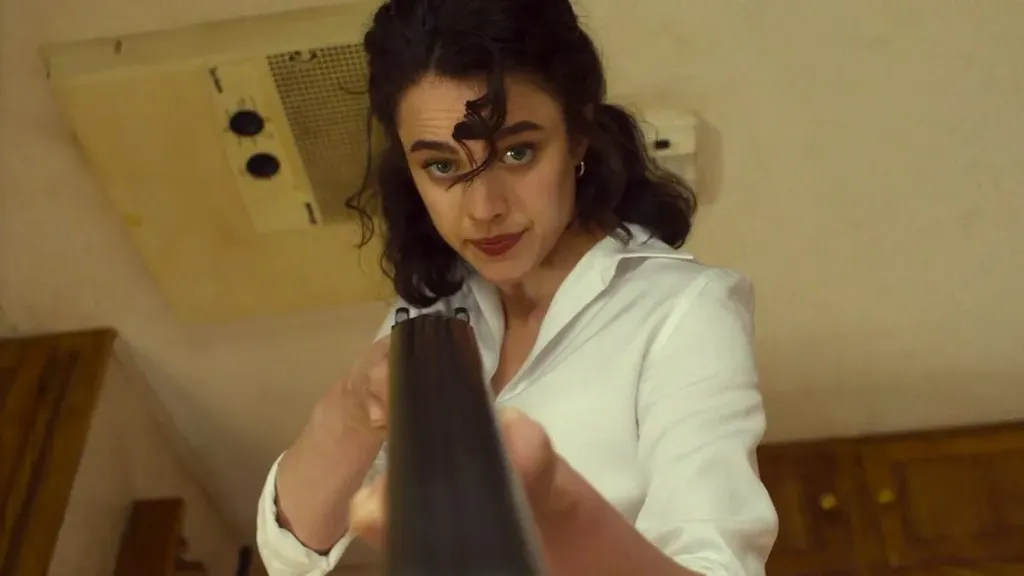
Honey Don’t! (15)
The second in the unconnected lesbian-noir trilogy by director Ethan Coen and his queer wife and writing partner Tricia Cooke, all three starring Margaret Qually but playing different characters. Here, the title taken from a Carl Perkins hit, driving a vintage turquoise Chevrolet SS, she’s Honey O’Donahue, a tough cookie gumshoe (gumshe?) in Bakersfield, California whose prospective client, Mia Novotny, is found dead in a car wreck the day they were supposed to meet, a previous scene showing a mystery woman removing a ring from her finger. The insignia links to the Four-Way Temple led by Reverend Drew Devlin (Chris Evans relishing his douchebag character), who uses his church as a cover for drug trafficking, for whom moped-riding Chère (Lera Abova) is the French liaison, and preaches a doctrine heavy on sexual healing, specifically him having sex with the vulnerable young women in his congregation. His evangelist spoofing sermon about macaroni is hilarious.
Getting Mia’s parents address from evidence room cop MG Falcone (Aubrey Plaza), Honey learns Mia was a church member. Another case, investigating a gay client’s unfaithful boyfriend, also links to the church when the latter’s run over by Hector (Jacnier), one of Drew’s middlemen, after refusing for the drugs he’s ordered, which, in turns, adds three more to the rising body count. Meanwhile, following a steamy fingering session in the local bar while discussing the difference between crochet and knitting, Honey’s having a passionate affair with Falcone, the pair bonding over their respective abusive fathers while, the disappearance of Honey’s niece, Corrine (Talia Ryder), herself beaten up her boyfriend, after being approached by a seedy looking man at the bus stop leads things into serial killer territory and an out of nowhere tone shifting plot twist.
Throwing in Kristen Connolly as Honey’s older sister Heidi, Gabby Beans as Honey’s assistant and a running gag involving homicide detective Marty Metakawich (Charlie Day) who keeps trying to set up a date with Honey despite her insisting she like girls, the haphazard narrative lurches through a variety of throwaway scenes, among them Honey’s father turning up looking to reconnect, that never really go anywhere even if they do keep the whipsmart repartee motoring, before it all wraps up with a bloody fight and shooting (and an unexplained swift recovery) and a final scene that would seem to be setting up further developments to unresolved plot points were it not for the fact no sequel’s planned.
The opening sequence is terrific, the names of the crew and cast appearing on billboards and building as, soundtracked by The Animals’ We Gotta Get Out of This Place, the camera roves through the dilapidated town in keeping with its retro chic style. But, Qualley aside, who sashays with a cool charisma like a lesbian Philip Marlowe, and despite some highly charged sex scenes, gay and straight, nothing else (parrot and window interface notwithstanding) rises to the same level. But then, it seems fairly evident that, much like Rodriguez’s grindhouse movies, Coen’s approaching his Chandlesque hard-boiled pulpy noir conventions with a tongue in cheek cockeyed flippancy, and as such, if you’re not looking any deeper, this is actually quite – if ultimately frustrating – fun. (Cineworld 5 Ways, NEC, Solihull; Mockingbird; Odeon Birmingham, Broadway Plaza Luxe; Omniplex Great Park; Royal; Vue)
ALSO RELEASED
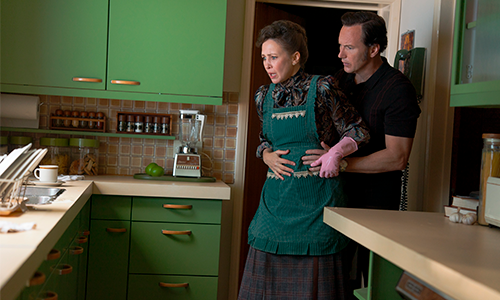
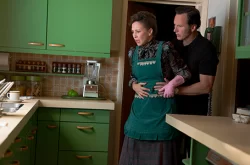
The Conjuring: Last Rites (15)
Twelve years and seven sequels/spin-offs on, the story of real life faith-driven paranormal investigators Ed (Patrick Wilson) and Lorainne (Vera Farmiga) Warren finally wraps up (and with it presumably the workmanlike Wilson’s days as a headline star, unless there’s more Insidious sequels in the pipeline) with the case that brought their active spook hunting days to end. Opening in 1964 , the pair (Orion Smith/Madison Lawlor) are checking out an antique wooden mirror with the carved heads of three babies, but when she touches it the glass cracks and she sees a vision of an entity and her unborn child. Immediately sending her into labour, their daughter, Judy is stillborn, but comes back from death after a minute, her parents subsequently embarking on their controversial and well-publicised (the two stars are inserted into a real Larry King interview with the Warrens) adventures.
Fast forward to 1986, and moving into a two-storey house in Pennsylvania (presumably unaware of the murders committed on the site), the Smurl family (I defy you not to think Smurfs) Jack (Elliot Cowan) and Janet (Rebecca Calder), her in-laws Mary (Kate Fahy) and John (Peter Wight), and their four daughters, teenagers Dawn Beau Gadson) and Heather (Kila Lord Cassidy), and the young twins, Carin (Tilly Walker) and Shannon (Molly Cartwright), celebrate Heather’s confirmation by gifting her that self-same, still cracked mirror, as you do. Almost immediately, things start to turn freaky, the ceiling light crashing down and the girls hearing voices and seeing shadowy figures, the older sisters eventually deciding to throw it out with the trash. Except, while crushed in a dumpster truck, the next day Dawn vomits blood and shards of glass and Jack is himself assaulted by an unseen force and then find themselves subject to a media frenzy. So, who you gonna call?
Well, apparently not the Warrens who, after Ed’s heart attack, have called it a day and now find themselves lecturing on the paranormal to a handful of bored attendees, and getting mocked as B-list Ghostbusters. However, inheriting psychic abilities from mum, Judy (Mia Tomlinson), who’s just got engaged to ex-cop Tony (Ben Hardy with half-hearted backstory) at her disapproving dad’s birthday bash, is starting to have vision of the Annabelle doll and an elderly woman. When old colleague Father Gordon (Steve Goult, one of several returnees and cameos from the franchise, many of them birthday/wedding party guests like Lili Taylor, Mackenzie Foy, Frances O’Connor, Madison Wolfe and Julian Hillard, alongside the real Tony and Judy and producer James Wan) fails to persuade the Warrens to help, he duly takes off to visit the Smurls himself. It doesn’t end well, with Judy having another vision at his funeral that sends her too off to the harassed family, and, hey, wouldn’t you know, that just what the demon wants. So, finally, off trot mum and dad to do their thing one last time. And guess what else has made a return.
Helmed by returning director Michael Chaves, all of this takes a punishingly and interminably slow 75 minutes with creaking doors, unlit rooms, haunted basements, possessed dolls and jump scare ghoulish faces desperately trying to sustain the creepiness before, the Smurls all but consigned to the sidelines, the last act finally opens the floodgates for axe wielding ghosts, sinks flooding blood, apparitions and general paranormal mayhem. It does eventually pay off and Wilson and Farmiga are duly committed to delivering the goods, but having had to sit through woeful dialogue that includes lines like “our family is not like other families”, “fetch the book” and the unintendedly hilarious “there’s something in the attic”, not to mention Howard Jones’ overly optimistic Things Can Only Get Better, you’d be forgiven for not sticking around after the real life footage of the Warrens and their cases, and a resume of their lives, and thus missing the end credit reveal of the mirror and the franchise’s title. Let’s just let the dead rest in peace. (Cineworld 5 Ways, NEC, Solihull; Mockingbird; Odeon Birmingham, Broadway Plaza Luxe, West Brom; Omniplex Great Park; Reel; Royal; Vue)
The Cut (15)
Generally remembered for his looks rather than his acting in things like the Pirates of the Caribbean and Lord Of The Rings franchises, Orlando Bloom turns in a revelatory career defining performance as an unnamed Irish boxer, dubbed “the Wolf of Dublin”, who, his chance of championship victory lost when he was momentarily distracted, now, ten years on, run a gym teaching young aspirant fighters with wife and former trainer Caitlin (Caitríona Balfe). While he’s a local celeb, happily posing for photos with the kids, he’s still hungry for the prize that got away. So, when a fatality opens up a contender slot for a title fight in Las Vegas, he approaches sleazy rules-bending promoter Donny (Gary Beadle) who offers him the opportunity. The only problem is he needs to lose over 30lbs in seven days to make the weight.
With no in the ring action other than the opening scene and its flashbacks (the climactic bout is only heard over a radio), directed by Sean Ellis, this is more a psychological thriller character study than sports movie, a boxing answer to The Wrestler, doing away with cliched inspirational training montages for a gruelling, physically and mentally demanding weight loss regimen that, with the dehydration it exacts, takes a punishing toll. Caitlin, herself the daughter of a former trainer to a father who wanted a son, initially takes charge of his training, assisted by his support team Manny (Ed Kear) and Jay (Oliver Trevena), but doesn’t believe they’ll meet the requirements in time and cares too much to put him through the wringer. At which point, Donny enlists Boz (John Turturro), a no-nonsense trainer with his own fierce demons and no emotional attachments to his boxers, ready to push them to their limits to get up to standard, even if that involves virtual starvation, blood-draining, relentless exercise, extreme sweating and even drugs proscribed by the boxing authorities. As he puts it, “We’ll squeeze your damn soul out if we have to”.
As the intensity mounts, Ellis introduces green-lit hallucinatory sequences and flashbacks to the boxer’s childhood with his single mother (Clare Dunne) during the Troubles and an incident that left him traumatised, the root of his fractured psyche. There’s also Lupe (Mohammed Mansaray), another fighter Boz is training who feeds the Wolf even more drugs and whose fate is kept deliberately ambiguous as, in order to shed the final ounces, the third act plunges into visually wrenching body horror.
The core performances are tremendous, Balfe the more centred and grounded of the three with Turturro playing Boz to the hilt and Bloom, cramming down chocolate bars then throwing them back up, his face, his every movement, a map of his pain, investing his whole body and soul into the physical and psychological maelstrom. A total knockout. (Cineworld 5 Ways, NEC; Odeon Broadway Plaza; Omniplex Great Park; Vue)
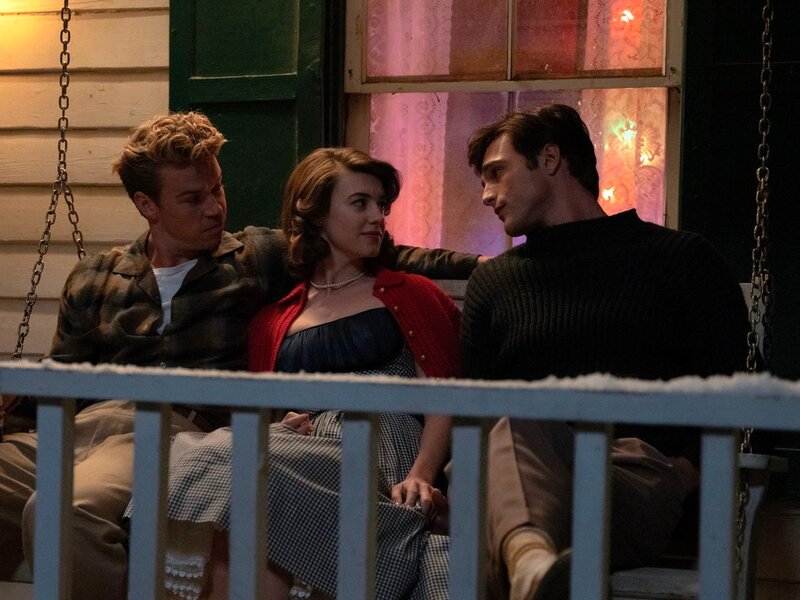
On Swift Horses (15)
Directed by Daniel Minahan from his adaptation of Shannon Pufahl’s 2019 novel about transgressing boundaries and the American Dream, set in the 1950s (with a matching cinematic style) around the Korean War, this is a sympathetic exploration of queer desires and repression, or otherwise, at a time when cruising bars were regularly raided by police and outed homosexuals publicly mocked for committing suicide.
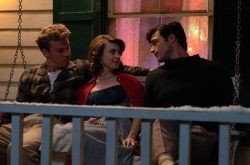
On Christmas Eve in Kansas, following the return of ne’er-do-well but charismatic Julius (a magnetically complex Jacob Elordi going all Montgomery Clift) whose just been discharged from the Navy without any pay, Muriel (a career best Daisy Edgar-Jones) agrees to marry his older war veteran brother Lee (Will Pouter). Given that she seems to have better chemistry with Julius, who teachers her to play poker, it initially looks like its setting up a love triangle. Until it becomes pretty clear that Julius is gay and a hustler for money with it. Lee wants Muriel to sell her mother’s house and for the three of them to build a new life together in San Diego, but Julius has other plans. Fast forward some years and Lee and Muriel have bought a house on a new development in California and Julius is in Vegas where, playing his card shark skills, he’s talked his way into a job spotting card sharpers in a casino. Meanwhile, Muriel’s gambling has progressed to horse racing, where she’s racking up the wins by listening to punters in the café where she works, amassing a tidy stash of cash that she keeps hidden from Lee in envelopes, claiming the money for the purchase came from selling her mother’s house.
Back in Vegas, Julius strikes up a secret relationship with fellow card sharp spotter gay Mexican co-worker Henry (Diego Calva), the pair sharing a motel room (at one point he tellingly takes Julius to watch a nuclear bomb test in the desert), until a scheme to cash in on their knowledge of cheating backfires. Meanwhile, an encounter with a woman at the racetrack who’s staying with her husband in a gay’s hang out hotel and, more significantly, her openly lesbian Latina farmer neighbour Sandra (Sasha Calle), who’s fighting to save her family home from being demolished for a new interstate, have unlocked her own queerness.
Minahan largely plays the physical sex in a low key manner, but the emotional fires burning in Julius and Muriel are well-stoked, with different consequences for them both and, although the film doesn’t end as violently as it might, its message about embracing a life you’re legally denied isn’t coated with happy ever afters either. As per the title, at some point a horse trots into the narrative, with whatever symbolism and metaphors you want to saddle it with.
The focus on Julius and Muriel means Poulter’s character is inevitably pushed into the background, but he remains the embodiment of America’s conservative picket fence family mentality against which the others are rebelling in their search for self-discovery, as the film pulls you into their worlds. (Cineworld 5 Ways; Odeon Birmingham; Omniplex Great Park; Vue)
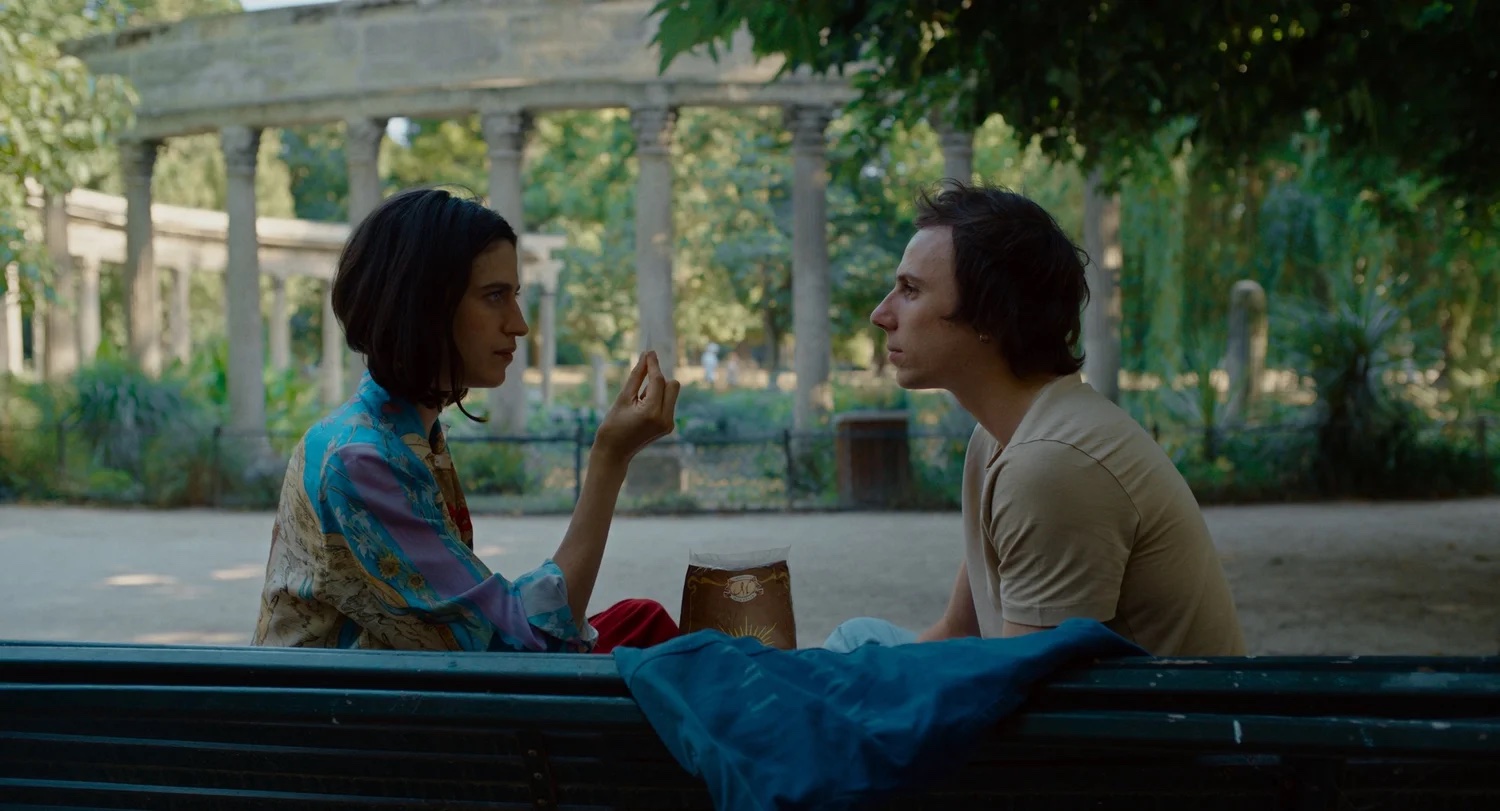
Paul & Paulette Take A Bath (12A)
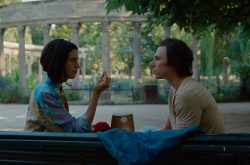
The feature debut of British-French writer-director Jethro Massey, the title a New Wave homage nod to Jacques Rivette’s Celine and Julie Go Boating, it demonstrates its impeccable taste from the outset with the pointed use of The Motels’ Total Control as an integral part of the soundtrack. With ambitions to be a photographer, Paul (Jérémie Galiana) is a young American in Paris who spots Paulette (Marie Benati), a stylish young French woman, kneeling down in the Place de la Concorde on the site of Marie Antoinette’s execution, imaging what it was like to be on the point of being beheaded. They strike up a conversation, he cutting her hair to bring more verisimilitude to her fantasy, discuss their love lives, her obsessions with Marie Antoinette and Elvis, and then part, he inviting her to his exhibition. When neither she nor anyone else turns up, he sells his cameras and takes up a real estate office job, resuming his affair with his now boss, the older, demanding Valérie (Laurence Vaissière). whom colleagues have nicknamed Goebbels.
They eventually hook up again, Paulette still nursing the hurt after being dumped by her on-off lover Margarita (Margot Joseph), taking a tour to experience first-hand the various crime spots around Paris (among them where the Communards were executed in 1871 and the site of the Bataclan terrorist attacks), accompanied by related photos, as well as a former 19th-century “human zoo” in the Bois de Vincennes that exhibited people subject to colonialism.
At one point, now occasional lovers, he drives her to see her parents in Salzburg, her dad remarking their names make them seem like siblings, which doesn’t end well given her racist mother (Fanny Cottençon) and at another, using his work connections they rent a Munich apartment where Adolf Hitler and Eva Braun reputedly lived, where, re-enacting, they take the titular bath. Later Paul will also rent an apartment once occupied by one of the Bataclan killers.
The film never really makes clear Paulette’s macabre fascinations to “touch the truths” and the frequent allusions to Nazism feel at odds with the otherwise Before Sunset-like romantic tone, but there’s a nice backstory touch as to why Paulette eats whole lemons and, the film ending with a stylish photographic montage, the fluid performances of the two leads have a chemistry that makes it well worth spending time in their company. (Mockingbird)
NOW SHOWING
Anora (18)
Written and directed by The Florida Project’s Sean Baker, this catapults Mikey Madison from supporting character roles to Oscar winner as Anora (the Hebrew word for light or grace) aka Ani Mikheeva, a stripper of Uzbek heritage living in Brooklyn’s Russian-speaking neighbourhood Brighton Beach. Materialistic and looking to the world of lap dancing at her upscale Manhattan strip club. So, as the only one of the girls who speaks passable Russian, she’s introduced to Ivan ‘Vanya’ Zakharov (Mark Eydelshteyn, Russia’s Timothée Chalamet), the spoiled, gangly, immature hard partying son of a wealthy Russian oligarch who lives in his parents’ lush gated mansion where he spends his time getting high, drinking and playing video games. Though vehemently denying she’s a prostitute, she takes up his lucrative offer for several bouts of sex, he then offering her $15,000 to stay with him for a week and pose as his girlfriend. This in turn finds them and his entourage flying to Las Vegas where he proposes (not least so he can get a green card and stay in America) and they end up getting hitched in one of the wedding chapels. So far so whirlwind romance as Ani quits her job to play shag-happy wife. However, when word gets out that Vanya’s ditched his clueless Russian-Armenian minders, Garnick (Vache Tovmasyan) and Igor (Yura Borisov), whose job it is to clean up the messes he makes, and rumours spread on Russian social media, his Orthodox priest godfather Toros (Karren Karagulianis) is ordered by Vanya’s domineering mother Galina Zakharovato (Darya Ekamasova) to find him and get the marriage annulled, she and her husband Nikolai flying over to America to take him back home. However, when his minders turn up, a coked-up Vanya does a runner and, after a lengthy apartment-trashing tussle (there’s a lovely moment as Igor tries to restrain Ani while respecting her personal space), they, Tonos and Ani set out to try and track him down, she reluctantly agreeing to $10000 in return for the annulment but hoping to convince everyone their love is real.
A cocktail of After Hours, Uncut Gems and Pretty Woman, with copious scenes of energetic screwing and liberal doses of black comedy, it’s a tad overlong to get going with perhaps more naked, gyrating lap dancing than are strictly necessary, but once the tragi-comic farce is underway it crackles with real energy and emotion. As the panicking Tonos, his beleaguered brother Garnick and tough but placid enforcer Igor, Karagulianis, Tovmasyan and Borisov (at times suggesting an Armenian Ewan McGregor) make for a wonderful comedic hapless trio and, while neither of the two central characters are especially likeable (both in it for what they can get), Eydelshteyn is immensely watchable as the brattishly entitled and shallow Vanya while Madison sets the screen alight as the smart, unsentimental but vulnerable Ani, giving the touching final shot a real hammer to the heart. (Sky Cinema)
Back In Action (12)
The title carrying a double meaning in that this is Cameron Diaz’s first film in 10 years, reaming with her Annie remake co-star Jamie Foxx, himself returning after being hospitalized, directed by Seth Gordon it’s a generic thriller that mines a familiar narrative involving kids who don’t know their parents are spies. Or at least they were. Fifteen years ago, more than platonic partners, she discovering she’s pregnant, CIA agents Emily (Diaz) and Matt (Foxx) narrowly escaped from a plane crash after apparently being betrayed by Baron (Andrew Scott, making the most of a thin role), an MI6 agent.
Resolving to retire, they’ve given up espionage and forged new lives and workaday mundane careers, now living in Atlanta with their two kids, snarky Alice (McKenna Roberts) and her younger rule-following techie brother Leo (Rylan Jackson). However, when a video of Matt losing his cool in a disco after discovering Alice isn’t actually studying with friends goes viral, their old handler Chuck (Kyle Chandler) turns up warning them their cover’s blown. But no sooner has he done so than he’s shot and the pair have to quickly grab the kids and hit the road, being pursued by both Polish KGB agent turned terrorist Balthazar Gor (Robert Besta) and his mercenary henchmen and Baron, who’s still nurturing a running gag crush on Emily, both believing they have the master-key, which they stole during Gor’s kiddies’s birthday party for his daughter, that will give its owner the ability to control any system in the world and which was never recovered from the plane wreckage. All of which means, clearly enjoying being back in the game, they have to, to the confusion of the kids, adopt new names and head to London to seek help from her long-estranged mother, Ginny (Glenn Close), a still formidable former British spy who’s living with her wannabe MI6 agent toyboy Nigel (an amusingly bumbling Jamie Demetriou as a nascent Johnny English).
Unfolding into a road movie with a series of brawls, parenting messages and boat and motorbike chases along the way, while it may be relentlessly rote there are some enjoyable spins, such as the couple improvising weapons out of a petrol pump, a bottle of Diet Coke and a tube of Mentos, an amusing joke at the expense of Jason Bourne and fights staged to Papa’s Got a Brand New Bag at the Tate Modern and Dean Martin’s Ain’t That a Kick in the Head as they literally kick thugs in the head. Trading off one another, Diaz and Foxx have palpable chemistry, Close sinks her teeth into the ham while Roberts and Jackson step up to the not exactly demanding mark as the kids finding mum and dad aren’t the bores they seemed. Undemanding fun, but fun nevertheless. (Netflix)
The Bad Guys 2 (PG)
A sequel to the 2022 Dreamworks animation, for late arrivals this opens with a brief catch-up detailing how, in a car heist and a fast paced Cairo car chase, critter criminals (motto – the heist is never about the loot), fast talking dapper Mr. Wolf (a superb Sam Rockwell), slippery safecracker Mr. Snake (Marc Maron), toxically flatulent Mr. Piranha (Anthony Ramos), unlikely prone to panic master of disguise Mr. Shark (Craig Robinson), and snarky hacker Ms. Tarantula (Awkwafina), were eventually caught and turned over a new leaf. Cut to the present and they’re down on their luck and a crappy car, unable to get jobs on account of their records Wolf goes for an interview at a bank he robbed three times), only a newly ripped Snake, who’s reinvented himself as a yoga-and-kombucha health fanatic, seeming upbeat.
Things proceed to get worse when they’re framed for a series of robberies carried out by the Phantom Bandit, alias snow leopard Kitty Kat (Danielle Brooks), who heads up a bad girls trio alongside raven Doom (Natasha Lyonne), the unwitting Snake’s girlfriend (kiddies’ eyes should be averted from their a make-out session), and literal-minded wild boar Pigtail Petrova (Maria Bakalova). They’re stealing a metal known (in a Hitchcock in-joke) as MacGuffinite, aiming to use its properties as a gold magnet to steal all the gold on Earth. It’s a plot that entails using a video of Wolf’s love interest, red fox state Governor, Diane Foxington (Zazie Beetz), that reveals her secret past as the Crimson Paw thief, to blackmail Wolf and his buddies into taking part in one last job, stealing one final MacGuffinite before hijacking the Moon X rocket from Musk-like tech billionaire (Colin Jost) and launching into space.
It’s a fairly twisty and convoluted plot, but it never loses momentum or sags, climaxing in a stunts-filled space sequence that adds a touch of Mission: Impossible and Moonraker to its Ocean’s Eleven meets Reservoir Dogs template. The voice cast and character chemistry is terrific, the core ensemble being augmented by the return of Alex Borstein as Misty Luggins, former Police Chief and now Commissioner, and Richard Ayoade as guinea pig villain Professor Marmalade, who, now in prison and bulked up, prompts a sly Hannibal Lecter homage when he’s visited by Diane. Visually dynamic, crammed with great gags, glowing with charm and sporting a very smart screenplay, it ends setting up a further sequel with our anti-heroes reconfigured as a team of anthropomorphic secret agents. Bring it on. (Everyman; Odeon Birmingham, Broadway Plaza Luxe; Omniplex Great Park; Reel; Royal; Vue)
The Ballad Of Wallis Island (12A)
Expanded from James Griffiths’ 2007 short The One and Only Herb McGwyer Plays Wallis Island, and co-written by its stars Tom Basden and Tim Key, this is a very British and very funny low key comedy.
Basden is the aforementioned Herb, a once famous folksinger and one half of a Buckingham-Nicks-like duo McGwyer Mortimer (though Baez and Dylan are the more likely touchstone) before they split nine years ago as he embarked on a (crassly commercial) solo career who, in the opening, is ferried by rowboat to a small – fictional –Welsh island where he’s been booked – for £500,000 – to play a private gig, the money needed to fund his new album. He’s not expecting it to be for an audience of one, Charles Heath (Key), a geeky two-time lottery millionaire winner superfan with poor social awareness and boundary issues and a predilection for appalling puns (when Herb falls in the sea he dubs him ‘Dame Judi Drenched’, and refers to his rider – pickled onion Monster Munch, Braeburn apples and Johnnie Walker Blue Label – as a Winona), in whose sprawling mansion he’s to be staying. “I’m in Misery, I’m going to wake up with no ankles” he tells his manager from the payphone.
Nor, more pointedly, is he expecting to be reunited with his former personal and professional partner Nell Mortimer (a wonderfully warm Carey Mulligan), who Charles has also booked (at a lower fee, since she didn’t write the songs) in the hope of a permanent musical reunion (that she arrives with her American husband – Akemnji Ndifornye, swiftly dispensed to go birdwatching), stymies any romantic one, though there is a brief spark of resurrected attraction).
As a lonely, melancholic soul with a sad widower backstory and a shyness that won’t allow him to bring himself to act on his feelings for Amanda (Sian Clifford) who runs the island’s solitary store (cue a running gag about rice to dry out Herb’s phone) and is blissfully unaware of things like Reese’s Peanut Butter Cups (she offers Herb peanut butter and a cup), Kay brings deep poignancy to Charles as the film navigates themes of love, loss, growth, the difficulty in reconciling with the past and the transformative and healing power of music, all to a stunning rustic backdrop and a winning collection of songs, Basden and Mortimer in glorious harmony.
With echoes of Local Hero and John Carney films such as Flora And Son, Once and Sing Street, beautifully acted and as emotionally on point as it’s gently humorous, it’s one of the year’s loveliest films. (MAC)
Blitz (12A)
When your star is Saoirse Ronan, it’s going to takes real effort to sink the credibility and quality she brings, but, his third feature after 123 Years A Slave and gritty crime thriller Widows, which were followed by the acclaimed Small Axe TV series and documentary Occupied City, Steve McQueen does rather fumble the ball with this tonally uneven and at times clunkily written wartime drama.
Set during the London Blitz of WWII, Ronan plays Rita, the mother of nine-year-old bi-racial George (a winning Elliott Heffernan), her Grenadian partner Marcus (CJ Beckford, seen in a hot club dance flashback), in absentia, living with her dad Gerald (Paul Weller in a decent acting debut and getting to sing Ain’t Misbehavin’ round the old joanna) in Stepney and working in a munitions factory where, a decent singer, she gets to perform for a Down Your Way-like morale-boosting BBC outside broadcast before her feisty fellow workers take the opportunity to call for better civilian protection against the air raids instead of locking the Underground stations.
When, on account of the bombing, London’s children are packed off as evacuees, George, feeling guilty at the way he angrily treated her for sending him away, jumps off the train and sets off to walk back to London. It’s a picaresque journey of adventure and self-discovery that will involve him with Ife (Benjamin Clémentine), a kindly Nigerian ARP warden (who he meets in a particularly clunky scene in an arcade with dioramas portraying Africans as savages), and, in less friendly circumstances, an embarrassing subplot straight of Oliver Twist involving a gang of Cockney scavengers (Stephen Graham and Kathy Burke hamming like panto villains) who enlist him to pilfer the corpses’ pockets in the bombed out ruins.
Meanwhile, back home, Rita’s helping out in shelters set up by socialist community organisers and, learning George has done a runner, going frantic and determined to find him. Added into her story is Jack (Harris Dickinson), a shy firefighter with a crush on her, but that never really goes anywhere.
Cobbling together the old-fashioned spirit of The Railway Children, Powell and Pressburger, and the those Children’s Film Foundation films, when not indulging in period drama cliches (and Haley Squires as Rita’s Cockerney sparra colleague) and repeatedly showing close-ups of bombs on their way to cause devastation, McQueen lurches from a sentimental road movie in the manner of Disney’s The Incredible Journey with a plucky child instead of animals to broad brush commentary about the era’s casual racism (George’s often called a monkey. There’s moments when, such as the scenes at a ballroom after a bombing with the hoi polloi in frozen death postures, crowds trying to escape a flooding tube station, and the opening shot of a fireman trying to grapple with an errant hose, he manages to capture wartime authenticity, but mostly it’s all rather politely tableaux through which Ronan wanders. All that and some surrealistic images of flowers. A cosy if at times uncomfortable Sunday afternoon watch in front of the telly, but for McQueen a major disappointment. (Apple TV+)
Carry-On (12)
Though indisputably Die Hard lite (or more accurately, given the time and setting, Die Hard 2), taking time off from having Liam Neeson kill people, set on Christmas Eve director Jaume Collet-Serra turns in some watchable if credibility stretching B-movie action hokum anchored by a central cat and mouse battle of wits between Taron Egerton and Jason Bateman.
The former is Ethan Kopek, sleepwalking through life as a Transportation Security Administration agent at Los Angeles International Airport after being rejected for the police academy after concealing his father’s criminal history. He’s given a wake-up call when his girlfriend Nora (Sofia Carson), who’s just been promoted to a senior role at the airport, announces she’s pregnant. To which end, he finally asks his boss (Dean Norris) about possible promotion and more responsibility and is given a trial period in charge of scanning luggage on one of the security lines, substituting for his friend and co-worker Jason (Sinqua Walls), and dealing with a steady stream of obstreperous passengers.
This, as it turns out, is rather unfortunate, since Bateman’s character, only ever known as the Traveller, had put in place a plot to force Jason, whose family he was going to imperil, into letting a passenger’s suitcase pass through unchallenged. So now, instead of Jason, Ethan becomes the mark, with Sofia’s life as the bargaining chip. And, after initially assuming it’s a prank, with his every move monitored by the Traveller’s sniper and surveillance accomplice (Theo Rossi), who’s holding someone captive in his van, with no way of alerting anyone, he reluctantly agrees to play ball, placing Nora’s life above the lives of everyone on the plane. What he doesn’t know is that the case, carried through by one Mateo Flores (Tonatiuh), contains a vial of Novichok, the world’s most lethal nerve gas. Meanwhile horrified to learn on the case’s contents, having framed Jason as drinking on the job in order to get back on the security line, Ethan is now frantically seeking a way of foiling the plot, but the Traveller, who’s feeding him instructions via an ear piece, is always one step ahead, as the death of the cop he passes a message to illustrates.
And as he racks his brain looking for a solution – finally confronting the Traveller, in his black coat and hat, who is clearly in total control, having investigated a fire that took the lives of two Russian mobsters at the start of the film, dogged LAPD detective (Danielle Deadwyler) has intuited something’s not right and called in Homeland Security as she starts putting all the pieces together, trying to figure out who the bomb may be targeting. It’s not a huge surprise to learn everything’s down to corporate profits.
There’s a few twists written in to its otherwise fairly simplistic narrative as not everyone involved turns out to be a bad guy while Collet-Serra throws in some messy but thrilling action sequences, variously involving a showdown among the luggage belts and an in-car struggle set to Last Christmas. It’s not one that stands up to scrutinising the logic, but Egerton again effortlessly carries off the action hero, albeit here a reluctant one, while Bateman sinks his teeth into a rare chance to play the villain, amusingly offering Ethan relationship advice in-between his demands. Ultimately, they’re not McClane and Gruber and there’s no rousing yippee ki-yay moment, but the film ably rises above the baggage it’s carrying. (Netflix)
Caught Stealing (15)
Adapted by Charlie Huston from his own 90s set novel and directed by director Darren Aronofsky, the title is a baseball term for when a runner is tagged out before reaching second base, third base or home plate, the runner here looking to get to safety being Hank Thompson (Austin Roberts), a California-bred, New York bartender and Giants fan whose promising baseball career was cut short when, swerving to avoid a cow, he hit a post killing his high school friend and fellow contender and shattering his knee, something that still gives him nightmares, wallowing in guilt and self-pity. A good guy who gives money to the local wino, he works as a bartender for biker boss Paul (Griffin Dunne), lives in a Lower East Side apartment building and is dating feisty paramedic Yvonne (Zoë Kravitz). One day. He comes home to find his next door neighbour, Russ (Matt Smith, giving it large), a British punk with an orange mohawk haircut, asking him to look after Bud (Tonic, who was the moggy star of Pet Sematary), his bad-tempered cat who bites everyone but Hank, while he flies back to London to see his sick father. But then a couple of bald Russian mob goons, Aleksei (Yuri Kolokolnikov) and Pavel (Nikita Kukushkin), aka Microbe, who work for Puerto Rican gangster Colorado (Benito A Martínez Ocasio aka rapper Bad Bunny), turn up looking for Russ and proceed to give Hank such a beating he ends up hospital having had a kidney removed (not good someone fond of booze).
It transpires they’re looking for a key (which, it turns out Russ hid in a plastic turd in Bud’s litter tray) which will unlock the location of a serious stash of drugs money, and they’re not the only ones, there’s also cooly assured Detective Roman (Regina King), who reveals Russ is a dealer, and Hasidic hitmen brothers Lipa (Liev Schreiber) and Shmully (Vincent Donofrio) Drucker, any or all of who, are willing to kill those close to Hank – or give the cat a kicking – to get what they’re after, as the film journeys from Flushing Meadows and Queens (and Shea Stadium) to Coney Island and Brighton Beach in Brooklyn.
Hank more of an everyday troubled joe than some John Wick type, Butler is magnetic without being flashy, the film a slow burner about personal redemption with a mostly dark lighting, the violence brutal and lethal, the humour pretty much the same as Aranofsky gradually ratchets up the tension, pace and odds, with Russ returning to reveal what the key unlocks, then Hank losing it after falling off the wagon. As the assorted mobsters close in, Hank, who’s still handy with a bat, does his best to stop anyone else getting hurt. Guy Ritchie seems to be a touchstone for some of the humour, not least Hank and the brothers visit to their mother Bubbe (Carol Kane) for Shabbos dinner, she taking a shine to him, and a running gag with Hank constantly phoning his baseball fan mother (an uncredited cameo surprise in the final frames) to assure he’s ok, always ending with “Go Giants”. There’ also a couple of intense metal crushing front on car and post interfaces unlike any you’ve seen before. I definite home run. (Cineworld 5 Ways, NEC, Solihull; Odeon Birmingham, Broadway Plaza Luxe; Omniplex Great Park; Vue)
Companion (15)
After a spate of films sounding warning notes about AI, writer-director Drew Hancock impressively flips the narrative from perpetrator to victim in a cautionary tale about technology and relationships woven with a commentary on toxic masculinity.
Meeting romcom cute in a supermarket, Iris (Heretic’s Sophie Thatcher) is in a relationship with underdog nice guy Josh (The Boys’ Jack Quaid), though there’s something uneasy about how, docile and submissive, she professes she’s wants to ensure all his wants and desires are fulfilled. Her opening voice-over sets you up for that’s to come as she says the two most important moments of her life where when she met him and when she killed him.
They’re off on weekend getaway to a remote luxury home owned by adulterous billionaire Russian Sergey (Rupert Friend with bristling moustache and thick accent), joined by Josh’s standoffish ex Kat (Megan Suri), who’s also Sergey’s girlfriend, and, also in their first flush of romance, mutually besotted gay couple by catty Eli (Harvey Guillén) and the hot but dim, anxious to please Patrick (Lukas Gage), who coincidentally also have their own meet-cute, although Iris feels uncomfortable and unwelcomed in their company. Well, not that unwelcomed by Sergey who, alone by the lake, attempts to rape her. We next see her walking back into the house, covered in his blood. At which point the film upends everything to reveal that Iris is in fact a humanoid, a lifelike fuckbot companion Josh is renting (flashbacks show her being delivered and programmed – her intelligence, level of aggression, voice, etc., all remotely controlled), theoretically programmed to not harm humans,.
It turns out that killing Sergey, apparently a drugs dealer, also throws a spanner in the works regarding the real reason the others are there, namely to steal $12million. But, as events spiral out of control into a cat and mouse battle of wits and survival between them and Iris, that’s not the only secret being hidden, but to reveal more would spoil the thrills as they unfold.
Thatcher is terrific in the way she handles Iris coming to terms with who or what she is (learning her tears are just fed from an internal reservoir), gaining Josh’s smartphone app controls and trying to become autonomous and overcome the restrictions of her programming and the feelings with which she’s been implanted. Playing counter to his character in The Boys, Quaid is also compelling in Josh’s mix of spinelessness and ruthlessness, and while Suri’s character is less developed, Guillén and Gage throw some clever curves as things develop.
Sporting an ingenious screenplay and working with themes of manipulation, appearances and reality, control, emotional abuse, the weaponisation and commodification of feelings and , it consistently takes off in unexpected directions, fusing moments of comedy with ones of sudden violence and horror. (Apple TV+)
Conclave (12A)
Peter Straughan’s take on the Robert Harris novel , despite a seemingly unpromising plot pivoting round the election of a new Pope, directed by Edward Berger this is a grippingly tense thriller about faith and the nature of and desire for power and unequivocally one of the year’s best films, its success in America a welcome reminder that, amid the familiar CGI-littered blockbusters, there’s still an audience for intelligent, thought-provoking filmmaking.
The central figure is the conflicted Cardinal Lawrence (an inscrutable, nuanced turn by Ralph Fiennes), who, when the Pope dies in his room in Domus Sanctae Marthae, is charged with overseeing the conclave, an assembly of fellow cardinals who, sequestered in the Sistine Chapel, charged with electing his successor (a problematic task foreshadowed by the difficulty in removing the Papal ring). It’s not a position Lawrence, whose resignation from his post as Dean of the College of Cardinals amid his crisis of faith in the church the Pope had refused, welcomes and he certainly harbours no ambitions for the position himself. That’s not the case, however, for the narrow-minded Tedesco (John Tuturro lookalike Sergo Castellitto) who wants to return the Papacy to the old, pre-liberal days with everything in Latin, or Tremblay (an almost salivating John Lithgow),who lusts for the power it brings. Lawrence’s fellow liberal friend Bellini (an edgy Stanley Tucci) claims he’s not a viable candidate, but for the sake of the Church, would rather himself than his rivals. Also in contention is the equally conservative and homophobic Nigerian Adeyemi (Lucian Msamati).
Amid the conspiratorial machinations, matters are complicated by Lawrence learning that Tremblay apparently had a meeting with the Pope just before he died and was apparently sacked for conduct unbecoming, though he insists this never happened. There’s also an incident with Adeyemi and a nun from Nigeria who was flown in to the Vatican at the express wish of one of his rivals. With all the cardinals secluded from any outside communication and forming their own cliques, as a web of secrets unfolds, there’s also the surprise arrival of the soft-spoken Mexican cardinal Benitez (Carlos Diehz) who wasn’t on the list and whose posting in Kabul was unknown to all and who, it transpires, had a planned visit to Switzerland paid for by the late Pope. All of this is being quietly observed by the head nun, Sister Agatha (Isabella Rossellini, scene stealing in an almost dialogue-free role).
As Lawrence stars digging into the rumours, while becoming increasingly worried that he’s getting votes himself, working with Bellini to try and stave off the election of either Tremblay or Tedesco, more hidden secrets come to light and there’s more coldly calculated backstabbing, as, bolstered by a tremendous score from Volker Bertelmann, Berger ratchets up the suspense to nail-biting levels while the screenplay throws up provocative debates about the state of the Roman Catholic Church in present times, as well as a sudden .intrusion by political events beyond the Vatican walls.
Amid the raft of outstanding performances, Fiennes gets a terrific sermon, declaring that he fears certainty to be the biggest threat to faith and encouraging the cardinals to embrace doubt while, amid the sea of red robes and detailed rituals, there’s some riveting visual moments, most notably an overhead shot of the cardinals gathering in the courtyard with white umbrellas that could easily become an iconic poster. Climaxing with a twist you’ll never see coming, it’s a masterclass in filmmaking and storytelling. (Amazon Prime)
The Damned (15)
With an unnerving score from Stephen McKeon and Eli Arenson’s striking cinematography, the feature debut by Icelandic director Thordur Palsson is one of the best of the recent best horrors, at times evoking thoughts of M.R.James. Set in 19th century Iceland with an atmosphere so thick it threatens to choke you, it centres around a shipwreck just off the coast that serves as home to a small fishing community. It’s winter and times are hard, food scarce and the weather murderous. Seeing the wreck, the villagers are divided, some say it’s their moral duty to rescue the survivors, others take the pragmatic view that, with scant food supplies already, doing so would threaten their own survival. It’s the latter view that wins the day and ships are not put out, However, when they do take to sea the next day hoping to recover the ship’s barrels of salt pork, they’re shocked to discover that some of the sailors have made it to the jagged rocky outcrop known as “The Teeth”, and when they try to get aboard they have to be beaten off and left to drown, though it also costs the life of their helmsman Ragnar (Rory McCann).
When the bodies eventually wash up (a shocking scene suggests one’s still alive but the stomach moments prove to be an eel that got inside the body), they’re buried on the beach, the elderly superstitious Helga (Siobhan Finneran) telling that they must have their hands tied with rope, their feet nailed down, and their wooden coffins rotated three times in order to confuse their spirits and prevent them returning as Draugr, undead creatures of Nordic lore composed of skin, bone and blood, only capable of being destroyed by fire. What follows is a series of mysterious deaths and suicides as well as unnerving visions of a black figure that are inevitably taken to be rooted in hauntings by the drowned men. The truth proves both less and more horrifying. As Daniel (Joe Cole), who becomes the new helmsman says, the living are more dangerous than the dead.
Morality play and psychological horror, it’s a spartan affair, cold and dark, steeped in shadows and mist, drawing on folklore superstition and guilty paranoia alike, given gutsy strength by a strong cast led by Odessa Young as Eva, a young but steely widow who’s in charge of the fishing boat and gets to make the decisions, and Joe Cole as Daniel, their mutual feelings throwing up another ethical dilemma that further stokes the simmering tensions amid a community founded on tough masculine values and survival through strength. Damned good indeed. (Sky Cinema)
Den of Thieves: Pantera (15)
A sequel to the 2018 original, inspired by the 2003 Antwerp diamond robbery, this reteams writer-director Christian Gudegast and its stars Gerald Butler and O’Shea Jackson Jr as testosterone sweating LASD sheriff ‘Big’ Nick O’Brien and cool master thief Donnie Wilson for another heist drama styled on Michael Mann’s Heat and its macho interplay between the two leads.
Just divorced and apparently put on leave, Big Nick, blackmailed by the girlfriend of Federal Reserve robber Merriman who wants her cut of the loot Donnie made off with, apparently in a Panama bank, heads to Nice where, armed with an expired international marshal’s badge and struggling with how to pronounce croissant, and working with the local task force led by Detective Hugo (Yasen Zates Atour) he intends to track him down. Donnie, meanwhile has hooked up with The Panthers, a criminal gang of Balkans who codenamed Pantera by the French cops and fronted by Jovanna aka Cleopatra (Evin Ahmad), intend to rob the ultra-secure and heavily guarded vault at the World Diamond Centre, to which end he’s posed as a high flying diamond dealer to infiltrate the bank where Chava (Nazmiye Oral), the wife of the vault concierge Olivier (Stéphane Coulon), is their insider, but can’t get initially access to the vault itself.
Having flirted with Jovanna at a night club (and getting into a fight with her ex, Marko who’s subsequently ejected from the Panthers along with his buddy Vuk, forming a rival gang), and convincing Donnie’s he’s had enough of the cop life and wants in on the heist, Nick too becomes part of the gang, its members using code names Houdini and Ronin (a John Frankenheimer reference) as they weigh in on a meticulously detailed plan to break into the vault.
Matters are complicated however by the fact that the Calabrian mafia, headed by The Octopus (Adriano Chiaramida) are after Donnie for stealing a red diamond from them in the film’s opening Antwerp sequence, demanding its return and setting up one of several high octane action sequences.
However, while there may be car chases and gunfights, the film’s prime and intense focus is on how, while Jovanna and her right hand man Dragan (Orli Shuka) keep surveillance, Nick, Donnie and Slavko (Salvatore Esposito) break into the vault by coming at from above after scaling the rooftops, the tension piling on as they negotiate the red and green light status to move from one location to the next. Added to which, echoing Heat, there’s those long alpha male bromance dialogue scenes, a lengthy backstory about their respective fathers included, between Nick and Donnie who, for some reason (and underscoring the sexual tensions), he keeps calling Fraulein which plays into the film’s criminal/cop moral ambiguity and con inside a con narrative.
Despite clocking at around 140 minutes, there’s not a second of filler, the yin and yang chemistry between the composed and calculating Jackson and the volatile Butler giving off high voltage sparks mesmerisingly compelling, the ending setting up a potential and highly welcome threequel reuniting all the Panthers for another ingenious heist. (Amazon)
Eddington (15)
Having announced himself as a promising new master of disturbing psychological horror with Hereditary and Midsommar, writer-director burst the bubble with the self-indulgent paranoia tragicomedy Beau Is Afraid and continues on the same losing stream with this even more laborious overlong state of the nation satire that, set against a backdrop of 2020 Covid lockdown, throws in everything from online conspiracy theories, George Floyd, Black Lives Matter and social polarisation to liberal-white privilege and guns in the hope something will stick.
It unfolds in the fictional New Mexico small town of Eddington where the reactionary local sheriff Joe Cross (Joaquin Pheonix) and the progressive mayor Ted Garcia (Pedro Pascal) are at loggerheads over personal liberty and mandatory masks, Cross arguing that it’s not helpful for anyone with asthma, like himself, and anyway there’s been no cases in the area at all. He also resents Garcia’s support for a planned environmentally dodgy, resource-absorbing data centre that’s got a hostile reception from the indigenous locals. There’s also the fact that Garcia has history with Cross’s wife Louise aka Rabbit (a virtually redundant Emma Stone), aa troubled artist who paints creepy looking dolls and suffers from hysteria and depression and whose mother Dawn (Deirdre O’Connell), now part of the lockdown bubble, is a conspiracy theorist (the Titanic was no accident) and social media addict mom with connections to cult leader Vernon Jefferson Peak (Austin Butler) who encourages his follows to dig up suppressed memories of child abuse. When Cross decides to run for election as Mayor (free our hearts is his mantra), driving round with conspiracy theories and bad grammar plastered across his jeep, things get even more tense.
Added to the character cocktail are Garcia’s brattish teen son Eric (Matt Gomez Hidaka) who’s dating social justice warrior Sarah (Amélie Hoeferle) who’s riddled with guilt for dumping bitcoin obsessed boyfriend Michael (Micheal Ward) because he’s become a cop, even though he’s Black. Plus there’s Eric’s best fried Brian (Cameroan Mann), another social justice warrior, Cross’s aggressive racist deputy Guy (Luke Grimes), Native American cop Butterfly Jimenez (William Belleau) from the Pueblo Reservation who, naturally, is the target of white cop prejudice, a deranged and violent homeless man whose altercation with Cross goes viral, and assorted disaffected wannabe do-gooder teens.
Framed as a contemporary Western, all this unfolds over an interminable and doggedly dull two acts devoid of any real tension before, following an abrupt plot twist and two murders, the third act finally injects life – not to mention shoot-outs, explosions and an Antifa hit squad – into proceedings. Visually it’s handsome looking and somewhere amid the screenplay (which has a few brief flashes of Trump) there’s themes about connection, communication breakdowns and alpha male anxiety alongside flashes of black humour, but the end result is just a chaotic mess of ideas that never forms a coherent narrative. (MAC; Mon/Wed: Everyman)
F1 The Movie (15)
Having taken to the skies for fast planes in Top Gun: Maverick, director Joseph Kosinski now returns to the ground for fast cars, the actors again actually behind the controls, for this formulaic but adrenaline-spiking brand-endorsed Formula One motor racing comeback redemption melodrama, with Lewis Hamilton as a producer as well as cameoing as himself along with all ten Formula One teams and their drivers in the 2023 season.
Swapping out Tom Cruise for Brad Pitt as the older guy showing the rookies how it’s done, he plays Sonny Hayes, a former F1 hotshot (cue de-ageing into blonde boyish flashbacks) until a near fatal crash took him of the track, spending the next 30 years as a professional (if unsuccessful) gambler, New York cabbie with a string of failed marriages (the press conference slyly plays off Pitt’s one personal track record) and, now, living out of his camper van and a nomadic racing driver for hire. His past catches up with him when his former racing buddy Ruben Cervantes (Javier Bardem), now owner of the APXGP F1 team but unlikely to be for much longer if their current piss poor run continues. He wants Sonny back in the seat with his old school magic, a move that, when he turns up at Silverstone, is met with sniffy disapproval by devious board member Banning (Tobias Menzies) and open disdain by skilled but cocky and insecure rising star Joshua Pearce (Damson Idris) who seems him as a threat to his No 1 driver status. A feeling shared by his protective mother (Sarah Miles) who declares Sonny as not a has-been but a never-was, With negative press, a “shitbox” of a car and driver friction, staying on the track let alone in the series will prove a real challenge.
Anyone familiar with sports movies can probably see the rest of the narrative coming as Hayes and Pearce butt heads before the latter learns to work together as a team as things head to the Grand Prix finale in Abu Dhabi, Sonny mixes things up with his, er, maverick, attack tendency to throw the rule book out of the car cockpit, some board member backstabbing and, of course, not forgetting the obligatory romantic interest, here in the form of a sterling Kerry Condon as APXGP technical director Kate McKenna who both gets to build the game changing supercar and play with Sonny’s gearstick.
Bringing his familiar sexily cool nonchalance to a character in it for the rubber burning moment of transcendence rather than the money and glory, Pitt exudes high octane charisma ably supported by a suave but panicking Bardem and the resentful, competitive Pearce, even if the latter’s character is less well-developed. There’s top gear back up too, notably Kim Bodnia as team principal Kaspar Smolinski, Will Merrick as Sonny’s race engineer, Abdul Salis as chief mechanic Dodge and Callie Cooke as tyre gunner Jodie who’s miscalculation in the early stretch afford a running narrative thread.
Fuelled by a stupendous Hans Zimmer score and opening set to Zeppelin’s Whole Lotta Love, at two and a half hours is well overlong but between the breath-taking race action, much from the driver perspective (filmed with mini-IMAX cameras), complete with crashes and those superfast tyre/parts changes, there’s also plenty of off-track personal dramas to keep you engaged. More pointedly, while most racing movies focus on the racing, this is equally balanced with the strategies and engineering mechanics involved in getting past the chequered flag first. As such, this is laps ahead of things like Days Of Thunder, Le Mans and Gran Turismo even if, for all the amusing Hayes/Pearce macho sparring and banter, it never quite rises to the same character dynamics as the Hemsworth/Bruhl classic Rush. Nonetheless, this is a Pitt stop you won’t want to miss. (Odeon Birmingham)
The Fantastic Four: First Steps (12A)
The fourth attempt (fifth if you include Roger Corman’s unreleased version), is, without damning with faint praise, far better than the previous three, even if the basic plot (the team have to battle the Silver Surfer and prevent Galactus (Ralph Inseson) devouring the Earth) parallels, the 2007 entry. Except this time, the twist is that he will spare the planet if Sue and Reed will give up their newborn son, Franklin, who apparently (though Reed can find no evidence) has the latent cosmic power to release Galactus from his hunger.
Directed by WandaVision’s Mark Shakman, like Superman is largely dispenses with an origin story, a TV show (presented by a nebbish Mark Gattis) sketching in that it’s been four years since they got their powers and signature blue and white costumes: socially awkward scientist Reed Richard (Pedro Pascal, elasticity), all cardigans and ties, feisty wife Sue (Vanessa Kirby, invisibility and force field projection, street cool brother Johnny Storm (Joseph Quinn) aka the Human Torch who can burst into flames (but is no longer the cocky hothead) and pilot Ben Grimm (Ebon Moss-Bachrach) who gained super strength but at the cost off being turned into an orange rock figure but, a kiddie loving funster, is no longer full of self-pity. A brief montage details their battles with villains like the Puppet Master, the Red Ghost’s Super Apes and Mole Man (Paul Walter Hauser), ruler of Subterranea, who will prove a plot point later on. All of which has made them, based in the Baxter Building, the planet’s beloved protectors, Earth 828 (more parallel dimensions, set in a 60s retro Manhattan) refreshingly having no other superheroes.
The celebration of Sue’s pregnancy (apparently after years of trying) is quickly overshadowed however with the arrival of the Galactus’s herald, the Silver Surfer, here as Shalla-Bal (Julia Garner) rather than Norrin Radd, who gave up her humanity to save her planet. She’s a bit of a turn on for Johnny, but the dampener is her announcing that Galactus is coming to eat their planet, has he has done countless others.
As with Superman, while there are big set pieces with wormholes and trashed buildings, this is very much a character piece about a tight knit family ready to sacrifice themselves (though not or one their child) for one another, and the quartet’s chemistry with its spats, ribbing banter and solid bonds is one of the reasons this really works. There’s also childbirth in space, surely a first.
Not all if it works, I wasn’t persuaded that, while a character from the comics, their pet robot H.E.R.B.I.E. was entirely necessary while calling Natasha Lyonne’s synagogue elementary teacher Rachel and Ben’s romantic interest rather than Alicia Masters a cameo would be greatly overstating things Also, while 7Up and Canada Dry get product placement, it does seems a touch crass that the FF have shoes that leave a 4 imprint in the ground. Mind you the running ‘It’s clobbering time’ gag is a beaut.
As with the previous film it builds to monumental climax that has Shalla-Bal finding her soul and still sees Sue being killed, though her resurrection here as a far more poignant mother-child resonance. A credits sequence with Franklin and a cowled figure holding an iron mask sets things up Avengers: Doomsday, but these first steps are a giant leap for the MCU. (Cineworld 5 Ways, NEC, Solihull; Odeon Birmingham, Broadway Plaza Luxe; Omniplex Great Park; Reel; Vue)
Freakier Friday (PG)
Twelve years on from the body-switch remake, Jamie Lee Curtis and Lindsay Lohan reunite for another bout of fish-out-of-water bonding, this time upping the ante with four not two characters trading places as they get to learn life lessons about family and parental relationships as they get to see each other’s lives through different eyes. Directed by Nisha Ganatra, there’s three generations involved. Now a single mum, Anna (Lohan) has quit her rock star dreams as frontwoman of Pink Slip (though she’s still a high-powered Los Angeles music manager) to raise teen daughter Harper (Julia Butters) although her spiky therapist helicopter mother Tess (Curtis) is constantly intruding. Meeting in the principal’s office following a chemistry class incident involving their respective daughters, Anna and widowed English celebrity chef Eric (a blandly anonymous Manny Jacinto) fall in love and set a wedding date, planning to move to the UK. Harper, naturally, resents the idea of uprooting her life while, still grieving her mother’s death and resentful of being in LA, Eric’s mean girl fashionista daughter, Lily (Sophia Hammons) most certainly doesn’t want a stepsister, the pair constantly feuding with each other.
While attending her bachelorette party, both Anna and Tess and Harper and Lily have separate sessions with a dotty multi-hyphenate psychic (Vanessa Bayer) who joins their palms together, warns about their fractured lives and advises the teens to find out where their hearts belong. And on Friday morning, three days before the wedding, they wake up to discover they’ve switched bodies. Harper with Ann and Lily with Tess, the teenagers uniting in a mission to get the wedding called off while the adults try to ensure it keeps to schedule.
It’s an inevitably convoluted plot, one which also involves Anna’s pop star client Ella (Maitreyi Ramakrishnan), who has a major tour upcoming, having a meltdown after her ex dumping her and writing a song putting her down, and, Lily as Tess trying to rekindle the spark between Anna and her record store high school boyfriend Jake (Chad Michael Murray), though he seems more interested in her mother.
There’s some vaguely touching moments as the teens learn how much their parents love them and are willing to sacrifice, but mostly the emotional needle barely flickers. More damagingly, it’s almost painfully unfunny as it strains for laughs, although Curtis (as Lily) does score points self-mockingly complaining about her wrinkles and the pitfalls of old age. Her lips makeover is also mildly amusing. The core cast also deftly mimic the character tics and traits on their new personas, but, while all four are engaging, they’re also mostly mugging at a high pitch with the pratfalls and physical comedy overcooked. Both the original and the remake tapped into the complex parent-child minefields to solid box office effect, but, while it may have its moments, this is a definite case where more is very much less. (Cineworld 5 Ways, NEC, Solihull; Everyman; Odeon Birmingham, Broadway Plaza Luxe; Omniplex Great Park; Reel; Vue)
Get Away (15)
Written by and starring Nick Frost, this is another of his genre spoofing excursions, turning the lens this time on folk horrors such as The Wicker Man and Midsommar with a plot that follows the familiar trope of outsiders being caught up in deadly rituals. The clueless targeted victims are middle-aged couple dorky dad Richard (Frost) and condescending Susan (Aisling Bea) Smith, who call each other mummy and daddy, and have brought their reluctant, bickering adolescent kids, sarcastic vegan Sam (Sebastian Croft) and surly misanthropic Jessie (a drolly deadpan Maisie Ayres), for a holiday stay on the fictional Swedish island of Svalta to watch the annual Karantän festival, an eight-hour re-enactment of a cannibalistically murderous 19th-century history incident when the locals killed and ate the four British soldiers who’d starved the island.
The family’s warned by the local storekeeper not to take the ferry, advising they won’t be made welcome, but, naturally, as in all such horrors, the blithely proceed, arriving to face a hostile reception led by veteran Karantän organiser Klara (Anitta Suikkari) before checking into the Airbnb they’ve rented off Matts (Eero Milonoff), who turns out to be a creepy pervert who steals Jessie’s underwear and watches her through a two way mirror.
As the islanders make no secret of how they feel about those culturally-deaf interlopers (having a dead rodent thrown at them seems pretty indicative), the Smiths are left in no doubt that more than theatrical blood may well be spilled. And indeed, things do finally erupt in knife-slicing and stabbing carnage with eviscerations and severed limbs and heads. But, as Frost delivers a wicked Psycho-spun twist, not quite in the way you might have assumed.
Directed by Steffen Haars with an enthusiastically scattershot narrative, it is, of course, all utterly but deliberately silly, ridiculous, and wildly overacted as it bathes in geysers of blood and gleefully sends up the genre conventions, complete with a punchline motto I can’t possibly reveal. Great fun. (Sky)
Havoc (18)
Tom Hardy seems to be all over the show at present, and, adding to his magnetic turn in Mobland, he now turns up in the Wales-set thriller as Patrick Walker, a bent cop who works as a fixer for corrupt politician and mayoral candidate Lawrence Beaumont (Forest Whitaker) and is a pretty crappy divorced dad (it opens with him doing last minute shopping at a convenience store for his daughter’s Christmas presents). Saddled with an idealistic new rookie partner, Ellie (Jessie Mei Li), he finds himself in the thick of things following the hijacking of a truck full of washing machines (loaded with cocaine, as it happens) that results in one of the pursuing narcotic cops, Cortez, ending up in hospital.
As the plot unfolds, it turns out the heist was carried out by Beaumont’s estranged son Charlie (Justin Cornwell) and his girlfriend Mia (Quelin Sepulveda) who take the coke to Triad head Tsui (Jeremy Ang Jones) only for three masked men to burst in and massacre everyone else. Now, Patrick has to somehow get Charlie and Mia to safety with Tsui’s mother (Yeo Yann Yann) flying in to exact revenge, her brother Ching (Sunny Pang), Tsui’s henchman, having claimed them as the killers, while also evading fellow corrupt cops Jake (Richard Harrington), Hayes (Gordon Alexander) and Vincent (Timothy Olyphant) who, as this is hardly a spoiler, are in league with Ching to whom they were planning to sell the drugs in the first place.
It’s all convoluted and complicated, but, directed by Gareth Evans who made the two Raid movies and clearly has a hard on for John Woo, it’s also wall to wall, with violent action, crushed skulls, severed limbs and geysers of blood spraying aesthetically on to the white snow, plus a grisly fishing harpoon death, all climaxing at a gunfight at a secluded cabin along with the redemption arc you could see coming a mile off and an ambiguous ending that leaves room for a sequel. For all the excess, Evans doesn’t really bring anything to the table you’ve not seen before, but you have to admit he puts on a pretty decent feast. (Netflix)
Heads Of State (15)
Having worked together on Suicide Squad, Idris Elba and John Cena reunite as co-stars in this ludicrous but hugely entertaining action romp playing respectively, army veteran British Prime Minister Will Clarke and US President Sam Derringer, a former Hollywood action star. Derringer, in the post for six months, is riding high in the approval rating, whereas, six-years into the job, Clarke is experiencing something of a Starmer moment. Neither has much respect for the other, so understandably their first meeting at a press conference to announce a NATO-supported energy initiative is prickly ego-jostling affair. So, to repair the PR damage of their very public argument, they’re persuaded by their respective Chiefs of Staff Quincy (Richard Doyle) and Bradshaw (Sarah Niles) to fly to the NATO summit in Trieste aboard Air Force One and present a united front.
All of this is preceded by the opening set-up wherein a joint MI6 and CIA mission in Spain, led by senior British agent Noelle Bisset (Priyanka Chopra), to capture Russian arms dealer Viktor Gradov (Paddy Considine with a subtext of pathos to his brutality), goes pear-shaped leaving the team dead during the annual festival food fight and Gradov acquiring a link to ECHELON, the global surveillance program used by the Anglosphere intelligence alliance Five Eyes. All part of his revenge for his son being murdered when his plans do create nuclear safety were misinterpreted as terrorism.
So, it’ll be no surprise when there’s an attempt to assassinate both Clarke and Derringer in flight, the plane being shot down with both heads of state presumed dead. Except they managed to parachute out and are now stranded in Belarus, aware that someone in their inner circle is a traitor. At which point, re-enter the pun-loving Bisset, who survived the massacre and is on Gradov’s trail. She also happens to have a romantic past with Clarke. Now they have to make it to safety, all the while being pursued by Gradov’s relentless assassins Sasha (Aleksandr Kuznetsov) and Olga (Katrina Durden).
With a pedal to the metal plot that involves a hammily cameoing Hawaiian-shirted Jack Quaid as Marty Comer who runs a CIA safe house in Warsaw, Stephen Root as Gradov’s hacker with a conscience and Carla Gugino as the Vice President (giving a timely Trump-impression speech about dismantling NATO and putting America first), there’s shoot-outs and stunts a plenty, both Elba’s Clarke as the straight man, and Cena’s broader written Derringer well-tooled up and shooting off bullets alongside the quips while Chopra shows she can kick ass with the best. Director Ilya Naishuller never pretends he’s making anything more than a gleefully silly big bucket popcorn mismatched buddy movie (even if the script does slip in a message about partnerships) and as such it’s an absolute winner, leaving you hoping they all get re-elected or a sequel. (Amazon Prime)
How To Train Your Dragon (PG)
Despite being a scene by scene, note by note and even joke by joke live action remake of the 2010 animation, helmed by original co-director Dean DeBlois, this somehow manages to be over half an hour longer. Which probably explains why, in the early going, it puts the drag into dragon.
A favourite among tweenagers, set on the remote island of Berk, subj ted to regular raids by dragons to steal the sheep and torch the huts, the animation told the story of Hiccup Haddock, a teenage Viking boy who was a disappointment to his father, tribal chief Stoick, whose wife was apparently killed by dragons, for not being of a warrior disposition. Looking to earn dad’s respect, when his bola invention manages to down a fabled but never seen Night Fury, he sets out to find the wounded dragon and kill it. However, he’s unable to do so and ends up befriending it (think ET with wings), creating a contraption for its injured tail to it can fly again, naming the black reptilian Toothless on account of its gummy expression, flying on its back and, ultimately, persuading dad and the other Vikings that, with a little mutual understanding (and taking out their fearsome Queen), the dragons don’t have to be enemies.
Nothing’s changed in the transition to live action. Hiccup (Mason Thames with floppy fringe) still has daddy issues (it’s still a bit disappointing that the father-son dynamic is conditional), as does Snotlout (Gabriel Howell), one of his fellow dragon-slaying trainees (under the tutelage of Nick Frost’s amputee dragon master Gobber) alongside dimwit twins Ruffnut (Bronwyn James) and Tuffnut (Harry Trevaldwyn), hulking softie Fishlegs (Julian Dennison) and feisty romantic interest Astrid (Nico Parker) who’s set on winning the dragonslayer mantle and is increasingly annoyed by how Hiccup, using taming secrets he’s learnt from Toothless to subdue their opponents, always manages to come out on top.
Returning to the role he voiced in the original, Gerard Butler is ebulliently well-cast as the macho Stoick unable to express his feelings while the new cast all acquit themselves honourably. Key moments from the animation such as the initial bonding between Hiccup and Toothless, with a large fish as a peace offering, still carry the emotional resonance and the accept me for who I am message remains pertinent, while the interactions between the human and scaly characters are convincingly realistic. Even so, while the training bouts and Hiccup and Toothless’s sky-soaring scene are fun enough, the sheer familiarity of them means it takes far too long for the film itself to actually take flight. When it does, however, in the third act as the Vikings invade the Dragon Nest, waking the humungous Queen, and Hiccup and his now dragon-partnered chums come to the rescue, the aerial action sequences soar with exhilaration while the Irish landscapes are often breathtaking. Like most animation to live remakes, it has no real reason to exist other than as a box office magnet, but after the woeful Snow White and the underwhelming Lilo & Stitch, it does at least have some fire in its belly. (Omniplex Great Park)
It Ends With Us (15)
Directed by and co-starring Justin Baldoni, and adapted by Christy Hall Colleen Hoover’s 2016 bestseller about the cycle of domestic abuse and denial, this may be a melodramatic soap opera (as is the ongoing legal battle between director and star), but it’s one from the top shelf, and, while overlong and reliant on contrived coincidence, has a dark edge and unfolds with some twists you don’t readily see coming.
Blake Lively stars as aspiring flower-shop entrepreneur Lily Bloom who we meet as she returns home to read the eulogy for her estranged father’s funeral but, scarred by the abuse she saw him (Kevin McKidd) mete out to her mother (Amy Morton), can’t find a single thing to say, her list of five point remaining blank. Later, she has a flirty rooftop encounter with neurosurgeon Rile Kincaid (Baldoni), a textbook tall, dark, and dashing self-styled stud (“Love isn’t for me. Lust is nice though”) with a line in smooth chat-up patter, who startles her by angrily kicking a chair though, as he explains, he’s upset because, a neurosurgeon, he’s failed to save a young boy following an accident with a gun (and yes, this does cycle back at ). There’s sexual tension but nothing happens, they part and she returns to Boston to her shabby chic florists, Lily Bloom’s, where she hires the irrepressible Allysa (Jenny Slate), even though she confesses to hating flowers, who rapidly becomes her best buddy. And, wouldn’t you know it, when Rile wanders into the store it turns out he’s her brother. And so the pair reconnect, she keeping things cool but agreeing to give him a dating chance. As the romance blossoms they, Allysa and her husband Marshall (Hasan Minhaj in a virtually identical role to that in Babes) go to a new upmarket restaurant which, back after eight years in the Marines, turns out to be owned by Atlas (hunky newcomer Brandon Sklenar), a former classmate and Lily’s first love.
Their backstory’s told in flashbacks with him (Alexander Neustaedter) apparently living homeless opposite her parents and the young Lily (a convincingly lookalike Isabela Ferrer) bring him food and the pair eventually falling in love (take note of the heart carved out of oak and the tattoo on her shoulder) before her irate father puts a brutal end to things.
Time moves on, Allysa gets pregnant, Lily and Rile get married and all seems roses. But Atlas’s suspicious of her bruise she says she got by accident and there’s an altercation between him and Rile at the restaurant. Then, after blow up about her relationship with Atlas, Rile apparently falls down the stairs. It’s not though, until later that, in hospital and learning she’s pregnant, the veil of denial’s torn away and she remembers exactly what happened to cause those bruises and wounds.
Both predictable and unpredictable in equal measure as it explores how we find ourselves repeating dysfunctional patterns in our lives (though not why the characters have such bad taste in clothes), it does rather want to have its cake and eat it when it comes to the central abuse and how we’re supposed to feel about Rile. We’re asked to despise him because of his abuse, but at the same time sympathise when we learn of the tragedy that made him who he is and also because he clearly want to try and be a better man, giving him a grace note in the way things end between them. Still at least her wife-beater dad’s 100% vile.
Bolstered by solid supporting turns, the two (three if you factor in young Lily) central performances are strong, complex and layered Lively on terrific form as a woman coming to realise she has to make the right choices, difficult though they may be. And if the screenplay can’t resist ending on the promise of a happy new future, it’s probably earned it. (Sky Cinema)
Jurassic World Rebirth (12A)
After a string of underwhelming spin-offs and sequels, the concept Spielberg launched back in 1993 kind of returns to its roots with, set five years after Jurassic World Dominion, a screenplay by the original’s writer, David Koepp, and directed by Gareth Edwards who, as Godzilla shows, knows his way round large scaly monsters.
Opening with a flashback scene wherein a Snickers bar wrapper (and confectionary gets plenty of product placement in a stalking in a convenience store nod to the original’s kitchen scene) leads to a system failure at a secret experimental facility that’s creating hybrid dinosaurs, it moves to the present where interest in dinosaurs has dramatically waned. Except that is for big pharma boss Martin Krebs (Rupert Friend) who’s found dinosaur blood has huge financial potential in treating heart disease. To which end, he’s recruited a team of mercenaries led by Zora Bennett (Scarlett Johansson) and boat captain Duncan Kincaid (Mahershala Ali), as well as palaeontologist Dr Henry Loomis (Jonathan Bailey), whose dinosaur museum is being mothballed, to take a blood sample with a DNA-extracting dart, three types of dinosaur, the sub-aqua Mosasaurus (cue a Jaws homage), the land-locked Titanosaurus (a pair seen literally necking) and the flying Quetzalcoatlus (this will require abseiling down a cliff face to get to its eggs). To which end they’re travelling to Île Saint Hubert in the Caribbean, the site of the facility in the prologue, where the species have congregate and which is illegal for humans to enter. En route they rescue a family sailing to Cape Town whose boat has been attacked and capsized, dad Reuben Delgado (Manuel Garcia-Rulfo), young daughter Bella (Audrina Miranda), her older sister Teresa (Luna Blaise) and, not his favourite person but turns out be quite heroic really, her boyfriend Xavier (David Iacano).
Separated by another attack when they reach the island, the film takes off into two interconnected storylines, the team’s quest for the samples (naturally seeing lesser members of the cast list winding up dino-lunch) and the family bonding as they head for the facility to find a radio, the latter involving them being chased downstream in an inflatable by a T-Rex (lifted from Michael Crichton’s original novel) and, in a patent nod to ET, Bella adopting a baby dinosaur (she named Dolores) by feeding it liquorice, a Mac-meal friendly thread that just teeters on the abyss of cute.
While there are some breathtaking shots of ambling herbivores that recall the awe the first film generated, there’s nothing remarkably new in the telling, the plot following familiar beats and character arcs, the team gradually whittled down until corporate greed finally gets its comeuppance in the teeth of the hybrid by Distortus rex. It’s thrilling enough but as the survivors sail off into the sunset, the plot and the film’s mission accomplished, any idea of being reborn again should be firmly discouraged. (Cineworld 5 Ways; Odeon Birmingham, Broadway Plaza Luxe; Omniplex Great Park; Vue)
The Life Of Chuck (15)
Written and directed by Mike Flanagan, adapted from Stephen King’s Twilight Zone/Inception-like short story, this unfolds in three acts, told in reverse. In Act Three, Thanks Chuck, it appears to be the end times as, amid a series of worldwide natural disasters, the shutting down of the internet and a spate of suicides, middle school teacher Marty Anderson (a lovely understated turn by Chiwetel Ejiofor) tries to persuade his students and their parents (among them David Dastmalchian as a grieving single father) that they should still study. During a phone call with his worried ex-wife nurse Felicia (Karen Gillan), he explains Carl Sagan’s theory of the cosmic calendar, that all of existence can be compressed into one year, and we’re heading to midnight Dec 31. His neighbour (Matthew Lillard) tells him of sink holes opening up and talks about how bees have all but disappeared. Marty’s also perplexed by TV ads and posters, including in the windows of houses he passes, featuring a man’s picture and the words “Charles Krantz: 39 Great Years! Thanks, Chuck!” When all telephone service and electricity go down, he goes to Felicia’s house and, in a beautifully poignant moment, they sit together in the night as the stars vanish from the skies. Just before this we finally meet Chuck (Tom Hiddleston), a 39-year-old who’s dying of a brain tumour, his wife Ginny (Q’orianka Kilcher) and teenage son Brian (Antonio Raul Corbo) at his hospital bedside.
Nine months earlier, in Act Two, Buskers Forever, he’s on his way to a banking conference when he encounters a street drummer busker Taylor Franck (Taylor Gordon) and is compelled to start dancing on the spot and, as a crowd gathers, invites Janice (Annalise Basso), who’s sad after being dumped by text, to join him in an improvised routine, briefly interrupted by a headache. The three go their separate ways and, as his health declines, he has the epiphany that God made the world just for that impromptu moment.
The first act, I Contain Multitudes, takes us back to his childhood where variously played by Cody Flanagan (age 7), Benjamin Pajak (age 11) and Jacob Tremblay (age 17), orphaned in a car crash, he goes to live with his paternal grandparents Albie (Mark Hammill) and Sarah (Mia Sara), the latter instilling in him his love of dance while former slowly becomes an alcoholic. At school (where Marty works) he’s captivated by Walt Whitman’s poem A Song of Myself and the line “I contain multitudes”, his teacher explaining that as we grow everything that happens and everyone we meet become part of the universe within our mind. He’s also intrigued as to why Albie forbids him from entering the house’s locked cupola. When Sarah suddenly dies, Chuck joins and becomes the star of his school’s dance extracurricular program “Twirlers and Spinners”, teaching them to moonwalk, where he has a crush on the older and taller Cat McCoy (Trinity Bliss) with whom he shares a euphoric moment at the Fall Fling. His dance ambitions are, however, discouraged by Albie who wants him to follow in his accountant footsteps. When his grandfather eventually dies, Chuck finally unlocks the cupola and sees a ghostly vision from the future.
Narrated throughout by Nick Hofferman, by now (given how recurring people from his childhood don’t seem to age as he does), it should be clear that what we are presented with at the start is not the end of the actual universe, but the end of Chuck’s and, consequently, the multitude his mind contains. As such, for all the cosmic mystery trappings, it’s ultimately a sentimental carpe diem message about embracing those around you while they’re here and living your life to the fullest, although it could be argued that, in not pursuing his terpsichorean dreams, Chuck doesn’t.
With support turns by Carl Lumbly as Marty’s elderly mortician friend Sam Yarborough, Flanagan’s wife Kate Siegel as Chuck’s idealistic teacher and Heather Langenkamp as the Krantzs’ neighbour Vera, while Hiddleston gets star billing and the dance sequence deserves to rank alongside the Gosling/Stone hilltop routine in La La Land, it’s actually the three younger actors, Pask especially, who carry the film. You really need to see it twice, aware of the construction, to fully appreciate and involve in its emotional heart, but it’s definitely a life less ordinary than it might first appear. (Until Mon: Mockingbird)
Materialists (15)
Having gained a multitude of nominations and awards and hailed as the best film of 2023, anticipation is naturally high for writer-director Celin Song’s follow-up to her Past Lives debut. However, another bittersweet triangular love story that again draws on Song’s own experiences, while exquisitely filmed, finely acted and with a thoughtful, intelligent screenplay about the contemporary dating game, it disappointingly fails to engage the emotions in anything like the same way.
A failed actress, Lucy Mason (Dakota Johnson) is a hugely successful matchmaker for the upscale clients of New York matchmaking company Adore run by Violet (Marin Ireland), although she herself’s a voluntarily celibate “eternal bachelorette”. She likes to refer to the perfect men she offers up as ‘unicorns’ (smart, handsome, fit and earning over $500K a year) but is increasingly frustrated by her clients’ unrealistically high standards, most specifically Sophie (Zoë Winters) who trails a stream of rejections in her frustrated attempts to ‘settle’.
Attending her ninth successful wedding, persuading the bride to put aside last minute doubts, she meets the groom’s brother, wealthy financier Harry Castillo (Pedro Pacal), rebuffing his overtures and suggesting he become an Adore client. At the same reception, she also bumps into her former boyfriend John Finch (Chris Evans), who’s working as a cater-waiter while continuing to purse his acting ambitions, they having broken up over their financial difficulties.
Harry persists in his courting and, while Lucy insists he could find better match, eventually they become an item, energising both her personal and professional life. Until that is it transpires that Sophie’s latest date, Mark, assaulted her and she’s suing the company, accusing Lucy of pimping her off to anyone she can find.
Meanwhile John lands a role in a play which she and Harry attend, joining him for after show drinks where it’s clear he still has feelings for her, although she reacts badly at his attempt to comfort her. The relationship with Harry eventually hits troubled waters, she finding an engagement ring and he confessing he had leg lengthening surgery to increase his hight and become more attractive to women. Realising they’re both ticking boxes rather than being in love, they break up and only someone who’s never seen a romantic comedy won’t know in whose arms she ultimately ends up with everyone having a happy ending.
Opening with a clunkily unfunny Cro-Magnon proposal, patently tapping into the narrative DNA of Jane Austen’s novels, with Adore’s clients looking for a “grave buddy” or “nursing-home partner”, the posturing cynicism of Song’s rom-com deconstruction (which she then proceeds to counter in the finale) is that contemporary relationships are all transactional, motivated by financial concerns. She makes a credible case about the mechanics of the modern swipe right dating market, although her belief in finding actual true love and those ‘intangible assets’ rather undercuts the propositions she advances, reinforced by the assorted weddings of the end credits. As such, there is only an illusion of depth to the screenplay and its questions of self-worth, working too hard until it finally succumbs to genre predictability.
There’s a solid soundtrack that includes Nilsson’s I Guess the Lord Must Be in New York City and John Prine/Iris DeMent duet In Spite of Ourselves, it looks visually stylish and there’s a smattering of laughter lines, notably Pascal’s (hopefully intentional) “it’s really hard for me to feel like it’s not about the legs”, but the emotional heart of her debut is all but stilled here. (Cineworld 5 Ways; Mockingbird; Odeon Broadway Plaza Luxe)
My Old Ass (15)
Written and directed by Megan Park, this is a bittersweet comedic riff on the what if your adult self could go back and advise your teenage version. The latter here is Elliott (Canadian actress-singer Maisy Stella and star of Nashville making her feature debut), a slightly brattish, gay 18-year-old who, along with her middle brother Max (Seth Isaac Johnson), a budding golfer, and the precocious younger Spencer (Carter Trozzolo) , lives with her parents (Alain Goulem, Maria Dizzia) on their Ontario cranberry farm. With no interest in carrying on the business, she’s going away to college at the University of Toronto in a few weeks.
Motoring out on her boat to spend the night on an island with her besties, Ruthie (Maddie Zeigler) and Ro (Kerrice Brooks) getting high on shrooms, Elliott hallucinates meeting her sarcastic older self (Aubrey Plaza ever wonderful in her few scenes) in an amusing set-up that knowingly wrings laughs from how they don’t look similar and how the former thinks 39 is middle-aged. She’s materialised to tell her she’ll grow up to take a PhD, advise her to be less distant from her folks and siblings and, most importantly, avoid anyone called Chad. She refuses to give more details as to why.
Returning to normality, she dismisses it all – until, out swimming, she meets a personable young man called Chad (Percy Hynes White) who’s got a summer job on her dad’s Ontario farm, returning to check out his family’s roots and is a dab hand at things mechanical. It’s a shock, but as much as discovering her phone now has a number under the name My Old Ass (a phrase she used when flirting with her older self) and that she can text and speak to her in the future (there’s no explanation how, just take it on trust).
She tries hard to avoid Chad but inevitably, with confused feelings, she begins to fall for him and also learns from Max, who was going to take it over, that her parents are selling up the farm. It hits hard because while she wants to leave, she also assumed she could always return. All of this is part of the film’s life lessons about savouring the moment because, as Chad tells her, you never know when it’s the last time you’ll experience something and how “The only thing you can’t get back is time”. Having been out of contact while she’s been overwhelmed with confused feelings, older Elliott then suddenly turns up just after younger Elliott and Chad have had, as she puts it, dick sex, leading to finally explaining, in a heartbreaking moment, why she told her to avoid him.
With a wistful tone that complements its end of summer photography, it’s both touching and humorous, the core actresses lighting up the screen with their charisma and comic timing, Stella having the look and vibe of a young Reese Witherspoon (and getting to sing a Justin Bieber cover), while White is charm personified. Park also sneaks in some sly filmic nods, a clip from Greta Gerwig’s Little Women, a nod to teen TV series Euphoria and having Spencer decorate her room, which he’s pre-emptively taken over, with pictures of Saoirse Ronan. Nestling in a similar YA coming of age zone to Booksmart and The Edge of Seventeen, it’s a low key but immensely engaging joy. (Amazon Prime)
The Naked Gun (15)
Devised by Zucker, Abrahams and Zucker, the team behind Airplane!, Police Squad was a short-lived 1982 police procedural parody TV series which was resurrected in 1988 as a feature film that spawned to sequels, all starring Leslie Nielsen as the clueless Clouseau-like LAPD detective Frank Drebin and peppered with sight gags, wordplay and non sequiturs. It’s now been revised by director Akiva Schaffer with Liam Neeson bringing a self-mocking spin to his action hero persona as widower Frank Drebin Jr., a fan of Sex And The City, Buffy and the Black Eyed Peas and every bit as deludedly self-confident and befuddled as his dad, with his partner Capt. Ed Hocken Jr. (Paul Walter Hauser) also stepping into his late father’s shoes.
Introduced foiling bank robbery in which someone blows a safety deposit box and makes off with something called a P.L.O.T Device, Dreben’s flouting of the niceties of the law sees him removed from the case by the long-suffering Chief Davis (CC Pounder) and assigned to car accident investigation. His first involves the apparent suicide of a high tech company employee and brings him into contact with the dead man’s sister, true-crime novelist Beth Davenport (Pamela Anderson), who ignites the feeling he could maybe love again and insists her brother as murdered. It’s a trail that leads to wealthy, unscrupulous electric-car tech company head, Richard Cane (Danny Huston), the man to whom the device was handed and who is planning to revert humanity to its primal instincts with only the chosen elite surviving.
It’s a generic destroy the world to save the world plot that really only serves as an excuse for a non-stop succession of juvenile slapstick, scatological jokes, groan-inducing puns (“U.C.L.A? ““I see it every day! I live here”), recurring throwaway sight gags about cups of coffee and sexual innuendo, the latter rather cruder than need be in a scene involving mistaken infra-red images of a turkey baster. Everyone plays the incessant absurdity perfectly straight-faced, and, while not a natural comic, Neeson’s deadpan approach perfectly matches to the material while also sharing a chemistry with romantic interest Anderson (cue cheesy romantic montage involving an animated snowman with a jealous streak) that’s spun over into real life. With targets that include Mission: Impossible, YouTube ads, Bill Cosby, OJ Simpson and a very funny gag about endemic police racism where Drebin narrows down a suspect by the fact he was the only white guy he shot, and cameos that include Priscilla Presley alongside Weird Al Jankovic and Dave Bautista as themselves, it’s never remotely subtle and, although the silliness tends to generate chuckles rather than guffaws perhaps it’s something the world needs right now. (Cineworld NEC; Everyman; Mockingbird; Odeon Broadway Plaza Luxe; Vue)
Night Always Comes (15)
Mostly set over a single night in a Portland, Oregon neighbourhood and adapted from Willy Vlautin’s novel, Vanessa Kirby stars as mid-30s Lynette, whose life is a litany of bad choices, demeaning jobs, escort sex work and rap sheets. She lives with her selfish, irresponsible mother Doreen (Jennifer Jason Leigh) and Downs syndrome older brother Kenny (Zack Gottsagen), of whom she’s fiercely protective, and they’re being threatened with eviction from her run-down childhood home – and Kenny being taken back into care – unless they can secure a purchase. However, on the day they’re due to sign at the bank, Doreen doesn’t turn up and Lynette finds she’s spent the $25.000 down payment on a new car. She now has until 9am the next morning to come up with the money.
Over the course of the day she attempts to raise the cash, including asking a former client, Scott (Randall Park), she’s still seeing for sex and when he refuses and a visit to friend and fellow escort Gloria (Julia Fox) doesn’t yield the $3000 she’s owed, she enlists her ex-con fellow worker Cody (Stephen James) to steal the safe belonging to Gloria’s senator lover. Inevitably, that too goes pear-shaped, and, still short $6000 and now accompanied by Kenny, ending with her first trying to get Cody to sell the Mercedes she impulsively stole from Scott and then visiting Tommy (Michael Kelly), the ex-boyfriend who got her into sex work when she was 16, hoping to offload the coke from the safe, he putting her in contact with dealer, Blake (Eli Roth). That too ends badly. And to cap it all, Doreen tells her she never wanted o but the house in the first place and is moving out with Kenny.
One of those long night of the soul affairs, Kirby (who also produces) delivers a compelling performance as the abrasive, desperate but good-hearted Lynette but is poorly served by a heavy handed and unsubtle screenplay, clumsy social commentary and poor support cast characterisation where the night may end but it feels the film never will. (Netflix)
Nobody 2 (15)
Riding the success of his roles in Breaking Bad and Better Call Saul, Bob Odenkirk made his big screen leading man debut in 2021’s box office topping Nobody as a suburban family man returning to his former life as kick ass assassin Hutch Mansell after his family’s threatened. Four years and one minor limited release later, he’s back for a sequel that, directed byTimo Tjahjanto, and co-written by the original’s Derek Kolstad (who created John Wick), is more formulaic and less fun, even if it is considerably more violent.
It opens in the exact same manner with a bruised and bloodied Hutch being interrogated by two FBI agents, setting up the flashbacks leading up to it. A quick daily montage shows he’s still carrying out nighttime hits to pay off his debt to his former government handler (Colin Salmon) after destroying a Russian bank. However, realising he’s neglecting his family, wife Becca (Connie Nielen) and kids Brady (Gage Munroe) and Sammy (Paisley Cadorath), he insists on taking time out for a family vacation, his retired FBI father David (Christopher Lloyd) along for the ride. His getaway choice is Plummerville, a cheesy theme park where he and his adoptive brother Harry (RZA) once spent time with dad, the only happy memory he has of his childhood. However, they’ve barely arrived when Brady’s involved in an altercation with a teenager in the arcade and, when one of the security goons clips Sammy round the head, Hutch teaches them all a brutal lesson in manners.
Unfortunately, the teen’s the son of Wyatt (John Ortiz) who owns Plummerville and instructs the sheriff, Abel (a vapid Colin Hanks), to make sure they leave. He, however, orders his men to kill them. The town, it transpires, is the centre of a bootlegging route run by the deranged Lendina (Sharon Stone chewing it up), for whom Abel works, and who, when Wyatt says he wants out, orders her array of goons to eliminate him and the Mansells.
It’s a thin plot at best, the theme of family, fathers and sons, flapping limply in the wind, characterisation barely enters the equation (though Neilsen gets a more hands on role this time) and the dialogue could have been generated by an AI cliché algorithm. But it does entail a relentless series of violent action sequences, including a fight on a duck boat to mirror the original’s bus sequence, as Hutch and eventually Wyatt, a samurai sword-wielding Harry, David and a dog take on a seemingly limitless supply of heavily armed thugs, climaxing in a war-zone funfair finale. Mindless action popcorn, it fancies itself as an everyman Wick wannabee, but lacking the wit, panache and fluid choreography, Nobody certainly doesn’t do it better. (Odeon Broadway Plaza Luxe; Vue)
The Old Guard 2 (15)
Released in 2020, written by Greg Rucka based on his comic book series and directed by Gina Prince-Bythewood, the original was about a group of centuries-old immortal (but that being of a somewhat arbitrary nature) mercenaries with regenerative healing abilities dedicated to protecting mankind. It was entertaining B movie action fun. Now, directed by Victoria Mahoney, comes the sequel, which is considerably less so.
Still led by Andromache/Andy (Charlize Theron), who’s now mortal, the team still comprises Joe (Marwen Kenzari), Nicky (Luca Marinelli), mortal CIA agent Copley (Chiwetel Ejiofor) and, having joined them in the first film, Nile (KiKi Layne), former member Booker (Matthias Schoenaerts) in exile after betraying them. The plot picks up several threads from the time around, namely Andy’s former best buddy Quynh (Ngô Thanh Vân) being rescued from the iron maiden and an eternity of forever drowning to which she was condemned as a witch (and about which Nile had dreams) by a woman going by the name of Discord (Uma Thurman) who, it transpires was actually the first immortal. With Quynh seeking vengeance for Andy’s apparent abandonment of her, Destiny has plans to use her for her own ends, the core of which, it’s eventually revealed, is using Nile (the last immortal) to render the others mortal. To which end, the team – Booker now back in play and joined by new immortal character Tuah (Henry Golding) who knows the secrets of their origins – are lured to a secret Chinese nuclear facility in Indonesia which she’s going to blow up.
Opening with a James Bond-like action prelude as, tentatively linked to the main narrative, they take out a gun runner, it settles into a tedious series of scenes where everybody sits around intensely talking to one another, occasionally punctuated by some so so combat sequences, primarily featuring Andy facing off against, first, Quynh and later Discord. Unlike the original, this feels drained of energy while going through any number of narrative hoops so that you’re never sure where loyalties actually lie. There’s a nice scene as Andy walks through a passageway in Rome, the background changing from one historical era to another, but invention and imagination is in short supply elsewhere.
Theron again proves herself a charismatic action woman who can maintain a decent hairdo while battling any number of assailants but her co-stars, Ejiofor in particular, are mostly underused, Thurman doing imperious haughty but never really feeling like someone who could snuff out immortality at a whim. With an act of sacrifice seeing Andy regain her immortality, it ends setting up a third chapter in which she and Quynh, have to rescue the others, but whether there’s enough life or interest left in the concept to get there remains to be seen. (Netflix)
The Roses (15)
Directed by co-star Danny DeVito and adapted from Warren Adler’s 1981 novel, The War of the Roses was a 1989 satirical black comedy about marital power play starring Michael Douglas and Kathleen Turner as a wealthy couple whose seemingly perfect marriage that begins to fall apart, with material possessions becoming the centre of a bitter divorce battle. It’s now been updated and reimagined by Meet the Fockers director Jay Roach from a screenplay by Tony McNamara that keeps the bare bones but reinvents the characters, settings and pretty much everything else as it variously addresses theme of masculine insecurity, co-dependency neediness, professional identity and jealousy and inappropriate parenting.
The couple this time round are Ivy (Olivia Colman) and Theo Rose (Benedict Cumberbatch) who met cute at a London restaurant where she worked as a chef during a corporate event for his architectural firm and within minutes were shagging in the cold storage room. Ten later, they’re living in America where he’s a hugely successful architect masterminding a maritime museum dream project and she’s a housewife looking after their two kids Hattie (Delaney Quinn) and Roy (Ollie Robinson) making delicious cakes and gourmet meals for the family (though she herself is allergic to raspberries), The film opens, however, with them attending couples therapy, swapping acerbic insults, and proceeds to flash back to what led to this point. It hinges on two things. Theo gifts Ivy a restaurant, which she names We Have Crabs, so she can make her food her own way and then a freak storm demolishes the museum, a video of him panicking going viral, the storm also bringing a food critic to the restaurant (where Ncuti Gatwa and Sunita Mani are part of the team) and Ivy getting a glowing review. He’s fired and her star ascends, she getting magazine articles and jetting off to meet celebrity chefs and opening a franchise, he playing house husband and getting the kids to sign a contract to follow a rigorous physical activity regimen. The pair start bickering and, to feed his frustrated architect talents and mitigate his sense of failure a bone, she funds the building of a luxury home which he designs at often exorbitant cost. Three years on, picking it up after that therapy session, the kids (now played by Hala Finlay and Wells Rappaport) are accepted into the University of Miami track and field team and the simmering marital hostilities come to a head over a celebratory dinner with friends (Andy Samberg, Kate McKinnon, James Demtrious, Zoe Chao) where they all fire off barbed unspoken resentments for their opposite numbers. All of which, spiritually awakened after his rescuing a whale and feeling unappreciated for his efforts, ends with Theo demanding a divorce. He just wants the house, but her lawyer (Allison Janney, a sharp cameo) is playing hardball. Now they just want to kill each other.
With an ending that both echoes but departs from the original, while there’s plenty of biting British wit, it never feels more than lines in the screenplay and, while both Cumberbatch and Coleman give solid performances in their own right, there’s just no spark between them to make you care whether they stay together or not. As such, things tend to plod rather than zip along, as one contrived confrontation follows another, the emphasis on the caustic and at times slapstick comedy never feeling remotely grounded in any sense of vitriolic reality as la Who’s Afraid of Virginian Woolfe. Not a good year for the Roses, then. (Cineworld 5 Ways, NEC, Solihull; Mockingbird; Odeon Birmingham, Broadway Plaza Luxe, West Brom; Omniplex Great Park; Reel; Royal; Vue
September 5 (15)
In the early hours of the morning of Sept 5, 1972, gunshots were heard in the Olympic Village where the Summer Games were being held in Munich, the first time in Germany since Hitler. A Palestinian terrorist group calling itself Black September had broken into the Israeli team’s apartments and taken 11 athletes and their coaches hostage, two dying in the process. Directed and co-written by Tim Fehlbaum, the film unfolds what happened over the course of the next 24 hours leading up the FUBAR West German police attempt to rescue the hostages at Fürstenfeldbruck airbase that was, in the confusion, initially announced as a success but eventually revealed to have seen the deaths of all hostages and five terrorists.
All this is shown from the perspective of the ABC Sports crew covering the games who, led inexperienced young TV producer Geoffrey Mason (John Magaro), operations manager Marvin Bader (Ben Chaplin) and Sports president Roone Arledge (Peter Sarsgaard) resisted Network demands that News take over the story, and, aided by engineer Jacques Lesgards (Zinedine Soualem), provided the first ever real-time coverage of a terrorist crisis (some 900 million watched, Arledge noting that was more than the moon landing), moving a hefty camera out onto a mound overlooking the Israeli quarters and even forging an athletes pass to enable one of the crew (Daniel Adeosun) to smuggle cans of film in and out of the Village, among them the infamous black-and-white shot of a masked gunman on the balcony.
With Arledge negotiating more advantageous satellite time slots to block out rival CBS and, at one point, ordering armed police out of the control room, Fehlbaum builds a tense, atmospheric thriller that brilliantly captures media in action as, improvising as they go, the team, among them star reporter Peter Jennings (Bejamin Walker) who with a small camera rig accessed a room overlooking the Israeli apartments and, crucially, fictionalised idealistic German translator Marianne Gebhart (Leonie Benesch), understandably horrified that Jewish blood was again being threatened on German soil, monitoring police channels, report what’s going down. But it also addresses the moral and ethical issues involved as things get increasingly competitive in maintaining their scoop. At one point Bader asks if they can show someone being killed on live television and if so whose narrative is it supporting, theirs or the terrorists, while another comes with the realisation that their images are being watched by the terrorists on the hotel room television, causing a rescue attempt to be called off. When the authorities negotiate with the terrorists to take everyone to the airfield by bus, Mason, again with a scoop in mind, sends Marianne too, armed with sound equipment in the event of any shootout. He also reports the ZDF announcement that the hostages have been freed (albeit with an as we are a hearing caveat) to beat other channels to the punch.
Making very effective use of archive footage, including negotiations with the Black September and that of ABC anchor Jim McKay and Peter Jennings (played by Benjamin Walker in the whose announcements (as well as a clip of Trevor McDonald) are seamlessly woven into the highly focused proceedings, it brilliantly captures the intensity of the moment and how, in reporting, often difficult and professionally callousness split second decisions have to be taken in order to get the story and where responsibility lies in doing so (it forever transformed the nature of live TV reporting) while also refraining from making any political comments (Arledge emphasises that emotions and people are more important), though inevitably prompting the still raw memories of the October 7, 2023 Hamas attack. Though the tragic outcome may be know, the film never loses its white knuckle grip as it travels there. (Sky Cinema/Now)
The Six Triple Eight (12)
While there are flaws, you can help but think that some of the acidic criticism it’s received is more about attitudes to its director Tyler Perry than the actual film which, telling the story of the real-life second world war battalion composed entirely of Black women and the only such group to serve in Europe, is a solid, well-acted and inspirational tribute that hits all the right emotional and indignation notes.
The pivotal figure is Lena Derriecott (Ebony Obsidian), a young small town Black woman whose best friend is the white Jewish Abram David (Gregg Sulkin), a relationship that naturally does not sit well with the white folk, especially her bitchy bigoted blond classmate Mary Kathryn (Sarah Helbringer). Before he ships out, having signed up as a pilot, he gives Lena a ring asks her to wait for him. Tragically, he’s destined never to return, shot down and burned beyond recognition, a bloodied letter to her recovered by the soldier that pulled his body from the wreckage.
Grief struck, Lena too resolves to enlist, joining the Women’s Army Corps where, inevitably, she and her fellow Blacks find the same bigotry, racism and segregation they faced in civilian life. At boot camp at Fort des Moines, they’re put through basic training under the command of Charity Adams (Kerry Washington) , her tough, no-nonsense approach fuelled by a determination not to give her white male colleagues any reason to claim her soldiers weren’t up to the task, reporters always looking to embarrass the military for accepting Black women into its ranks.
Constantly pushing to be deployed to Europe, Adams (eventually promoted to Major, the highest ranking Black woman to serve in the US Army), and, a result of a campaign by activist Mary McCloud Bethune (Oprah Winfrey) who bends the ear of Eleanor (Susan Sarandon) and Franklin Roosevelt (Sam Waterson), her troops are finally assigned a mission as the 6888th Central Postal Directory Battalion and deployed to Birmingham, and, without formal orders and adequate resources, lodged in freezing wooden buildings at King Edward’s School in Edgbaston, their job being to sort some 17 million letters to and from home that have piled up in enough bags to fill several aircraft hangers, having the knock on effect of damaging morale at both the front and back home. Given just six months, it’s a task the bigoted Southern General Halt (Dean Norris) believes they are incapable of pulling off and is determined to seem the fail. He, however, fully underestimates the 855-strong battalion and especially, Adams who, when threatened with being relieved of command and replaced by some white Lieutenant, responded “over my dead body, sir”.
With Lena’s lost letter naturally among those being sorted (setting up a moving cathartic moment), Adams comes to realise their job is far from demeaning, but of vital importance to the war effort, as the women devise ingenious ways of identifying otherwise undeliverable mail from fabrics, logos and even perfume scent.
While the real-life Derriecott and Adams are the central characters, this is very much an ensemble piece with Sarah Jeffery, Kylie Jefferson, Sarah Helbringer and Shanice Shantay among Lena’s circle, the latter scene-stealing and providing sharp comic relief as the straight-speaking Johnnie Mae (who may or may not be based on Pvt Johnnie Mae Walton) while Jay Reeves give charm as the soldier who takes a shine too (and eventually married) Lena.
Other than the opening battlefield scenes and a sudden UXB incident that claims to women’s lives, the action and tensions are wholly embodied in the combat against prejudices, Adams and the others fighting with a verbal armoury to prove themselves and seek equality and respect. Ending with photos of the real women and credit notes on what happened to some of them along with an oration by Michelle Obama celebrating the 6888, it’s not in quite the same league as the similarly themed Hidden Figures, but, like the women it portrays, it deserves far more respect than it’s been afforded. (Netflix)
Small Things Like These (15)
His first film since Oppenheimer, though the scale is smaller Cillian Murphy (who served as producer) and the intensity of the story are no less intense. Set near Christmas in 1985 New Ross, Ireland, Bill Furlong (Murphy) is a successful coal merchant, married with five daughters. One day, delivering coal to the local convent where young girls are supposedly trained for their future, he sees something that gives him pause, a women being dragged inside while her mother ignores her pleas. Going inside, he finds young women, supposedly the school’s pupils, being made to scrub the floor and one who asks for his help so she can escape and drown herself. It’s pretty clear –and one unspoken common knowledge – that the convent is, in fact, one of the infamous Magdalene Laundries, Catholic institutions little more than workhouses where unmarried sex workers and pregnant women, so called ‘fallen women’ – were sent for supposed rehabilitation, their babies taken away. Bill can sympathise, he himself being the illegitimate son of an unmarried teenage mother, though, while ostracised by her family, she was fortunate as a wealthy woman took her in as her maid.
Troubled but reluctant to get involved, his conscience is pricked on his next visit to discover Sarah (Zara Devlin) shivering in the coal shed, ostensibly locked in by accident, who asks him to help find her baby. They’re interrupted, however, by Sister Mary (Emily Mortimer) who, feigning kindness, says the girl is mentally unwell and bribes him with a hefty bonus for his wife who – along with the local publican – tells him to not get involved. After all, the church treats the townsfolk well in exchange for turning a blind eye. But, finding Sarah again in the shed, he can no longer stand idly by, reputation be damned.
Directed by Tim Mielants and based on the novel by Claire Keegan, it’s a slight story but still carries a heavy weight about, to borrow the old phrase, how evil thrives when good men stand by and do nothing. Bill’s discovery of his father is, essentially, a redundant element when the film’s thrust is the cruelty and moral turpitude of the outwardly respectable Catholic Church in a repressive Ireland as well as the underlying toxic masculinity. There’s no melodrama and dialogue is sparse, Murphy conveying his emotions through his eyes and expression while Mortimer is chilling as the corrupt and cruel Mother Superior with a fierce and intimidating stare, and the film, which is dedicated to the more than 56,000 young women who suffered in the laundries up until 1996 and the children taken from them, is drenched in a devastating melancholy. It may lack the incendiary power of Peter Mullen’s The Magdalene Sisters, but its quiet anger is no less compelling. (Amazon Prime; Apple TV+; Sky Cinema)
Smurfs (U)
After the high that was Puss In Boots, director Chris Miller hits rock bottom with this wholly superfluous and boringly pointless attempt to reboot the franchise built around the tiny blue-skinned entities created by Belgian comics artist Peyo. After being previously voiced by Katy Perry and Demi Levato, this time round it’s the turn of another pop diva, Rhianna, to phone in her take on Smurfette, inexplicably the only female Smurf in Smurf Village. The film opens with one of her two wholly, unmemorable original songs as, by way of some sort of exposition, everyone dances while, a la the Seven Dwarfs, announcing their defining Smurf characteristics – among them Clumsy Smurf, Grouchy Smurf (voiced by Miller), Vanity Smurf (Rylan Clark), Worry Smurf and even Sound Effects Smurf. There is, however, one of them who has no ‘thing’ and as such only goes by No Name (James Cordon, one of the film’s few redeeming features), prompting an at least half decent ballad “trying to find a reason to be strong”. He wishes he could do magic, a wish sort of granted, without his knowledge, by Jaunty Grimoire (Amy Sedaris), one of four magical books that provide the film’s maguffin, who’s hiding out in the village.
At this point, it’s fairly clear what the Disney-esque narrative arc is going to be about, kicking off with No Name’s new powers leading to Papa Smurf (John Goodman) being kidnapped by Razamel (JP Karliak), the shorter, cat-hating brother of fellow evil wizard and Smurf nemesis Gargamel (Karliak again). So now, Smurfette and No Name lead an interdimensional rescue mission (which includes Marshmello as slow-witted Turtle) that lumbers through an often hallucinogenic variety of animation styles a la Spider-Verse, various run-ins with Razamel, who wants to gain possession of all four magic books and turn them bad so he can take over the Evil Alliance of Wizards (Octavia Spencer, Nick Kroll, Hannah Waddingham), and adventures in a live action Paris, Munich and the Australian Outback where they interact (poorly) with assorted actors, animals and vehicles. They also discover Papa Smurf not only has a brother named, er, Ken (Nick Offerman) who is part of the Guardians of Good alongside his daughter Moxie (Sandra Oh), but also one with flowing yellow hair named Ron (Kurt Russell) who’s missing presumed dead. Of yeh, there’s also the cake loving colourful troll-like Snooterpoots led by Mama Poot (an unmistakable Natasha Lyonne) who was once in a relationship with Ken.
At one point the film stops dead for a lengthy origins mythology speech about the Smurfs’ purpose, before it resumes its hyperactive rush to the climax where Smurfette turns out to have her own secret backstory. South Park writer Pam Brady displays a welcome sense of self-awareness but also throws in ancient pop culture jokes that will not only go over the heads of the kiddie audience but probably their parents too while lines like Razamel’s henchman Joel (Dan Levy) asking for a good Linked In rating reeks of desperation to be relevant. Ultimately No Name finds his reason to exist. To borrow a recurring euphemism, this pile of Smurf never does. (Odeon Birmingham)
Sorry, Baby (15)
Another film told achronologically over five chapters, both starring and the feature debut by writer-director Eva Victor, the first, The Year With the Baby, opens with Agnes (a magnificently nuanced Victor), a literature professor at Fairpoint, a liberal arts college in rural New England, who lives alone with her cat in a secluded forested area, being visited by her old college friend Lydie (Naomi Akie) who now lives in New York and is married to Fran (E. R. Fightmaster), shares that she’s pregnant via sperm donor. Over the weekend, they hook up for dinner with fellow Fairpoint graduates Logan (Jordan Mendoza), Devin (Cody Reiss) and the openly hostile Natasha (Kelly McCormack), all once part of a group mentored by literature professor Preston Decker (Louis Cancelmi). Its clear one of them harbours resentment and a conversation between the two friends hints at something troubled in the past.
The second chapter, The Year With The Bad Thing, takes us back to their time in the graduate programme, Lydie the slacker and Agnes the top student, and most believe Decker’s favourite. Certainly, at a meeting he he praises her thesis and shows her his first edition of Virginia Woolf’s To The Lighthouse. Later she goes to his home to discuss her work. We never see what happens but the camera lingers on the front of the house as the night draws in. Eventually, Agnes emerges and walks back to her car. Subsequently she graphically describes to Lydie how Decker sexually assaulted her. And they visit an insensitive doctor to check her out for infection or pregnancy. The next day they learn Decker’s resigned and left, the disciplinary board saying that, as he’s no longer in their employ, they can’t investigate nor punish him, and she won’t report him to the police because he’s a co-parent with his ex-wife.
In the wake of what happens, the traumatised Agnes, self-confidence broken, becomes emotionally numb, papering her thesis over the windows and taking in a stray kitten (leading to an excruciating scene where she has to kill a mouse its mauled). She briefly contemplates setting Decker’s office on fire and, seeking an outlet for her feelings, begins a sexual relationship with her nice guy neighbour, Gavin (Lucas Hedges), from whom she cadged lighter fuel for the intended blaze. Again the timeframe shifts, with Agnes up for jury service but feeling her experience, which she doesn’t talk about in detail, won’t make her impartial, is excused. In an ironic twist, feedback from her work as a part-time professor (where, with more irony, she teaches Lolita, a book that makes her students uneasy), she’s offered a full-time position, replacing Decker and being given his former office, something that leads to a confession from one of her jealous friends and panic attack. The film then comes full circle with Lydie again visiting, this time with Fran and the baby, to whom, caring for her while the couple visit the nearby lighthouse, she offers advice and hope for a good life even if sometimes bad things can happen. It’s from here the film’s title stems.
Both tender and piercing in the way it traces the fall out of a sexual assault betrayal and the tentative attempts to learn to forge new relationships and trust, full of small joys and without resorting to cliches, it leavens the dramatically underplayed emotional heft with deadpan humour that, given Victor resembles Phoebe Waller-Bridge, conjures thoughts of Fleabag. There’s a particularly poignant moment involving John Carroll Lynch as Pete, a sandwich shop owner who offers calm reassurance following her panic attack while the scene where the administrators awkwardly, in an attempt to show solidarity, say they understand what she’s going though because they’re, well, women, will genuinely make you squirm. An intelligent examination of the slow and not always full healing and recovery from trauma and grief, it’s one of the year’s best. (Mockingbird)
Speak No Evil (15)
A remake of the unrelentingly grim 2022 Danish film (an in-joke nod concerns a Danish trio obsessed with food), complete with title, plot and even large chunks of dialogue, but with a change from the original’s devastatingly nihilistic ending, Eden Lake writer-director James Watkins’s thriller cautions that kindness to strangers may have an ulterior – and sinister – motive. Their marriage having problems since he lost his job and she quit hers in PR, not to mention a dash of infidelity, holidaying in Italy with their anxiety-prone (she can’t bear to be separated from her stuffed rabbit) 11-year-old daughter Agnes (Alix West Lefler), might just be the tonic Americans Ben (Scoot McNairy) and Louise (Mackenzie Davis) need. Life certainly brightens up when they’re befriended by retired doctor Paddy (James McAvoy) and his wife Ciara (Aisling Franciosi), who have their own young child, the mute (his tongue apparently shorter than the norm) and distant Ant (Dan Hough), who invite them out for meals, ward off the annoying Danes and are generally friendly, solicitous and outgoing to a fault. When it’s time to go, Paddy invites them to come visit their farm in the West Country and, while Louise is hesitant, she agrees and off they duly go,
Everything seems great. Their hosts are charming and considerate, even if they seem to forget Louise is vegetarian (she nevertheless accepts a slice of their prize goose, as it would be rude not to given it was roasted in their honour). Paddy plies Ben with his homemade cider and, in touch with his alpha male, takes him out in the wilds for some primal scream therapy, their kids hang out together and the foursome go for a dinner of locally sourced food at a friend’s restaurant. But something feels off, and not just that Paddy happily lets Ben pay the bill or that they wind them up faking under the tablecloth fellatio and Paddy saying he’s not actually a doctor when Louise cuts herself.
Louise is put off by the stained bed blankets and resents Ciara calling Agnes out on her table manners, but is apologetic when told the reason. At one point, Louise having found Agnes in the couple’s bed, they pack up and leave before dawn, forced to return for the forgotten toy. Again Ciara offers a reasonable explanation. And, as Louise tells herself, they are British after all. Nevertheless, it’s harder to ignore red flags like the bruises Ant shows Agnes, or how Paddy loses his cool when his son can’t dance in time to Cotton Eye Joe, later saying he’d had too much to drink.
Things take a turn for the terrifying, however, when Ant, whose previously showed Agnes Paddy’s watch collection and passed her an indecipherable message, steals the keys to the locked barn and reveals its and his secrets. Now, it’s a case of trying to get away as soon as they can, Ben forcing himself to man up. But Paddy, who’s professed he prefers the hunt to the kill (someone says he likes playing with his food), and Ciara aren’t about to let that happen.
The core cast are all in solid for, but this is very much McAvoy’s show as he brilliant channels Paddy’s passive-aggressive and controlling nature, his forced smile and predatory eyes speaking volumes, before going full over the top berserker in the last act as Watkins switches from uneasy dark social comedy of manners to full on visceral Straw Dogs intensity. And you’ll never hear The Bangles’ Eternal Flame the same way again. (Sky Cinema)
Superman (12A)
Despite being overlong at 130 minutes and excessively given to repetition in both narrative and action, James Gunn’s reboot of the iconic superhero delivers the goods and, while, as the latest to sport the S chest logo, David Corenswet ultimately falls short of Christopher Reeve’s (son Will has a cameo as a reporter) seminal portrayal, his very human cocktail of vulnerability and sweetness but also anger outperforms the forgettable Brandon Routh and charismatic but somewhat self-serious Henry Cavill versions.
Dispensing with backstory with opening captions, three years after revealing himself to the world, it whams in what Superman crashing to earth in the Arctic after being handed his first defeat in Metropolis at the hands of someone calling himself the Hammer of Boravia who’s seeking revenge after Superman intervened to prevent his country invading the neighbouring Jarhanpur (Russia/Ukraine parallels no accident). In short order, we’re introduced to Superman’s unruly dog Krypto (overused but fun though quite why he needs to have a red cape is up for debate) and his Fortress of Solitude where Kryptonian robots (three voiced by Alan Tudyk, Michael Rooker and Pom Klementieff)) tend his wounds and play a calming hologram message from his parents Jor-el (Bradley Cooper) and Lara (Angela Sarafyan), though, and a crucial plot driver in the second act, only part of it (do good) was not damaged when he crashed to Earth as a baby and was adopted by Kansas couple Jonathan (Pruitt Taylor Vince) and Martha (Neva Howell) Kent.
However, as raised during his interview with Lois Lane (Rachel Brosnahan), who’s aware if his secret identity as her fellow Daily Planet reporter and lover Clark Kent, his life-saving intervention actions were unsanctioned and, as such, a political minefield for American foreign policy. Looking to persuade the administration that Superman’s an alien threat, it’s this and the retrieved other half of the message that egomaniacal envy-driven tech billionaire Lex Luthor (a wonderfully deranged Nicholas Hoult), who’s working the Boravian President (Zlatko Burić), seeks to exploit to turn people against, contain and eliminate Superman so he can’t interfere in his plans, to which end he’s created his own enhanced supervillain muscle, the nanotechnology-powered Engineer (María Gabriela de Faría) and Ultraman (whose identity is a third act twist).
In an increasingly convoluted plot, Gunn also brings in metahumans Guy Gardner (Nathan Fillion), the arrogant Green Lantern with the bowl cut hairdo, techno-whiz Mister Terrific (Edi Gathegi) and re-incarnated alien Hawkgirl (Isabela Merced) as The Justice Gang (or at least that’s what Gardner want to call them) who have less compunctions than Superman about hurting people, alongside element transmuting Metamorpho (Anthony Carrigan), held captive in Luther’s pocket universe and forced to manifest a kryptonite hand to keep Superman weak, Then there’s Daily Planet editor-in-chief Perry White (Wendell Pierce) and reporter Jimmy Olsen (Skylar Gisondo) who has a connection with Luther’s latest girlfriend (his last is also caged in his pocket universe), the ditzy mutant-toed Eve (Sara Sampaio) whose selfies also prove vital to the plot.
There’s a lot to take in (not to mention cameo appearances by characters like columnist Cat Grant, Frank Grillo as A.R.G.U.S. director Rick Flag Sr., Maxwell Lord – played by Gunn’s brother Sean – who funds the Justice Gang and even amusingly John Cena’s Peacemaker) and the constant switch between actions set pieces (a Luther-created dimensional rift ripping Metropolis apart for starters) and tonal shifts (snappy humour, an execution) makes it exhausting to keep up, but it’s certainly worth the effort and, with the brief last act appearance by Supergirl (Milly Alcock), Krypto’s actual owner in advance of her own 2026 film, it gets the new DC universe off to a literal and metaphorical flying start. (Vue; Amazon Prime; Apple +)
The Surfer (15)
From the style of the opening credits, this is stylistically very much in the mode of a 70s exploitation B movie, complete with a surrealistic ride into the psychedelic hallucinatory breakers in the final stretch. Directed by Lorcan Finnegan from Thomas Martin’s screenplay, it stars Nic Cage as an unnamed businessman, credited only as The Surfer, who, after time in America, has returned to Australia looking to buy his old family home on the hilltop overlooking Luna Bay on the Australia’s south-western coast where he, wife and son, can live. Except she’s waiting for him to sign the divorce papers. And he only has a few days to raise the extra cash to counter another offer.
Set in the run-up to Christmas and in a single location, as the film opens he brings his somewhat reluctant teenage son (Finn Little, credited only as The Kid), who he’s pulled out of school, to the beach to surf the waves he used to ride. Which is where he’s immediately confronted by the obnoxious Bay Boys, a bullying territorial clique of socially privileged figures, one of whom, Pitbull (Alexander Bertrand), tells him in no uncertain terms, “Don’t live here, don’t surf here”, a point they bloodily make to a couple who come along later. The alpha male ringleader Scally (Julian McMahon) advises him to just move on without a fuss, but, his son going back to mum, he has no intention of capitulating and is resolved to surf there (a series of confused flashbacks that involve his father dead on the beach and a suggestion of an incident for which he blames himself, serve to explain why). Things quickly begin to unravel. All the locals tell him he’s not wanted, his Lexus is vandalised by a gang of teenagers, his surfboard’s stolen by the Bay Boys and the local cop is patently on their side. His phone dead, his money and possessions stolen, he can’t pay for a cup of coffee or call his broker, so he makes a deal with the local food hut vendor, handing him his late father’s watch as collateral, only to find he’s been ripped off and conned. He resorts to living out of his car in the parking lot but then that’s stolen and he left with no option but to sleep in the rusting Volkswagen belonging to a crazed old man (Nic Cassim) whose son was a local surfing champ and is looking for the dog he swears the gang has killed along with his missing son. Here he finds a bullet. Reduced to drinking the polluted tap water from the beach toilets, scavenging the bins for food and almost chomping into a rat he’s killed (later to become weapon), he’s once well-groomed, well-dressed appearance is replaced by the look of some beach bum, watching the gang through the binoculars the old man traded for his sunglasses. Already a man on the edge, as the humiliations, the ridicule and the abuse mount up and sanity shrinks, inevitably it’s only a short time before he goes full on Nic Cage gonzo.
A study of mid-life crisis, identity, toxic masculinity and its rituals (“before you can surf you must suffer” is self-appointed guru Scally’s mantra) as well as the illusionary nature of home, it works well until it doesn’t, descending in to a climactic cathartic freak out that twists the bullying into some sort of gaslighting initiation and the reintroduction of the gun from several scenes earlier. Having built the intensity of Cage’s character’s psychological, physical and emotional degradation, it feels like the filmmakers don’t really know how to tie it together, where to take it or resolve in a satisfying fashion, with an ending that basically just stops. That said, shots of snakes, spiders and rats add to the poisonous nature of the whole environment, Miranda Tapsell has a brief role as the photographer whose image of him by his car reasserts his grip on sanity and the Bay Boys cast are suitably odious, but this is unquestionably Cage’s film and it’s his unhinged, raw, volcanic performance that keeps you gripping the film’s board as it plunges into the riptide. (Sky Cinema/Now)
The Thursday Murder Club (12)
Adapted from the Richard Osman series of novels and directed by Chris Columbus, this is very much the sort of cosy Sunday afternoon elderly amateur detective fare as (obliquely referenced here) typified by Rosemary & Thyme, Miss Marple and, currently, Only Murders In The Building, the title referring to a bunch of pensioners in Cooper’s Chase, a retirement home with emotional support llamas on the site of an old convent, who regularly assemble to try and solve cold cases.
It features a stellar lead cast lining up as former MID operative Elizabeth (Helen Mirren whose role as The Queen provides an in joke), former trade unionist figurehead Ron (Pierce Brosnan and wandering accent), erstwhile psychiatrist Ibrahim (Ben Kingley) and, the latest recruit, nurse Joyce (Celia Imrie with a running gag about making cakes), their latest case being the 1973 murder of a young woman who was stabbed and, witnessed by her boyfriend Peter Mercer, pushed from her bedroom window, ostensibly by a masked man, and Mercer’s subsequent disappearance. The case was investigated by Penny Grey, who founded the Club and now lies comatose in the home’s hospice wing attended by her devoted veterinarian husband (Paul Freeman).
While this is the film’s launch pad, it’s put on the backburner until the final stretch, as a series of present day murders occupy the group’s attention, starting with rough round the edges builder Tony Curran (Geoff Bell) one of the investors in the property, who’s at odds with his unethical partner Ian Ventham (David Tennant), who, strapped for cash and facing an expensive divorce, wants to dig up the cemetery and turn the place into luxury flats, kicking out the residents in the process. Eliciting the help of newly arrived policewoman Donna (Naomi Ackie), the foursome proceed to follow assorted clues to arrive at the identity of the killer/s (some poignancy thrown in as to the motivations), their investigations unearthing presumed dead gangster Bobby Tanner (Richard E Grant) and variously involving Ron’s boxing champion turned TV celebrity son Jason (Tom Ellis), DCI Hudson (Daniel Mays, Polish immigrant handyman Bogdan (Henry Lloyd-Hughes), Elizabeth’s dementia-afflicted author husband Stephen (Jonathan Pryce) and Joyce’s financier daughter Joanna (Ingrid Oliver).
It’s self-aware and lightly handled, perhaps too much so, to appeal to the grey pound audience (though Imrie does get to say what the fuck), and, to be fair, the whodunnit(s) leaves you guessing until the end, while the cast, a sly twinkling Mirren doing most of the heavy lifting, give watchable performances without ever really themselves. There’s no bite to trouble the dentures, but it’ll go down nicely with a cuppa and a couple of biscuits. (Netflix)
Together (18)
‘Let’s Stick Together’ sang Bryan Ferry but he never meant it as literally as in this compelling writer-director debut by Michael Shanks, a couple’s therapy co-dependency body horror with a rich vein of dark humour about the fear and pull of commitment that opens with a prologue in which two dogs merge together. Real-life married couple Alison Brie and Dave Franco star as Millie and longtime boyfriend Tim, she an elementary school teacher, he an aspiring but underachieving thirty-something musician who can’t drive. Landing a job at a school in the countryside, at their New York going away party she proposes to him, but, caught off guard and emotionally distant since the death of his parents, he hesitates before responding, an early cue to the increasingly fragile nature of the relationship.
Having relocated, the pair go hiking and come upon a bell entangled in undergrowth. Caught in a rainstorm, they tumble into an underground cave, where they shelter for the night, he drinks from the pool and recounts how he was traumatised to find his mother in bed with his father’s decaying corpse. The next morning, they wake to find their legs partially stuck together, Tim subsequently becoming increasingly physically drawn to Millie, much to their mutual confusion. Not least when, during impulsive bathroom sex at the school, after he cannot resist the urge to be away from her, they find it almost impossible to uncouple. Realising Jamie (Damon Herriman), a fellow teacher at the school sporting one of those moustaches you should never trust, has sussed them out, she goes to his home to apologise and finds herself talking about her relationship problems with Tim (basically “I’m not sure if we love each other or if we’re just used to each other”), he recounting Plato’s theory of the origin of eros (Zeus dividing eight-limbed beings into two halves, each always seeking to unite with the other, and reminiscing about his apparently late husband. Later, he turns up to welcome them to the neighbourhood, explaining that that the cave they fell into used to be the site of a New Age church. Meanwhile, Tim, who reckons he’s having panic attacks, discovers a photo of a missing local couple at the same site and becomes convinced he and Millie are going to suffer the same fate.
Saying what that might entail would spoil the film’s deliciously creepy and grotesque horrors, but suffice to say their pair find their arms becoming fused together, Millie having to take up an electric saw to separate them.
Drawing on Cronenberg and John Carpenter’s The Thing, riffing on themes and puns about becoming one with your other half (the soundtrack wittily includes The Spice Girls 2 Become 1), literally as well as metaphorically joined at the hip (not to mention lips and eyeballs), it loses something in explaining the supernatural ritual but Franco and Brie deliver knowingly ripe and powerfully physical performances while the final act in the driveway as the couple try to avoid being pulled together and a coda that puts a spin on the term gender fluid make this one of the year’s most inventive and imaginative horrors. (Cineworld 5 Ways; Odeon Broadway Plaza Luxe)
Touch (12A)
A departure from his usual action movies, adapted from the novel by Olaf Olafsson, Icelandic director Baltasar Kormákur delivers a decades and continents-spanning romantic melodrama of memory, ageing, loss and love that will inevitably but also deservedly prompt comparisons with Past Lives. An elderly Icelandic widower who owns a restaurant in Reykjavik and sings in a local choir, Kristófer (Egill Ólafsson) learns he has early onset dementia and is advised by his doctor that it might be a good time to settle any unresolved business. To which end, much to his somewhat overbearing daughter’s consternation, he heads for London just as pandemic lockdown looms (the only guest at his hotel with the 2 metre rule giving the title an extra resonance), to try and find his first love, the less conservative daughter of the stern but fatherly owner of Japanese restaurant Nippon, Takahashi-san (Masahiro Motoki), for whom, he worked as a dishwasher after dropping out of the London School of Economics some 50 years earlier (the reference to John and Yoko’s bed-in places it in 1969), his Marxism at odds with his studies.
As such, the film moves back and forth between Kristofer’s present day search, the restaurant now a tattoo parlour, and 60s flashbacks to his youth (Palmi Kormákur, the director’s son) and the growing but clandestine romance with Miko (Yôko Narahashi) as he teaches himself Japanese, the tones of the cinematography changing accordingly. There’s a poignant backstory involving Hiroshima regarding why Miko and her father moved to London after the war that adds further emotional resonance to the narrative, the relationship coming to abrupt end when Kristofer discovers they have closed the restaurant at short notice and just vanished. Back in the present, he learns they moved back to Japan, setting up the third act as he travels to Tokyo to finally reunite with the now older Miko (Yoko Narahashi, also the film’s casting director) and learn of her new life and why she left the old one.
Switching languages and locations, a film about accepting your life and the changes that accompany it, it slowly build its melancholic warmth in its tale of compassion, understanding and forgiveness, interspersed with amusing and touching sidebars such as the older Kristofer’s sake bar encounter with a Japanese “salary man” widower (Masatoshi Nakamura) that ends up with them doing karaoke together, and the younger man being persuaded to sing for his Japanese friends not to mention a truly sensual scene of Kristofer preparing a Japanese breakfast for Miko.
With grace notes support from Meg Kubota as Nippon waitress Hitomi, Tatsuya Tagawa as opera-singing chef Arai-san and Ruth Sheen as young Kristofer’s nosy landlady and a soundtrack that takes in Nick Drake and The Zombies, it’s a beguilingly bittersweet gem that truly puts the touch into touching. (Sky Cinema)
The Toxic Avenger Uncut (18)
Founded in 1974, Troma was the byword for B movie horror comedy in the 70s, parodies of 50s horror and awash in splatter. In 1983, they released The Toxic Avenger, a superhero horror in which a mild-mannered janitor in Tromaville fell into a vat of toxic waste and emerged mutated with superhuman powers. Launching three sequels and even a children’s animated TV series, it became a passion project of Peter Dinklage to star in a remake. Thus, in 2023, actor-turned-filmmaker Macon Blair wrote and directed a reboot that co-starred Kevin Bacon, Jacob Tremblay, Elijah Wood and Taylour Paige. Opening with Dinklage’s voiceover saying “I didn’t want any of this. Not the grief. Not the illness. Certainly not the heroic voiceover”, this time round, set with a homage nod in St Roma Village, he plays Winston Gooze, confrontation avoiding, good-hearted, attention-shy stepdad to sullen teenager Wade (Tremblay) whose mother died of cancer, who works as a janitor at BTH, a wellness corporation owed by Thad Barkabus (Jonny Coyne) and run by the sleazy Bob Garbinger (a gleefully scenery-chewing Bacon) that spills pollution into the surrounding area.
Givet at most a year to live on account of a brain tumour and with a loophole denying him company insurance, he resolves to rob the company to pay for treatment, during which he crosses paths with J.J. Doherty (Paige), an investigative reporter whose partner (Mel Ferd, named after the first Toxie) Garbinger had murdered, who’s looking to expose the truth about BTH, and winds up being killed by those in pursuit, namely psycho monstercore punk band The Killer Nutz who are managed by Garbinger’s creepy brother Fritz (Wood channelling The Penguin) who’s also the Head of Security.
Dumping his body in a vat of chemicals, he emerges (now physically played by Luisa Guerreiro) green and mutated (a look inspired by The Elephant Man), with blue blood and an enlarged eyeball that detaches from his socket, and armed with a glowing toxic chemicals sludge mop, sets out to get revenge. A gleefully excessive sequence in which he takes down The Nasty Boys holding deli customers hostage, has him hailed by the media as a hero, though an attempt to reconnect with Wade doesn’t initially go well.
And so, the plot proceeds with Garbinger and his partner/fixer Kissy Sturnevan (Julia Davis) looking to eliminate both him and Doherty, taking Wade captive, and inevitably prompting a torrent of graphically over the top bloody gore involving dismemberments, semi-decapitations, disembowelments and even death by car engine.
Premiered in 2023 and shown at assorted festivals, the film failed to get international distribution on account of its violence. However, given the sort of fare that no one bats an eyelid at these days, it’s finally emerged, with Blair adding back in bits (such as a Toxie’s acid-spraying penis) initially cut to ‘tone’ it down.
There’s not quite the same degree of black humour as in the original, the revamp also making Winston a sympathetic character looking to protect and bond with his son, but, dispensing with good taste and coherent storytelling alike, it remains self-consciously silly with captions for places such as Depressing Outskirts, Corporate Fartplex, and Ye Old Shithead District and characters like Guthrie (David Yow), a sort of homeless backwoods Yoda who may or may not have been a doctor and whose wisdom should be taken with a pinch of salt, or a bottle of booze. Original screenwriter Lloyd Kaufman also turns up for a knowing cameo bickering with Blair’s Noisy Slob Dennis. The end credits promise a possibly more outrageous sequel; well, Avenger assemble then. (Mockingbird; Odeon Broadway Plaza Luxe)
Weapons (18)
Writer/director Zach Cregger’s follow-up to Barbarian has the same intricately constructed, slow-burn creepiness and knotted twists, playing out in character chapters, returning to the same events to offer different perspectives before tying it all together in the final moments.
The fulcrum of the plot is that at exactly 2.17am, 17 children from a single smalltown Pennsylvania town third-grade school class get up and leave their homes, running with arms out as if playing aeroplanes, and just disappear. All the children that is bar one, young Alex (a mesmerisingly calm and composed Cary Christopher), a regular target of the class bullies, who duly turns up the next day. The class teacher, borderline alcoholic Justine (a suitably nervy fragile Julia Garner), quickly becomes the scapegoat for the angry parents, most notably Archer (Josh Brolin), though she insists she’s as shocked and upset as anyone. That doesn’t stop her becoming the target of understandable parental grief and rage, getting threatening phone calls and someone (clearly Archer) painting the word witch on her car in bright red letters. The school principal, Marcus (Benjamin Wong) forces her to take a leave of absence and warns her not to approach Alex. Naturally, she does only to find the windows of his house all papered over and, peering through a crack, two motionless figures sitting inside.
Justine is the first chapter, followed by Archer, a builder who starts seeing a pattern in the trajectory of the disappearances, then Paul (Alden Ehrenreich), a married cop with self-worth issues unable to resist either the drink or Justine. The remaining chapters put the focus on James (Austin Abrams) a junkie that Paul busts and who accidentally stumbles on the answer to the disappearance riddle while attempting to rob Alex’s parents (), Marcus and finally Alex, for the big reveal involving his visiting disturbingly oddball aunt, Gladys (a chilling Amy Madigan), who has a very dark agenda of her own wherein the film lays bare its Grimm colours; suffice to say the accusation levelled at Justine is misdirected.
Tapping into the American zeitgeist unease, teasing things out with the interlinked characters as the tension builds to the violent and richly metaphorical climax but largely avoiding jump scares (even if he does overdo the it’s just a dream horrors), Cregger may eventually lay bare the mechanics but he deliberately never offers any motivation behind what’s happening. Evil just is. In the final stretch he also uncorks some a dark and grim humour, well aware that the climactic scenes while shocking and horrific can only be played for intentional almost silent movie slapstick laughs. Bring Her Back remains the year’s best horror, but this comes a very close second. (Cineworld 5 Ways, NEC, Solihull; Everyman; Odeon Birmingham, Broadway Plaza Luxe; Omniplex Great Park; Reel; Royal; Vue)
The Wild Robot (PG)
The last DreamWorks in house animation, based on Peter Brown’s 2016 novel, it unfolds on a remote island where a cargo ship from robotics corporate Universal Dynamics has crashed during a typhoon, with only one of its all-purpose people pleaser domestic products, ROZZUM Unit 7134 (Lupita Nyong’o), surviving. Charged with providing whatever assistance is needed, she attempts to offer her services the local wildlife, who, rather inevitably, see her as a monster. Even learning how to speak their language doesn’t help and, she’s about to activate her retrieval signal when she’s chased by a Thorn (Mark Hamill), a grizzly bear and, in the process, manages to crush a goose nest and its occupant, leaving only a single egg. Preventing it from being eaten by Fink (Pedro Pascal), a wily but friendless red fox, it hatches and the young gosling runt immediately imprints itself on her and manages to break her beacon transponder. Now, stuck on the island, after being informed by Pinktail (Catherine O’Hara), a mother opossum, that the chick thinks she’s his mother, she now has a task, to feed him, teach him to swim and ensure he learns to fly in time to join the winter migration. And a ROZZUM always finishes their task.
She now calling herself Roz and naming the gosling Brightbill (Kit Connor), the film follows her and Fink’s efforts to get him into shape, while, discovering others of his kind, he’s treated as a laughing stock for his size, ungainly swimming and living with the monster that killed his true family. As such, the film has familiar messages about belonging, family, thinking with your heart, love and working together, but it’s also a poignant commentary on how, as Pinktail explains, being a mother is a case of making it up as you go along and not just checking boxes (breaking programming), especially if the kid’s adopted.
Eventually, with mentorship from a falcon (Ving Rhames), Brightbill learns to fly in his own individual fashion (we all have to find our way to soar) and is taken under the wing of Longbill (Bill Nighy) for the migration, he and Roz bidding each other goodbye, possibly not to meet again.
After the geese depart, a particularly harsh winter sets in, and Roz and Fink rescue the other animals and bring them to the shelter she’s build, Fink firmly telling them that they have to work and live together if they want to survive (they also promise to not eat each other once things improve, which makes you wonder if the food chain goes vegetarian). They also come together to rescue Roz when Vontra (Stephanie Hsu), a retrieval robot, arrives to capture her and take her memories for Universal Dynamics to study, albeit the ensuing battle setting the forest ablaze.
Roz is wonderful creation, with her extending limbs, remarkable expressive spherical head, detachable self-functioning hand and the ability to mirror any animal’s movements as she ‘goes native’, and barely a second goes by without a stunning visual design, inspired animation, heartfelt emotion or droll and refreshingly unsentimental humour (Pinktail’s litter are all hilariously obsessed with death), Headed up by sterling performances from Pascal and Nyong’o, the voice cast are faultless, their number also including Matt Berry as Paddler, a sarcastic beaver who’s mocked for trying to gnaw down a massive tree. While following in the lineage of The Iron Giant and Wall-E, two earlier animations about robots with similar themes, this is on an entirely different level and one of the most beautiful and moving films you’ll see this year. (Sky)
Woman Of The Hour (15)
Ana Kendrick not only stars but makes a very impressive directorial debut in this true crime recounting of 70s serial killer Rodney Alcala (Daniel Zovatto) who, when eventually caught, was convicted of five murders though the estimated number of victims was far higher (he killed two, a woman and young girl, while out on bail). As seen in the opening in 1977 Wyoming, posing as a photographer looking for models, he would lure women to a remote spot before killing them during a sexual assault. The film depicts two further victims, that of young runaway Amy in 1979 San Gabriel (she escaped, leading to his arrest) and, in a change of routine, flight attendant Charlie in 1971 New York City whom he kills after helping her move into her apartment.
The story centres, however, in 1978 Los Angeles where, after a string of failed auditions, struggling aspiring actress Sheryl (Cheryl) Bradshaw (Kendrick) is persuaded by her agent to appear as a contestant on the TV show The Dating Game. She thinks it’s beneath her but with the potential to be spotted as well as meet potential suitors, she agrees, turning up to her episode in which she has to ask questions of the three bachelors hidden behind a partition. Bachelor #3 is revealed to be Rodney.
Much to the annoyance of the host (Tony Hale), Sheryl ditches the banal prepared questions and starts asking her own, confusing dim-witted Bachelor #1 with one about philosophy and exposing Bachelor #2’s sexism. Alcala, though, is smooth and charm her, they winning a romantic trip for two to Carmel. However, a member of the audience recognises him as the man she saw with her friend, who was later found murdered but, just as the police didn’t respond to reports by survivors, isn’t taken seriously by the show’s security. Meanwhile, out in the parking lot, after the show, Sheryl’s having reservations about her intended date, especially when, having brushed him off after they’ve been for drinks and his mood shifts, he starts following her.
As director, Kendrick adeptly builds the tension and navigates the film’s themes of sexism and misogyny and how women so often have to bear the burden of proof when reporting assault, though is less assured in the generic narrative mechanics, the abrupt ending feeling somehow tossed away, leaving credits to wrap things up. However, as Sheryl she delivers another strong and multi-faceted performance while Zovatto is suitably chilling and the creepily smooth but compassionless long-haired Alcala. An impressive debut, it’ll be interesting to see how she builds on this. (Netflix)
.
Screenings courtesy of Cineworld 5 Ways & Odeon Broadway Plaza Luxe
CINEMAS
Cineworld 5 Ways – 181 Broad St 0871 200 2000
Cineworld NEC – NEC 0871 200 2000
Cineworld Solihull – Mill Ln, 071 200 2000
The Everyman – The Mailbox 0871 906 9060
MAC – Cannon Hill Park 0121 446 3232
Mockingbird – Custard Factory 0121 224 7456.
Odeon Birmingham, 0871 224 4007
Odeon Broadway Plaza Luxe – Ladywood Middleway 0333 006 7777
Odeon West Bromwich – Cronehills Linkway, West Bromwich 0333 006 7777
Omniplex Great Park, Rubery www.omniplexcinemas.co.uk/cinema/birmingham
Reel – Hagley Rd, Quinton, Halesowen 0121 421 5316
Royal – Birmingham Road, Maney, Sutton Coldfield 0121 492 0673
Vue Star City – Watson Road 08712 240 240