
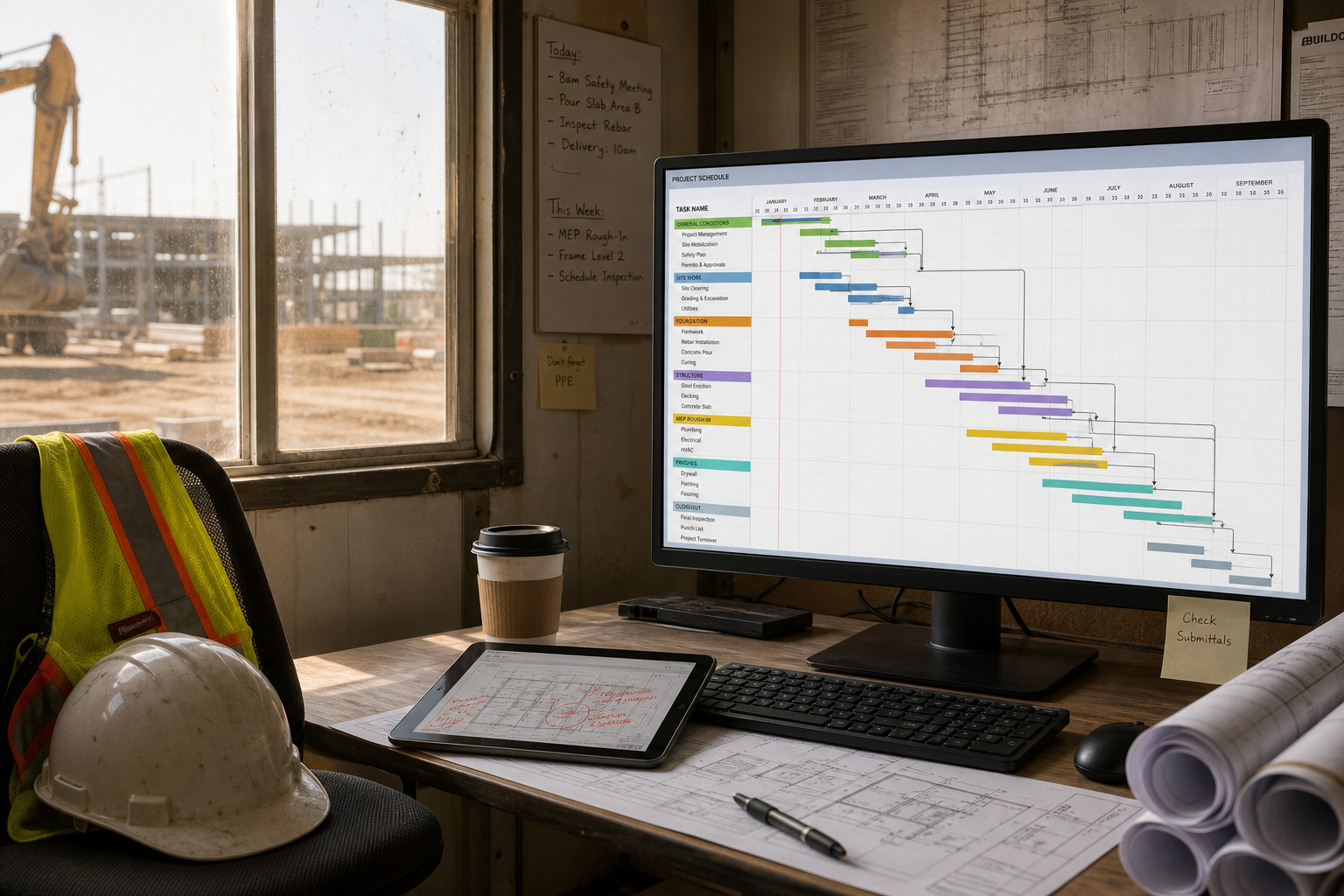
Stadium expansions, infrastructure upgrades, manufacturing plant builds, and large-scale event venues in Birmingham usually arrive with flashy renderings and ribbon-cutting dates. What those announcements leave out is the stack of specialist disciplines running underneath every delivered project. These include site sequencing, equipment selection, hydraulic maintenance, analytical testing, documentation, and contingency planning.
Each system remains invisible to the public while being entirely essential to the final result. This article maps all six for the operators, analysts, and project managers doing the actual work.
1. From Brief to Battle Plan
A complex brief left unstructured becomes a liability faster than most project managers expect. The brief needs to produce three concrete outputs before any site work begins. These include a phased site sequencing document naming dependencies, a supplier lead-time map aligned against milestones, and embedded quality checkpoints.
Approval gates placed early catch problems when correction costs a single day rather than an entire month.
Actual precompletion rework costs average 0.38% of contract value. Postcompletion corrections push that average up to 0.76%. Every downstream system relies on this early baseline to function correctly.
2. Matching Machinery to the Work
Large Birmingham projects run multiple material-handling tasks simultaneously across different site zones.
Crews might handle lifting in one area while grading in another. Mismatched attachments frequently cause schedule slippage on these mid-scale construction sites, largely because improper tools create immediate bottlenecks. The practical audit starts by evaluating site conditions, material types, and access constraints instead of just checking machine availability.
Attachment selection operates as a primary planning input. Sourcing parts precisely suited to the task prevents the extended lead times common with factory-direct channels. Construction operators selecting equipment for demanding projects often need fast access to reliable tools.
For teams specifying heavy equipment components, HW Part Store’s aftermarket Caterpillar skid steer attachments provide an exact-fit route. These options are built to manufacturer specifications and sit neatly alongside other standard equipment plans.
| Quote: A gap in any one of these six systems planning, equipment, maintenance, testing, documentation, or contingency propagates directly into the ones downstream. The disciplines that protect the visible outcome are the ones most worth investing in before breaking ground. |
3. Hydraulic Health and Zero Downtime
Hydraulic failure stalls a project timeline instantly despite being highly preventable. Proactive planning covers pre-project inspection schedules, stocked replacement seal kits, and a pre-built response protocol for hose blowouts.
Consider the difference between a cylinder failure during a lift sequence when parts are on hand versus sourcing them after the breakdown. Having inventory ready turns a two-day work stoppage into a manageable two-hour repair window.
Failure modes follow predictable patterns when managers track routine maintenance schedules. Storing necessary replacement parts ensures operators maintain steady momentum throughout heavy lifts. Proper fluid management and component care keep site machinery running without sudden interruptions.
| Important: A hydraulic failure during a critical pour can cause a two-day stoppage if parts aren’t on site. Pre-stocking seal kits and cylinders turns the same failure into a predictable two-hour repair, protecting the entire project timeline. |
4. Testing as a Workflow, Not a Hurdle
Treating laboratory testing as a final verification step remains a major operational error. On Birmingham projects connected to food manufacturing facilities or environmental monitoring programmes, late-stage failures require highly expensive corrections.
Data shows that many factors influence the accuracy of soil test results, including field sampling techniques and laboratory quality control. The smartest alternative is embedding testing at defined workflow intervals using standardised sample preparation protocols.
Reproducibility breaks down during the extraction, cleanup, and matrix handling steps long before the instrument sees the sample. Analysts handling food or environmental materials need consistent preparation methods to support reliable results across large batches.
For those laboratory analysts doing that work, Restek’s standardised QuEChERS sample preparation kits offer application-tested extraction protocols. Other sample preparation approaches like solid phase extraction may suit different matrix types based on the specific regulatory context of the programme.
| Key Insight: Reproducibility breaks down before the sample reaches the instrument. Inconsistent extraction and cleanup steps are the primary source of failed late-stage testing and the costly rework it triggers. |
5. The Paper Trail That Prevents Rework
Documentation failure creates immediate friction at four specific handoff types. These include transitions from contractor to contractor, shift to shift, laboratory batch to batch, and design to execution.
Each handoff requires method standards, traceable results, approved change records, and completion checklists. A technical team must be able to reproduce any decision made on the project and defend it later.
Lost context at a handoff produces the same outcome as a physical structural failure. Deviations resulting in rework, repair, or replacement account for an average of 12.4% of total installed project costs. Treating documentation as mere compliance theatre turns minor recoverable problems into massive schedule-breaking liabilities.
| Pro Tip: For every handoff, record method standards, traceable results, approved changes, and a checklist. This ensures any team can reproduce a decision, preventing lost context from turning into schedule-destroying rework. |
6. Planning for What Goes Wrong
Weather disruptions, supplier delays, equipment failures, and unusual analytical results are not exceptional events on large construction sites. They are standard risk categories that experienced teams plan for well in advance.
A strong contingency system functions as a pre-built decision tree so operators know exactly how to respond when specific issues arise. Every major project requires explicit protocols for these disruptions before breaking ground.
Planners must define site access windows, pour scheduling limits, and material exposure thresholds for severe weather conditions. Supplier delays require alternative sourcing channels and lead-time buffers built directly into the milestone map.
Teams facing potential equipment failure should stock essential spare parts immediately. Documenting re-run procedures and escalation paths for strange laboratory results keeps all subsequent investigations moving smoothly.
The Bottom Line
The finished building, facility, or infrastructure corridor is all that Birmingham residents ultimately see. What makes those structures possible is the stack of specialist systems operating quietly in the background. Sourcing aftermarket attachments for heavy lifting work determines whether machines operate smoothly or stall the entire timeline.
Meanwhile, utilising specialised extraction and cleanup kits forms the reproducibility foundation for every project-linked laboratory programme analysing materials. Proper planning, rigorous testing, and clear documentation interlock to keep operations moving.