
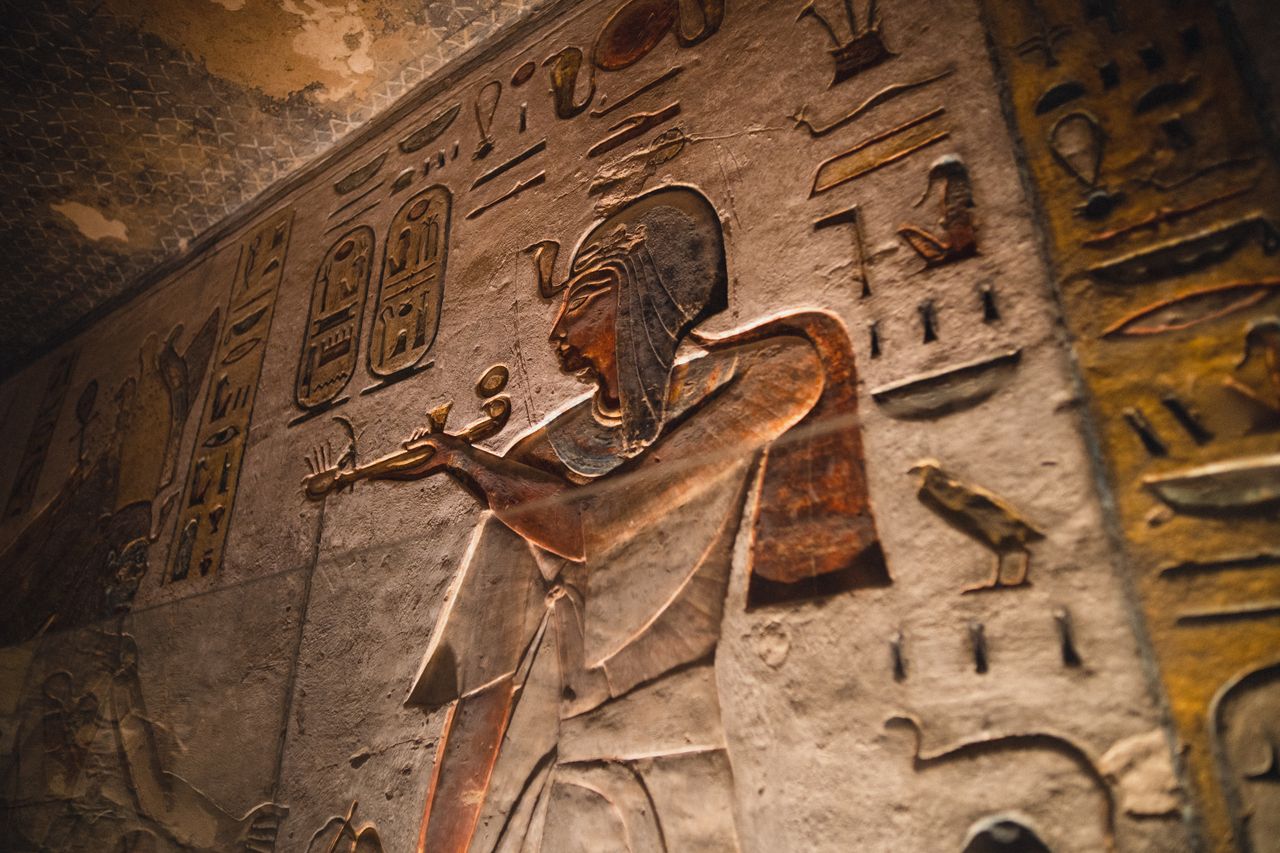
Photo by MEUM MARE
Ancient Egyptian mythology is one of the most fascinating of all ancient myths and legends. Although it faded more than 2,000 years ago, Ancient Egypt has remained part of modern culture, with designs and characters from its mythology still used today in popular culture.
Few characters in Ancient Egyptian mythology are as iconic as the Sun god, Ra. Today, this falcon-headed god might not be held with the same reverence as before, but he’s arguably more well-known thanks to his use in pop culture and popular media.
Who Ra was in Ancient Egyptian mythology
Ra was one of the most important gods in the religion. According to the myths, Ra had ruled as the very first pharaoh of Ancient Egypt, and he was not only the god of the sun, but also of order, kings and the sky.
Ra was portrayed in drawings and statues as having the head of a falcon. He shared a lot of characteristics with the sky god, Horus, and the two deities were sometimes merged as Ra-Horakhty, which means “Ra who is Horus of the Two Horizons”. During Egypt’s New Kingdom period between the 16th and 11th centuries BC, Ra was fused with Amun to make Amun-Ra.
According to Ancient Egyptian mythology, all forms of life were created by Ra. Some legends spoke of humans being created from Ra’s tears and sweat, so many Ancient Egyptians referred to themselves as the Cattle of Ra.
Why the sun god held such an important position
In Ancient times, the Sun was often seen as a god. It’s a giver of life, controlling the ripening of crops. As a result, the Sun god Ra represented life, warmth and growth. Because he was seen as the creator of the universe and the source of life, Ra had a lot of influence on Ancient Egyptians, and he was one of the most worshipped of all gods at the time. Some even considered Ra the King of the gods.
According to the Ancient Egyptian creation myth, there was nothing but chaos at the beginning of time. The universe was a watery abyss known as Nuna, and from these waters, a pyramid emerged. A lotus flower blossomed at the top of the pyramid, and from this, Ra emerged. In some accounts of this myth, Ra called all forms of life into existence by speaking their secret names.
When Ra became too old to continue his reign over Earth, he went to the skies. As the Sun god, he was responsible for carrying the Sun across the sky. The setting of the Sun was believed to be Ra travelling to the underworld, with the horizon seen as a gate or door leading there. Every night, he would be attacked by Apophis, the Egyptian deity of chaos and darkness. However, Ra would defeat the snake to return with the Sun at dawn to light the day again.
How depictions of Ra have changed over time
The Ancient Egyptian civilisation existed for over three thousand years and spanned three distinct periods. Of course, a lot can change in such a vast amount of time, and understandably, the depiction of gods changed too. While Ra was always highly regarded in Ancient Egyptian culture, he was often combined with other popular deities, creating connections among multiple gods.
Amun was an Ancient Egyptian god who, like Ra, could create life. However, he was closely linked to the wind rather than the Sun. With both Amun and Ra becoming very popular, rulers at the time combined the two to create Amun-Ra, a solar creator god and unite different groups of worshippers. This new deity was depicted as a red-eyed man with a lion head that had a solar disk surrounding it.
A scarab beetle god, known as Khepri, was sometimes seen as the morning manifestation of Ra. It was believed to have been responsible for rolling up the sun into the sky in the mornings. On the other hand, the ram-headed god, Khnum, was seen as the evening manifestation of Ra.
Ra in popular culture and media
Ancient Egyptian mythology has had a lasting impact on modern culture, even if our beliefs have changed significantly since those days of early human civilisation. Ra has appeared in many forms of media, including books, films, comics, television and games.
Stargate is a hugely popular science fiction media franchise which includes a number of films, TV series and animated shows. The Egyptian god Ra was a recurring character in Stargate, appearing in the 1994 Stargate film. Two video games and a novel series were adapted from the film, expanding on the original story, which involved the successors of Ra.
How modern games reinterpret Ra and Egyptian mythology
The mythology and legends of Ancient Egypt continue to fascinate us in the modern day, and Egyptian gods prove to be excellent subjects for books, films and even video games. Many of these reinterpret Ra, often including some kind of connection to aliens and ancient technology.
Meanwhile, games like the Legacy of Ra Megaways eschew the science fiction connection and focus purely on what makes the Ancient Egyptians so interesting. There are the typical Ancient Egyptian designs like great stone tombs and pyramids, along with scarabs, burial masks and canopic jars, which feature the heads of the gods.