
Films showing this week either in cinemas or on streaming platforms
FILM OF THE WEEK
The Devil Wears Prada 2 (12A)
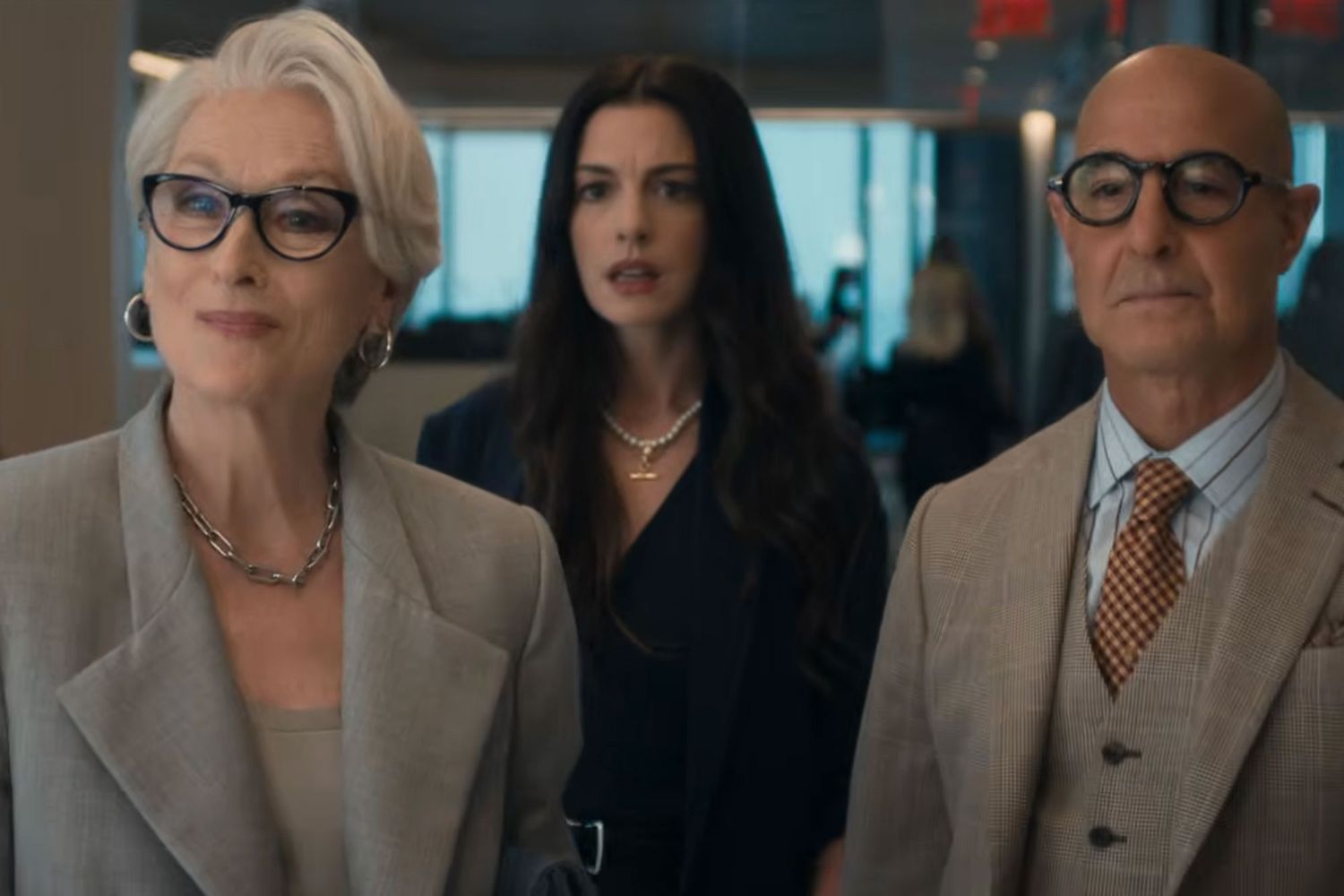
Twenty years on from the original (though you wouldn’t know it from looking at its stars), loosely based on Lauren Weisberger’s fictional novel based on Vogue editor Anna Wintour, director David Frankel and writer Aline Brosh McKenna return to the catty world of fashion alongside the core cast of Meryl Streep, Anne Hathaway, Stanley Tucci and Emily Blunt, but while the look, performances and indeed the fashion, are top notch the story feel a little thin and over-extended.
It opens with a press awards gala where, now a top investigative journalist at a New York magazine, Andy Sachs (Hathaway, a tad overplaying) receives the top prize only for her and her entire team to simultaneously be fired by text as part of print cutbacks. However, she swiftly gets a call from Irv Ravitz (Tibor Feldman), the CEO of Runway magazine where she used to work as an assistant to its editor Miranda ‘Beastly’ Priestley (Streep, magnificently imperious) inviting her to return as Features Editor to manage a scandal about endorsing a brand usings sweat shop labour that’s dented its credibility and reverse the declining circulation (a recurring theme) with serious content rather than social media memes. Aside from Miranda, who feigns not to recognise her, she’s also reunited with Miranda’s long time right-hand man, the dry-witted, calm and composed stylist Nigel Kipling (Tucci, a laid back joy as ever) and, in a pitch to retain the magazines’ vital advertisers, Emily Charlton (snarky Blunt), Miranda’s former first assistant and now a senior exec at Dior whose millionaire boyfriend is Benji Barnes (Justin Theroux), the now fit-looking but still unpleasant tech wiz ex-husband of reclusive designer Sasha (Lucy Liu), an exclusive interview with whom becomes crucial plot point in saving Runway.
When Irv’s son (BJ Novak) takes over the reins from his father and plans to downsize and offload the print magazine, Miranda and Andy have to work together on a plan to save the day in a convoluted narrative that involves backstabbings and betrayals along with cameos from pretty much any designer name you care to mention (Donatella Versace has a cameo of her own), a Milan fashion show performance by Lady Gaga, a dinner with Da Vinci’s Last Supper as the backdrop (cue a Judas character). Fleshing out the cast but with very little to do are Kenneth Branagh as Miranda’s classical musician husband, Patrick Bramwell as Andy’s love interest Peter, an Australian building renovator, Helen J. Shen as Andy’s assistant Jin Chao (cue accusations of Chenese stereotyping) and, disconcertingly resembling a female Noel Clarke, Simone Ashley as Miranda’s fashionista snob first assistant Amari Mari with her woke reminders to keep her boss in check. There’s some nice one-liners, but nothing as acidic or sharp as in the original, though Blunt’s “May the bridges I burn light my way” is a t-shirt slogan in waiting, and Streep gets to show Miranda’s human side when she confesses what her ambition and career have cost her, a softer version of the original’s cautionary tale. An enjoyable but undeniably lightweight affair, in the end it’s less Prada and more TK Maxx. (Cineworld 5 Ways, NEC, Solihull; Everyman; Odeon Birmingham, Broadway Plaza Luxe, West Brom; Omniplex Great Park; Reel; Royal; Vue)
Apex (15)
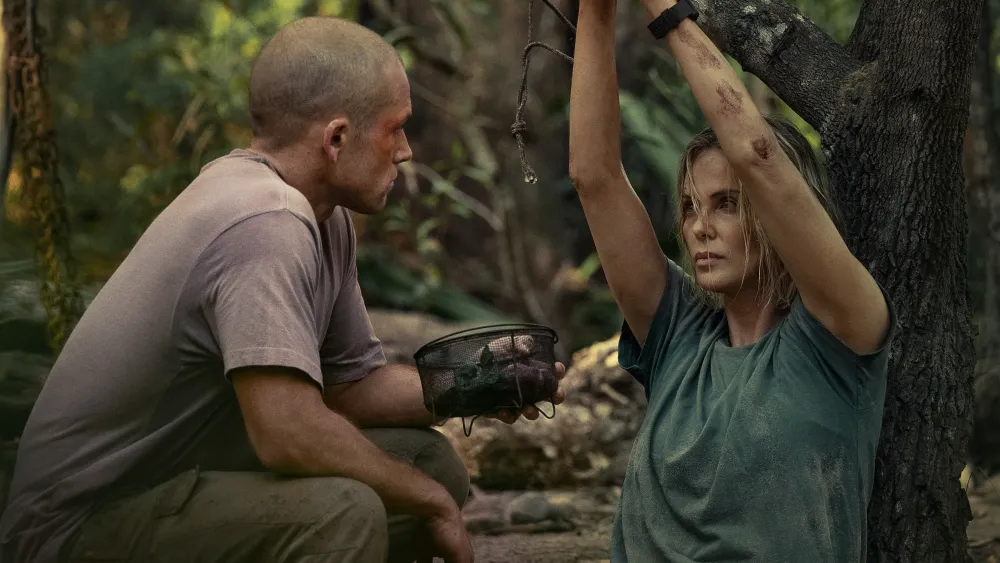
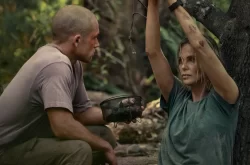
She may have had several stunt doubles, but Charlie Theron still gives a powerful physical performance in this survival prey vs predatory drama set in the Australian outback. Playing adrenaline junkie Saha, in the taut opening sequence she and husband Tommy (Eric Bana) are climbing Norway’s forbidding Troll Wall peak when a storm comes in and, she forced the cut the rope tying them together, an avalanche sends him to his death.
Cut to some months later as, holding Tommy’s lucky compass, she turns up at the fictitious Wandarra National Park on a pilgrimage of healing, and is warned by the ranger at the gas station that there’s been a string of disappearances, including families with young kids, in the region to where she’s headed. She’s then harassed by a pair of lascivious game hunters (Matt Whelan, Rob Carlton), ominously named Diesel and Ripper, before a third stranger, Ben (Taron Egerton with credible Aussie accent), intervenes, she asking him how to reach the Grand Isle Narrows. Given to possible routes she, naturally, chooses the hard but scenic way, starting out at Blackwater bay.
Arriving at night, she has another intimidating encounter with the hunters who are skinning kangaroo carcasses (a misdirection given they then vanish from the plot) and, in the morning sets out down the rapids by kayak, setting up camp only to awake in the morning to find her bag missing and, continuing down the river, eventually reaching the Narrows where she’s surprised to find Ben already there, explaining he lives in the area, where he makes the homemade jerky he supplies to local stores, and offering to share supplies – which, naturally, turn out to be the ones that were stolen. He then produces a crossbow and says she has until the song on the stereo ends to get a head start before he comes after her.
The feature debut by writer Jeremy Robbins and directed by Iceland Baltasar Kormákur, it’s firmly rooted in the same wilderness terror territory as things like Wolf Creek while also echoing Kormákur’s earlier thriller Beats, but with a two rather than four-legged predator. Once the chase begins, the film follows a fairly predictable course, embellished by a captured Sasha, chained to Ben, being taken to his man cave, discovering he’s a cannibalistic serial killer with ghoulish orthodontics and mummy issues that make Norman Bates seem well-adjusted and learning the grisly ingredients of his distinctive tasting jerky, building to a climax that moves from yet more fighting in the rapids to, she having broken his leg, a mirror of the tandem climb opening.
A virtual two-hander, while boasting some spectacular cinematography and wild water sequences, it’s basically standard B-movie fare with just a token subtext about grief, guilt and letting go, but Theron and Egerton deliver fully committed performances, even if he can be a tad over-manic, while Kormákur slowly builds the sense of dread before all hell breaks loose in the visceral climax. (Netflix)
Hokum (15)
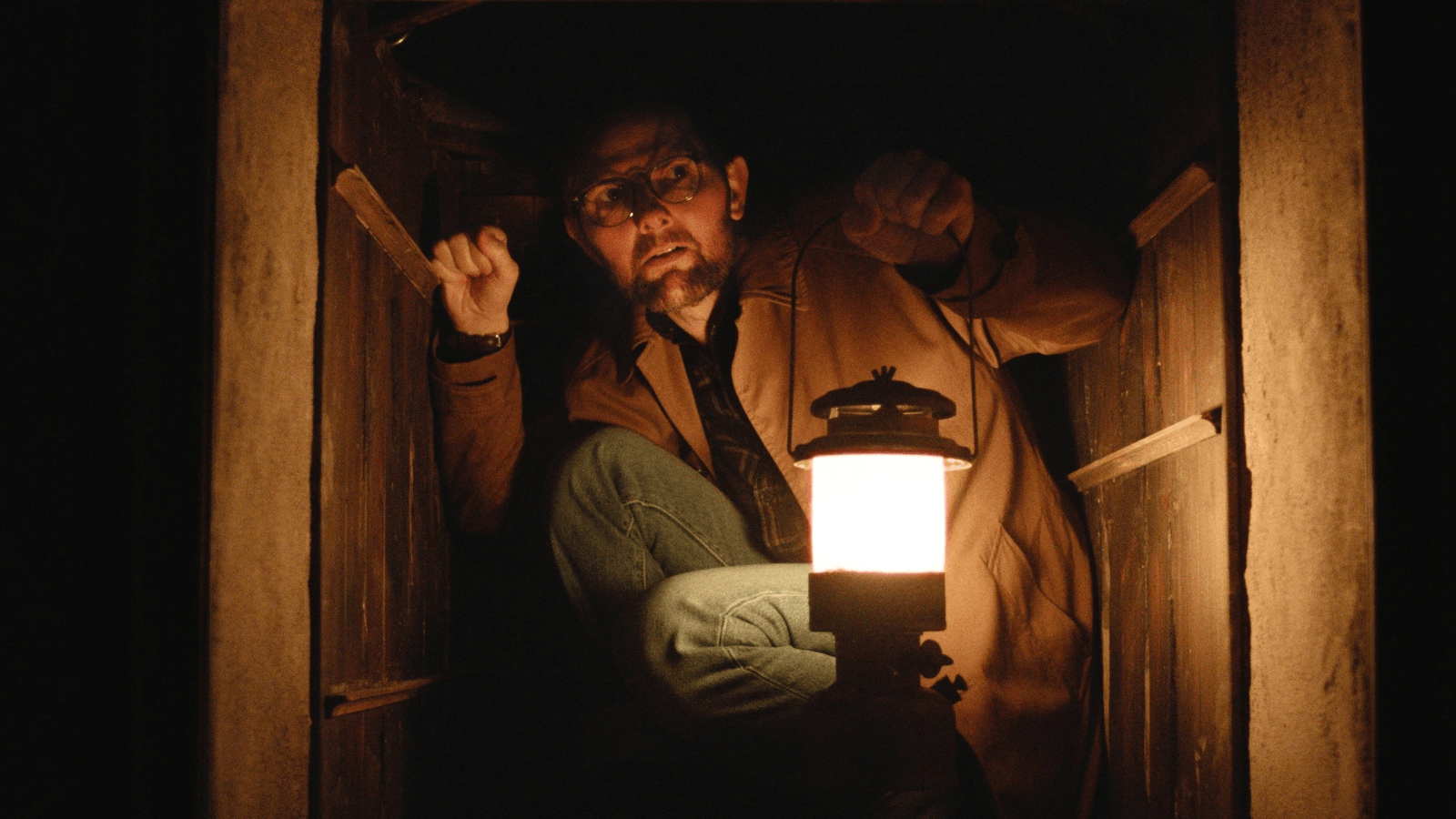
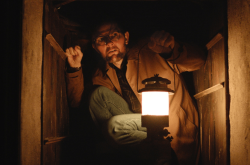
Set within a hotel in rural Ireland, the latest from Irish writer-director Damian McCarthy is another haunted house horror with themes of guilt, grief and atonement and a narrative rooted in folklore. It opens, though, in a desert with a conquistador and young boy searching for buried treasure, the former about to crack a glass bottle over the latter’s head, This turns out to be all in the mind of borderline alcoholic, depressed and misanthropic American author, Ohm Bauman (Adam Scott), sitting at his desk struggling to come up with ending to his best-selling series of novels. Alone in the dark, he sees or imagines a shadow figure on the stairs, this setting the film’s psychological bedrock.
When he was a boy, his mother died in a tragic accident (more details and his role emerge later), his father subsequently drinking himself to death. Having held on to their ashes for years, he’s now decided to travel to Ireland scatter them at a giant redwood tree near to the hotel where they honeymooned. The way he scatters them says much about his feelings about them both.
He checks into the same hotel, arriving to see hotel handyman Fergal (Michael Patric) in the drive with a dead goat (apparently the animals get high on magic mushrooms and climb on cars, though this proves a quirky red herring that never actually goes anywhere) and quickly gets on the wrong side of all the staff with acerbic meanness, being rude to receptionist Mal (Peter Coonan) and bartender Fiona (Florence Ordesh), who doesn’t like the bleakness of his books, and burning the hand of aspirant writer bellboy fan Alby (Will O’Connell) with a hot spoon when he asks if he’ll take a look at his manuscript.
Things take a turn when after being saved from a suicide attempt by Fiona, he returns to the hotel to apologise and say thank you only to learn she went missing after a Halloween party. However, Jerry (David Wilmot), a shaggy oddball who, wanted by the police, is hiding in the woods, drinks magic mushroom-laced milk and gave him some pocheen, insists (having apparently been visited by her ghost) that she’s imprisoned in the hotel’s honeymoon suite (the film’s version of The Shining’s Room 217) which the oddball owner (Brendan Conroy) keeps locked, the key in custody of Mal, believing he’s trapped a witch there (though how and why is never explained). Ohm’s dismissed this as superstitious hokum but, the hotel closing for the season and feeling an obligation to Fiona, agrees to help Jerry check it out.
From here, McCarthy embarks on a somewhat incoherent and ultimately overly predicable storyline that borrows ideas from Resident Evil and repeats tropes from his previous film (a call bell, crossbow, scary rabbit) and which variously entails secret basements, a novelty clock, a hidden dumbwaiter with a body, freaky hallucinations, the hotel’s psycho answer to Norman Bates, creepy miniature statues, jump scares involving female figures, and Ohm finding himself trapped in the honeymoon suite drawing a chalk circle around the bed ( a mirror of the red circle in the Conquistador prologue and epilogue) for protection from the supposed witch before it all almost literally goes to Hell.
Scott delivers a committed, twitchy performance as a dickhead beset by both his own and possibly actual demons who comes to find self-forgiveness, but, while undeniably creepy, the second half winds up going round in circles with both Ohm and the screenplay running up against dead ends, the trauma-based emotional subtexts never quite matching up to the unsettling visuals. (Cineworld 5 Ways, NEC, Solihull; Mockingbird; Odeon Birmingham, Broadway Plaza Luxe; Omniplex Great Park; Reel; Vue)
NOW SHOWING
Apnas (15)
Co-directed by Ashley Chin and Darren R.L. Gordon from a screenplay by Adrian Scott inspired by real events, this is a slick crime thriller set amid Manchester’s Pakistani Muslim community. Cousins, as kids Awais and Majid Khan tussled about who would play with a toy car before the argument was settled with a bat and ball game by the latter’s father Zafar (Rehan Sheik) in favour of the former. Years later, Awais (Birmingham actor James Greaney) is an accountant with a second-generation British Asian identity issues while Majid (Asim Ashraf), who now goes by MK, drives a flashy car and is a brash violent drug dealer. Awais’s father Aslam (Nitin Ganatra) is a taxi driver family man working to ensure his three kids have a good life and marriages while, the brothers not having spoken for 15 years, Zafar runs a criminal network from Pakistan where he’s a prominent politician, MK handling the UK side of his heroin operation.
Fired from his call centre job, dad’s taxi repossessed and the family struggling to pay the rent, Awais gets sucked into his uncle’s network when he meets MK, who he’s not seen in some years, at a lavish wedding (the guests hiring swanky cards to impress) and is persuaded to work for him as a ‘washer’, laundering the ill-gotten cash using cryptocurrencies. Soon he’s rolling in it, but his new role and lifestyle also see a dramatic personality change in the way he treats people, especially caregiver girlfriend Mollie (Elenor Elmsley). With MK still harbouring resentment about that toy car and the cops (Ash Tandon’s rookie, his Asian boss Mark Smalley and a couple of strongarm white goons) on his trail and a run in with a rival Bradford gang, it doesn’t end well.
Awais has two sisters, Sara (Aisha Osman) who’s studying to be a pharmacist but has ambitions to be a dancer and the younger darker-skinned non-verbal aspiring author Sanaya (Haiesha Mistry) doling out voice over exposition and narration in the form of her diary notes, explaining how their culture influences the choices the characters make (the title is a Hindi word meaning “one’s own” often used to describe family, close friends, or community). With a support cast that includes Reuben J Virdee as Awais’s tattoo artist schoolfriend Chico, it goes through its predictable generic paces well-enough (spot the corrupt cop) with decent performances from its leads even if the climactic redemption feels rather contrived and abrupt. (Vue)
The Bad Guys 2 (PG)
A sequel to the 2022 Dreamworks animation, for late arrivals this opens with a brief catch-up detailing how, in a car heist and a fast paced Cairo car chase, critter criminals (motto – the heist is never about the loot), fast talking dapper Mr. Wolf (a superb Sam Rockwell), slippery safecracker Mr. Snake (Marc Maron), toxically flatulent Mr. Piranha (Anthony Ramos), unlikely prone to panic master of disguise Mr. Shark (Craig Robinson), and snarky hacker Ms. Tarantula (Awkwafina), were eventually caught and turned over a new leaf. Cut to the present and they’re down on their luck and a crappy car, unable to get jobs on account of their records Wolf goes for an interview at a bank he robbed three times), only a newly ripped Snake, who’s reinvented himself as a yoga-and-kombucha health fanatic, seeming upbeat.
Things proceed to get worse when they’re framed for a series of robberies carried out by the Phantom Bandit, alias snow leopard Kitty Kat (Danielle Brooks), who heads up a bad girls trio alongside raven Doom (Natasha Lyonne), the unwitting Snake’s girlfriend (kiddies’ eyes should be averted from their a make-out session), and literal-minded wild boar Pigtail Petrova (Maria Bakalova). They’re stealing a metal known (in a Hitchcock in-joke) as MacGuffinite, aiming to use its properties as a gold magnet to steal all the gold on Earth. It’s a plot that entails using a video of Wolf’s love interest, red fox state Governor, Diane Foxington (Zazie Beetz), that reveals her secret past as the Crimson Paw thief, to blackmail Wolf and his buddies into taking part in one last job, stealing one final MacGuffinite before hijacking the Moon X rocket from Musk-like tech billionaire (Colin Jost) and launching into space.
It’s a fairly twisty and convoluted plot, but it never loses momentum or sags, climaxing in a stunts-filled space sequence that adds a touch of Mission: Impossible and Moonraker to its Ocean’s Eleven meets Reservoir Dogs template. The voice cast and character chemistry is terrific, the core ensemble being augmented by the return of Alex Borstein as Misty Luggins, former Police Chief and now Commissioner, and Richard Ayoade as guinea pig villain Professor Marmalade, who, now in prison and bulked up, prompts a sly Hannibal Lecter homage when he’s visited by Diane. Visually dynamic, crammed with great gags, glowing with charm and sporting a very smart screenplay, it ends setting up a further sequel with our anti-heroes reconfigured as a team of anthropomorphic secret agents. Bring it on. (Sky/NOW)
Ballad Of A Small Player (15)
After the widescreen expanse of All Quiet On The Western Front and Conclave, director Edward Berger takes a more intimate low key approach to this character study about dislocation and self-destructive addiction. Giving another standout performance, Colin Farrell plays an Irish con artist gambler who, hiding out in Macau, China’s answer to Vegas, where the locals refer to him as a gweilo or hungry ghost, passes himself off as British aristo Lord Freddy Doyle, complete with precisely clipped accent. Living in a decadent Chinese casino-hotel, with three days to settle his 145,000 hotel bill, he’s on a losing streak and saddled with huge gambling debts he can’t pay off, wiped out at baccarat by a foul-mouthed old dear (Deanie Ip) at the only casino that’ll still extend him credit, but, in his supposedly Savile Row leather yellow gloves, is still looking for the win that will turn things around.
Into his life comes Fala Chen (Dao Ming), who, like a drug dealer feedings junkies, lends money to losers at exorbitant rates, but has decided to get out of the game after her latest mark took a dive from the rooftop, she inheriting his debt. The pair hang out in her houseboat and he wakes to find her gone and numbers written on his palm. Also entering his orbit is frump in designer glasses Cynthia (Tilda Swinton), who, calling herself Betty, is a private detective hired to recover the money he stole from her elderly client, She spots him a stake and suddenly his fortunes change, now he just can’t lose.
Visually striking and vibrantly coloured, adapted by Rowan Joffe from Lawrence Osborne’s novel, it’s a thoughtful meditation on self-loathing, end of rope desperation, compulsion, guilt and redemption, Farrell going all-in on a rollercoaster that variously sees him having a heart attack and wolfing down lobster, sweating out anxiety and almost maniacally exulting in his luck. Though she disappears (for reasons explained later) in the second half, Ming makes for a suitably haunting femme fatale while Swinton digs into her character’s quirks with a sly wink in her eye. With supporting turns from Anthony Wong relating an anecdote about a gambler who dies and goes to what he thinks is Heaven and Alex Jennings as the friend and fellow gambler who know who Doyle really is, both imparting the message that winning kills you quicker than losing, this might not ever play an ace but it holds high enough cards to keep you in the game. (Netflix)
Crime 101 (15)
Adapted by writer-director Bart Laton from the Don Winslow novella, the 101 refers to the LA highway and the crime concerns a string of high end jewellery robberies along the route, the thief being Mike (Chris Hemsworth on terrific form) who leaves no traces and never harms anyone. On his trail but with no clues to follow is Lou Lubesnick (an understated Mark Ruffalo), a hangdog detective recently dumped by his long-term girlfriend (a cameoing Jennifer Jason Leigh) whose theory that it’s all the work of one man is dismissed by his fellow cops and superior who just want cases wrapped up. Mike literally works for Money (a grizzled Nick Nolte), who sets up the heists and takes his cut but, after a close call involving a jammed gun, Mike’s decided to call time, a decision compounded by having struck up a romance with Maya (Monica Barbaro), a music publicist who rear-ended his car and who is frustrated that she knows nothing about his background. Passing on a job he was doing for Money in Santa Barbara, considering it too risky, it’s carried out instead by motorbike-riding thug Ormon (Barry Keoghan who starred in Layton’s heist docu-drama American Animals), who, unlike Mike, has no compunctions about violence.
The net, however, is closing in with Lubesnick using DNA from a blood sample found in Mike’s abandoned car to uncover his real name and identity. Meanwhile there’s a plot intertwine involving Sharon Colvin (Halle Berry, feisty), an insurance broken for elite clients who’s pissed at being constantly passed over for partner and whom Mike tries to get onboard for a robbery involving a ton of cash, illegally important diamonds and his upcoming wedding at the Beverly Wilshire Hotel, the confidential details of which she has access to.
Inevitably summoning Michael Mann references, though this is more a study of characters adrift in a sea of corruption (Mike has issues about his line of work, Sharon about being a woman in a toxic man’s world and overshadowed by a younger rival, Lou with the department’s cover up of a shooting) than action movie, Layton still has a firm grip on the slowly building tension (even if there’s a couple of loose ends involving Money and Mike’s hacker) while the hotel room showdown by way of two characters engaged in deceiving each other while riffing on Steve McQueen and the chaotic car chases through LA (with its subtext scenes of homelessness and urban decay) get the pulse working overtime. After the Damon/Affleck Netflix thriller The Rip, this is shaping up to be a great year for 90s throwback crime thrillers. (Amazon Prime)
Don’t Let’s Go To The Dogs Tonight (15)
Adapted by first time director Embeth Davidz from part of Alexandra Fuller’s memoir of her childhood growing up in Rhodesia period to and during its transition to Zimbabwe, the title referring to an expression about things falling apart, with its limited release and lack of promotion, seems unlikely to draw more than a handful of punters. Which is a shame because, closer in tone and spirit to Chocolat than Out Of Africa, its easily one of the year’s best.
It’s 1980, on the eve of the election that brought Robert Mugabwe to power and saw the Black majority win back control of their own destiny, and also at the tail end of the terrorism that saw many white farmers and so-called Black collaborators, being murdered (the film doesn’t shrink from footage of atrocities). Herself born in South Africa, Davidtz plays Nicola Fuller, a horse-loving part-time policewoman married to soldier husband Tim (Rob van Vuuren) who tends the family farm (and sleeps with a machine gun) when he’s away on patrols. She has two daughters, awkward and insecure adolescent Vanessa (Anina Reed), who will at one point be sexually abused by her ‘uncle’, and the fiercely outgoing 8-year old tomboy Alexandra (Lexi Venter) or Bobo as she’s affectionately known. There were once two other children, guilt over the death of one of them weighing heavily on Bobo. To help on the farm, there’s two Black servants, the gruff Jacob (Fulami Shilubana) and Sarah (Zikhona Bali), who’s very much the nanny to the somewhat over-indulged Bobo, something she’s warned puts her in danger (compounding the images of armed patrols, hostile looks from local Blacks and scenes, shots through binoculars flashing in the distant hills are an early clue that things will turn nasty).
As the election night unfolds and the consequences are brought home, the alcoholic Nicola increasingly unravels. However, as with the book, the film is told and shot from Bobo’s perspective, soaking up everything she sees and hears and totally without a filter in what she says (such as how Africans don’t have last names), and who also provides the insightful and often amusing voice over and dialogue commentary (she speaks of her parents having sex as moving the furniture with their clothes off), talking of being afraid to go to the toilet at night lest a terrorist, riding her motorbike through the bush, smoking cigarettes and shooting bottles with her popgun. As such, Venter, who had never acted before, is a sensational find, her blonde hair matted, her face almost constantly smudged with dirt, her eyes darting, at once both vulnerable and a feral wild animal. In a just world, she’d be up there in the Best Actress nominees. With a soundtrack that includes South African artists Roger Whittaker and Clut and, inexplicably Chris de Burgh’s Patricia The Stripper, the film powerfully builds to a close and the end of the exile from Eden myth Sarah was telling Bobo. Do yourself a favour and go to the dogs. (Sky/NOW)
The Drama (15)
Head curator at a Boston art museum, bespectacled moody Brit Charlie (Robert Pattinson ine one of strongest layered performances) meets cute with Emma (Zendaya in internal mode) in a swanky coffee bar by pretending to have read the novel she’s absorbed with. So far so generic. They become a couple over the course of assorted montages (backdropping his wedding speech preparations) before arriving at the week before the event when they’re joined by his outgoing best man, Mike (Mamoudou Athie), and his flinty wife, Rachel (Alana Haim), the maid of honour, to test the wedding dinner menu choices.
Having previously seen their wedding DJ Paulina (Sydney Lemmon) smoking heroin in the park, the couple deliberate whether to fire her or not. However, adopting the view that everyone’s probably done something bad in their life, lubricated by wine, Rachel proposes each of them has to confess the worst thing they’ve done. Mike admits to using a former girlfriend as a human shield during a dog attack in Mexico, Charlie severely cyberbullied a classmate and Rachel confesses to having locked a mentally disabled boy in a closet overnight. But that’s nothing compared to Emma’s jaw-dropper.
As a bullied shy15-year-old outsider (Jordyn Curet), she says she planned to carry out a school shooting with her father’s assault rifle, However, while she practised, becoming deaf in one ear as a result (which is why she doesn’t hear Charlie’s awkward coffee shop chat up), another mass shooting on the day she was about to carry out hers meant she abandoned the idea and, a friend one of the victims, began advocating for gun control instead. Understandably the others are shocked, Rachel furious at the very idea given her cousin, Samantha, was paralysed in a shooting. More pertinently, Charlie starts to wonder whether his seemingly well-adjusted bride still has latent psychopathic tendencies. Cue his worst scenario fantasies. Or is that just amped up pre-nuptial nerves?
Cue Hitchcockian paranoia played as dark psychodrama farce as Charlie’s grip on sanity begins to falter, his nervous tics magnified, the relationship creaking under the strain and, when his museum assistant (Hailey Benton Gates) comforts him when he breaks down after asking what she’d do in a similar hypothetical scenario involving her boyfriend Blake, aggressively comes on to her. Thus setting up a confrontation at what proves to be a decidedly unpredictable wedding entailing a passive-aggressive speech from Rachel, an inadvertent outing of Charlie’s almost cheating and a fracas with a furious Blake.
Written and directed by Norway’s Kristoffer Borgli, whose body horror Sick of Myself also referenced a school shooting, the film’s style pretty much mirrors Charlie’s state of mind with an unsettling sound design, intense closeups, hyper-realistic lighting, constant cutting back and forth in time and within scene, both flashing back to teenage Emma with Charlie both imaging the two of them together and, having read a book with images of gun-toting models, Emma as she is now, but armed. There’s also a lot of vomiting.
It’s an unsettling and uncomfortable squirm-inducing watch, an anti-romcom of sorts, that asks its audience to consider the moral debate as to whether there’s a difference between intent and action and whether people should be judged on what they thought rather than what they did. At the same time it becomes increasingly funny, notably the photographer’s rehearsal talking about shooting everyone and the glitches on Emma’s webcam as she tries to record the obligatory post-shooting social media message. All building up the slapstick farce of the wedding banquet itself. It reconciles with another meet cute, but even so anyone planning the big day might want to avoid. (Cineworld 5 Ways, NEC, Solihull; Odeon Birmingham, Broadway Plaza Luxe; Omniplex Great Park; Vue)
Eternity (12A)
Who would you choose to spend eternity with? That’s the premise underlying this throwback to Golden Age of Hollywood screwball romantic comedies (there’s a reference to Montgomery Clift) by openly queer director and co-writer David Freyne. Attending a family gender reveal party with Joan (Betty Buckley)), his wife of 65 years, grumpy Larry (Barry Primus) chokes on a pretzel and dies. The next thing he knows, he’s arrived by train at somewhere called The Hub, a sort of purgatory waystation, where his Afterlife , Anna (an engagingly warm Da’Vine Joy Randolph), explains that, now looking like his younger self (Miles Teller) when he was happiest, here the dead have a week to choose where they want to spend eternity (there is no heaven or hell) from the hundreds of available options, among them Men Free World (currently full), Famine Free Ireland, Queer World, Infantilization Land and Weimer World” (“Now with 100 percent less Nazis!”). But whichever you choose is final and any attempt to leave sends you to The Void.
Shortly after, Larry sees the younger looking Joan (Elizabeth Olsen), who was dying of cancer, and is given the opportunity for them to both spend eternity together. However, there’s a slight hiccup in that the bartender he was having drinks with turns out to be Luke (Callum Turner), Joan’s first husband who, marrying when she became pregnant, died in the Korean War and has been waiting at the Hub for her for 67 years (illogically, since the dead don’t age, dyeing his hair to keep looking young). Now she has to choose between them, Anna and her own AC Ryan (John Early) respectively advocating for Larry and Luke.
An afterlife spin on the classic love triangle, it follows a fairly predictable path with both men trying to outdo the other in professing their love and reminding Joan of their time together, she having to choose between the man who helped her through her grief and with whom she spent most of her life, and the man for whom she was grieving and a life she never had. The screenplay likewise has the audience rooting for one or the other, though both are seen as having selfish and less likeable sides in their attempts to win over their spouse, while sympathising with Joan’s predicament. In light of which, she’s given permission to try out an eternity with each of them (a mountain, a beach), visiting the Archives in which she’s shown tableaux from her two love stories. There’s also the sense of a growing attachment between Anna and Ryan, both of whom have their own reasons for not moving on as the film develops, while the film also introduces Joan’s friend Karen (Olga Merediz), who’s going to Paris Land and reveals that she was happiest in her 70s after her husband died and she got to come out of the lesbian closet. On a similar note one of the husbands also reveals a same sex dalliance.
All three stars deliver engaging and emotionally nuanced performances, although the squabbling between the men can become tiresome, and the script sprinkles humour and poignancy in its bittersweet relationship observations. But, at 114 minutes, its decidedly overlong with the last act offering three successive different resolutions before its literal walk off into the sunset. (Apple TV)
Exit 8 (15)
By their very nature, multi-level video games are built around repetition, perhaps none more so than the Japanese walking simulator which revolves around the player walking through a Japanese metro station passageway trying to reach the exit but only able to advance if they can spot anomalies, failure to do returning them to Exit 0. Sort of Groundhog Day on the underground. It seems an unlikely proposition for a film adaptation; however, scored to Ravel’s Bolero, director and co-writer Genki Kawamura has managed to turn it into an unsettling psychological and existential creeping dread horror which introduces new but mostly blank characters to offset the ever-repeated scenarios.
It begins with an anonymous worker ant figure credited only as The Lost Man (Kazunari Ninomiya) on a subway where he’s witness to a fellow passenger berating the mother of a crying baby while he and the other commuters bury themselves in their cell phones. He then gets a call from his ex-girlfriend saying she’s pregnant and, waiting at the hospital, asking him what to do before his phone connection fails. Exiting the train (and initially shot from a player POV) he finds himself in deserted, sterile white tiled corridor which, as he tries to reach Exit 8, constantly loops back in itself. Tellingly one of the posters on the wall is Escher’s figure of eight Möbius Strip II (Red Ants). Reading a set of instruction, he learns he needs to look for anomalies, advancing when there is none and turning back if there is, such as blood raining from the ceiling. He needs to get it right eight times, but if he misses any (and as a viewer you’re equally on the lookout), he’s returned to the start.
In the first chapter, he’s constantly encountering The Walking Man (Yamato Kochi), a balding, bearded unresponsive figure in a white shirt clutching a briefcase and a mobile phone who gets his own brief flashback chapter, Subsequently, he meets The High School Girl (Kotone Hanase), The Woman (Nana Komatsu) who could be an apparition of his girlfriend or the mother of The Boy (Naru Asanuma) who ran away from her and was following The Walking Man who abandoned him, resulting in them both becoming trapped in the loop. The Boy gives the Lost Man a hermit crab shell for good luck.
A labyrinthine meditation on anxiety, guilt, numbing routine, masculinity, parenthood and feeling your life is a cyclical purgatory, it exercises a compelling fascination alongside the frustration of its constant resetting, at one point The Lost Man having to save The Boy from a sudden flood that’s straight out of The Shining before it loops back to the commuter, mother and crying child where it began. You might leave the cinema feeling vertigo of the soul, but you’ll certainly appreciate the fresh air. (Cineworld 5 Ways, NEC; Mockingbird; Odeon Birmingham, Broadway Plaza)
Final Destination: Bloodlines (15)
Fourteen years after the last film and marking the franchise’s 25th anniversary, self-contained this pretty much dispenses with everything in-between (but finds ways to include easter egg references) yet remains true to the concept (originally a spec script for The X Files) wherein someone has a premonition of a disaster and saves everyone’s lives only for Death, who doesn’t take kindly to having his plans thwarted, kills one by one in the order they should have died. This time, though, there’s a fifty-six year gap between the premonition and the tidying up of loose ends in the form of descendants who were ever meant to exist.
It opens in 1968, as, with the intention of proposing, Paul Campbell (Max Lloyd-Jones) takes his girlfriend Iris (Brec Bassinger) to the grand opening of the Skyview Restaurant Tower. At the dance party, she has a premonition of how a loose chandelier shard, poor health and safety practices, shoddy workmanship and a brat throwing a coin (a quite literal bad penny that pops up later) off the platform cause the glass floor to shatter and the tower to catch fire and explode resulting in a truly visually spectacular and inventive orgy of bloodily gruesome and grisly dismemberings, impalings, burnings and squishings (including, with some satisfaction, that of the aforementioned brat,). However, disrupting the band playing Shout and warning of what’s about to happen, she saves everyone, among them the young son of the band’s singer.
Fast forward to the present and college student Stefani Reyes (a stressed out Kaitlyn Santa Juana) is having recurring nightmares about the disaster that never happened, to which end she returns home to dad Marty and kid brother Charlie (Teo Briones), her mother Darlene (Rya Kihlstedt) having left when she was much younger, to try and find some answers. This leads her to her uncle, Howard (Alex Zahara), aunt Brenda (AprilTelek) and, her estranged cousins, tattoo artist Erik (Richard Harmon), Julia (Anna Lore), and peanut-allergic Bobby (Owen Patrick Joyner). Learning that Howard’s mother was Iris and that she subjected him and sister Darlene to a rigidly overprotective upbringing, given letters by Brenda she tracks her down to a remote, heavily fortified cabin in the woods where she (Gabriel Rose) relates how she disrupted Death’s design and that, over the years, he’s been taking out the survivors and their descendants, the bloodlines of the title. The only reason he’s not caught up with her family being that she’s never ventured out of her fortress. Stefani’s understandably sceptical until, stepping outside to give her a book documenting the deaths, Irish is skewered by a weather vane. Now, back home, Darlene returning for the funeral, she has to convince the rest of the dysfunctional family that Death is coming for them too.
At the barbecue, it’s Stefani’s turn for a premonition , ending up in Howards’ death by lawnmower and the others, but not Howard, taking her seriously. There was also mention in Iris’s book of a survivor who cheated death, who turns out to be the boy Iris saved who’s grown to become hospital mortician William Bludworth (a poignant emaciated final appearance life is precious monologue by franchise veteran and Candyman horror icon Tony Todd, who was dying of cancer at the time) who explains you can cheat death by dying and then being brought back to life.
Needless to say, while the snarky Erik would appear to be safe due to a revelation about his parentage (despite teasing a tattoo parlour nose ring meets ceiling fan demise), the bodies begin to mount up in order of birth with yet another series of bloody and blackly comic slayings (you’ll not want an MRI scan anytime soon) before a climax back at Iris’s cabin and Charlie’s prom night coda that, Death having the last word, suggests a sequel is highly unlikely.
Directors Zach Lipovsky and Adam B Stein knowingly mixing the splatterfests and franchise references with very real anticipatory tension as you wonder who’s next in line and how, the characters (some of who you actually care about) grounded with personalities rather than mere cipher fodder. Huge fun. (Sky/NOW)
Frankenstein (15)
The most dramatic changes come, however, with the character of Elizabeth (the fittingly named Mia Goth, whose confession box moment about the sin of anger is rare comedic touch), who, in the novel is Victor’s childhood sweetheart bride, murdered by the Creature (a quietly graceful and tormented Jacob Elordi) when he refuses to create him a companion. Here though, will he lusts after her (that she also plays his late mother adds a Freudian subtext) , she’s actually William’s betrothed and, while she still dies, it’s not at the Creature’s hands, for whom, something of a hottie despite his patchwork body, she has a decided emotional attraction. She also happens to be the daughter of German arms merchant Henrich Harlander (Christoph Waltz), the film’s version of Victor’s chum Henry Clerval, who funds Victor’s experiments (for an agenda revealed later), with William (Felix Kammera) overseeing the elaborate scenes assembling the machinery in an abandoned tower in which Victor channels lightning through the lymphatic system of the figure he’s stitched together from the body parts of assorted hanged criminals and soldiers killed in Crimean War. Pointedly he’s strapped to the machinery like a Christ on the Cross (prompting later thoughts of father, why have you forsaken me). Succeeding in bring him to life, he then chains him in the cellar, looking for some signs[of intelligence, frustrated that all the Creature can say is Victor. Until, following her visit, he adds Elizabeth to his vocabulary.
All this forms the first chapter, with the second, picking up from Victor’s destruction of his lab (during which, in another symbolic variation, he lost a leg), with the Creature recounting his story to the captain and, involving the blind old man (David Bradley), who thinks he’s the Spirit of the Forest, but with a different approach, how he learnt language – and the word friend – from listening to him being read to by his granddaughter from the likes of Paradise Lost and Genesis. Anyway, this is all about humanising someone who pretty much everyone else sees as a monster, though, of course, as somewhat heavily spelled out, the question is who is the real monster, the Creature (who’s horrified to find the notes depicting how he came to be) or, playing God, his Creator. Fathers, sons and forgiveness are the (un)holy trinity at work here.
One of the film’s most powerful elements his how life becomes a curse, the Creature here proving a Victorian Wolverine, both super strong and invulnerable to death (rising up and his flesh healing after being peppered by bullets and stabbed), condemned to an eternity of loneliness. Unlike the novel, the ending brings notes of contrition and redemption, with a final sunset scene that inverts that happy ever after motif. Often visually breathtaking (even if the scenes on the ice look like a stage set and some CGI wolves prove less than persuasive), it offers up a different kind of horror that is philosophically and existentially provocative but ultimately crushingly touching. (Netflix)
The Friend (15)
When her friend, one-night lover, former professor and best-selling author and much married mentor Walter (Bill Murray) with a penchant for sleeping with his younger students, commits suicide, Iris (Naomi Watts), a middle aged singleton creative writing teacher living alone in a small fixed rent New York apartment and struggling with writer’s block, finds she’s expected to take on Apollo, his 180lb Great Dane. Navigating the thorny network of Walter’s widow (Noma Dumezweni) and two former wives, the rich narcissistic Tuesday (Constance Wu) and Elaine (Carla Gugino), as well as Val (Sarah Pidgeon), the adult daughter with whom he recently reconciled and with whom she’s compiling a book of his correspondence, some 30,000 emails, Iris finds herself on her own journey of grief and self-reawakening, she and Apollo each other’s emotional support. There’s also the problem that the apartment block doesn’t allow pets and unless she rehomes it she’ll be evicted.
Adapted from Sigrid Nunez’s 2018 best-seller, it’s framed by scenes of Walter’s fateful encounter with the abandoned Apollo in Brooklyn Bridge Park, a story he regularly rehashed over dinner parties, it’s a touching and very New York story about healing and companionship that has echoes of Neil Simon. Watts is predictably wonderful but even she’s eclipsed by Bing who plays Apollo, initially refusing to eat or get in the apartment lift, lays claim to her bed, destroys the apartment when she’s out and spends the time just staring into space. He only perks up when, as Walter did, being read to. The question being how do you explain death to a dog.
As such, it shares a spirit with things like Hachi: A Dog’s Tale, A Dog’s Purpose, Marley And Me and even Greyfriar’s Bobby, pitching the right degree of sentimentality (you just know she goes from dog hater to dog lover) as well as some gentle if slightly black humour. The final act which has her talking to his ghost about the novel she’s writing based on him, doesn’t really come off, but otherwise this is a lovely heartwarmer. (Sky Cinema/NOW)
Hedda (15)
Candyman director Nia DaCosta takes a swerve into classical territory with this updated five act (with title cards) and no suicide take on Ibsen’s dour Hedda Gabbler (also embracing Chekhov’s gun in act one maxim), relocated from Norway to 1950s England and given a racial makeover with an awards buzz performance from a finely-accented Tessa Thompson (who starred in DaCosta’s Crossing The Line) as the scheming but vulnerable Hedda, an illegitimate manipulative free spirit who’s just wed well-born but bland academic George Tesman (Tom Bateman) and persuade him to purchase the sprawling mansion where she’s throwing a lavish (but no flowers) party. The reason being that, in debt up to his eyeballs, she needs Tom to be appointed to a newly vacant professorship, hence inviting the movers and shakers, specifically his superior, Professor Greenwood (Finbar Lynch), to get them on his side. Among the guests is also Judge Brack (Nicholas Pinnock), who facilitated the house purchase and who Hedda is screwing. Unfortunately, so too is the self-invited Eileen Lomborg (Nina Hoss), a gender switch from the play as Hedda’s former lover and classicist who is also after the job on the back of her new book on sexuality, the only manuscript of which she’s brought with her. A now sober alcoholic, Hedda intends to use her Dionysian get together to push her off the wagon and humiliate herself out of the running. But she also still carries a torch, something complicated by the presence of Eileen’s naïve new lover, and co-author Thea Clifton (Imogen Poots), herself an old friend of Hedda.
Opening with Hedda being interviewed by the police about a shooting, it then unfolds in flashback, with not one but two guns, one Hedda’s late father’s (the key to the case of which she wears around her neck) and one wielded by the professor who comes across his young wife Tabitha (Mirren Mack) having it off in the garden with Eillen’s lothario chum David (Jamael Westman).
Subtly examining the constraints on being both Black and a woman (one of the guests remarks their hostess is “duskier than I thought she would be”) forced into socially imposed roles with a below stairs scene involving Kathryn Hunter affording a class commentary, it’s a slow and sensual smoulder that underlines what a good adaptation should be. (Amazon Prime)
Highest 2 Lowest (15)
Spike Lee reunites with Denzel Washington for a reimaging of Akira Kurosawa’s 1963 noir High and Low, itself based on Ed McBain’s King’s Ransom, in which a shoe company executive is forced to choose between certain financial ruin and saving his chauffeur’s son when a kidnapper mixes up their two sons. Transplanted from Yokohama to New York, here the man facing the moral dilemma is David King (Washington), the founder of Stacking’ Hits Records and acknowledged by the like of Quincy Jones as having the “best ears in the business” (magazine covers of him adorn his office along with images of Aretha, Stevie Wonder and others. However, the hits aren’t coming any more and, having previously sold his majority interest. he’s looking to buy it back to avert a rival label buyout that he says will see new artists being shed and the music used in commercials. His plan means he has to buy out his partner’s (Wendell Pierce) share, to which end, despite his philanthropist wife Pam’s (Ilene’s Hadera) reservations, he puts up most of his personal assets, including his penthouse home in Brooklyn’s trendy Dumbo neighbourhood and Black art collection (Jean Michel Basquiat’s Now’s the Time and Kehinde Wiley’s Investiture of Bishop Harold as the Duke of Franconia among them) as collateral.
However, the day the deal is due to go through, he gets a call saying his son Trey (Aubrey Jospeh), a promising basketball player he dropped off at practice, has been kidnapped with a ransom of $17.5 million in Swiss 1,000-franc notes for his safe return. Contacting the cops, although it could risk the business deal he and Pam agree to pay. But then comes the twist. Trey is found safe and it turns out that, in a mistake confusing their headbands, the kidnapper has instead abducted the son of King’s ex-con Muslim convert driver and best friend confidant Paul (a dramatically nuanced Jeffrey Wright), Trey’s best friend and fellow athlete Kyle (Wright’s real life son Elijah), racist white cop Detective Higgins (Dean Winters) suggesting Paul staged it himself.
The question now is whether King will stay pay the ransom, warned that refusing to do so will harm his and the label’s image. He does, eventually, agree, but the handover of the money, in a backpack containing a tracer, does not go as expected when, an emergency stop as he’s standing between subway train car carriages end route to Yankee Stadium sees it fall to the street, resulting in a lengthy chase involving it being passed between an extended series of moped riders weaving between a Puerto Rican Day Parade (an indulgent excuse to feature Latin Jazz bandleader Eddie Palmieri, Anthony Ramos and Rosie Perez appearing as themselves) before being retrieved only to find the money gone.
Kyle’s duly returned and King’s the hero of the hour, Stacking’ Hits records now back in the charts. But, with those who lent the $17.5 million demanding repayment within two weeks because he broke the terms of the contract by using it as the ransom, he’s determined to track down the kidnapper and recover his money. Kyle’s recalling of hip hop number he heard while being held captive and a demo tape of upcoming artists Trey compiled for his father to listen to, leads him and Paul to ex-convict and aspiring rapper Yung Felon (APAP Rocky) and one of two outstanding rap battle styled face off scenes as he first confronts him at a recording studio and then in prison where Felon, whose crime has made his music a global phenomenon, tries to convince King to sign him. The final showstopping scene explains the film’s title, it being a number written by Sula (rising British soul star Aiyana-Lee in her film debut) a young singer-songwriter discovered by Trey, who auditions for the Kings for their new independent label.
A fairly straightforward thriller with some social commentary on the changing times injected, it’s not up there with Lee’s best, but, despite some unnecessarily prolonged sequences (it opens with a full rendition by Norm Lewis of Oh, What A Beautiful Morning’ from Oklahoma as the camera slowly zooms in on King’s balcony), it sustains the momentum and narrative with Washington delivering a performance as fluid and flexible as an improvised jazz riff. (Apple TV)
Hitpig (PG)
Voiced by Jason Sudeikis, Hitpig is a porky bounty hunter who, raised by Big Bertha until she was eaten by a croc, specialises in tracking down animals that have left their owners voices. His latest hire (for a million bucks) is by Leapin’ Lord (Rainn Wilson), a rich tubby LA circus performer in a yellow leotard whose prized double act partner is Pickles (Lilly Singh), a dancing elephant, who, abused and kept locked up, (as are the dancing poodles) has been freed by animal rights activist Letícia (Anitta) who’s taken her to London en route to her family in India. However with his big ‘out of this world’ show looming, Leapin’ Lord, with his trusty croc sidekick (and yes, the same one), wants her back asap.
Hitpig does manage to retrieve Pickles, but a series of misadventures ensue, including being ejected from the plane mid-air after a lavatory mistake, driving a makeshift truck to Vegas but ending up riding a hot air balloon and crashlanding on a cooking show set in San Francisco (hosted by Flava Flav) where, with the help of Pickles’s trunk, Hitpig gets to make his prize winning omelette. All of this plus a flooded tower block, Pickles gatecrashing a dance show elephant costumes and Super Rooster (Charlie Adler), the accident prone star of a TV show, coming to the rescue climax. Naturally, in the manner of mismatched buddies road movies, Hitpig begins to forge a bond with Pickles, and begins to question whether he’s on the wrong side of the animal-lib fence.
With Leticia’s support crew including a Koala (Hanah Gadsby) with attitude, a polecat (RuPaul) with radioactive farts and a lobster (Adler) trying to avoid being boiled, it’s rammed with pop culture references, clever verbal and visual gags for kids and grown-ups alike , a soundtrack that includes Born To Be Wild, Walking On Sunshine, Hit Me With Your Best Shot, Wile One and, if course, Rock Lobster , this may be low budget animation, but it’s considerably funnier and more inventive that the current Super Mario rubbish. (Vue)
A House Of Dynamite (15)
Director Kathryn Bigelow’s first feature since 2017’s disappointing Detroit, written by Noah Oppenheim, told Rashomon-style, returning to the same scenario from different perspectives, this is a white knuckle nuclear nightmare thriller that’s prompted the Pentagon to blusteringly refute its suggestion that America’s nuclear deterrence is little more than a coin toss.
The premise is as simple as it is chilling. A nuclear missile has been launched from an unknown location by an unknown country, possibly North Korea, undetected until mid-flight, and is due to strike Chicago in twenty minutes. The first scenario has Capt. Olivia Walker (Rebecca Ferguson), the intelligence analyst oversight officer for the White House Situation Room, learning of the missile and initiating communication between her office, the Pentagon, assorted armed forces command and, eventually, the President as the threat level is raised to DEFCON 2. Out at Fort Greely, Alaska, Maj. Daniel Gonzalez (Anthony Ramos) launches two ground-based interceptors, neither of which succeed in bringing it down. Meanwhile, the Secretary of Defence (Jared Harris), whose daughter is in Chicago, initiates the protocol evacuation od designed federal evacuees, among them Federal Emergency Management Agency official Cathy Rogers (Moses Ingram) while, rushing to the Presidential Emergency Operations Center, Deputy National Security Advisor Jake Baerington (Gabriel Basso) advises the President (Idris Elba, not seen until the third act) not to make any impulsive retaliations until the source of the launch can be attributed, Russia and China both denying responsibility. As the seconds tick away, a call has to be made.
The film then backtracks to Nebraska where STRATCOM commander Gen. Anthony Brady (Tracy Letts) is informed of the launch and B-2 bombers are scrambled in readiness, Russia, China and Iran having mobilised their forces in anticipation. NSA advisor Ana Park (Greta Lee) says it’s possible that North Korea could have used a submarine but that there was no awareness of them having such capability. Barrington contacts the Russian foreign minister seeking to have them stand down, but the clock’s ticking and the President is advised to consult with his nuclear aide, Lt Cmdr. Robert Reeves (Jonah Hauer-King) who holds the briefcase with the launch codes.
Finally, in scenario three from which the film takes its title, the focus turns to the President who, having been earlier evacuated from a basketball event, who, now airborne and overwhelmed by events, regards non-retaliation as a nonstarter, Barrington advising the only options are surrender or suicide. Of course, there’s always the chance it might not detonate.
What happens next is never shown, it doesn’t need to be, the film’s frightening cautionary depiction of what might become mutually assured destruction, especially given the nuclear sabre rattling from Putin, more than enough to leave audiences unnerved by the inexorableness of everything, shaken and too stressed to sleep and face what nightmares it might bring. (Netflix)
Hoppers (U)
Following the underwhelming Elio, Pixar is relatively back on form with a family friendly film that puts a new spin on the whole anthropomorphised talking animals genre. It opens though with the rebellious young Asian-American Mabel Tanaka (Lila Liu) embarking on a one-girl animal liberation mission at her school before her mother drops other off with her park ranger grandma (Karen Huie) who, seated together on a rock overlooking the glade, teaches her about finding calm and serenity in the beauty of nature because “It’s hard to be mad when you feel like you’re part of something big”.
Years later, however, grandma having passed, that beauty is soon threatened by a plan by Beaverton’s up for re-election Mayor Jerry (Jon Hamm, developing different personality levels as the narrative progresses) to blow up the beaver dam and drain the glade in order to build a concrete highway overpass, displacing its many creatures in the process. And so Mabel (Piper Curda), now a 19-year-old college student, embarks on a eco-activist mission, although her attempt to get the community to sign her petition falls on deaf ears. Her activism means she’s neglecting her studies, annoying biology professor, Dr. Fairfax (Kathy Najimy) who, she discovers has invented a technology called ‘hopping’ which enables humans to transfer their consciousness into a robotic creature, enabling them to talk to the animals. Hijacking a robot beaver, Mabel ends up in the glade where the animals believe her to be a real beaver, grumpy bear Ellen (Melissa Villaseñor) and dopey beaver Loaf (Eduardo Franco), who she saves from becoming the former’s lunch, take her to meet King George (Bobby Moynihan), the almost hippie-like head beaver of the communal Superlodge with its ‘pond rules’ and discovers that Jerry has installed noise-emitting artificial trees which have driven the animals away. Destroying them, she and George bond over their backgrounds and ideals, and the animals gradually begin to repopulate the glade, all of which only further fuels Jerry’s efforts, leading George to summon a meeting of the Animal Council involving the laid back Amphibian (Steve Purcell, frog), self-important Fish (Ego Nwodin), slow-witted Reptile (Nichole Sakura as the three snake sisters), bad tempered Bird (Isiah Whitlock Jr, goose) and Insect (Meryl Streep relishing her role as a malevolent butterfly) rulers. Unfortunately, her accidentally killing the Queen who’s declared Jerry must be squished, makes Mabel and George targets by her vengeful and power-crazed son Titus (Dave Franco) and the other council members alongside Jerry, one attempt involving him being divebombed in a hair-raising mountain car chase by an apex predator shark named Diane (Vanessa Bayer). With Mabel now seeking to protect her former nemesis, this all leads the Council forcing Fairfax and her team (Aparna Nancherla, Sam Richardson) to build a robot Jerry for Titus to inhabit in his own single-minded agenda for the glade and the local humans.
Directed by Daniel Chong and written by Jesse Andrews, it carries a clear message about the need to respect the natural world and its inhabitants, work for community safety and protect the vulnerable, it manages to be both simultaneously sweet and red in tooth and claw (the certificate is a tad generous perhaps), in what’s to all intents and purposes a beaver version of Avatar, though a great deal more fun. (Vue)
Jay Kelly (15)
A sort of love letter to and starring George Clooney that draws lightly on both Fellini’s 8 ½ and Woody Allen’s Stardust Memories, director Noah Baumbach and co-writer Emily Mortimer (who also plays hairstylist Candy), is centred around a proposed tribute to beloved Hollywood star Kelly (Clooney). However, having just wrapped his most recent film, and having a midlife crisis, he wants to spend time with his youngest and increasingly estranged daughter, Daisy (Grace Edwards) before she leaves for college in Europe. However, while he envisions the two of them going on a trip, she wants to head off with her friends. To add to his emotional baggage, his loyal but long suffering co-dependent manager (Adam Sandler) tells him that Peter Scheider (James Broadbent), the director who gave Jay his break, has died, leaving him feeling guilty that when, his career in decline, Schneider asked him to lend his name to support a new film, he refused.
At the funeral, he runs into his cold college roommate, child psychologist Tim (Billy Crudup) and, while the reunion starts out amicably, resentment about how Jay stole both his girlfriend and the star-making role for which he was auditioning, leads to a brawl. The next day he drops out of his next film and books everyone on a flight to Europe where he now intends to participate in the award ceremony tribute in Tuscany, although this means Ron now has to rearrange things since, when Jay declined, he had the tribute transferred to his other client, Ben Alcock (Patrick Wilson).
The real reason Jay’s in Europe though is to ‘coincidentally’ find himself on the same train as Daisy whose movements his assistant Meg has been tracking via one of her friend’s credit cards. Travelling by train like any ordinary person while the fellow passengers recognise him, they pretty much treat him as one of them. Until he foils a handbag snatching and the incident goes viral, turning into a real-life action hero. On the other hand, Tim is suing for assault.
Throw in Jay inviting his estranged, loveless and libidinous father (Stacy Keach) to the lifetime achievement tribute (never expecting him to attend), his older daughter Jessica (Riley Keough), who still carries the scars of his putting career before his family (he walked out of a therapy session involving a letter she’d written about missing him), Ron’s wife Lois (Greta Gerwig) dealing with their own daughter’s abandonment issues and his former partner Liz (Laura Dern) talking about how they’ve subsumed their own lives and relationships to cater to Jay’s needs and problems, and you’ve got a whole tumble of emotional dramas playing out (flashback scenes have Jay stepping in to observe). Finally, it makes its way to Jay’s realisation that he’s confused paid loyalty for love (at one point he calls Ron “a friend who takes 15%”) with his final line at the tribute bringing new import to his frequent on-set “can we go again?”
Opening with Sylvia Plath’s quote “It’s a hell of a responsibility to be yourself. It’s much easier to be somebody else, or nobody at all”, it’s all about self-discovery and seeing who it is in the mirror looking back (at one point, Kelly stares into one reciting the names of Cary Grant and Clark Gable – both Clooney comparisons – interspersed with different intonations of his own name).
With a support cast that includes Louis Partridge as the younger Jay and Eve Hewson an old flame, Isla Fisher as Ben’s wife (Isla Fisher), Baumbach leavens the poignancy with gentle humour (a running gag involves cheesecake always being on Jay’s rider because he once said he liked it and every time he says he’s alone a minion is at hand to give him something) and commentary on the whole Hollywood/movie star illusion and reality.
A different film might have taken a harder All About Eve look at things, but with stand-out turns from Sandler and ever twinkle-eyed and grinning Clooney this is one of the better souffles. (Netflix)
Lee Cronin’s The Mummy (18)
Not to be confused with the upcoming family friendly Brendan Fraser threequel, written and directed by Cronin this is a full on body horror, demonic possession horror awash with extreme blood, gore and vomit. Following an Arabic prologue in which, an Egyptian returning to their farm to find the pet canary brutalised, mom (Hayat Kamille) and dad open a sarcophagus buried in the basement of their Cairo, young Katie (Emily Mitchell) wanders off into the garden to play with her friend Layla,. She doesn’t show but her mother turns up and asks if she wants to see a magic trick.
Eight years later, with police investigations having drawn a blank, TV journalist father Charlie Cannon (Jack Reynor) and nurse mother Larissa (Laia Costa) are living in Alburquerque with their now teenage son Sebastián (Shylo Molina), his new sister Maud (Billie Royas) and their Mexican grandmother Carmen Santiago (Verónica Falcón) when they get a call to say Katie’s (Natalie Grace) has been found alive. Albeit recovered from a plane crash carrying the sarcophagus in which, swathed in bandages, she was entombed, catatonic deformed, malnourished and with really bad skin and overgrown nails. Bringing her back to New Mexico to care for her, it’s clear from the offset (staring eyes, flesh biting, etc) that things are not good as Cronin ramps up the horror while splicing that with a psychological study of parental fears and a family coping (or not) with stress and grief, alongside a procedural with Egyptian detective Dalia Zaki (May Calamawy) putting the pieces together and Charlie vising a professor of Egyptology to translate the Hieratic script on the skin peeled off Katie’s body. And so, eventually offering up the prologue’s backstory, the narrative enter the realms of demonic possession (an ancient family-destroying entity called the Nazmaranian from 3000 BC) and transference as Cronin draws liberally from the likes of The Evil Dead (he having directed Evid Dead Rise) and the Exorcist (and very little from Mummy lore) with body contortions, weird voices, crawling along ceilings, levitations to which scenes involving overgrown nail cuttings, projective vomiting, ingesting scorpions (dad suggesting she might be better moved to an institution), floods of black blood, teeth pulling, wolves mauling a body and a wildly over the top family wake that ventures into zombie/vampire territory as icing on a very bloody cake.
Mixing gathering dread and visceral carnage (in a climax that is hysterical in every sense), Cronin shovels it on while still finding space for emotional character development, though, it must be said, it’s the former that fuels the engine. Delivering a very physical performance, newcome Grace is terrific in what’s essentially the Regan surrogate and while at 134 minutes, it’s painfully overlong and repetitively stretched out, for horror fans it’s also utterly repellent in all the right ways. (Cineworld 5 Ways, NEC, Solihull; Odeon Birmingham, Broadway Plaza Luxe; Omniplex Great Park; Vue)
Written and directed by Mike Flanagan, adapted from Stephen King’s Twilight Zone/Inception-like short story, this unfolds in three acts, told in reverse. In Act Three, Thanks Chuck, it appears to be the end times as, amid a series of worldwide natural disasters, the shutting down of the internet and a spate of suicides, middle school teacher Marty Anderson (a lovely understated turn by Chiwetel Ejiofor) tries to persuade his students and their parents (among them David Dastmalchian as a grieving single father) that they should still study. During a phone call with his worried ex-wife nurse Felicia (Karen Gillan), he explains Carl Sagan’s theory of the cosmic calendar, that all of existence can be compressed into one year, and we’re heading to midnight Dec 31. His neighbour (Matthew Lillard) tells him of sink holes opening up and talks about how bees have all but disappeared. Marty’s also perplexed by TV ads and posters, including in the windows of houses he passes, featuring a man’s picture and the words “Charles Krantz: 39 Great Years! Thanks, Chuck!” When all telephone service and electricity go down, he goes to Felicia’s house and, in a beautifully poignant moment, they sit together in the night as the stars vanish from the skies. Just before this we finally meet Chuck (Tom Hiddleston), a 39-year-old who’s dying of a brain tumour, his wife Ginny (Q’orianka Kilcher) and teenage son Brian (Antonio Raul Corbo) at his hospital bedside.
Nine months earlier, in Act Two, Buskers Forever, he’s on his way to a banking conference when he encounters a street drummer busker Taylor Franck (Taylor Gordon) and is compelled to start dancing on the spot and, as a crowd gathers, invites Janice (Annalise Basso), who’s sad after being dumped by text, to join him in an improvised routine, briefly interrupted by a headache. The three go their separate ways and, as his health declines, he has the epiphany that God made the world just for that impromptu moment.
The first act, I Contain Multitudes, takes us back to his childhood where variously played by Cody Flanagan (age 7), Benjamin Pajak (age 11) and Jacob Tremblay (age 17), orphaned in a car crash, he goes to live with his paternal grandparents Albie (Mark Hammill) and Sarah (Mia Sara), the latter instilling in him his love of dance while former slowly becomes an alcoholic. At school (where Marty works) he’s captivated by Walt Whitman’s poem A Song of Myself and the line “I contain multitudes”, his teacher explaining that as we grow everything that happens and everyone we meet become part of the universe within our mind. He’s also intrigued as to why Albie forbids him from entering the house’s locked cupola. When Sarah suddenly dies, Chuck joins and becomes the star of his school’s dance extracurricular program “Twirlers and Spinners”, teaching them to moonwalk, where he has a crush on the older and taller Cat McCoy (Trinity Bliss) with whom he shares a euphoric moment at the Fall Fling. His dance ambitions are, however, discouraged by Albie who wants him to follow in his accountant footsteps. When his grandfather eventually dies, Chuck finally unlocks the cupola and sees a ghostly vision from the future.
Narrated throughout by Nick Hofferman, by now (given how recurring people from his childhood don’t seem to age as he does), it should be clear that what we are presented with at the start is not the end of the actual universe, but the end of Chuck’s and, consequently, the multitude his mind contains. As such, for all the cosmic mystery trappings, it’s ultimately a sentimental carpe diem message about embracing those around you while they’re here and living your life to the fullest, although it could be argued that, in not pursuing his terpsichorean dreams, Chuck doesn’t.
With support turns by Carl Lumbly as Marty’s elderly mortician friend Sam Yarborough, Flanagan’s wife Kate Siegel as Chuck’s idealistic teacher and Heather Langenkamp as the Krantzs’ neighbour Vera, while Hiddleston gets star billing and the dance sequence deserves to rank alongside the Gosling/Stone hilltop routine in La La Land, it’s actually the three younger actors, Pask especially, who carry the film. You really need to see it twice, aware of the construction, to fully appreciate and involve in its emotional heart, but it’s definitely a life less ordinary than it might first appear. (Netflix)
The Magic Faraway Tree (U)
Written in 1943, this was the second of four Enid Blyton books about a gigantic magical tree in an enchanted wood where faerie folk live, and which is discovered by three childrenwho move into a house nearby. The novels were adapted into animated ten-minute episodes for the BBC and now (losing a book’s fourth child, a cousin) it’s been updated by Paddington 2 screenwriter Simon Farnaby and directed in his feature debut by Ben Gregor.
In this telling, when electronics engineer Polly Thompson (a curiously muted Claire Foy) is loses her job after refusing to allow her firm’s smart fridge (voiced by Judi Dench) to spy on people, she, house-husband Tim (Andrew Garfield in full golly gosh wow ha ha ha mode) and the kids, surly spoiled smartphone addict Beth (Delilah Bennett-Cardy), computer-game fanatic Joe (Phoenix Laroche), here the middle not eldest child, and bookish elective mute Fran (Billie Gadson) are evicted from the company house and relocate to what turns out to be a dilapidated barn out in the countryside where Tim grew up. Inevitably the transition is a shock for Beth and Joe, who are resolute tech-dependent city kids (the film’s best joke involves Farnaby as an unintelligible farmer when he tells Joe he has wi-fey”), less so for Fran who, given a book about Fairies, spies one in the nearby woods.
With the eccentric parents renovating their new dwelling, Polly designing a greenhouse and irrigation system and Tim, inexplicably peppering his words with Italian, intent on growing tomatoes to market his specialist sauce, sent a mysterious note by pixie post, Fran ignores warnings not to venture into the ‘enchanted’ wood. At which point the film enters Narnia territory as she stumbles upon kindly golden haired fairy Silky (Nichola Coughlan), the boastful white-crescent haired Moonface (Nonso Anozie) and, his name rather self-descriptive, the Saucepan Man (Dustin Demri-Burns) who, in turn, introduce her to the amnesiac Mr. Watzisname (Oliver Chris) and arboreal launderer Dame Washalot (Jessica Gunning) who’s in charge of the device that controls which particular city is in the clouds above them at any given time. Access to these is launched by performing a funky disco dance.
So it is that Fran and her three new chums climb to a land where sweets are in copious supply. After a narrow escape as the land moves on, Fran returns home and manages to persuade her disbelieving siblings to join her on a second visit, this time climbing to Birthday Land (manned by French elves) where your wishes can come true and, naturally, the adage be careful what you wish for comes into play and they have to visit literal loudmouth Mr Oom Boom Boom (Mark Heap) to get them reversed.
Unfortunately, Beth’s isn’t which means that, with dad’s sauce launch facing disaster, they have to take another trip to save the day, firstly visiting the multiple-headed Great Know-all (Lenny Henry, Michael Palin, Simon Russell-Beale) then falling foul of tyrant teacher Dame Snap (Rebecca Ferguson chewing scenery), formerly Slap until the fairy equivalent of Osted banned physical punishment, before the inevitable happy ending.
As with Paddington, the themes of family and loss of childhood wonder loom large and if you happen to be six years-old then it’s kind of diabetic-unfriendly sweet with lots of colour and the magical characters undeniably endearing. But the repetitive and somewhat tedious plot is paper thin, lacking in real charm and the humour relying on groaning misheard wordplay before resorting to the staple standby of fart gags. And let’s draw a veil over Jennifer Saunders’ bizarrely accented screeching turn as Polly’s controlling mother and the naff family song. Staying faraway might be the best advice. (Cineworld NEC; Omniplex Great Park; Vue)
Michael (12A)
While reviews have raged over the film not making any mention of the child abuse allegations, it should be said that director Antoine Fuqua can’t be held wholly accountable as the film’s third act firmly addressed the elephant in the room, but had to be shot and restructured when the Jackson estate raised a legal restriction regarding any mention of Jordan Chandler. That’s not to say that the biopic doesn’t have its dark tones in an early scene in which Jackson’s abusive, controlling Svengali father Joseph (a perfectly vile Colman Domingo pursuing family – and money – above all) whips the young Michael (Juliano Valdi) with his belt while there’s an undeniably creepy feel to the way Michael surrounds himself with toys and animal ‘friends’ llama, giraffe, chimp Bubbles and rat Ben all included) and pores over a Peter Pan storybook about Neverland, all designed to underscore some sort of arrested development for the normal childhood he never had. That nose job and skin lightening ( blamed here on vitiligo) doesn’t go unnoticed either.
Nor does it shy away from suggesting a somewhat toxic obsession with being adored in his pursuit of becoming the word’s biggest music star, but nevertheless, with a terrific first timer performance from Jermaine Jackson’s son Jafaar in the title role (though the vocals are all Michael’s) this is first and foremost an exultation of Jackson’s undeniable musical genius. As such, it charts a familiar genre path from the 1966 Gary Indiana days of the fashion-challenged Jackson 5 (although Marlon, Tito, Jermaine and Jackie are pretty much here in name only, as is La Toya while Janet declined to be included in the story), through being signed to Motown to going solo (with the dialogue’s mantra variations on “I want to live my own life”) with Off The Wall and the world conquering Thriller (perfectly recreating shooting the title video with Michael giving notes to John Landis), produced by Quincey Jones (Kendrick Sampson) and under the artistic guidance of his lawyer John Braca (Miles Teller) who fires an indignant Joseph by fax, to the legendary performance of Billie Jean on the Motown 25th anniversary special, and the reunited (and still fashion challenged) Jackson 5 farewell Victory tour (with its early hair afire incident), culminating in the massive Wembley Stadium concert in 1988.
Taken for what it is, it’s a somewhat shallow and psychologically blunt but nonetheless spectacular work that inevitably is most alive in the scenes of Michael performing (teasing that moonwalk moment) and, while it would have been interesting to see the creative process (inspired by Little Richard and Charlie Chaplin alike), and the songs that changed the face of pop music. The sequence where he recruits rival gang members for the choreography of Beat It is inspired.
Fleshing out the cast, Nia Long gets to sadly do little as mother Katherine than look pained by her husband’s cruelty, KeiLyn Durrel Jones gets an inordinate among of screen time as Michael’s bodyguard and surrogate father Bill Bray while Mike Myers gets a scene stealing cameo as CBS CEO Walter Yetnikoff, bullying a very white artist-inclined MTV into showing Michael’s videos. No, those abuse allegations don’t get a mention, but maybe Fuqua has a point when the film’s final words are “Who’s bad?” (Cineworld 5 Ways, NEC, Solihull; Everyman; Odeon Birmingham, Broadway Plaza Luxe, West Brom; Omniplex Great Park; Reel; Royal; Vue)
Mission: Impossible: The Final Reckoning (12A)
Directed by Christopher McQuarrie and produced by star Tom Cruise, the sequel and conclusion to 2023’s Dead Reckoning, to all intents and purposes it’s also the last of the long-running eight-film franchise. As such, while arguably not as good as Fallout, it ends with a huge popcorn explosion of action, stunts and emotional punches. However, in determining to pay homage to the preceding fil
ms – and Cruise’s daredevil stunts – much of the early going is a bit of a blurry mess of expeditionary flashbacks to pivotal scenes and characters, something that even extends to later in the film with a scene involving Eugene Kittridge (Henry Czerny), the former IMF director now CIA head and a connecting flashback clip from the first film of John Voight as IMF founder Jim Phelps.
For those needing quick catch-up before the action finally kicks in after an hour or so, at the end of the last film Ethan Hunt (Cruise) and his team, technical expert Benji (Simon Pegg), computer whizz Luther (Ving Rhames), pickpocket turned agent – and teased romantic interest – Grace (Haley Attwell) and new French assassin addition Paris (Pom Klementieff) were outsmarted by Gabriel (Esai Morales) who’s the human liaison to The Entity, an AI programme with the capability of taking control of cyberspace and over all the world’s nuclear arsenals with the aim of eradicating humankind and who, it’s revealed, actually owes its existence to Hunt’s past mistakes. So basically, there’s just four days left to save the world, to which end former CIA director now President Erika Sloane (a regal Angela Bassett) assign (on the sly) Hunt and his team the responsibility of stopping The Entity, all of which will involve using the cruciform key Ethan acquired in the previous films to unlock the Petkova, a source code located in a Russian nuclear sub sunk in the Bering Sea, while the rest of the team try and figure out its location with the help William Donloe (Rolf Saxon), a CIA analyst last seen in the first film who now lives in Alaska with his Inuit wife.
So cue a lengthy underwater sequence and risk of death by decompression, a run in with Russian troops, an internal plot to override Sloane for their own Entity agenda, a dying Luther’s ‘poison pill’ that needs to be paired with the Petkova, a knife fight in white shorts, two tense bomb defusing moments, and, of course, the much touted stunt involving two bi-planes filmed up-lose with the wind gusting through Cruise’s hair (Attell amusingly notes how the longer style suits him).
A supporting cast that includes Shea Whigham’s US Intelligence agent Jasper Briggs, Theo Degas as his former partner now on Hunt’s team, Janet McTeer’s Secretary of State, Hannah Waddingham as the Rear Admiral commanding the aircraft carrier loaned to Hunt, Holt McCallany’s Secretary of Defence and Nick Offerman as the Chairman of the Joint Chiefs of Staff all do solid work and while well self-aware of the preposterous nature of its plot, the tsunami of adrenaline sweeps away any quibbles. As characters are fond of saying “It’s all been leading up to this” and, while it’s hard to ignore the near messianic glorification of Cruise/Hunt for whom “every living soul on Earth is his responsibility”, when he says “I ask you to trust me, one last time”, it’s not a mission you should turn down. (Sky Cinema/NOW)
Mother Mary (15)
In a wholly different cinematic dimension to his previous film, The Green Knight, director David Lowery offers up a clunky and overly self-serious gothic melodrama about public and private personas, possession and exorcism, and the pressures of celebrity with an overly earnest Anne Hathaway’s titular pop star, renowned for her religious iconography and trademark halo, looking to make a full on stadium comeback, after an onstage disaster 15 years earlier. To which end she needs a suitable dress in which to perform Spooky Action (never heard), which means ending her decade-long estrangement from erstwhile bestie (and possibly lover) maverick British designer Sam Anselm (scene stealer Michaela Coel) who helped craft the Mother Mary persona.
Meeting up in the English countryside, despite resentment for being sidelined by the show business and fashion worlds, after watching her perform her dance, sans music (Sam’s vowed to never listen to her again), which seems to have been choreographed by Regan from the Exorcist, she agrees to accompany Mary’s return to the spotlight, but also exercises a creative and personal power over her, creating a costume that will mirror Mary’s true self, leading to a violent confrontation of mystical and psychological proportions.
With Hathaway’s character a cocktail of Taylor Swift, Beyoncé, Lady Gaga and Madonna and Coel channelling Gloria Swanson in Sunset Boulevard, it’s an indulgent and pretentious affair involving visions and a time-shift occult experience with Mary and assorted young women participating in a Dublin post show séance with fan Imogen (FKA Twigs, who contributes songs alongside Charli XCX and Jack Antonoff) summoning a spirit.
Virtually a one location two-hander (Hunter Schafer has little to do as Sam’s assistant), overwritten and poorly paced, while visually striking it’s simultaneously excessive and dull, although Hathaway turns out to have a decent set of pipes, albeit heavily electronically augmented. Fabulous red dress, though. (Mockingbird)
Night Always Comes (15)
Mostly set over a single night in a Portland, Oregon neighbourhood and adapted from Willy Vlautin’s novel, Vanessa Kirby stars as mid-30s Lynette, whose life is a litany of bad choices, demeaning jobs, escort sex work and rap sheets. She lives with her selfish, irresponsible mother Doreen (Jennifer Jason Leigh) and Downs syndrome older brother Kenny (Zack Gottsagen), of whom she’s fiercely protective, and they’re being threatened with eviction from her run-down childhood home – and Kenny being taken back into care – unless they can secure a purchase. However, on the day they’re due to sign at the bank, Doreen doesn’t turn up and Lynette finds she’s spent the $25.000 down payment on a new car. She now has until 9am the next morning to come up with the money.
Over the course of the day she attempts to raise the cash, including asking a former client, Scott (Randall Park), she’s still seeing for sex and when he refuses and a visit to friend and fellow escort Gloria (Julia Fox) doesn’t yield the $3000 she’s owed, she enlists her ex-con fellow worker Cody (Stephen James) to steal the safe belonging to Gloria’s senator lover. Inevitably, that too goes pear-shaped, and, still short $6000 and now accompanied by Kenny, ending with her first trying to get Cody to sell the Mercedes she impulsively stole from Scott and then visiting Tommy (Michael Kelly), the ex-boyfriend who got her into sex work when she was 16, hoping to offload the coke from the safe, he putting her in contact with dealer, Blake (Eli Roth). That too ends badly. And to cap it all, Doreen tells her she never wanted o but the house in the first place and is moving out with Kenny.
One of those long night of the soul affairs, Kirby (who also produces) delivers a compelling performance as the abrasive, desperate but good-hearted Lynette but is poorly served by a heavy handed and unsubtle screenplay, clumsy social commentary and poor support cast characterisation where the night may end but it feels the film never will. (Netflix)
Nosferatu (15)
There’s a certain degree of déjà vu among the cast of writer-director horror maestro Robert Eggers’ revision of the F.W. Murnau 1929 silent horror based on Bram Stoker’s Dracula and the 1923 Tod Browning adaptation. As real estate agent Thomas Hutter (based on Stoker’s Jonathan Harker), Nicholas Hoult recently played Renfield to Nic Cage’s Dracula while, as Albin Eberhart Von Franz, based on Stoker’s Abraham Van Helsin, Willem Dafoe previously starred in Shadow Of A Vampire, about the making of the original Nosferatu, as Max Schreck, the actor who portrayed Count Orlock, Murnau’s renaming of Dracula. Blood it seems is indeed thicker than water in the casting department.
Character names aside and with some excisions, while largely following Stoker’s narrative, it opens with the young Ellen (Lily Rose-Depp) praying to find relief from her loneliness, her cry of ‘come to me’ answered by a shadowy figure (its silhouette on the windblown curtain a nod to Murnau) that manifests as a terrifying monster that attacks her, leaving her in a seizure and setting up the call of psychosexual desire across time and distance that underpins what follows. Cut then to winter in 1883 Wisborg, Germany, with upcoming estate agent Thomas Hutter (Nicholas Hoult) being charged by his employer, Herr Knock (Simon McBurney) with travelling to the Carpathian Mountains in Transylvania to sign a contract with the elderly and eccentric Romanian Count Orlock who wishes to purchase Schloss Grünewald, a decrepit Wisborg stately mansion. Hutter’s new bride, Ellen, is fearful, telling him of her terrifying dream prior to their wedding in which she married Death in front of a congregation of corpses, and disturbingly found herself enjoying it. Looking to boost his fortunes, Thomas ignores her pleas to stay at home and, leaving her in the care of his friend Friedrich (a Murnau nod) Harding (Aaron Taylor-Johnson), and his wife Anna (Emma Corin), sets off for his fateful date with the devil.
Warned by the local Romani not to venture to Orlock’s home, he witnesses or dreams the peasants impaling what they claim is a vampire’s corpse, before continuing his journey, being met by an unmanned coach and horses that transports him to the foreboding castle to be greeted by the Count (Bill Skarsgård) who (seen only in glimpses) insists on being addressed as befits his title, rasps in deep and low resonating tones (he speaks the extinct Dacian language), has skeletal fingers and long fingernails and generally exudes an icy sense of dread. It’s not long before he discovers the Count’s true nature, an undead blood drinker (Thomas himself becoming a victim) who sleeps in his coffin by day and, more frighteningly, has an obsession with Ellen, purloining the locket containing her hair. Thomas, though weakened, manages to escape but by now Orlock, through the ministrations of Knock, who, a la Renfield, he has made his servant), is in a crate full of plague rats aboard a ship bound for Wisburg (as opposed to Whitby).
Meanwhile, Ellen is suffering from sleepwalking and seizures and Knock incarcerated as a raving madman who feeds on living creatures (pigeon fanciers, look away now), to which end Ellen’s physician Wilhelm (another Murnau nod) Sievers (Ralph Ineson), enlists the help of his mentor, Albin Eberhart Von Franz (Dafoe), a scientist ostracized for his occult beliefs, who deduces both are under the spell of a Nosferatu, something Harding dismisses as nonsense.
Things gather to a head as Orlock, now ensconced in Schloss Grünewald, appears in a dream telling Ellen that he tricked Thomas into signing divorce papers and that she has three nights in which to affirm the covenant she made with him as a child, or he will kill Thomas and wipe out Wisborg with the plague, Anna and her two young daughters serving as bloody proof of his powers. Orlock has to be destroyed, but the only way to do this involves a willing sacrifice.
Shot in dark, drained and muted tones with a pervasive ominous soundscape, it ratchets up the gothic horror as it goes, but beyond the core vampire element Eggars (who researched Eggers French neurologist Jean-Martin Charcot’s work on hysteria) delves into disturbing themes of sexual desire, the (linked) stigma of mental illness and its treatment, corruption and decay, and the fear yet allure of the Other. Visually chilling with its use of shadows and the way Orlock (brilliantly played by a prosthetics-laden Skarsgård) is, until the final scenes, never fully seen as the grotesque, corpse-grey, balding, moustachioed nightmare, it exerts a relentless grip as it builds to the climax. Even if a poker-faced Dafoe at times feels a little melodramatic in the way he delivers the expositionary dialogue and Taylor-Johnson’s a tad hammy as the devastated sceptic sunk into necrophilia, the performances from Hoult as the frantic husband and a mesmerising turn from Rose-Depp who apparently did all her own carnal-driven convulsions, are triumphant. Repulsive and intoxicating. (Sky/NOW)
Nurenberg (15)
The trial of high ranking Germans complicit in the horrors of the Holocaust was formerly dramatised in 1961’s Judgement At Nuremberg, but, directed by Stanley Kramer, the central focus was on respected jurist and legal scholar Ernst Janning, Here, in his gripping sophomore outing, a psychological thriller of sorts, his first film in 10 years, director and screenwriter James Vanderbilt has drawn on Jack El-Hai’s 2013 book The Nazi and the Psychiatrist and the relationship between American army shrink Douglas Kelly (Rami Malek), who was brough into evaluate the mental state of the prisoners, and Hitler’s Reichsmarschall, Hermann Göring (Russell Crowe on towering peak form), the highest-ranking surviving Nazi, who didn’t even figure in Kramer’s film, here first introduced imperiously surrendering to American troops and ordering them to carry his luggage.
The film follows the mechanism that brought the courtroom and trial into being, many of the higher ups just wanting to line the prisoners up against and wall and shoot them rather than affording them a propaganda platform, with Supreme Court Justice Robert H. Jackson (Michael Shannon) insisting the Allies should be better than their enemies and that they have their day in court, creating the concept of crimes against humanity in the process. There’s some interesting moral murkiness too, Kelley seeing an opportunity to make his name writing a book about his patients while, playing devil’s advocate, Göring argues that bombing Hiroshima and carpet bombing of German cities were as much war crimes as anything he and his fellow defendants, among them naval commander Karl Dönitz, propagandist Julius Streicher, labour leader Robert Ley and Hitler’s deputy Rudolf Hess (who tried to fake amnesia about the whole thing, are accused of.
While there are some dramatic inventions, the film is mostly true to the facts and includes numbingly horrific real footage of the concentration camp victims as part of the court proceedings, Vanderbilt also elaborating on the poignantly tragic real life backstory of Kelley’s translator Howie Triest (Leo Woodall), including how Kelley and Göring became essentially the film’s Clarice Starling and Hannibal Lecter, the former carrying letters to and from his wife and daughter in hiding. And, while it may seem like a narrative flourish, British prosector David Maxwell Fyfe (Richard E. Grant) really did turn the tables on Göring when, while having admitted he set up the concentration camps as forced labour but blaming Himmler for the exterminations, arguing that the Final Solution was a mistranslation of total solution, seemed to have crushed Jackson’s case, he goaded him into condemning himself through loyalty to Hitler.
There’s some solid support work from John Slattery as Burton C. Andrus, the Commander of the Nuremberg prison, and Colin Hanks as the shrink brought in to give a second opinion when it’s felly Kelley’s compromised, and Shannon is excellent as Nelson, constantly being outmanoeuvred by his prime accused and undermined by his superiors. However, the film’s beating heart is the psychological cat and mouse therapy sessions between its narcissistic bromance couple, Kelley with his internal struggles and the fiercely self-confident, quietly spoken and assured Göring (dramatically Crowe has the upper hand), insisting he’s never going to be hanged (in fact, he committed suicide on the night he was due to be executed, though whether he managed to do so by borrowing a palming magic trick Kelley showed him is uncertain).
Following the verdicts and the harrowing execution scenes, the film moves forward to a shamed and drunk Kelley trying to promote his book and, the film moving from historical observation to contemporary commentary, arguing that the crimes that were prosecuted remain a present danger as history never learns from itself, the talk of deportations and persecution ringing a very clear bell about the nature and actions of current American administration and, as Weist says earlier, the complicity of a nation that lets it happen. Never feeling its two and a half hours, it compels from start to finish. (Sky/NOW)
Directed by Daniel Minahan from his adaptation of Shannon Pufahl’s 2019 novel about transgressing boundaries and the American Dream, set in the 1950s (with a matching cinematic style) around the Korean War, this is a sympathetic exploration of queer desires and repression, or otherwise, at a time when cruising bars were regularly raided by police and outed homosexuals publicly mocked for committing suicide.
On Christmas Eve in Kansas, following the return of ne’er-do-well but charismatic Julius (a magnetically complex Jacob Elordi going all Montgomery Clift) whose just been discharged from the Navy without any pay, Muriel (a career best Daisy Edgar-Jones) agrees to marry his older war veteran brother Lee (Will Pouter). Given that she seems to have better chemistry with Julius, who teachers her to play poker, it initially looks like its setting up a love triangle. Until it becomes pretty clear that Julius is gay and a hustler for money with it. Lee wants Muriel to sell her mother’s house and for the three of them to build a new life together in San Diego, but Julius has other plans. Fast forward some years and Lee and Muriel have bought a house on a new development in California and Julius is in Vegas where, playing his card shark skills, he’s talked his way into a job spotting card sharpers in a casino. Meanwhile, Muriel’s gambling has progressed to horse racing, where she’s racking up the wins by listening to punters in the café where she works, amassing a tidy stash of cash that she keeps hidden from Lee in envelopes, claiming the money for the purchase came from selling her mother’s house.
Back in Vegas, Julius strikes up a secret relationship with fellow card sharp spotter gay Mexican co-worker Henry (Diego Calva), the pair sharing a motel room (at one point he tellingly takes Julius to watch a nuclear bomb test in the desert), until a scheme to cash in on their knowledge of cheating backfires. Meanwhile, an encounter with a woman at the racetrack who’s staying with her husband in a gay’s hang out hotel and, more significantly, her openly lesbian Latina farmer neighbour Sandra (Sasha Calle), who’s fighting to save her family home from being demolished for a new interstate, have unlocked her own queerness.
Minahan largely plays the physical sex in a low key manner, but the emotional fires burning in Julius and Muriel are well-stoked, with different consequences for them both and, although the film doesn’t end as violently as it might, its message about embracing a life you’re legally denied isn’t coated with happy ever afters either. As per the title, at some point a horse trots into the narrative, with whatever symbolism and metaphors you want to saddle it with.
The focus on Julius and Muriel means Poulter’s character is inevitably pushed into the background, but he remains the embodiment of America’s conservative picket fence family mentality against which the others are rebelling in their search for self-discovery, as the film pulls you into their worlds. (Sky/NOW)
One Battle After Another (15)
Best Film and Director Oscar winner, following 2014’s Inherent Vice, this is the second Paul Thoms Anderrson film to be influenced by a Thomas Pynchon novel, namely 1990’s political allegory Vineland about a former 60s radical who, twenty years later, now spends his days drinking and smoking. Working from this basic premise, Anderson has expanded things considerably for a mix of comedy, action and drama that runs for over two and a half hours.
Set in a fascist America where police and the military have become fused, it opens with insurgency guerilla group French 75 (actually a cocktail made from gin, champagne, lemon juice and sugar) which includes Junglepussy (rapper Shayna McHayle), Mae West (Licorice Pizza’s Alana Haim), badass Deandra (Regina Hall) and cerebral Howard (Paul Grimstad) aka Billy Goat, and led by the uncompromising Perfidia Beverly Hills (R&B star Teyana Taylor) and her explosives expert lover Bob Ferguson (Leonardo Di Caprio), nicknamed Ghetto Pat, liberating a bunch of Mexican immigrants from a San Diego holding centre where she captures and sexually humiliates Captain Steven Lockjaw (Sean Penn), a military creep who’s turned on by Black women. Despite his racist views, he subsequently has sex with her, though he’s in the submissive position, and several bombing and bank robbery montages later, a very pregnant Perfidia (the image of her spraying round from her Uzi is unforgettable) is captured by Lockjaw, strongarmed into selling out her fellow activists, goes underground in a witness protection programme he arranges but escapes to Mexico.
Fast forward 16 years to the strains of Steely Dan’s Dirty Work, and Bob, who got out of the game when their daughter was born, now slobs around in a plaid bathrobe and a beanie, drinking, taking drugs and playing a tough love daddy (no phones, no parties) to the teenage Willa (Chase Infiniti) who believes her mother died a hero to the cause. At which point, Lockjaw re-enters their lives. Desperate to become a member of the Christian right white supremacists cabal, Christmas Adventurers Club (Tony Golwyn among the leaders), he’s told them he’s never had carnal relations with a woman of colour. Which means eliminating the incriminating evidence that Willa represents. To which end, sending the militia to Baktan Cross, rounding up migrants as a pretext for finding Bob and Willa, the film basically becomes a catch and rescue chase movie by the two dysfunctional fathers, one from the left, one from the right, with the abducted Willa at the centre, her karata Sensei (Benicio Del Toro), who happens to run an immigrant underground railway, joining forces with Bob.
The narrative’s packed with car chases (the final act involving a three car roller coaster across the desert highway), betrayals, shoot-outs, ICE-like raids (the film was made before Trump returned to power but carries a political immediacy) and locations that include a convent of radical nuns. Scored to nerve lacerating effect by Jonny Greenwood, there’s plenty of dramatic and emotional tensions but equally Anderson laces things with absurdist comedy, notably in a telephone exchange between Bob, who’s trying to find the group’s rendezvous, and a by the book operative who insists he gives him a password Bob’s weed-fogged brain’s long since forgotten.
As a befuddled flawed but very humanised father DiCaprio, gives his best turn since The Revenant while Penn, with weathered features, menacing steely scowl and a semi-limping gait deservedly won Best Supporting Actor, their core performances given solid and striking support by Infiniti in her film debut and, though she’s only in the first act, Taylor (Jena Malone) also gets to cameo as the voice of the greeting code.
Narratively sprawling, overflowing with provocative ideas and disturbing images of contemporary America and undeniably overlong, even so it never once feels didactic or out of Anderson’s control. (Sky/NOW)
Peaky Blinders: The Immortal Man (15)
The final chapter in Tommy Shelby’s story follows an arc of redemption and salvation for both Tommy (Cillian Murphy as magnetic as ever) and his estranged illegitimate son Duke (a complex Barry Keoghan). His father, sequestered in self-exile in his country estate where brother Arthur’s buried, tended only by Johnny Dogs (Packy Lee), haunted by possibly opium fuelled visions of ghosts from the past, notably daughter Ruby, and writing a book, Duke has become the new leader of the Peaky Blinders, implementing a far more brutal regime.
Set against a WWII backdrop that in the opening scenes entails the bombing of the BSA munitions factory in Small Heath and Duke, facilitated by a corrupt Chief Constable, subsequently stealing the arms, the plot entails a Nazi plan to flood Britain with forged banknotes to bring about economic collapse and victory for Germany. As such, Cockney fascist sympathiser Beckett (Tim Roth chewing scenery), treasurer of the British Union of Fascists, is in charge, recruiting loose cannon Duke (“The world don’t give a fuck about me and I don’t give a fuck about the world”) as his treasonous weapon of choice to facilitate the mission.
Having refused to his MP sister Ada’s (Sophie Rundle) plea for him to come back and sort his son out, after being visited by Kaulo Palmer (Rebecca Ferguson), the Romany psychic twin sister of Zelda, Duke’s dead mother, Tommy’s persuaded to return to Birmingham, dressed in signature hat and coat and at one point riding a horse, and confront his living ghosts in an attempt to find the peace denied him. What unfolds, punctuated by another Shelby family death, sees Tommy and Duke working together through their issues to foil Beckett’s plot, Steven Knight’s screenplay careful to keep you guessing as to whether betrayal is on the cards in its Greek-tragedy styled father-son narrative.
Despite some expositionary dialogue and flashbacks to bring both devotes and newcomers up to speed in regard to Tommy’s history, director Tom Harper keeps the pace and tension on a fairly direct course, revisiting franchise Birmingham landmarks like the Garrison pub, the canal docks and warehouses while, the latter stretch, moving to Liverpool, with Stephen Graham, last seen in 2022, returning as Tommy’s scouse counterpart Hayden Stagg, building to big explosive shoot out and the final closure.
Soundtracked by music from Fontaines DC, Girl In The Year Above and, naturally Nick Cave and the Bad Seeds, along the way there’s several highpoints, not least Tommy’s return to the Garrison giving a mouthy soldier a grenade lesson on who he is, a father and son fight in a muddy pig stye (earlier the site of a grisly body disposal) and some emotional heft involving sex between Tommy and Kaulo – or maybe Zelda – and his confession (to himself rather than anyone else) as to his role in Arthur’s death. It doesn’t have the depth and character development you get from an extended series, but, tight and efficient in its execution, it’s a worthy bringing down of the curtain, while leaving it open for a next generation follow-up. (Netflix; MAC)
The Phoenician Scheme (15)
These days, it’s fair to say there are Wes Anderson audiences and then everyone else. Droll, deadpan, mannered, witty and idiosyncratic, they are, perhaps, the archly meta absurdist equivalent of Peter Greenaway. The follow-up to Asteroid City, again co-written with regular collaborator Roman Coppola, it reunites him with Benicio del Toro from The French Dispatch, here taking the lead role, alongside recurring Anderson faces such as Tom Hanks, Willem Dafoe, Scarlett Johannson, Hope Davis, F.Murray Abraham, Jeffrey Wright, Bryan Cranston, Rupert Friend, Mathieu Almeric and Bill Murray (as God) alongside newcomers to his universe, Michael Cera, Riz Ahmed, Richard Ayoade and Kate Winslet’s daughter Mia Threapleton.
Dedicated to Anderson’s late father-in-law, Lebanese construction mogul Fouad Mikhael Malouf, it’s a satire on capitalism that takes in themes of family, religion, mortality, redemption and more along the way, del Toro stars as Zsa-zsa Korda, a 50s European arms-dealer industrialist of no particular nationality trying to bankroll a byzantine three-part public works project, the “Phoenician Land and Sea Infrastructure Scheme (the plans for which are separated into shoeboxes) as his legacy, while, in America, a secret business and political cartel of his enemies (headed by Friend as Excalibur) are looking to sabotage it and someone is also trying to assassinate him. Case in point being a mid-air explosion on his private jet which, like previous attempts, he walks away from relatively unscathed. It does, though, prompt him to reconcile with his estranged pipe-smoking novice nun daughter Liesl (Threapleton) – he also has nine young sons – who he’s not seen for six years, put his dealings in order and make her his heir, something which she’s reluctant to do, not least because she thinks he may have murdered her mother (rumours are he killed all his wives, among them Charlotte Gainsbourg),
Persuaded to go along, they and Korda’s new personal assistant Bjorn (a hilarious Michael Cera), a Norwegian entomologist geek and the boys’ tutor who may not be all he claims to be and has a crush of Liesl, head out to try and make deals with various associates to cover the funding gap, these lining up as Prince Farouk (Ahmed), American railway tycoon associates Reagan (Cranston) and Leland (Hanks) who negotiate by way of a basketball challenge in an underground railway, shady fez-wearing French nightclub owner Marseilles Bob (Almeric), their meeting interrupted by Sergio (Ayoade) and his a gang of liberal-minded revolutionaries, American shipping magnate Marty (Wright) from whom he gets a blood transfusion after taking a bullet, cousin Hilda (Johannson) who’s building a desert kibbutz and to whom he proposes a marriage of convenience, and, finally, his duplicitous Germanic half-brother Uncle Nubar (Benedict Cumberbatch, who starred in Andersons Henry Sugar short) who may be behind the assassination attempts and Liesl’s real father.
With Jason Watkins always ready as the notary to stamp the agreements, all of this labyrinthine mix of espionage , conspiracy and business dealings is punctuated with trademark Anderson quirkiness, such as Korda handing out gifts of own-brand grenades and, after each brush with death, his visions of appearing before a celestial tribunal (which includes Dafoe, Abraham and Murray) – filmed in black and white –to account for his dodgy life and dealings.
The cast is firmly committed to Anderson’s aesthetic with everyone delivering their dialogue in pitch perfect form, del Toro while Threapleton is comedic joy as Liesl opens herself up to the temptations of booze, sex and opulent ceremonial daggers. Not, perhaps, up there with The Grand Budapest Hotel in the grand scheme of Andersonworld, but devotees will love it – and, who knows, it could pull in a fair few converts too. (Sky Cinema/NOW)
Project Hail Mary (12A)
Having previously adapted The Martian, Drew Goddard now turns his hand to another Andy Weir lost in space novel, directed with consummate flair by Phil Lord and Christopher Miller with Ryan Gosling again proving the dictionary definition of charismatic. As molecular biologist Ryland Grace, it opens with him awakening, shaggy haired and bearded, after some light years in hypersleep to find himself aboard a spacecraft in a distant star system with his two fellow astronauts having died. Initially confused and amnesiac, he gradually pieces things together remembering, via flashbacks, that he’s a middle school teacher who’s been co-opted by ultra-composed government agent Eva Stratt (a cooly classy Sandra Hüller) to study Astrophage, a microorganism emanating from an infrared line from the Sun to Venus called the Petrova line that’s causing the Sun and surrounding starts to dim, which will result in a globally catastrophic cooling of Earth within 30 years. However, there is one star, Tau Ceti, that’s not been infected and, using Astrophage as fuel source (albeit rather volatile as an explosion subsequently shows) the plan is to travel there and find out why it’s immune in the hope of saving Earth and the rest of the universe. Adopting the football term for one last outside chance, dubbed Project Hail Mary (full of Grace, geddit) with only enough fuel for a one way journey it’s a suicide mission, the crew’s scientific findings being sent back to Earth.
Despite his reluctance (‘I put the “not” in “astronaut”’), with no family or attachments Grace is forcibly made to take the place of the original science officer who’s killed in the explosion, and now finds himself alone, Until, that is, he discovers another spacecraft manned by another sole survivor on a similar mission, this turning out to be a spidery rock-like alien Grace decides to call Rocky. Working out that his species sees through echolocation, Grace finds a way to communicate, Rocky eventually given a computerised voice, as they work together to save their respective planets.
A near perfect cocktail of irresistible charm, top shelf humour (a hilarious Meryl Streep gag included), soulful emotional depth, sharp sensitivity and massive blockbuster action with eye-popping visuals, its themes of odd couple bromance, courage, sacrifice draw on a whole package of influences that take in ET, Close Encounters, Silent Running and Short Circuit. Other than the flashbacks and the scenes involving Rocky (puppeteered and voiced by James Ortiz), this is very much a one man show, one which Gosling commands with a masterful class that seems certain to earn a 2027 Oscar nomination. There are arguably one too many endings before the final amusing scene, but it never feels the two and a half hour running time and deserves to be seen on the biggest screen you can find. (Cineworld 5 Ways, NEC, Solihull; MAC; Odeon Birmingham, Broadway Plaza Luxe; Omniplex Great Park; Vue)
Regretting You (12A)
The second feature adaptation of a Colleen Hoover novel following last year’s It Ends With Us, directed by John Boone who made The Fault In Our Stars this (not in the same league as either but vastly better than The Notebook) is firmly in similar soapy romantic melodrama/mother-daughter tearjerker territory. The trigger event comes early when a car crash takes the lives of Chris Grant (Scott Eastwood) and Jenny Davidson (Willa Fitzgerald), respectively the hunky husband and party girl younger sister of sensible-headed Morgan Grant (Kate Middleton lookalike Allison Williams), who likes to design houses, leaving behind her bereaved aspiring actress nearly 17 daughter Clara (McKenna Grace) and widowed new father Jonah (Dave Franco). As flashbacks show, he’s her longtime best friend who’s carried an unspoken crush since they were at high school 17 years earlier (de-aged but still looking then like their older selves), geekily mooning into her eyes (and she his) but never revealing his feelings when she got together with his best friend Chris. And also got pregnant.
Even if you don’t know the book, anyone familiar with the genre will see what’s coming and it’s not long before Morgan and Jonah realise their respective partners were having an affair, casting into doubt the parentage of his baby son Elijah who’s mostly cared for by his never seen mother. Both decide to say nothing about all this to Clara, who’s not only wracked by grief but also riddled with guilt for reasons explained later. She’s comforted by aspiring filmmaker Miller (Mason Thames), the chivalrous cool boy in school who’s in an off girlfriend relationship and we first meet as (in a whimsical running joke) he enlists her help to relocate a city limits sign so that a pizza company will deliver to his cancer-afflicted grandfather (Clancy Brown). At some point Clara will learn the truth about her dad and aunt and will also catch her mother and Jonah in a clinch (their first kiss), throwing more emotional hand-wringing into the mix.
Largely down to the strong performances and chemistry, the film’s actually better than this makes it sound, even if the tone is somewhat inconsistent and any tears or lumps in the throat are genuinely earned. Even so, you’re left wondering just how much trauma therapy’s going to be needed to sort everyone’s complicated family relationships out and, more to the point, if you’ve seen the trailer, why the line that gives the film its title isn’t actually in the film itself, thereby losing its arguably most reach for a tissue moment. (Sky/NOW)
Relay (15)
A paranoia thriller written by Justin Piasecki and directed by David MacKenzie, the title refers to a real-world service that allows those who are deaf, hard of hearing, blind or have a speech disability communicate with others by phone using a device to place and receive calls, typing out their messages on a machine which are then relayed by an operator who’s sworn to confidentiality. Here, Riz Ahmed is Ash, a New York loner and, as we learn later, recovering alcoholic, who, as ‘Tom’, uses the service to help whistleblowers who’ve changed their mind return the incriminating evidence, they signing an NDA in return for a pay-off and he retaining a safety copy. Demanding they follow his instructions to the letter, he never meets his clients and their only contact is via the relay service. The first we see of how this works is when he brokers a deal between Hoffman (Matthew Maher) and McVie, the CIO of Optimo, a big pharma company for whom he worked, Ash secretly keeping tabs until he’s assured he’s safe.
Facilitated by a lawyer who declines to take her case on, his next client is Sarah (Lily James) who’s discovered that the genetically engineered grain her company sells to farmers in developing countries has seriously toxic side effects, but they’re selling it regardless and are about to be bought out by a corporate in a deal worth billions. With just a few days before the deal goes through, having been ostracised, transferred, finally harassed and stalked, she steals the evidence but then, wary of her safety has a change of mind. Thus bringing her into contact with Ash, whose name she doesn’t know and who she never meets.
This time, however, things don’t go as smoothly, the firm having hired a team of enforcers, headed by Dawson (Sam Worthington) and Rosseti (Willa Fitzgerald) to put on the pressure and identify her contact so as to recover the goods without paying anything. With strong turns from James and Ahmed, he with very few speaking lines, although the logic doesn’t bear close scrutiny, McKenzie has crafted a tense and atmospheric cat and mouse game that plays more to psychological aspects than action (though there’s some intricate manoeuvrings involving the postal services) as Ash and Sarah develop a deeper connection as well as some shared musical tastes. Unfortunately, it comes with a generic third act twist that contrivedly and unconvincingly turns it all on its head (and adds a shootout) and doesn’t play fair with what’s gone before. Even so, this is distinctive and original enough to warrant discovering. (Amazon Prime)
The Rip (15)
Directed and written by Narc’s Joe Carnahan, channelling Michael Mann and Antoine Fuqua, and taking its title for an operation where police seize stolen items, this reunites Matt Damon and Ben Affleck on screen for the first time since 2023’s Air, here as, respectively, Lieutenant Dane Dumars and Detective Sergeant J.D. Byrne, jaded cops from the Tactical Narcotics Team of the Miami Police Department. It opens with one of their colleagues, Captain Jackie Velez (Lina Esco), being gunned down while on a case, with Internal Affairs and the FBI, here led by Byrne’s brother Dale (Scott Adkins), suspecting an inside job. Following a tip, ), ostensibly suggesting it’s a drug search Dumars and his team, Byrne Mike Ro (Steven Yuen), Numa Baptiste (Teyana Taylor) and Lolo Salazar (Catalina Sandino Moreno) visit a house in a cartel controlled neighbourhood, occupied by the late homeowner’s granddaughter, Desi Molina (Sasha Calle), who turns out to be a police informant, and, with the aid of a money sniffer dog (yes, that’s real) discover $20 million in drug cartel cash hidden in the attic. What follows is a taut tale in which, Dumars refusing to follow protocol and confiscating everyone’s phone, it teases the possibilities of corruption and betrayal, DEA Agent Matty Nix (Kyle Chandler) telling Byrne that Dumars may have been involved with Velez’s death, leading to a siege, shoot outs, and an ingenious series of misdirection twists. Steeped in film noir moral murkiness and fuelled by vociferous performances by the heavily bearded Damon and Affleck, their chemistry again igniting the screen, it cranks up the tension as you try and work out who’s dirty and who isn’t (Dumars has tattoos across his knuckles, acronyms for “Are we the good guys?” and “We are and always will be”) as, with a frantic car chase, it builds to a fierce finale. Ripping stuff. (Netflix)
Rose Of Nevada (15)
The latest from Cornish film-maker Mark Jenkin, directed of Bait, again leans into his distinctive primitivist visual and storytelling style for a timeslip ghost story set in a small slowly dying fishing village. One morning, one of the villagers (Edward Rowe) is astonished to see the trawler Rose of Nevada in the harbour, especially since it and the crew were presumed lost at sea in a storm 30 years ago, one of them leaving behind a widow (Rosalind Eleazar) and two daughters.
Deciding the boat, which he owns, should be put back into service, he enlists grizzled captain Murgey (Francis Magee) and a crew of two young men, local lad Nick (George MacKay), who needs the money to repair the leaky roof of the house where he lives with his wife and daughter, and boozy drifter Liam (Callum Turner), who flirts with Jess (Yana Penrose) the daughter of one of the lost fishermen, and who gives him her father’s old red cap.
Though Nick’s disturbed to see the words “Get off the boat now” scratched into the wood, having made a good catch (you can almost smell the fish as they gut them), they return home. Except it’s now 1933, three years before Nick’s birth, the town’s in better shape (the post office no longer a food bank) and, while they still look like themselves, everyone thinks they’re the two men who vanished.
They aware of the anomaly, Nick’s distressed at the loss of his future family but feels an obligation to the villagers who are relying on him, whereas Liam is quite content with this new stable life as husband to the now not widowed Tina (Rosalind Eleazar) and father to the girl who grows to become the woman he flirted with. Matters are further complicated as Nick’s assumed to be the son of Mr (Adrian Rawlins) and Mrs Richards (Mary Woodvine), his elderly neighbours in 2023 and with whom he’s now living in 1933, who drowned because the Rose was short-handed, leading to the suicide of another who refused to go.
Shooting on 16mm with a wind-up Bolex camera, Jenkin loads the film with detailed intense close ups of rust and peeling structures, weathered faces, weeds, and yellow wading boots, as well as the sounds of creaking wood, clanking chains and machinery. Heavy with existential dread and angst and an ambiguously open ending, it’s a genuinely eerie horror. (Until Mon: Mockingbird)
Sinners (15)
Directed by Original Screenplay Oscar winner Ryan Coogler, set in the 1932 Jim Crow era Mississippi over 24 hours, at its most basic, this is a Black take on Robert Rodriguez’s vampire horror From Dusk To Dawn but with considerably more thematic and allegorical layers about racism, family and cultural appropriation or, as Delroy Lindo’s scene-stealing blues piano playing drunk Delta Slim puts it “white folks like the blues just fine; just not the people who make it”.
Opening with gifted young bluesman, Sammie (R&B singer-songwriter Miles Caton making an impressive acting debut) aka Preacher Boy, staggers into his preacher father’s church, his face scarred and clutching the broken neck of a guitar, dad having warned him that if you dance with the devil one day he’ll follow you home.
Flashback then to introduce his cousins, the goateed Smoke twins, nicknamed in one of several blues legend puns as the blue-capped Smoke (the more volatile of the two) and red-capped, gold-toothed Stack (both played by Coogler regular go-to and Best Actor Oscar winner Michael B. Jordan on compelling double duty),back in Clarkesdale after fighting in WWI and working for the mob in Chicago. Their plan is to get rich by opening a juke joint in the sawmill they’ve bought, with stolen mob money, from local white landowner Hogwood (David Maldonado) who protests rather too forcefully that the Klan no longer exists. To which end they set about recruiting help for the opening night, starting with Sammie and his dobro then adding Slim, sharecropper Cornbread (Omar Benson Miller) as bouncer, Chinese grocery store owners Bo (Yao) and Grace (Li Jun Li) to paint the logo and supply the catfish to go with the 500 bottles of Irish beer they’ve acquired, and Smoke’s occult-dabbling spiritual healer ex-lover Annie (a strikingly soulful Wunmi Musako) to cook. Along the way, at the railway station Stack’s also confronted by his well-heeled, mixed-race former lover Mary (Hailee Steinfeld, who gets to sing Dangerous, her first new music in two years) who’s still pissed that he never returned for her as he promised and that neither of them attended the funeral of her mother who raised them when they were orphaned. While at the station, Sammie also encounters Pearline (the fiery Jayme Lawson), a young woman stuck in a loveless marriage, with palpable sparks striking between then. She’ll come to the opening night and also take to the stage to sing a smoulderingly erotic blues number. Despite being advised by Cornbred not to come in, Mary also turns up as old flames are passionately – and ultimately fatally – rekindled.
All this is a slow build-up that initially feels like some period anti-hero gangster movie with assorted dysfunctional relationships, motivations and desires. But then it switches gear as an Irish folk singer called Remmick (a manic Jack O’Connell), smoke steaming from his body knocks on the door of Klan couple Bert (Peter Dreimanis) and Joan (Lola Kirke) begging they hide him from a posse of Choctaws. Bad move, because he’s a vampire and quickly turns them both into followers. The pace and action gathers when the three of them arrive at the club asking to be invited in (true to lore vampires can’t enter of their own accord) and play. Rebutted, they wander off but stay close, to be found singing Will Ye Go, Lassie Go? when Mary rather foolishly ventures out to talk to them. She now turned, one of the twins soon follows suit along with more of the guests and workers, ultimately erupting into a blood bath feeding frenzy as Remmick’s now swollen legion of memory-sharing followers burst in to be met with garlic, silver and wooden stakes.
To reveal who survives until sunrise would be a spoiler, but suffice to say there’s hard decisions to be made about loved ones before a bizarre hallucinatory vision about Annie and Smoke’s dead baby and the mid-credits scene with bluesman Buddy Guy as the older and successful Jamie getting two visitors from the night.
With allusion to the blues being the devil’s music, there’s times when it feels Coogler’s brought more to the thematic table than the film can support, be it the wages of sin, the nature of freedom, disenfranchisement, racism, money, power and more. Nevertheless, he never loses his grip on either character or action, delivering to remarkable musical set pieces, one with Remmick and his cult, now with numerous Black vampires, doing a wild Irish jig to Rocky Road to Dublin and the other inside the club where Sammie’s guitar playing crosses time and space in a number that blurs cultures and eras (a voiceover relates how music can pierce the veil between life and death and summon timeless spirits, among them evil ones, who Annie calls the ‘haints’) to involve an electric guitar player, a hip-hop DJ, a breakdancer, West African ceremonial dancers, women in traditional Oriental dress and a girl in contemporary gear. At two hours plus, it’s a tad overextended, but every second is invested with a molten intensity.(Sky Cinema/NOW)
Spinal Tap II: The End Continues (15)
Back in 1984, director Rob Reiner and stars Christopher Guest, Michael McKean and Harry Shearer created an instant cult class with a spoof documentary about a fictional heavy metal band who were as clueless as they were loud and whose drummers had a habit of dying. Now, 41 years later they reunite for a sequel, reprising their role as filmmaker Marty DiBergi, guitarists Nigel Tufnel and David St. Hubbins and bassist Harry Smalls.
Following an acrimonious split, the members have gone their separate ways, Smalls composed a rock opera called Hell Toupee and now runs a glue museum, St. Hubbins plays in a mariachi band and composes for naff commercials and phone on hold music, while Nigel has set up a shop in Berwick-Upon-Tweed selling or exchanging (according to weight) cheese and guitars. The film opens with Marty telling how, after not speaking to one another for 15 years, the band made a comeback with a one-off concert in New Orleans in a slot vacated by Stormy Daniels. It seems that Hope Faith (Kerry Godliman), the daughter of their late manager Ian Faith has discovered that the band are contractually obliged to play one more show. Thus, Marty follows proceedings, interviewing the individual members and those who worked with them, including groupie Jean Cromie Schmit (June Chadwick) who’s become a nun after mistaking The Police’s Every Breath You Take for the voice of God, former artist liaison manager turned Buddhist Bobbi Flekman (Fran Drescher) and incompetent promotions man Artie Fufkin (Paul Shaffer), as preparations are put in place for the much-anticipated reunion. To which end, Hope enlists the services of tone-deaf shyster PR man Simon Howler (dryly hilarious Chris Addison) whose clients include a Nicaraguan K-pop boy band, and who suggests one or two of the band dying on stage would cement their legacy.
Living in a house that holds regular ghost tours and serve roast alligator, finding a drummer willing to risk the curse (they’re turned down by Lars Urich, Questlove and Chad Smith) proves a problem until the slot’s eventually filled by young lesbian rocker Didi Crockett (Valerie Franco) whose drum kit is coloured in tribute to the two late Stumpys while Caucasian Jerry (C. J. Vanston) comes aboard as the keyboardist. Rehearsals are fraught with tensions between Derk and Nigel resurfacing, an argument about a chord change sees Paul McCartney offering his thoughts (Big Bottom, which features as a duet by Garth Brooks and Trisha Yearwood, is apparently “almost literature”) and siding with Nigel (David subsequently calling him a toxic personality) while, a long-time fan, Elton John drops by and sings Flower People, before agreeing to join them for Stonehenge at the concert. Finally, the old childhood friends reconciled, all’s set for the big night, complete with a full-sized Stonehenge prop this time, but, as ever, things inevitably don’t go to plan.
Adopting the same deadpan poker faced buts elf-aware approach as the original, it’s packed with a flood of stingers, some of which may or may not be improvised, and silliness, notably Nigel revealing how he as a slot inside his Union Jack guitar where he stores cheese and a grater in case he fancies a nibble mid-tune and how he received a Rock and Roll Hall of Fame rejection letter saying “Fuck off, Sincerely yours”. Then there’s Derek’s new song about music and mortality called Rockin’ The Urn. It may not go quite up to 11 as the original did, but it’s still a brilliant send-up of rock’s so often self-serious nature. And it has the best visual fart gag of the year. (Sky/NOW)
Steve (15)
Adapted with a character focus shift by Max Porter from his 2023 novella Shy, Cillian Murphy reteams with Small Things Like These director Tim Mielants and again shows why he’s regarded as one of the greatest actors of his generation. Here, set in 1996, a time of social care resources being cut to the bone, he plays the titular Steve, headmaster of Stanton Wood, a private reform school for troubled youths with mental health issues and violent tendencies who would otherwise be locked up in a detention centre.
The film’s rhythm and busy handheld camerawork (part SD Betacam, part film) mirroring the drum and bass drive to which several of the teens (a mix of actors and non-professionals) listen, Murphy plays Steve, still recovering from a tragic car accident that left him riddled with guilt and substance and drink abuse, as a bundle of nervous energy and anxiety, his emotional pain echoed in that of those in his charge, primarily Shy (a breakout turn by Jay Lycurgo), a shy, smart and introverted teen who, following a phone call from his mother in the wake of another volatile explosion, sinks into a depression as heavy as the backpack in which he keeps his collection of rocks. But, living life like a permanent and physical rap battle, all of the boys are likely to kick off at any point and for any reason, the most volatile being Jamie (Luke Ayres), always ready to poke the bear, Ash (Joshua Barry) and Tyrone (Tut Nyuot), the latter having had his privileges revoked following sexually inappropriate behaviour towards new teacher Shola (Simbi Ajikawo).
All this unfolds over the course of single chaotic day, one in which a TV crew, with an insensitive director and presenter, are filming a segment for a clearly negatively-biased news piece about Steve and his work at the school, several altercations erupt among the boys, and Steve and his staff, among them deputy head Amanda (Tracey Ullman) and tough love therapist-counsellor Jenny (a measured Emily Watson), that the trust have sold the school and it will be closing by Christmas, causing Steve to erupt in rage just like the boys in his care. But they still have to put on an upbeat front for the cameras and a visit by condescending pompous local MP Sir Hugh Montague Powell (Roger Allam), who gets verbally taken down by Ask in one of the film’s funniest moments.
The boys inevitably play to the cameras, massing behind a window and pretending to masturbate, and responding to such banal questions as what would your 1996 self say to your 1990 self with lines like “Always carry a blade”. These, however, are offset by a piercingly poignant interview with Shy (“Sometimes you want to be four years old and start again but not fuck it up this time”) and Steve’s interview on how he feels about the boys the presenter calls society’s waste product.
It’s clear throughout that, while battling with being underpaid and under resourced, all the teachers passionately care for and are fiercely committed to the boys, for whom they are their likely last chance, walking a fine line between tolerance and discipline, friendship and authority. Pitched somewhere between the rawness of Alan Clarke’s Scum and the sentimentality of To Sir, With Love, it seems to be leading to a tragic denouement but, switching between the school and Steve returning to wife and kids at home pulls back from the brink for notes of salvation, redemption and hope. It’s the only time the film doesn’t feel real. (Netflix)
The Stranger (15)
Written by Albert Camus in 1942, L’Etranger spearheaded the literary existentialist movement with its nihilistic story set in 1940s French Algeria where, two weeks after his mother’s death, displaying no remorse, or indeed emotion of any kind, antihero French settler Meursault kills an unnamed Arab, the novella detailing events leading up to it and the subsequent trial. Directed by François Ozon and shot in black and white, the film opens in prison before flashing back Meursault (Benjamin Voisin) in his Algiers office, declining promotion and a transfer to Paris, and learning his mother’s died in the care home to where he consigned her.
Given leave to attend the funeral, he shows total indifference before returning to Algiers where he rekindles a relationship with old flame Marie (Rebecca Marder), though, again passion seems to be an alien concept. He lives in apartment block where, unmoved by either, cantankerous old neighbour Salamano (Denis Lavant) regularly beats his dog and Raymond (Pierre Lottin), a known pimp, beats his Arab girlfriend, here named Djemila (Hajar Bouzaouit). He later testifies in a court case that (cue racist attitudes) sees Raymond acquitted. However, while Marie, Meursault and Raymond are vacationing at the beach, the latter’s assaulted by Djemila’s brother and another Algerian. Shortly after, in a decidedly homoerotic scene with a phallic knife, Meursault finds the brother and shoots him dead. At the trial he offers no defence, remorse or explanations (he puts it down to the heat of the sun), and accepts the death sentence with the same dead-eyed equanimity he’s shown throughout his life.
Aside from giving the Arab characters names and personalities (and a bizarre desert guillotine hallucination where Meursault meets his dead mother), Ozon hews faithfully to the novella, including the debate with the prison chaplain (Swann Arlaud) about the existence of God, though it does seem rather lazy to play The Cure’s Killing An Arab over the end credits. (MAC; Tue: Mockingbird)
Superman (12)
Despite being overlong at 130 minutes and excessively given to repetition in both narrative and action, James Gunn’s reboot of the iconic superhero delivers the goods and, while, as the latest to sport the S chest logo, David Corenswet ultimately falls short of Christopher Reeve’s (son Will has a cameo as a reporter) seminal portrayal, his very human cocktail of vulnerability and sweetness but also anger outperforms the forgettable Brandon Routh and charismatic but somewhat self-serious Henry Cavill versions.
Dispensing with backstory with opening captions, three years after revealing himself to the world, it whams in what Superman crashing to earth in the Arctic after being handed his first defeat in Metropolis at the hands of someone calling himself the Hammer of Boravia who’s seeking revenge after Superman intervened to prevent his country invading the neighbouring Jarhanpur (Russia/Ukraine parallels no accident). In short order, we’re introduced to Superman’s unruly dog Krypto (overused but fun though quite why he needs to have a red cape is up for debate) and his Fortress of Solitude where Kryptonian robots (three voiced by Alan Tudyk, Michael Rooker and Pom Klementieff)) tend his wounds and play a calming hologram message from his parents Jor-el (Bradley Cooper) and Lara (Angela Sarafyan), though, and a crucial plot driver in the second act, only part of it (do good) was not damaged when he crashed to Earth as a baby and was adopted by Kansas couple Jonathan (Pruitt Taylor Vince) and Martha (Neva Howell) Kent.
However, as raised during his interview with Lois Lane (Rachel Brosnahan), who’s aware if his secret identity as her fellow Daily Planet reporter and lover Clark Kent, his life-saving intervention actions were unsanctioned and, as such, a political minefield for American foreign policy. Looking to persuade the administration that Superman’s an alien threat, it’s this and the retrieved other half of the message that egomaniacal envy-driven tech billionaire Lex Luthor (a wonderfully deranged Nicholas Hoult), who’s working the Boravian President (Zlatko Burić), seeks to exploit to turn people against, contain and eliminate Superman so he can’t interfere in his plans, to which end he’s created his own enhanced supervillain muscle, the nanotechnology-powered Engineer (María Gabriela de Faría) and Ultraman (whose identity is a third act twist).
In an increasingly convoluted plot, Gunn also brings in metahumans Guy Gardner (Nathan Fillion), the arrogant Green Lantern with the bowl cut hairdo, techno-whiz Mister Terrific (Edi Gathegi) and re-incarnated alien Hawkgirl (Isabela Merced) as The Justice Gang (or at least that’s what Gardner want to call them) who have less compunctions than Superman about hurting people, alongside element transmuting Metamorpho (Anthony Carrigan), held captive in Luther’s pocket universe and forced to manifest a kryptonite hand to keep Superman weak, Then there’s Daily Planet editor-in-chief Perry White (Wendell Pierce) and reporter Jimmy Olsen (Skylar Gisondo) who has a connection with Luther’s latest girlfriend (his last is also caged in his pocket universe), the ditzy mutant-toed Eve (Sara Sampaio) whose selfies also prove vital to the plot.
There’s a lot to take in (not to mention cameo appearances by characters like columnist Cat Grant, Frank Grillo as A.R.G.U.S. director Rick Flag Sr., Maxwell Lord – played by Gunn’s brother Sean – who funds the Justice Gang and even amusingly John Cena’s Peacemaker) and the constant switch between actions set pieces (a Luther-created dimensional rift ripping Metropolis apart for starters) and tonal shifts (snappy humour, an execution) makes it exhausting to keep up, but it’s certainly worth the effort and, with the brief last act appearance by Supergirl (Milly Alcock), Krypto’s actual owner in advance of her own 2026 film, it gets the new DC universe off to a literal and metaphorical flying start. (Sky/NOW)
The Super Mario Galaxy Movie (PG)
If you’re unfortunate enough to have to take the kids to the last computer game adaptation about the two Italian-American plumbers by directors Aaron Horvath and Michael Jelenic and screenwriter Matthew Fogel, then take a deep breath before the film starts because there’ll not be time later as it hits it frenetic stride from the get go. And don’t even bother trying to make sense of the plot which darts all over the place in a manner that makes ADHD look like a coma.
The opening scene has Princess Rosalina (Brie Larson), the keeper of the cosmos and mother of the glowing star-shaped Lumas, attacked and kidnapped by Bowser Jr (Benny Safdie), the daddy issues mini-me turtle son of Bowser (Jack Black, no songs this time) who Luigi (Charlie Day) and Mario (Chris Pratt) shrank at the end of the first film and they now keep in a tiny castle where, his demons largely under control, he spends his time painting. Jr,. however, fondly remembers the days when he intended to conquer the universe with some super-weapon, and is determined to free him so they can carry out the plan together.
Rosalina has been abduced as her powers are needed to fuel the weapon. However, one Lumen has managed to escape and travel to the Mushroom Kingdom to seek help from Princess Peach (Anya Taylor-Joy), who, it transpires, is Rosalina’s sister. So armed with a pink umbrella given her as birthday gift by the besotted Mario, she and grouchy Toad (Keegan-Michael Key) set off on a rescue mission in tandem with Mario, Luigi and Yoshi (Donald Glover), a cute pink-booted green dinosaur they saved earlier and who has a habit of eating anything that passes by.
As they hurtle from planet to planet, location to location (one of which is a space version of a Las Vegas casino), frequently hopping across floating platforms as in the game, they encounter an array of characters, among them Honey Queen (Issa Rae), who rules the Honeyhive galaxy, Frog King Wart (Luis Guzmán), red desert denizens who look like Day of the Dead Mexicans, Rob the Robot , a T. rex and a giant purple dragon, and hook up with Fox McCloud (Glen Powell), a stranded cocky pilot from Nintendo’s Star Fox series channelling Pratt’s Star Lord character from Guardians of the Galaxy. It all ends, of course, with the sisters reunited and the big show down between our intrepid heroes and the father-son evil villain double act. It ends with a credits sequence that features Lumalee (Jelenic’s daughter Juliet), the blue Luma taken captive by Bowser in the previous film and now working as a prison guard overseeing him and his son.
Not that any of this much matters, the threadbare bland plot just being a loose anchor for the constant stream of video game Easter eggs and the dizzyingly exhausting but, it must be said, quite dazzling and colourful animation, clearly targeted at young (and perhaps not so young) gamers and an audience who shoe size is bigger than their age. Minecraft showed us the best of video game adaptations, this shows us the worst, someone fetch a plumber to flush it away. (Cineworld NEC, Solihull; Odeon Birmingham, Broadway Plaza Luxe West Brom; Omniplex Great Park; Reel; Royal; Vue)
The Thursday Murder Club (12)
Adapted from the Richard Osman series of novels and directed by Chris Columbus, this is very much the sort of cosy Sunday afternoon elderly amateur detective fare as (obliquely referenced here) typified by Rosemary & Thyme, Miss Marple and, currently, Only Murders In The Building, the title referring to a bunch of pensioners in Cooper’s Chase, a retirement home with emotional support llamas on the site of an old convent, who regularly assemble to try and solve cold cases.
It features a stellar lead cast lining up as former MID operative Elizabeth (Helen Mirren whose role as The Queen provides an in joke), former trade unionist figurehead Ron (Pierce Brosnan and wandering accent), erstwhile psychiatrist Ibrahim (Ben Kingley) and, the latest recruit, nurse Joyce (Celia Imrie with a running gag about making cakes), their latest case being the 1973 murder of a young woman who was stabbed and, witnessed by her boyfriend Peter Mercer, pushed from her bedroom window, ostensibly by a masked man, and Mercer’s subsequent disappearance. The case was investigated by Penny Grey, who founded the Club and now lies comatose in the home’s hospice wing attended by her devoted veterinarian husband (Paul Freeman).
While this is the film’s launch pad, it’s put on the backburner until the final stretch, as a series of present day murders occupy the group’s attention, starting with rough round the edges builder Tony Curran (Geoff Bell) one of the investors in the property, who’s at odds with his unethical partner Ian Ventham (David Tennant), who, strapped for cash and facing an expensive divorce, wants to dig up the cemetery and turn the place into luxury flats, kicking out the residents in the process. Eliciting the help of newly arrived policewoman Donna (Naomi Ackie), the foursome proceed to follow assorted clues to arrive at the identity of the killer/s (some poignancy thrown in as to the motivations), their investigations unearthing presumed dead gangster Bobby Tanner (Richard E Grant) and variously involving Ron’s boxing champion turned TV celebrity son Jason (Tom Ellis), DCI Hudson (Daniel Mays, Polish immigrant handyman Bogdan (Henry Lloyd-Hughes), Elizabeth’s dementia-afflicted author husband Stephen (Jonathan Pryce) and Joyce’s financier daughter Joanna (Ingrid Oliver).
It’s self-aware and lightly handled, perhaps too much so, to appeal to the grey pound audience (though Imrie does get to say what the fuck), and, to be fair, the whodunnit(s) leaves you guessing until the end, while the cast, a sly twinkling Mirren doing most of the heavy lifting, give watchable performances without ever really themselves. There’s no bite to trouble the dentures, but it’ll go down nicely with a cuppa and a couple of biscuits. (Netflix)
Train Dreams (12)
Based on an award-winning novella by Denis Johnson and directed by Clint Bentley from a screenplay by Sing Sing director Greg Kwedar with a touch of the Terrence Malick, set in the early years of the last century, narrated by Will Patton and set over several decades, this maps a changing America through the eyes and life of Robert Grainier (Joel Edgerton), an introspective itinerant logger and railroad worker. Arriving in Idaho on the Great Northern Railway in 1917 as an orphaned child, he spends his younger years without direction or purpose, labouring alongside migrants of various ethnicities. During his time on the Spokane International Railway, he witnesses a Chinese worker thrown of the bridge, suspected of horse stealing, and, not interfering, the man’s silent ghost will continue to haunt him, Robert believing he’s now cursed.
His life changes, though, when he meets Gladys Olding (Felicity Jones), with whom he falls in love, marries, builds a cabin on the Moyie River and has a daughter, Kate. However, seasonal logging work takes him away from home and his daughter growing for long periods, during which time he crosses paths with a variety of characters, among them Arn Peeples (William H Macy given a scene-stealing monologue) with whom he becomes friends but is killed by a falling branch. There are other deaths too, a worker is killed by a vigilante avenging the murder of his brother and others killed by a falling tree, their graves poetically marked by boots nailed to a tree.
Struggling to find works in the post-World War I economy, he and Gladys take up farming and he builds a lumber mill, but, while he’s away, a wildfire puts an end to his happiness and, while he rebuilds the cabin, his life is now empty and, though he returns to logging, the new technology is rendering his kind redundant. Instead, he becomes a carriage driver, which brings him to contact with Claire Thompson (Kerry Condon) of the United States Forestry Service. Despite what you might expect, no romance develops and he continues to live alone in the vain hope his wife and daughter might return, he even has hallucinatory dreams of Kate.
The years pass, Robert witness to such events as John Glenn’s flight into space and even decides to fly a biplane, the people and events of his life rushing through his mind as he circles and loops through the skies. Eventually it ends in 1968 as he passes peacefully in his sleep.
Similar in theme and structure to Forest Gump, Days Of Heaven and The Tree Of Life, it’s an elegant and elegiac work, documenting the lives of those who worked to change a nation, to open up new horizons and who often tragically suffered as a result. It’s a quietly meditative affair, anchored by a magnificent soulful performance from Edgerton (Jones has less to do, but is effective in her scenes) and the breathtaking cinematography by Adolpho Velos. You should take a ride down its tracks. (Netflix)
Wake Up Dead Man: A Knives Out Mystery (15)
As penned by authors such as John Dickson Carr, Dorothy L Sayers and Agatha Christie, locked room detective mysteries are ones where solving the murder seems impossible. Indeed, Carr’s novel The Hollow Man is a crucial element in Ryan Johnson’s third Knives Out offering.
An outstanding Josh O’Connor plays the Rev. Jud Duplenticy, a former boxer, who once killed someone in the ring, turned New York Catholic priest albeit with a sometimes foul mouth, who’s assigned by Bishop Langstrom (Jeffrey Wright) to the backwater rural parish of Chimney Rock to serve at Our Lady of Perpetual Fortitude after punching out a deacon. He’s to be assistant pastor to Monsignor Jefferson Wicks John Brolin), the firebrand grandson of Reverend Prentice Wicks, who forced Jefferson’s ‘harlot whore’ mother, Grace (Annie Hamilton), to remain at the church with the promise of receiving his inheritance, only for it to go missing following his death, Grace ransacking the church looking for it, destroying the crucifix, which her son has refused to replace.
Jud takes issue with Wicks’s incendiary preaching, targeting specific members of the flock, which has driven away all but a group of loyal parishioners, Wheelchair-bound cellist Simone Vivane (Cailee Spaeny) looking for a miracle, failing MAGA-friendly sci-fi novelist Lee Ross (Andrew Scott), scheming lawyer Vera Draven (Kerry Washington) whose adoptive stepson Cy (Daryl McCormack) is a failed politician and aspiring influencer who’s always filming everything around him and posting YouTube videos, alcoholic doctor Nat Sharp (Jeremy Renner) whose wife and kids left him, fiercely devout and devoted longtime church housekeeper Martha Delacroix (Glenn Close, given a scene stealing exit), who witnessed the older Wicks’s death when she was a girl, and groundskeeper Samson Holt (Thomas Haden Church), her adoring admirer.
Refusing to temper his sermons, during his Good Friday service Wicks retires into a storage closet to regather his energy and is almost immediately found dead, stabbed in the back by a knife fashioned from a devil’s head lamp adornment, suspiciously similar to the one Jud stole from a local bar. Although Police chief Geraldine Scott (Mila Kunis) has Jud down as prime suspect, he was after all caught on video threatening to cut him out of the church like a cancer, with nobody in the congregation near Wicks when he died, this is thus a locked room mystery.
Enter, after the lengthy prelude, atheist private detective Benoit Blanc (Daniel Craig with longer hair and more stylish suits), who recruits Jud to assist his investigations, which reveals that Wicks, who is buried in the family mausoleum, disavowed his blindly loyal followers congregation and had apparently found where the fortune was hidden and was planning to enter politics with Cy, who, it transpires, was his illegitimate son.
As things unfold and the murder mystery becomes increasingly convoluted, Jud steps back preferring to focus on his ministry (at one point he cuts off Blanc to comfort a comfort-seeking stranger on his phone), there’s an apparent rising from the tomb, another murder and everyone’s revealed to have had a motivation for Wicks’ death. Naturally, it all builds to the obligatory drawing room – or in this case pulpit – explanation as to what actually happened, ingeniously rendering the impossible possible, and who was responsible, Blanc bathed in light streaming through the stained glass windows.
Less flippant than the previous two films, though not without some sharp humour (notably Wicks confessing his masturbatory regimen to Jud), it turns a critical eye on such issues as misogyny, the abuse of power (Wicks is Trump in vestments and at one point someone says “Give me four years, you could be president”), religious hypocrisy, right wing extremism and themes of sin, guilt, greed and God, while also poking fun at the conventions of detective mysteries. O’Connor and Close arguably deliver the stand-out performance but the whole – and again Joseph Gordon-Levitt has a voice cameo – are note perfect as Johnson slyly misdirects to raise suspicions as to their possible guilt. Originally conceived as a trilogy, Johnson and Craig have said they are considering ideas for a fourth. Here’s hoping they sharpen their knives on the whetstone sooner rather than later. (Netflix)
Weapons (18)
Writer/director Zach Cregger’s follow-up to Barbarian has the same intricately constructed, slow-burn creepiness and knotted twists, playing out in character chapters, returning to the same events to offer different perspectives before tying it all together in the final moments.
The fulcrum of the plot is that at exactly 2.17am, 17 children from a single smalltown Pennsylvania town third-grade school class get up and leave their homes, running with arms out as if playing aeroplanes, and just disappear. All the children that is bar one, young Alex (a mesmerisingly calm and composed Cary Christopher), a regular target of the class bullies, who duly turns up the next day. The class teacher, borderline alcoholic Justine (a suitably nervy fragile Julia Garner), quickly becomes the scapegoat for the angry parents, most notably Archer (Josh Brolin), though she insists she’s as shocked and upset as anyone. That doesn’t stop her becoming the target of understandable parental grief and rage, getting threatening phone calls and someone (clearly Archer) painting the word witch on her car in bright red letters. The school principal, Marcus (Benjamin Wong) forces her to take a leave of absence and warns her not to approach Alex. Naturally, she does only to find the windows of his house all papered over and, peering through a crack, two motionless figures sitting inside.
Justine is the first chapter, followed by Archer, a builder who starts seeing a pattern in the trajectory of the disappearances, then Paul (Alden Ehrenreich), a married cop with self-worth issues unable to resist either the drink or Justine. The remaining chapters put the focus on James (Austin Abrams) a junkie that Paul busts and who accidentally stumbles on the answer to the disappearance riddle while attempting to rob Alex’s parents, Marcus and finally Alex, for the big reveal involving his visiting disturbingly oddball aunt, Gladys (a chilling Amy Madigan), who has a very dark agenda of her own wherein the film lays bare its Grimm colours; suffice to say the accusation levelled at Justine is misdirected.
Tapping into the American zeitgeist unease, teasing things out with the interlinked characters as the tension builds to the violent and richly metaphorical climax but largely avoiding jump scares (even if he does overdo the it’s just a dream horrors), Cregger may eventually lay bare the mechanics but he deliberately never offers any motivation behind what’s happening. Evil just is. In the final stretch he also uncorks some a dark and grim humour, well aware that the climactic scenes while shocking and horrific can only be played for intentional almost silent movie slapstick laughs.(Sky/NOW)
You, Me & Tuscany (12A)
Pointedly referencing 2003 Diane Lane romantic comedy Under The Tuscan Sun, a clear influence, directed by Kat Coiro from Ryan Engle’s screenplay, this is a fluffy insubstantial romantic souffle in which The Little Mermaid’s Halle Bailey gets to hook up with Bridgerton’s Regé-Jean Page. She’s Anna, a New Yorker singleton whose life has fallen apart since her mother’s death, dropping out of culinary school to become a professional housesitter for wealthy employees. Fired by the latest (Nia Vardalos) after cosplaying in her lingerie, she turns to her best friend, Claire (Aziza Scott), an upmarket hotel receptionist with a store of barbed one-liners, and has a one-nighter with flashy Italian guest Matteo (Lorenzo de Moor) whose stories of his idyllic life in Tuscany prompt her to use the last of her money on her and her mother’s planned trip to Italy.
Here, with no accommodation, she breaks into Matteo’s unoccupied luxury villa, and, trying on a ring she finds, is discovered by his mother, Gabriella (Isabella Ferrari), his sceptical eavesdropper nonna (an amusing Stefania Casini), and the rest of his estranged family who instantly assume she’s his fiancée and, she not dissuading them, take her to their collective bosom. However, she then has a meet cute in a local deli with his British-born adoptive winemaker cousin Michael (Page, naturally ripping off his shirt amid vineyard sprinklers), from where you can probably write the rest of the predictable script yourself as initial dislike turns into inevitable romance before Matteo turns up and it’s decided to keep the pretence going, Anna rekindling her cooking passion when Matteo’s father has to drop out of a local festival.
Drowning in Italian stereotypes and cuisine, it’s a passably unambitious affair that comes with decent chemistry between the two leads and some lovely Tuscan scenery, and also boasts a comedic support turn from Marco Calvani as Anna’s sandwich-eating cabbie, Lorenzo, who gets to deliver the film’s moral message that “By living a fake life you might find truth in your own – or you’ll go to prison”. Just don’t expect anything more. (Cineworld NEC; Odeon Broadway Plaza Luxe; Vue)
Screenings courtesy of Cineworld 5 Ways, & Odeon Broadway Plaza Luxe
CINEMAS
Cineworld 5 Ways – 181 Broad St 0871 200 2000
Cineworld NEC – NEC 0871 200 2000
Cineworld Solihull – Mill Ln, 071 200 2000
Everyman – The Mailbox 0871 906 9060
MAC – Cannon Hill Park 0121 446 3232
Mockingbird – Custard Factory 0121 224 7456.
Odeon Birmingham, 0871 224 4007
Odeon Broadway Plaza Luxe – Ladywood Middleway 0333 006 7777
Odeon West Bromwich – Cronehills Linkway, West Bromwich 0333 006 7777
Omniplex Great Park, Rubery www.omniplexcinemas.co.uk/cinema/birmingham
Reel – Hagley Rd, Quinton, Halesowen 0121 421 5316
Royal – Birmingham Road, Maney, Sutton Coldfield 0121 492 0673
Vue Star City – Watson Road 08712 240 240